
EP 401 Light, Circadian Rhythm, and Ovulation: The Fertility Connection Hiding in Plain Sight
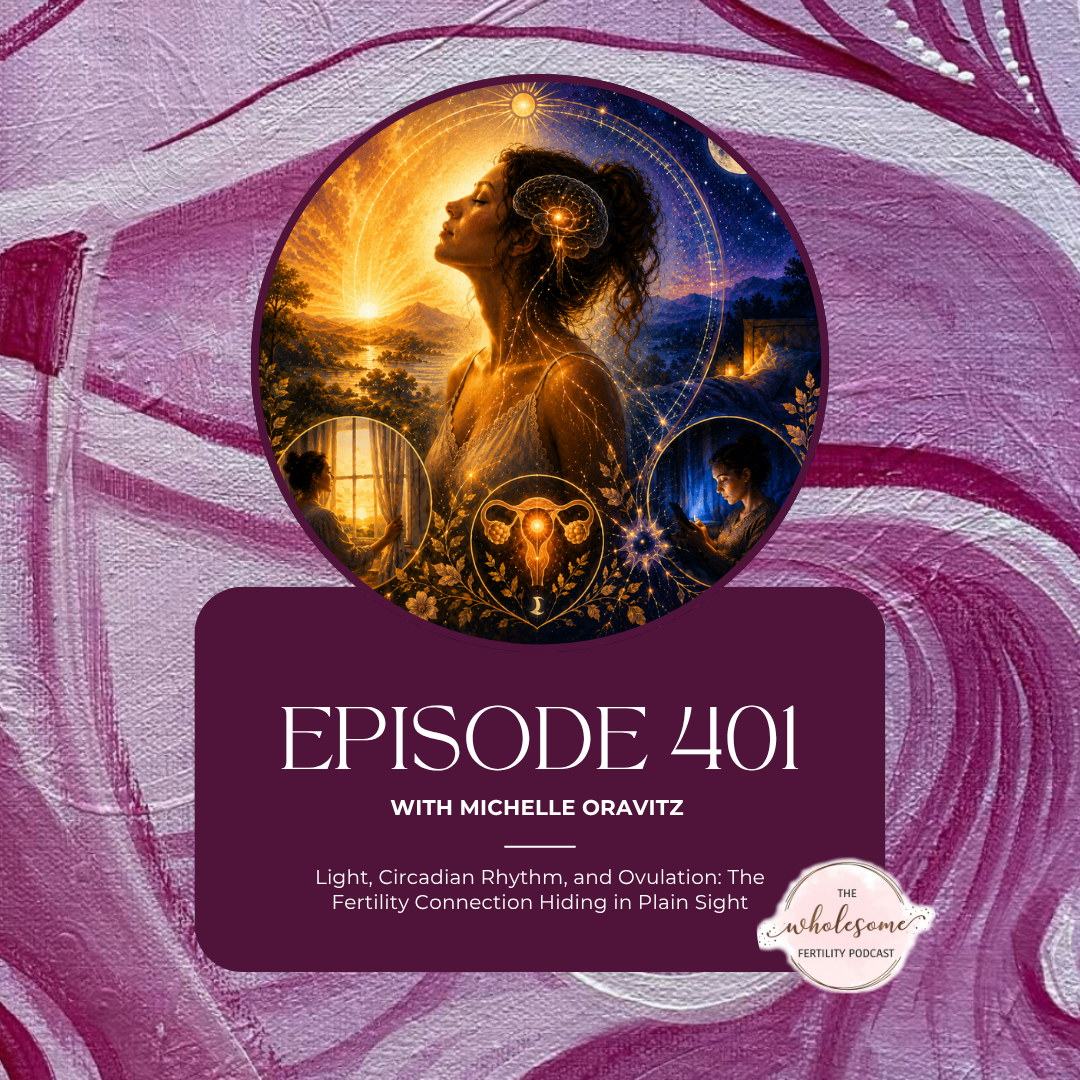
In this solo episode, Michelle takes you into one of the most underrated topics in fertility. Light. Specifically, how the way you interact with light during the day and at night is shaping your hormones, your ovulation, your egg quality, and your sleep more than almost anything else you are doing. You will learn how melatonin protects developing eggs, how the circadian rhythm anchors the menstrual cycle, and the four foundational light habits that rebuild fertility from the most ancient signal in the body.
Key Takeaways:
Melatonin is a powerful antioxidant in the follicles, not just a sleep hormone
Circadian disruption shows up in altered LH pulsing, delayed ovulation, and shortened luteal phases
Morning light exposure is one of the most impactful fertility habits a woman can build
Evening light, screens, and artificial light at night suppress melatonin and disrupt cycles
In Chinese medicine, light rhythm directly supports yin, the foundation of fertility
Harmonize Moon Cycle: michelleoravitz.com/hackyourcycle
Disclaimer: The information shared on this podcast is for educational and informational purposes only and is not intended as medical advice. Please consult with your healthcare provider before making any changes to your health or fertility care.
Ready to discover what your body needs most on your fertility journey?
Take the personalized quiz inside The Wholesome Fertility Journey and get tailored resources to meet you exactly where you are:
https://www.michelleoravitz.com/the-wholesome-fertility-journey
For more about my work and offerings, visit: www.michelleoravitz.com
Curious about ancient wisdom for fertility? Grab my book The Way of Fertility:
https://www.michelleoravitz.com/thewayoffertility
Join the Wholesome Fertility Facebook Group for free resources & community support:
https://www.facebook.com/groups/2149554308396504/
Featured in this episode, my Fertility Affirmations Ebook, a gentle, grounded way to begin offering your body kinder and truer words:https://www.michelleoravitz.com/fertilityebook
Connect with me on social:
Instagram: @thewholesomelotusfertility
Facebook: The Wholesome Lotus
-
Michelle Oravitz (00:00)
So the first thing to understand is that your body is, biologically speaking, a creature of light. Every hormonal rhythm that you have is regulated by light. Your sleep and wake cycle, your cortisol curve, your hunger signals, and your reproductive hormones. All of it is anchored to the rising and setting of the sun.
So this is not a soft or spiritual idea, it's hardwired biology. There's a small bundle of neurons in your hypothalamus called the suprachismatic nucleus, and it is your body's master clock. That clock is set primarily by one thing
Light entering your eyes through specialized receptors in your retina that are different from the ones you use to see. When you wake up in the morning and the light reaches your eyes, your master clock starts a cascade. Cortisol rises gently, melatonin drops, and your body knows it's day, and your hormones begin their daytime rhythms.
When evening comes and the light dims, melatonin rises and cortisol falls, and your body prepares for sleep, repair, and the deep work that only happens in darkness.
Here's where it gets interesting for fertility. Melatonin is not only a sleep hormone, it's one of the most powerful antioxidants your body makes,
And it is found in very high concentrations in your ovarian follicles. So the fluid surrounding your developing egg is rich in melatonin, and research shows that melatonin in the follicular fluid helps protect the egg from oxidative stress,
Which is one of the main drivers of declining egg quality.
Studies also suggest that melatonin support can improve egg quality in women undergoing IVF, those who have had poor outcomes before.
Here's what this can mean for the modern woman. When melatonin runs low at night, often because of light at the wrong times, your follicles may have less of this natural antioxidant available.
supporting your own melatonin is one foundational way to support egg quality. Most women never make this connection because it sounds too simple to matter, but it's not simple and it's foundational. Let me walk you through what disrupts the circadian rhythm,
The first disruption is too little light in the morning.
Most women wake up, reach for their phone, get ready, drink coffee, and head to work without ever getting natural daylight into their eyes in that first hour. If you live somewhere with long winters or work in an office with no windows, this can go on for months. The body never gets a strong signal that it is day. The master clock drifts. Melatonin stays slightly elevated, cortisol does not rise the way it should,
And the whole hormonal day starts off rhythm.
The second disruption is too much light at night. In the evening, many women sit under bright overhead lights, looking at their phones and laptops, with light flooding their eyes hours after sunset. The body reads this as daytime and holds back melatonin,
So it never really gets that deep sustained dark signal that triggers a full release. The third disruption is irregular sleep timing. One night you are in bed at 10, the next at midnight, and the next at one. The body never knows what's coming, the master clock cannot settle, and reproductive hormones drift.
The fourth disruption is shift work or chronic late nights. We will come back to shift work specifically because it deserves its own care. The fifth disruption is artificial light at night, even in small amounts, a bathroom, night light, blue light from your phone, by the bed, the television left on, a street light through the blinds, all of it can signal to the body that it's not quite safe to fully release melatonin.
Now let me make this concrete for your cycle because your menstrual cycle is itself a circadian rhythm. it's simply a longer one.
In the first half of the follicular phase, estrogen rises and your follicles develop. FSH tends to peak in the morning hours, so healthy daytime light during this phase supports steady follicular development. Ovulation is then triggered by a surge of LH
And that surge has a circadian component of its own. In most women, it begins in the early morning with ovulation following roughly twenty-four to thirty-six hours, which is why
Ovulation often happens in the morning.
After ovulation, the luteal phase brings rising progesterone, which is also released in a daily pulsatile rhythm and which gently raises the body temperature.
When the circadian rhythm is disrupted, the whole cycle feels it. LH patterns can shift, so ovulation is delayed or skipped, the luteal phase can shorten, and progesterone can fall, which can affect the lining.
And keep in mind that none of this happens in response to anything extreme or even shift work. A few months of poor sleep, late screens, and little morning light can be enough. Your cycle is not separate from your daily life. It's a longer wave on the same ocean.
There's also some intriguing research on moonlight and the menstrual cycle. A few studies suggest that before artificial light was everywhere, some women's cycles loosely track the light of the moon,
With Mencies tending to fall near certain lunar phases. I wanna be honest with you though, because this evidence is still emerging and debated.
It rests largely on self reported records and more recent data from cycle tracking apps has not consistently found the link. So I'm not telling you your cycle should follow the moon. What it does remind us of is something we can say with confidence that female reproduction is deeply sensitive to light. And I myself have always noticed that I got my period on the full moon. So for me, anecdotally, I did see the connection.
Now the practical part and the good news is that it is simple. You do not need a red light device, special glasses, or anything expensive. The first habit is morning light. As soon as you can after waking, get your eyes on natural light. Not through a window, not through sunglasses, outside if possible, or at least with the window fully open. Even on a cloudy day, outdoor light is many times brighter than indoor light. Aim for 10 to 20 minutes and
Walk the dog, drink your coffee on the porch, take your supplements outside, whatever works. If you truly cannot get outside, get the brightest light source you can in front of your face for at least ten minutes,
A bright lamp at the breakfast table, a light therapy box, or an east facing window. Anything is better than nothing. The single habit anchors your whole rhythm. The second habit is daytime brightness. Get outside at least once during the day if you can. Eat lunch outdoors, take a short walk between meetings, open the blinds at your desk.
Your body needs to feel the brightness of day to know what time it is.
The third habit is evening dimming. After sunset, lower the lights, use lamps instead of overheads, warm colored bulbs in the bedroom and the bathroom,
And night mode on your phone and laptop. Blue light blocking glasses in the evening to help if you want to be extra rigorous.
You're simply allowing your body to know that night has arrived And melatonin responds beautifully to that darkness.
The fourth habit is a dark bedroom, making it as dark as you can, black curtains, no night lights, phone in another room or face down, cover the little lights on the alarm clock or the air filter. The darker the room, the deeper the melatonin release. This is one of the simplest fertility supports out there, and most women don't even realize they need to do it.
The fifth habit is consistent sleep timing. Try to go to bed around the same time each night.
The body loves rhythm. It does not need to be perfect, but staying within a thirty to sixteen minute window most nights makes a real difference.
Aim to be asleep by around eleven the latest. Your deepest, most restorative sleep comes in the first stretch of the night. So the earlier and more consistently you settle into darkness, The more your body can use that window. The sixth, especially in the winter, is supplementation. Some women, particularly in the northern climates, do not get enough winter sun to make adequate vitamin D.
So it's worth testing and supplementing if you are low.
And some women, especially those who suspect poor egg quality, may benefit from a small dose of melatonin in the months leading up to retrieval or conception attempt.
This is something that you might want to talk about with your practitioner who knows specifically your case because here melatonin is working as an antioxidant in your not just a sleep aid.
So if you want to know the why behind the morning light habit, it's worth knowing. Your eyes contain specialized cells called intrinsically photosensitive retinal ganglion cells.
These cells are not for seeing, they exist to sense the time of day. When bright light reaches them, signals travel straight to the master clock and tell it that day has begun,
Setting your entire hormonal day in motion.
Now here's the thing, the intensity is the part that most people underestimate.
A typical office runs around three hundred to five hundred lux. Outdoor light on an overcast day is at least ten thousand lux and bright sun can be hundreds of thousands more.
That is an enormous gap and that is why opening the blinds is not quite enough. You need real outdoor light, especially in the morning.
Timing matters just as much. The clock is most sensitive to light early in the day when light tells your body morning has come. Light late at night, especially blue light, does the opposite and pushes the clock later.
Flood your eyes with phone light at midnight and your biology reads it as daytime, holding melatonin back even as you feel exhausted. There's also a meal timing piece. Your metabolism follows a rhythm as well.
Insulin sensitivity is highest in the morning and declines as the day goes on. So the same meal eaten at eight in the morning has a gentler blood sugar effect than it does at ten at night. Late in the
Large late meals disrupt the rhythm in a way that touches sleep, hormones, and reproduction. For fertility in general, the guidance is to front load your eating a real breakfast and a solid lunch and a lighter dinner finished a few hours before bed.
This pattern supports steadier blood sugar, which supports steadier hormones, and many women notice their cycles improve within a few months of the shift. I want to speak directly to the shift work because some women cannot avoid it.
If your job involves night or rotating shifts, your rhythm will be challenged no matter what. and that is not your fault. The research does show higher rates of irregular cycles, miscarriage, and longer time to conception among shift workers
Though the increases are rather than dramatic, there is still a lot you can do.
Use blackout curtains during your sleep window, wear blue blocking glasses on your night shift if you can. Eat at consistent times relative to when you wake up,
Even if that is not the morning,
Catch sunlight when you can, even if the timing is not ideal. And use melatonin under guidance to help anchor your sleep when your shifts change. If fertility is a priority and you have the option to move to day work, even for a season, it may be worth considering.
There is a seasonal layer to this as well. In the northern hemisphere, winter brings short days and weak sun, and many women notice that their cycles run a little longer, their energy dips and their mood drops in these months. That is a normal response to darkness, and
If it becomes severe, a light therapy device, usually around ten thousand lux for twenty to thirty minutes in the morning, is well researched for seasonal mood and may help with circadian disruption more broadly. Talk to a practitioner whether it fits your situation specifically.
In Chinese medicine, the rhythms of light and dark map onto yang and yin. Day is yang and night is yin,
We build yang through the day and replenish yin in the dark. When we fight that rhythm with late screens, short sleep, and artificial light, we slowly exhaust yin, and yin is foundational for the cool, nourishing, deep substance that builds the lining, nourishing the eggs, and holds the body's reserves.
Yin depletion is a very common pattern that happens with women who are trying to conceive. And bringing your light and sleep back into rhythm is one of the most direct ways to replenish it.
So here's what I most want you to hear. If you've been doing everything still feel like something's may be the missing piece.
Light is the oldest signal your body knows, and modern life has scrambled it for almost everyone. You don't have to be perfect about this, you just have to begin. So morning light, evening dim, a dark bedroom, consistent sleep, done with some consistency over a few months,
These change your sleep, your mood, your energy, your cycles. Your body has not forgotten how to do this. It's wired for these rhythms, and when you work with that wiring instead of against it, the system reorganizes. For women who want to go deeper on aligning their cycle.
My harmonize your moon cycle resource is a free place to start. You can find it at Michelle Orbits dot com forward slash hack your cycle. That's Michellebits.com forward slash hack your cycle.
If you found this information helpful, be sure to share this with somebody who you think will also benefit and subscribe if you haven't done so already.
This way you could be sure to be notified with new fertility supporting episodes.And remember, your body's listening to light. It's always been. So thank you so much for tuning in today, and I will see you next time.