

THE WHOLESOME FERTILITY PODCAST
Ep 404: What Your Cycle Is Trying to Tell You: Prolonged Bleeding, Ovulation, and Body Literacy with Robyn Srigley
On today’s episode of The Wholesome Fertility Podcast, I am joined by holistic nutritionist Robyn Srigley to discuss menstrual health, prolonged bleeding, ovulation tracking, and the pressure many women feel to “optimize” every part of their fertility journey.
Robyn explains why a positive LH test does not always confirm ovulation, how low progesterone and iron may contribute to prolonged bleeding, and why normal lab results do not always mean the body is functioning optimally. We also discuss the importance of listening to your body, simplifying your wellness routine, and focusing on nourishment rather than perfection.
Key Takeaways:
A normal period runs about three to seven days. Bleeding or spotting that drags on for weeks, or shows up throughout the cycle, is worth investigating rather than waiting out.
Low progesterone is one of the most common patterns behind prolonged bleeding. When ovulation is weak or absent, estrogen runs unopposed and the lining sheds unpredictably.
LH strips show that the brain is signaling for ovulation. They do not confirm it happened. Basal body temperature lets you see, in hindsight, whether you actually ovulated.
Heavy bleeding and low iron feed each other. Standard iron salts often absorb poorly, while gentler forms like iron glycinate, paired with vitamin C, and whole food sources such as beef liver tend to be better tolerated and more effective.
“Within range” on a lab is not the same as optimal. What you feel in your own body is real information, even when results come back normal.
More is not always better. Slowing down, simplifying, and removing what your body does not need can matter more than adding another supplement to the pile.
Nervous system regulation comes first. When the body feels safe and settled, digestion and absorption improve, which supports everything else you are working toward.
Guest Bio:
Robyn Srigley is a Cycle Guide, Fertility Nutritionist, and Women’s Health Educator who helps women understand irregular cycles, prolonged bleeding, ovulation, and fertility through a grounded, holistic lens. Her work blends body literacy, nourishment, nervous system support, and herbal wisdom to help women hear what their cycles are communicating and feel more informed, empowered, and confident in their bodies. After her own PCOS, now PMOS, diagnosis sent her searching for real answers, she went on to conceive both of her sons naturally and has spent more than a decade guiding other women to better understand their bodies. She shares daily on TikTok.
Connect with Natalie:
TikTok: https://www.tiktok.com/@robynsrigley
Instagram: https://www.instagram.com/robynsrigley
Beacons (all links): https://beacons.ai/robynsrigley
Disclaimer: The information shared on this podcast is for educational and informational purposes only and is not intended as medical advice. Please consult with your healthcare provider before making any changes to your health or fertility care.
Ready to discover what your body needs most on your fertility journey?
Take the personalized quiz inside The Wholesome Fertility Journey and get tailored resources to meet you exactly where you are:
https://www.michelleoravitz.com/the-wholesome-fertility-journey
For more about my work and offerings, visit: www.michelleoravitz.com
Curious about ancient wisdom for fertility? Grab my book The Way of Fertility:https://www.michelleoravitz.com/thewayoffertility
Join the Wholesome Fertility Facebook Group for free resources & community support:https://www.facebook.com/groups/2149554308396504/
Connect with me on social:
Instagram: @thewholesomelotusfertility
Facebook: The Wholesome Lotus
-
# Video\_TWF: EP 404 Robyn Srigley
[00:00:00]
Michelle: Welcome to the podcast, Robyn. I'm so happy to have you
Robyn: Thank you so much, Michelle. I'm excited
Michelle: So I always like to start with an origin story. I'd love to hear, like, your background, how you got into the world that you're in
Robyn: Yeah, absolutely. So I've been working as a holistic nutritionist for 13 years, since 2013. But the reason that I got into women's health and hormones and cycles is because around that same time I was, actually diagnosed with PCOS, or now it's PMOS, and at the time my doctor was like, "Lose weight," despite the fact that I was a completely normal and healthy weight.
They suggested birth control, which I had come off of a year prior, and that's kind of what led to the diagnosis anyways. and that was basically it, and I was left feeling extremely confused. I was already in nutrition [00:01:00] school, already sort of wanting to do things like as naturally as I could. and that kind of led me down the rabbit hole of figuring out what would regulate my own periods and reduce the other symptoms of PMOS that I was experiencing, and then I started doing the same, with women in my practice and have since then.
Michelle: Yeah, we have similar stories. I had, um, I, I think it was undiagnosed PCOS 'cause I look back and I'm like, I had all of the signs. missed periods and similarly was given the birth control pill. Like, "Just take this, you'll be fine." I'm like, "Wait, I don't know about that." Um, acupuncture was the only thing really after 12 years that helped me.
Um, and, and it's true, like People go often and, and they really get told that there's no... And they don't just get told that, there's nothing that can be done. It's almost like so definitive that people don't realize there are other options to help them. And that, and that I [00:02:00] guess is where I get frustrated because it's personal.
Like I've gone through it myself, and it can be really frustrating to... 'Cause you feel like, wait, there's gotta be something else. Like it's intuitively you feel like there's gotta be something that can be done about this. It just doesn't make sense. And then you're told just because, I guess, a certain type of medicine doesn't see that aspect of it or doesn't have like an answer specifically, doesn't mean it's definitive and there is no other answer.
So
Robyn: Yeah. 100%. And like I was told too, like, "You'll probably never be able to conceive, certainly not without IVF," and things like that. I have two sons who are both conceived naturally. Like, all these things are possible, and so it's been really exciting over the past 13 years to kind of help bring that awareness as well.
Michelle: Yeah
for sure. Um, so I know that you cover... Well, one of the things that really kind of, uh, stuck out for me is you talked about prolonged bleeding and spotting. that's actually, like, a [00:03:00] big thing, and we haven't really dove deep into this topic in the podcast. I've talked about regulating, uh, periods and everything, so but that's a big one because, um...
And we had just talked about it before, a lot of people have, and there can be many reasons For it. But I'd love for you to talk about it kind of like a really, I guess like zoom out and then kind of zoom in 'cause of course there's so many different factors that can contribute to this.
Robyn: For sure. For sure. So it's probably a good way to start by like explaining what that actually means. So prolonged bleeding would really be anything outside of a normal like three to seven-day period. Like if you're going longer than that, some of the women that I work with or that, you know, follow me on social or whatever, they're bleeding for weeks or months or even years at a time.
This is not normal whatsoever. And the same thing with spotting. Like if you have a tiny bit of something the day before your period comes or whatever, like that's normal for some women. [00:04:00] But there are some who are spotting for weeks at a time or literally throughout their whole cycle, and that's anything that's really just not a full bleed or a proper period.
So sometimes it shows up as being brownish, sometimes it's pinkish, sometimes it's a mix. You'll get a random clot here and there, things like that. And these situations can happen with seemingly no explanation. So if they're going to their doctor and they're doing an ultrasound or blood work, and so many are being told, "Eh, nothing wrong, like wait it out or maybe get on some birth control."
or they can sometimes come along with diagnoses like adenomyosis, endometriosis, fibroids, and so on.
Michelle: Yeah. Definitely, um, the fibroids is a big one I remember. Um, it... and it's also, just for people listening, it's usually when it's in the inside, not on the outside of the lining. so within the lining it can cause, um, a lot of bleeding. but then it was interesting, I had somebody come on.
the [00:05:00] podcast that talked about iron, and she had mentioned that most of the iron supplements are actually not...
They're causing more problems. They're, because they're causing more, circulation of iron in the blood, but not getting absorbed the way they're supposed to. And what happens is, Or maybe not. It's stored in the tissue, is what she was saying, and then that sometimes the body wants to release that iron, and so it'll bleed more.
it'll be like a natural way of the body wanting to let blood out. But, um, it's because it's not processing iron the way it's supposed to. So, like, taking things like beef liver, like a synergistic blend of nutrients that can help absorption of the iron can make a difference. And I thought that was really fascinating, 'cause that's not something that you typically hear people talking about.
So I was wondering if you've heard of that before?
Robyn: Yeah, iron definitely plays a big role here. And I mean, to their credit, a [00:06:00] lot of doctors will test for that, and they'll tell you to take an iron supplement. Usually it's an iron salt like ferrous fumarate or something like that, and those are the ones that tend to, like accumulate. They're not absorbed well, digestive issues, constipation, like so many potential issues with those.
And they don't necessarily even increase the iron when it's retested in blood work. They don't necessarily stop the bleeding. But there is like what I like to call the iron depletion loop, right? So if you are bleeding and you're bleeding frequently or you're bleeding heavily, obviously you're losing iron, right?
'Cause it, you know, through your blood that's leaving your body. But having low iron, having not enough iron can also exacerbate the bleeding too. So it can kind of become this vicious cycle, and you can be still on iron supplements for months and months at a time and not seeing a difference, which is really unfortunate.
So that's where like absorption and circulation of the iron, like you were just talking about, is really important. Like [00:07:00] vitamin C helping with absorption, taking a different form of iron than the standard one that's often recommended, like a glycinate form or through natural ways, like you said, like a beef liver supplement can be much more effective
Michelle: Yeah, and I've actually seen, um, uh, I recently spoke with somebody, but I've heard of people using organ meat supplements, and that would, would be really the only supplement that actually helped increase their ferritin. So I thought that was interesting.
Robyn: Yeah, for sure
Michelle: very interesting. So, um, what are some of the thing...
And I know too, like, uh, uh, low progesterone, you talked about that, right? being a big factor
Robyn: For sure. So there's like four major core patterns I see behind this prolonged bleeding. Progesterone issues would be one of them, and a lot of times it's like one of two things. Either they're not ovulating in their cycle, or most of the time they're not ovulating, or their ovulation is kind of weak and so that corpus luteum is not producing enough progesterone.
And the thing is like [00:08:00] progesterone helps to stabilize that lining, right? So if you don't have that 'cause you're not ovulating or your ovulation is weak, then it's gonna be shedding constantly, right? Because estrogen is kind of running unopposed. So it's a good thing to kind of investigate, like what's going on in your cycle?
Are you ovulating or not? How long is your luteal phase? All of these things can kind of point towards whether progesterone is one of the patterns, right, that's contributing to the bleeding.
Michelle: Yeah
And then of course, let's talk about the LH sticks 'cause that's probably the most misleading, test that people are taking because it's really just all it does is signal, say that the brain is signaling the body, but it doesn't necessarily confirm ovulation. it could be good if you know you're already ovulating.
Maybe you went to the doctor, they did the ultrasound. They, they know that you ovulated so that your body is ovulating, then okay, it could be kind of like a good [00:09:00] timing tool. but for people who don't know, they're... You know, because people can have cycles that are not ovulatory. They could still get a period which can seem confusing and, and, you know, make people think that they're actually ovulating, but not necessarily.
So, um, so talk about what you, how you approach that with the people you work with because, it's important to really understand your cycle, like to, to see it, to really investigate and, and to understand what things mean because of course women are not taught these things unfortunately.
Robyn: Absolutely. And it, and it's important to understand your cycle, whether you're trying to conceive or not too. Like, we have to learn what our bodies are telling us. And so to your point about the LH strips, or sometimes they're marketed as ovulation tests, which is something that is a pet peeve of mine.
But basically, LH is the brain hormone that's going to signal to your ovaries to release an egg. It does not guarantee that this actually happens. And so a lot of women will see what they [00:10:00] consider a positive on that, and they think, "Oh, I ovulated. Great." A lot of the times that is not the case, especially if cycles are irregular.
There's things like PCOS, PMOS going on. and so they're not really reliable. You can get your pr- progesterone blood test, approximately seven days after you think you've ovulated. A doctor will usually recommend day 21, which is not necessarily accurate for everyone, or by
Michelle: Because, um, people could be ovulating early or late or, or, um, early or late. Yeah
Robyn: Exactly, right? Like you, if you have an irregular or a long cycle, you might not ovulate until like cycle day 30. You know what I'm saying? And if you went on day 21, it would be a useless result. But you don't even have to go to that extent of blood tests and ultrasounds. You can do it at home with your basal body temperature.
I do this with every single one of my clients in the beginning so we can see what their cycle is doing. And essentially, basal body temperature is the temperature of your body when [00:11:00] you first wake up in the morning. So like before you get up, before you drink water, before you go pee, any of those things, you take your temperature.
There's wonderful apps where you can chart all that out. And before ovulation, your temperature will be on the lower side, and then after ovulation it will spike up usually around like a half a degree kind of give or take, and it will sustain that rise. It's progesterone that causes that lift, in your temperature.
And so by doing that, you can actually confirm, oh yeah, I did ovulate, right? It's a retrospective kind of looking back, oh yeah, I did probably on that day. Versus LH, which is trying to predict when that may happen soon, but it's not a guarantee.
Michelle: Yeah, and what's good is, of course, if you do it a couple of months in a row, you start to understand the patterns of your body, and see if it is regular, like more, regular within its pattern so that it repeats itself, 'cause sometimes it could really go all over the place
Robyn: Exactly. Exactly. And it can give you clues too, like we were talking about progesterone, as a pattern behind bleeding. Like [00:12:00] if you see you're tracking that and your luteal phase is short, that could also indicate progesterone issues. If you see your temperatures in that phase are not sustaining high, maybe you get a few days and then it starts to drop, right?
Again, your progesterone may not be maintaining. So there's so many different things that you can learn based on your, your patterns with the basal body temperature, which is why I do it with everyone, at least in the beginning, so we can see what's actually happening.
Michelle: And you also talk about why normal doesn't always mean healthy when it comes to menstrual cycles
Robyn: Yeah. So I can't tell you the amount of women who I work with DM me, comment, whatever, and they're like, "Well, I'm having XYZ issues," or, "I can't get pregnant." And I'm like: Have you gone to your doctor? And they're like: Yep, and I had hormones tested and all this stuff, and everything came back normal. But they're still experiencing symptoms with their periods, with their cycles, irregularities, whatever, even their mood, their weight, their sleep, [00:13:00] everything, right?
And of course, struggling to get pregnant, but they have all these normal results. And so it's important to look at it from a lens of like within range is essentially what your doctor is saying normal, right? But that's not necessarily optimal. Personal example, literally from this week of this, I had some blood tests 'cause I've been working on my own iron, and my ferritin in the last three months only went up eight points.
And from my perspective, it's still under what I would consider an optimal range. But my doctor says, "Oh, it's perfect now. You can stop taking your iron. You're all good to go. Nothing else needs to be done there." Right? But with my training and history and knowledge, like I know, and also in my body, I still feel it, right?
I know that I need to continue, and so this is not like anti-medical. It's important to have someone you [00:14:00] can go to for conversations, for testing, for investigation. But it's also important to like do your own research, take what they say about results with a grain of salt, especially if you are having issues and you're being told that everything is normal.
Michelle: You said something that was so key. You said, "I feel it in my body." And I really wanna stress that because, uh, every time I work with somebody, and I've been doing this for over 10 years now, like, I always, always, I'm like, "What do you feel? Like, what does your body feel?" Um, let me tell you, that is not something that should...
That's not an element that should be ignored. It should be part of the conversation because nobody else knows, and I've seen so many cases where people have felt things being off and that being dismissed, later to find out that they were actually feeling something very significant and specific. one person had a blockage in, like, the [00:15:00] tube.
It was like a, almost like a stenosis, so, and they ended up, they felt it. They felt something was off years before, and it was like the body was telling them. And sure enough, there was something there. So
Robyn: Absolutely. Yeah. As women, we have that intuition, and it's really important to, to listen, to that because it can lead to, you know, a lot of good things if we go down that road and support what we're actually feeling versus what a lab test tells us on paper. Yeah.
Michelle: then you also talk about nourishment versus over-optimization. I, I, I feel that. I definitely feel that
Robyn: Yeah, absolutely. So there's this tendency in the wellness sphere and women's health on social media like, "Oh, just, you know, take all these supplements. Make sure you have this exact morning routine. Go lift weights five days a week. Like, do all of these things to optimize your fertility, to optimize your health, to make sure that everything [00:16:00] is perfect."
And women run themselves into the ground trying to do this, right? And, and they'll come to me and they'll be like, " I'm doing everything right. I'm eating well. I'm not eating these things. I am eating these things. Look at all these supplements that I'm taking. I've researched them all." They go down the Google rabbit hole instead of sleeping every night.
You know what I mean? Like, they're up and they're looking and they're reading and they're consuming information and all they see is, "Oh my gosh, like I'm missing this. Okay, I better add this in." Right? And then if they have like a cheat day or, they miss a supplement day or they don't do their routine exactly, they can be so hard on themselves.
And I'm no stranger to that in the past either. It takes some like reprogramming to kind of get out of that. What really what we need is simplification and slowing down, honestly, and like nourishment piece as well. Like you don't need to be [00:17:00] necessarily tracking your macros and counting your calories and weighing all your food and stuff like that if you're not entering a bodybuilding show or whatever.
Like we don't need that. What your body needs is nourishment. It needs real food. It needs you to slow down when you eat. It needs you to not rush through brushing your teeth in the morning. It needs you to like take a breath, you know what I mean? Like through the day, just really slow down and get rid of a lot of the things that you might already be doing.
I was working on a protocol for a client, new client this morning, and she's taking so many different things and I'm actually advising that she remove like 80% of those things because at this point in time they're not necessary and they're just gonna put more load and burden on the body trying to deal with all of these like capsules and things, right?
Michelle: Oh, 100%. Those capsules, I'm... And people get so nauseated from taking all of the supplements. And sometimes if I [00:18:00] have to, especially if they have, like, sensitive, stomachs, I give them, Quicksilver, you know, like, uh, some of the liquid, uh, supplements, which is a lot easier on the gut. But it's just, it's overwhelming.
It really is overwhelming. In some cases, sometimes they do need certain things if they're, like, really prepping for, like, egg retrieval or really trying to up the egg quality for a little bit, but it's not forever, and I tell them to space it out. But it could be very overwhelming. But what I do find is that, you know, the, the, the checklists, everything that you have to get done, but, like, the nervous system should be number one, because if the nervous system is off, nothing's gonna get digested.
I mean, not nothing, but, like, it really does impact the gut and your ability to digest. If you feel overwhelmed, you're not going to... You know, your body is not gonna be digesting optimally, because, you need to be in rest and digest to be optimally digesting. people, Yeah
it, you know, they, they're rushing through trying to get everything [00:19:00] done, and it always tends to be put on the back burner how they're feeling and, like, the feeling of safety.
and so that's something that is invisible. We can't really see it or quantify it. It's a state of feeling. So I think that that's why it's often missed, because, it's something that requires us to go inward to sense.
Robyn: And that makes it one of the harder things to do. It's easy to pop a supplement capsule. It's easy in comparison to eat your vegetables and get more protein, right? But slowing down is much harder. Regulating your nervous system and focusing a lot of your energy there is much more difficult, and that's valid, right?
Michelle: because you feel like, um, you're, you're getting stuff done. you're actually, like, seeing it and, uh, and you feel unproductive, like, slowing down. And I think that we're conditioned like that as a society, and we get rewarded f- a lot for getting things done and, and being [00:20:00] overachievers. So it is...
You had mentioned actually, and I thought that was really on point on deprogramming yourself, you know? Because for so long you're so used to seeing the world that way, and you don't realize, wait, the body doesn't necessarily run that way. Nature doesn't necessarily run that way
Robyn: Yeah. And I don't think anyone expects that when they go into a journey with their health, trying to conceive, fixing their hormones, whatever. They expect, okay, I'm gonna eat a certain way, I'm gonna take these supplements, I'm gonna exercise, I'm gonna do all these kind of basic foundational things. No one expects that they're gonna have to turn inward, that they're gonna have to slow down.
It's gonna fundamentally change how they approach their life even, uh, as a person. so it can be kind of surprising and, and almost make them like more hesitant, I find.
Michelle: 100%. I've had that happen. I've had people that I've coached, and when I told them that, they're like, "Wait, wait, but what supplements and what..." A- and [00:21:00] I can see the resistance, and then I kind of like ease them in, you know. If I, if I sense that, you kind of like go with them until they're ready to hear.
But
Robyn: Mm-hmm.
Michelle: do feel the resistance is like, "Wait, but, but what should I do? Like, give me something to do." And, and so... And I'm like, "Wait, but here, here's what it is." And sometimes I'll, you know, show some studies and research so that they can understand kind of behind the scenes what happens with the nervous system and why that really impacts their body and trickles down.
It, it, it's fascinating.
Robyn: It is
Michelle: Yeah
But I totally get it. I mean, I, um, I've had to work on my own programming for years, and I think we all started, a lot of us started as patients ourselves. And I had to really train myself to like receive, to be in a state of like bringing in, kind of filling my own cup, because It felt very foreign.
And, and that's the key thing is
that whenever you're changing any habit or [00:22:00] shifting your perspective to something that you're not used to, your body and your subconscious mind are gonna resist it at first, 'cause it just does not feel like home. It doesn't feel familiar
Robyn: Yeah. It can be easier to stay in the habits and lifestyles that are problematic because it's what you know and what you're used to. Yeah
Michelle: 100%. so interesting. So talk about, building body literacy. Um, we, we kinda talked about the ovulation, kind of beyond apps and predictions. You were saying that it's important to really understand, BBT charting. I think is amazing. I think even if people... You know, there are so many other tools, but even if people could use those tools, I always say at least do it for a couple of months, 'cause I feel like it just gives you so much information, and it's so old school.
I love it. It kind of, it goes back to the basics, is to really understand the temperature. And in Chinese medicine, it's amazing because you can, like, imprint the yin [00:23:00] and the yang onto the cycle. the yin being really estrogen, the yang being the progesterone. luteal being the yang, which is heat, and, you know, temperature rises, and it's cooler and more moist in the, um, follicular phase.
And it's really fascinating how you can see all of the things that they described in Chinese medicine
Robyn: Mm.
Michelle: of years ago, and you can, like, literally just superimpose it onto whatever it is, whatever cycle it is, and see it. It's incredible. but you talk about body literacy, really understanding your body rather than looking at it as a textbook.
Like, to really, like, embody it and feel it.
Robyn: Yeah, absolutely. And I find like so many women, 'cause w- again, like we were talking about earlier, like nobody was ever really taught any of this. You know what I mean? We were taught like once a month you get a period, use some pads, take some Advil, whatever. But like nobody's really taught anything outside of that.
And then when you try to conceive, you start learning about [00:24:00] all the different phases of your menstrual cycle. You start to learn about, oh, I better figure out when I'm ovulating 'cause that's when I can get pregnant. and one important thing when you are charting is, yes, you will see a lot of other women's charts online when you start going down that rabbit hole.
You don't have to have perfect textbook charts, perfect examples of what your temperature is doing, to be optimally fertile, let's say, or to get pregnant, right? learning your own patterns is more important than comparing it to anyone else's or even what you might see in books or things about this.
The goal is understanding, not perfection. And like you said, we can tell so many different things, even to the point of like a lot of women will be tested for their thyroid and their TSH is within that range. And again, back to that like normal versus optimal conversation or whatever, but when you're doing basal body temperature, you can pick that right out if you [00:25:00] know what you're looking for.
If you have temperatures that are chronically much lower on average than what's considered optimal, then there's likely some thyroid involvement e- even if your TSH is within range, right? And so there's just endless things that you can learn from doing that type of thing, even if it is just for a few months, right?
Because sometimes that is actually more helpful. You learn what your cycle is doing at first and then let it go. One of those things of like not over-optimizing, right? We don't need to track everything all the time forever. Once you know what your body is doing, if you're trying to conceive, then you know around about when you're fertile and you can attempt and you can just otherwise be living your life.
You know what I mean? And just not constantly be focused on numbers. And BBT is a pattern as well, right? We don't need to focus on, uh-oh, this day is this random temperature that I don't normally see. Well, what is the overall pattern of [00:26:00] your cycle actually looking like? That might just be a random blip 'cause you didn't sleep well, you know, or you went to bed later or you had alcohol or something and that's fine to note, but it's not a make or break when you're looking at the overall pattern.
Michelle: Yeah
totally. That's, uh, so key. you're gonna have off days, you're gonna have times where it's not gonna be consistent. You're gonna have times where maybe you got up to pee in the middle of the night, which can, you know, if it's, like, too close to the time you wake up, can impact that. So, um, it's okay if things are a little out of whack 'cause I, I get that too.
Uh, people are like, "Oh, what, what happened here?" And I'm like, "If you look at the overall, it's like the stock market." Zoom out, and then you can see an overall picture, and then it makes a lot more sense than, you know, the, the day-to-day. but for people who are, looking into doing BBT, you had mentioned a couple of things that, doing it, like, early in the morning before getting out of bed, taking...
What tips would you give if somebody's never done a BBT before and they're [00:27:00] like, "Hmm, I'm curious, like, how do I get started?"
Robyn: For sure. So get yourself a basal thermometer. Sometimes pharmacies have them in, usually in the section with like pregnancy tests and stuff, or with the other thermometers or Amazon. I mean, they're super inexpensive. And you get the digital one, and typically the thermometers when you use it, when the temperature is ready, it will beep at you so you know you're good to go.
But get your thermometer, put it somewhere you can reach it very easily without getting up, without sitting up when you open your eyes in the morning. There's three different places that you could potentially take your temperature from. The biggest thing is to pick one and stick with it. So you can do orally under the tongue, you can do in your armpit, or you can do vaginal temping as well.
And again, it doesn't matter, just pick one and stick with it because I find that like the vaginal temps especially tend to be slightly warmer
than, than the other areas. My favorite way is, is orally under the [00:28:00] tongue. You'll turn on your thermometer, put it under the tongue, hold it there nice and steady until it beeps at you that it's done.
Then you can look at your temperature. There's tons of apps out there. I prefer the ones that don't try to predict your cycle based on an algorithm. So I personally prefer one called Kindara for that reason. You can still input your period, intercourse, your temperatures, like all the things that normal cycle and fertility apps have, but without the interference of an algorithm which often is incorrect in predicting your cycle and your fertile window and all of that.
And then that's it. That's literally it. It takes like 30 seconds in your morning. Input it into your app. You'll see the graphs over time of what everything is looking like, and then you just observe your patterns
Michelle: Yeah. definitely something that I recommend at least doing once. definitely better to do it at least three months [00:29:00] than just one month. well, you had mentioned actually briefly, some people do feel more stressed. It's kind of like over-optimizing or over-checking. that can happen, but if you know that it's only, like, a few months, then I think in your mind it might not feel as stressful.
It's just kind of like, oh, you know, out of cu- with curiosity, look into it and kind of approach it in that way rather than, "I have to do this," and it's like another thing to do. Just more of kind of like data collection of your own. But it is really nice to observe it on your own, and it does give a sense of empowerment that you might not have when you're kind of at the whim of, you know, whoever's testing and going somewhere else and, and having it done.
So it is a really nice thing. now for people who, are curious to learn more about you, find out, get more information, 'cause I know that you share a lot on your content and social media, and then even work with you, how can they find you?
Robyn: Yeah. So the biggest place I [00:30:00] am is on TikTok as far as social media. I'm posting there at least once a day. we have a lot of good conversations about everything we talked about here and more, so definitely come on over there. and my link there will provide you with all of the other details as far as like where to go if you want to chat with me about working together, my programs and other services and all of that stuff.
Everything is over there. and I always love to connect and hear about everyone and what you guys are dealing with so that we can have these conversations, especially things like cycle tracking and the optimization and the prolonged bleeding that are not, I feel, talked about enough in this space
Michelle: Yeah, for sure. Well, Robin, Thank you so much, This was such a great conversation. We really got into, uh, depth with the menstrual cycle, which is always, always very important when it comes to fertility health, 'cause it really is the heartbeat of your fertility. So thank you so much for coming on today
Robyn: Thank you so much, Michelle
[00:31:00]
Ep 403 Genetics, Epigenetics, and Fertility: What Your DNA Can and Can’t Tell You with Natalie Samson
How much of your fertility is written in your DNA, and how much can you actually influence? In this episode, I’m joined by genetic counselor Natalie Samson to explore the fascinating world of genetics, epigenetics, and what they really mean for your fertility journey.
Natalie breaks down the difference between the genes you’re born with and how those genes get expressed, which is where epigenetics comes in. We talk about how your nutrition, stress, environment, and daily choices can turn certain genes on or off, and why that shift is so empowering. We also get into why MTHFR is only one gene out of more than 20,000, the role of methylation and hormone metabolism, what carrier screening can reveal about both male and female fertility, and how personalized testing can take the guesswork out of supporting your body.
This is a grounded, hopeful conversation about understanding your unique blueprint. Your body isn’t broken. Sometimes it’s simply waiting for the right information.
Key Takeaways:
The genes you’re born with don’t change, but how they’re expressed can shift based on your nutrition, stress, environment, and lifestyle. This is the heart of epigenetics, and it puts more in your hands than most people realize.
MTHFR is just one gene out of more than 20,000. Looking at the full methylation pathway, rather than MTHFR alone, gives a much clearer picture of how to support your body.
More methylated B vitamins isn’t always better. With certain gene variants like COMT, too much can actually drive anxiety, a racing heart, and trouble sleeping, so personalized dosing matters.
Carrier screening can reveal more than inherited conditions. It can sometimes uncover hidden contributors to both male and female infertility.
Genetic testing can guide truly personalized nutrition by showing how you process folate, omega-3s, histamine, and gluten, instead of prescribing a one-size-fits-all diet.
Your intuition counts as data. The most useful approach combines genetic testing, bloodwork, and your own felt sense of your body.
Privacy matters. Working with a HIPAA-compliant provider keeps your genetic information protected in ways that direct-to-consumer testing often does not.
Guest Bio:
Natalie Samson, MS, CGC, INHC, is a board-certified genetic counselor and integrative nutrition health coach, and the founder of Golden Genetics. After training in cancer genetics, she felt called toward a more proactive and preventative approach, inspired in part by watching her brother thrive through holistic, lifestyle-based care. Today she blends conventional genetic testing with functional, nutrition-focused interpretation to help people understand their unique genetic blueprint and make personalized, empowered choices for their health and fertility. Her practice is fully virtual, and she works with individuals and couples through preconception and beyond.
Connect with Natalie:
Natalie’s Instagram: https://www.instagram.com/geneticswithnatalie/
Golden Genetics Instagram: https://www.instagram.com/goldengeneticshealth/
Website: https://www.goldengeneticshealth.com/
Book a Logistics call with Natalie: https://www.goldengeneticshealth.com/book-a-discovery-call-1
Natalie’s 4P Framework Quiz: https://form.typeform.com/to/RkvZ32qV
Disclaimer: The information shared on this podcast is for educational and informational purposes only and is not intended as medical advice. Please consult with your healthcare provider before making any changes to your health or fertility care.Ready to discover what your body needs most on your fertility journey?
Take the personalized quiz inside The Wholesome Fertility Journey and get tailored resources to meet you exactly where you are:
https://www.michelleoravitz.com/the-wholesome-fertility-journey
For more about my work and offerings, visit: www.michelleoravitz.com
Curious about ancient wisdom for fertility? Grab my book The Way of Fertility:
https://www.michelleoravitz.com/thewayoffertility
Join the Wholesome Fertility Facebook Group for free resources & community support:
https://www.facebook.com/groups/2149554308396504/
Connect with me on social:
Instagram: @thewholesomelotusfertility
Facebook: The Wholesome Lotus
-
[00:00:00]
Michelle: Welcome to the podcast,
Natalie. So happy to have you
Natalie: Thank you so much for having me.
I can't wait to chat
Michelle: too. So, uh, we just had a little pre-talk about how exciting, and interesting genetics i- are. I mean, it's, it's a whole other world. So I'm actually really excited to dive in. But before we get started, I would love for you to share your origin story, how you got into
such interesting work.
Natalie: Yes. Okay, so this question is always interesting for me to answer because I'm always like, "How far back do I go?"
Michelle: the rabbit
Natalie: sure people feel the same. Yeah, it's such a rabbit hole.
but I do start with my childhood because I grew up with a brother who was neurodivergent. He was, diagnosed with many different diagnoses from autism spectrum disorder to OCD, ADHD, bipolar.
and so growing up, he really influenced me of course, and, the way that he [00:01:00] experienced treatment, which I'll get into, it definitely influenced me. And so, I just grew up loving and wanting to understand the body on such a deep level. And so when I went through my undergraduate program, I studied biology and I had no idea what I wanted to do with it.
I knew I wanted to work with people 'cause I loved people too, and I was like, "Is there a world in which you work with people, you can enjoy science, but maybe not take the entire med school route?"
Michelle: Mm-hmm
Natalie: And so I found genetic counseling. Someone came in and chatted with us about pediatric genetic counseling.
She was seeing patients with autism at the time, and so obviously I felt very drawn to that population. And, you know, I, I realized that I could study genetics, which is like such a micro scale of the body, and understand, you know, how the body works from that teeny-tiny scale, and be able to work with patients.
I loved how it also included psychology in the program, and so after I graduated, I [00:02:00] pursued, a genetic counseling degree. And, during my journey of genetic counseling, I originally went in for pediatrics because of my brother and wanting to work with patients with autism, but I felt actually more drawn to the proactive, personalized, preventative aspect of genetics, because I felt like pediatrics was maybe a little bit too close to home, and I was...
ended up being more drawn to cancer genetics. So I routed to cancer genetics, and ultimately kind of ended up in a situation where I felt disconnected from that world too because it still didn't feel like proactive. And in my head I was like, "But genetics can be so helpful for proactive care, you know, why aren't we using it in that way?"
And at the same time, my brother actually ended up being treated with more of a holistic approach using nutrition, lifestyle, mindfulness, and supplementation, and that really ended up helping him. So I [00:03:00] felt pulled into more of a proactive and integrative world. So with all of that being said, I went back to general genetics and started my practice to really bring more of a holistic approach to the world of genetic testing and interpretation.
Michelle: It's so wild. So tell me, um, I guess for the listener listening to this, obviously we know what, uh, genetics are and DNA, you know, people are like, "You know, I have my mom's genes, my dad's genes." But most people don't know it the way you know it. so can you break it down, like really why it matters? And I know that now we're learning that it's a blueprint and that the environment can affect it as to what can open it...
You know, that's the, I guess, the proactive aspect of it, of what can, turn certain genes on and off, which is the whole epigenetics world where they're finding... It, it's sort of, to me, it's almost like the neuroplasticity of the epigeneti- of, the genes 'cause neuroplasticity was like a, you know, they used to think your brain [00:04:00] is just the way it is.
You are the way you are. Then they found neuroplasticity. They were like, "No, you can actually shift things and change things." And it seems to me like the n- the epigenetics... I mean, this is just from my perspective. I'm not an expert on that. But to me, the epigenetics is sort of like that for genetics where you were like, "Oh, well, you have these genes, and that's that, and you're gonna have exactly like what your mom had if you have her genes."
and now we're finding, no, there's something called epigenetics where the environment, and that can also be emotions that can trigger certain hormones or, you know, chemicals in your blood that can be the environment of the genes because your blood is like the petri dish. So it's kind of that whole thing, so that it sort of, brings a little more power into our hands or empowerment.
So, um, I'm just fascinating by the whole topic, but I love that you're here because you know so much more than I do. So I'd love for you to break it down for
people who, like, really don't know much.
Natalie: Yeah, [00:05:00] absolutely. And it's so true. I love talking about epigenetics and nature versus nurture because it is such a complex topic, but it's also so exciting and empowering to understand it. So, I always start with the basics. So inside our cells, we have these structures called chromosomes, and people in preconception and prenatal, they may have heard of chromosome testing because that's actually how you actually normally determine the gender of your baby, when you're doing NIPT, it's called, or NIPS.
And so we have these structures called chromosomes. Chromosomes are basically just wound up DNA or genetic material. So if we stretch out the DNA and we segment certain parts of that DNA, that's what we call our genes. So it's almost like, a chromosome is a chapter of our book, and sentences are DNA and words or, you know, sentences inside that chapter are our genes.
And so genes give our bodies instructions to do [00:06:00] things. we have genes for pretty much everything in our body. We have genes for development, hair color, eye color, but we also have genes for making hormones, you know, making melatonin. We have genes, that are, influenced every day, inflammation genes, glucose and insulin genes.
So we have so many genes in our body, and we have spelling of these genes that we're born with. And so that spelling of that gene doesn't change throughout our life. It's what you're born with. But the expression of that gene can change, and so that's where we get into epigenetics, which I'll talk about.
but I always also like to mention, so we have two copies of each gene. We get one from our mom and one from our dad. And so
when we look at the spelling of those genes, because, like I mentioned, genes are made up of letters, so when we look at the spelling of those genes, most of the time we have human diversity and differences in those genes.
You know, everyone has such a different and unique genome, we say. and so when we're doing genetic testing for health, we're looking to see if there [00:07:00] are changes in genes that can cause the gene to work differently. That's what we call variants or mutations sometimes people hear. and what we're studying and understanding is how does that change in that gene impact you?
and so that's kind of the basics of, you know, what we're doing with genetic testing, what your genes tell us. And so when we're thinking of the topic of nature versus nurture- some genes are really impactful in our bodies, and if you have a change in those genes, you might have a diagnosis of a genetic condition.
And so when we're thinking of preconception and fertility, carrier screening, is a test that's sometimes run. but these are conditions such as like Huntington's disease, Tay-Sachs disease, cystic fibrosis, Down syndrome. So these are conditions that when you're born with a genetic change, you have a diagnosis.
But many of our genes fall on the other side of the spectrum, where you can have changes in these genes, but you might be at [00:08:00] increased risk. But how we eat, what our lifestyle is like, what we are exposed to, our stress levels will influence how those genes are turned on or off, and that's where epigenetics comes into play.
And so to answer your question in a very long-winded way, when, when I answer the question, when people say, "Is it nature versus nurture?" I always say it's both, and it's dependent on what gene and genes we're talking about. But most of the time, we have lots of influence on, you know, what our genes are doing in our bodies
Michelle: Yes. So you're saying that there are certain things or conditions that immediately if there's a shift or change to that gene, or
DNA, I think, um, um, and they're born that way, then it's an automatic diagnosis. But in some cases, it could be kind of like just something that we have that may not be, like, automatic and 'cause it's not, like, as, I guess, like, solidified, [00:09:00] where it, it can turn on and off, and that would obviously, shift and, and, you know, the diagnosis.
But it sounds like it... There's so much
nuance to it.
Natalie: Exactly. Exactly. And yeah, that's why, I mean, I always tell patients we have over 20,000 genes in our bodies, and so genetic testing has kind of exploded with ancestry genetics and the availability we now have to sequence your genome, which is all of your genes. however, that doesn't make it less complex.
So that's why, you know, interpretation and understanding what this information means is almost bigger than the ability to just test for everything, because that is the piece that really helps us be actionable with, with our results
Michelle: for sure. And, and are you guys, finding that as time goes on more gets discovered? I'm sure,
'cause there's just so much
Natalie: Exactly. We are, a big part of our jobs as just genetic counselors [00:10:00] in general is staying up to date with the research as genetics is rapidly evolving, which makes our field so exciting to be in because it's never boring. So
Michelle: new.
Natalie: yes.
Yeah, Yeah. Okay, go ahead
Michelle: No, no. So go on.
Uh, what were you gonna
Natalie: Okay. Yeah, I was gonna say sometimes the concept of nature versus nurture I think can be helpful if I bring up an example too.
So I was, I was gonna mention an example of, right now it seems that there's a lot of patients with, you know, questioning diagnoses of Ehlers-Danlos syndrome. I don't know if you've heard about, hypermobile Ehlers-Danlos syndrome before? Okay. It seemed to be a trend on TikTok, so all of a sudden everyone was asking us for this.
but if you heard of it, it's, it's a connective tissue disorder, so it makes you hyper flexible, but you
can
have
Michelle: of it. Actually, somebody had
mentioned it, but the name I didn't know. Yes
Natalie: Yes. Okay, so I, I wanted to bring up this example 'cause it might seem familiar. So if someone has, a certain subsite [00:11:00] or certain subtype we say of Ehlers-Danlos syndrome, that can be genetic in nature. So that person might be born with a genetic change that gives them a diagnosis of Ehlers-Danlos syndrome.
However, there are many genes that also relate to symptoms that we're now seeing, so genes such as your inflammation pathway or how you break down histamine. those genes are very influenced, especially the inflammatory pathway, that's very influenced by our environment. So if someone has a diagnosis of Ehlers-Danlos syndrome, of course there are clinical things we want to consider to help with that.
And if someone also has changes in genes related to inflammation, they might be more prone to chronic inflammation, and so how can we support that genetic pathway? Of course, that would be doing things like Mediterranean style diet or anti-inflammatory diet, you know, considering supplementation like omega-3s or curcumin and turmeric.
how can we, support lifestyle to lower inflammation? So those [00:12:00] are all things that are very much in our power, and it's not that these patients can never enjoy ice cream and pizza and, you know, do the things they love, but it just helps us understand maybe you're more prone to chronic inflammation, which is impacting your symptoms more.
So how can we balance in majority of our time, help shut that pathway down? And that is full epigenetics. So that's how we as, in our practice, how we integrate both worlds and support patients from both aspects.
Michelle: Yes. And it's interesting 'cause as you were talking about it, it seems like if you have one genetic tendency and then you have another one, that can exacerbate or kind of like shift the other. So it's almost like
they have a community
Natalie: Yes. Yeah, everything works together in the body. And I think that's one reason I also wanted to start my practice because it seemed that healthcare was very siloed. So you'd go to this specialist for GI, and then you'd go to this specialist for OB. [00:13:00] And then what about, you know, do they talk? Most of the time, no.
So practitioners aren't really talking about the one case. And in genetics that happened where we are trained in certain specialties, which I think is so important because you can obviously have expertise. However, for us in our practice, we actually... Because we're trained in all specialties, we wanted to open everything to general genetics, and the reason is because everything is connected as well.
So part of our job, at Golden Genetics is really being able to or- order any tests that make sense for you and interpret all tests in that context. Of course, we have s- you know, there's certain scope, and if we need to refer out, we will. But in general, we actually want to look at how different pieces of the body are working together because like you mentioned, you know, they, they oftentimes influence each other.
For, for another example, cancer. If someone has a high-risk cancer mutation, like a BRCA mutation, for example, how are their other genes potentially influencing that, like [00:14:00] detoxification, oxidative stress? How is that playing a
Michelle: That's so interesting. It's just really fascinating work. Um, as far as the fertility world or reproduction, what have you seen impact that? Um, we know the, the mo- like a very common one that I think everybody knows about is the MTHFR gene mutation. but what are some of the other things that you've seen that people might have not realized and kind of go through years of just tr- trying and, and not realize that maybe that can be contributing, and/or what are some of the things that people can do or are some of them, like, workable?
Natalie: Absolutely. And so many people have heard of MTHFR, but I always tell patients that that's one gene out of 20,000 genes. So, um, MTHFR can be very important, and it's something we do test for in our practice. And when it comes to preconception, there are so many other genes that can give us really good insight [00:15:00] to support fertility.
So, uh, and I'm showing with my hands, and I know listeners who are listening on audio can't see that, but I kind of think of two different worlds. So if we think of the left world, this is more conventional, traditional genetic testing. On the right, this is more functional, holistic genetic testing. And again, we combine both.
So when we're thinking about the left side, more medical traditional, this is where tests such as carrier screening, karyotype, which I'll go into, NIPT, these are amniocentesis, CVS. These are tests some women may have heard about. So carrier screening, for example, is a test that looks at how your genes, how you and your partner together may pass something down to offspring.
We call this recessive conditions. So the reason it's called recessive is because we have two copies of each gene. If we have one gene that has a change but our other one works, we might not have symptoms. But if our partner also has one change in [00:16:00] one gene and we both pass down that change, that can lead to a recessive condition.
That would be like cystic fibrosis, Tay-Sachs disease, those recessive conditions. So carrier screening can be really helpful during preconception and fertility, n- not just because of assessing for potential, disorders that could be passed down that you can be proactive and plan ahead with, but also people don't realize that sometimes we can find changes that can influence fertility.
So for example, um, if men are carriers, meaning they have one change in a cystic fibrosis gene, that can sometimes lead to them having something called an absence of the vas deferens, which just impacts sperm. And so it can actually be a situation of male infertility if that comes up, and we have options and things we can do about it.
So an example of why this can be important, I have a friend who, was on an infertility journey for five plus [00:17:00] years, and they finally r- got genetic testing done. Unfortunately, it's usually, you know, the story of how it's late. And they figured out that's what happened to him. And so they were just excited at that point to finally have an answer, and they were able to actually use, utilize IVF and conceive, through IVF and have two beautiful babies now.
And so
it just shows, yeah. So that's, that's one piece. and then there's also the functional side of things, which I can get into too.
Michelle: Yeah, Yeah, sure. Um, one of the things too, before we go onto that, is, I was thinking about also compatibility. One of my patients was trying for years and then found out that her and her husband, it just... There was a, an incompatibility with, the sperm and the egg, and I thought that was kinda interesting.
it was kind of one of the first times I've heard of it, 'cause it doesn't really... Is that something that that is
tested through genetics?
Natalie: Yes. Yes. So there's, I actually, it's so funny 'cause [00:18:00] I have, we just actually, from a lab that we use, we, we just found out about a genetic test that can look at carrier screening mixed with the compatibility test as well. So that's really exciting. That's out right now. yeah, so that can come up.
The other thing that can sometimes happen is, so I mentioned karyotype. Karyotype is testing the parent's chromosomes. So if we go back to chromosomes are just all of our wound up DNA or genetic material.
Michelle: Mm-hmm.
Natalie: Sometimes what can happen is, so chromosomes kind of look like, it's hard 'cause I use my hands to talk a lot, but it, they look like an X.
And so sometimes what can happen is someone's left side of their X can be switched with the right side of their X. So it looks like,
Michelle: Is it, is it trans, um, what is it?
Trans... Translocation,
Natalie: exactly, translocation.
Michelle: yeah
Natalie: Exactly. So that, because they have the X switched, that doesn't affect them because they have all the genetic material, so their [00:19:00] chapter, their chapter's complete.
But what can happen is when, meiosis, which occurs during implantation, that takes away the chromosome incorrectly, and so it can lead to, a zygote, meaning egg and sperm, that it doesn't have complete DNA, and that can result in miscarriage. And so sometimes, um, that can happen for people as well.
So we, we can test for that too if there is, um, history of miscarriage, which can be really helpful to, you know, have answers there too.
Michelle: For sure.
Natalie: yeah, so
Michelle: great. Well, thank
you for that, and then we'll talk about
the functional
Natalie: Perf- okay, so this is my favorite, me- my favorite stuff to talk about. so basically in the more holistic functional world, MTHFR, let's talk about methylation first actually So MTHFR is a gene that is involved in something called methylation. methylation is a biochemical process in our body that does many things.
One being processing [00:20:00] folate and B12, as well as choline. So obviously we've heard that folate is really important for women, during pregnancy to, inhibit or reduce risk of neural tube defects. But folate can be really helpful in our bodies for many other reasons. So when we're doing genetic testing for methylation, it's actually really helpful to not only look at MTHFR, but also all the other genes involved in the methylation pathway.
So that would be things like, people may have heard of COMT or MTR, MTRR. these are genes involved in the entire methylation pathway. And so the reason we wanna do this is because this can help us understand how to support your methylation specifically. So it's actually not just about taking methylated versions of methylf- folate, methyl B12, and choline, but sometimes we need to adjust dosing as well specifically for you.
So for example, if someone has a [00:21:00] gene variant in the COMT gene, C-O-M-T, you actually need to take m- less methylated B12 and folate than other people because you might have increased risk of anxiety if you take too much.
And so some people come to us and they're like, "I can't sleep. I have MTHFR so I've been taking this methyl B complex in the morning and at night, and I, I'm just anxious."
And we're like, "Well, actually that's because what happens is because you... if you have COMT, um, COMT helps process dopamine, adrenaline, and norepinephrine. So if you have too many methyl donors, you're processing those too quickly, and that can lead to, um, fast heart rate, anxiety, and, um, insomnia." So it's really helpful.
Um, we always tell patients like, "Okay, let's start there", and then that can help us understand what prenatal that you might, you know, benefit from 'cause some prenatals have a little bit more dose, some prenatals have a little bit less [00:22:00] of a dose. So that's really helpful. and then we have genes that actually help us understand how you metabolize and process hormones.
So anyone, you know, in the fertility space, I'm sure, uh, in the TTC journey has started to understand their hormones a bit better and why estrogen and progesterone can be so important. Sometimes women, we have genes that can indicate risk for, um, estrogen dominance, which can keep estrogen, you know, lower and s- and I mean, keep progesterone lower, and so that can have inf-, you know, influence on, um, the ability to conceive and, uh, miscarriage risk as well.
So we have hormone metabolizing genes. We have genes, you know, with again, um, histamine detoxification, inflammation, glucose and insulin. All of these can be so helpful in preconception and also during pregnancy. Like the glucose and insulin genes can be really helpful for us to understand, you know, during [00:23:00] pregnancy, um, risk of blood sugar spikes and drops and things like
Michelle: Yeah, that's fascinating. And it's really amazing to be able to really, uh, to get that perspective because even sometimes labs don't pick up on the, you know, the subtleties of the body or the things that are maybe, like, uh, subclinical. So it's, it's just fascinating to really just take a look at the genes and see what people have tendencies for
Natalie: Absolutely. Yeah. Yeah
Michelle: And does it also, can you figure out like what, types of foods people would be sensitive to? I mean, you mentioned like the Mediterranean diet or, you know, anti-inflammatory diet. Can it go in more detail on like the types of foods that would work best for people?
Natalie: Yes. Yes. And so, the study of nutrigenetics and nutrigenomics is so interesting and, and we utilize it in our practice. It is very mis- [00:24:00] or there's a lot of mi- misinformation around it, unfortunately. So we always think it's so important to make sure you're working with someone who has genetics expertise, because the way that nutrigenetics and genomics works is we're not necessarily giving patients a specific diet plan to follow.
What we're looking at is how you process and respond to nutrients. So an obvious example, an easy example I'll start with is we actually do test for the celiac genes, which are a little bit more black and white. So the celiac genes can actually tell us, if you should be, uh, avoiding gluten or not. And the reason I love the celiac genes is because many people go undiagnosed celiac for years because our celiac testing, even if they do the blood test, sometimes isn't always the most accurate because you'll have, you have to eat a lot of gluten for that antibody test to show up.
And what happens is some people stop eating gluten because they notice it hurts, then they do the antibody test and [00:25:00] it's negative, and they're like, "Oh, I guess I don't have celiac," then they go back to eating gluten. But genes, you know, genes don't lie, so if you have a high, high risk of celiac from a genetics test, it really helps us uncover the fact that you probably have developed it, you know, in adulthood, and that it g- would be good to do trial elimination without having to do an endoscopy and a biopsy to really confirm that.
If you test negative with the celiac genes, you rule celiac out, which is also helpful in its own way. So that's one example, but, other examples that are not as black and white that gene- genetics can help us with in terms of what you can be eating to support your health, we do have genes that help us understand how you break down omega-3s, for example, and if you me- if you may need more or less oma- omega-3s.
We also have- Right ... yeah, we also have genes, that help us understand if you need more or less detoxification support, which could [00:26:00] impact if we recommend sulforaphane or cruciferous vegetables. the histamine genes are so helpful and interesting because if you have issues breaking down histamine, things like fermented foods might actually make your GI symptoms worse.
Michelle: Um, that's true. Yeah. No, Um, some people get really sensitive to that
Natalie: Yeah. And yeah, exactly. And we have patients that are like, "I don't understand why I have GI issues. I'm eating so many fermented foods all
day."
We're like, "Well, actually, your genes show you can't break down histamine, so you're...
Michelle: Oh, so interesting
Natalie: Yeah. So, so it's less about, you know, sometimes, like, the Mediterranean anti-inflammatory style diet we will recommend if there's inflammation genes, but it's less about, like, this specific diet, and it's more about what food groups maybe can be helpful to avoid or add in to support you.
Michelle: Right. And then another question I had was blood type. I know that it's, you know, it's different, but you are [00:27:00] born with, you know, it, it is genetically passed down in a sense. It's not necessarily a, a, a gene, it's a blood type, but I'm sure the genes inform how that is expressed. Am I correct? I don't, I don't, I'm not a
I don't know
Natalie: Yeah. That's a good question. Yeah, that one, it's ... So the genes definitely inform what type of blood type you have, but they're less interactive. Once you have the specific blood type, since that doesn't change, it's less interactive in epigenetics.
Michelle: Mm-hmm
Natalie: But it's helpful, you know, definitely helpful information to also know.
And that's why w- what you were saying earlier too with, um, blood tests, w- we also always like to put things in context. So we obviously think that genetics could hone- you know, could honestly benefit everyone. It's so important. And we also think that other genetic tests ... I mean, sorry, other tests like blood tests are also helpful to hel- help, help us understand [00:28:00] another layer of data.
And, you know, just in general, we also wanna put together different tests and pieces of data, including we always tell the patient, "You know your body best." And it's fascinating how many patients will actually ... When we read their DNA, it's fascinating how many patients will actually be like, "Oh my gosh, I just feel like intuitively this aligns
so much," you
know?
Michelle: That's why everybody should always listen to their patients because they know, like, people know their bodies, and I, I think that that... I feel very strongly about that because so many people, um, I get it, you know, you go to school and you learn your, your information, but there's something about the intelligence of the body and the communication that people get from their own bodies that should
never be dismissed
Natalie: 100%. I, I love that so much, and we think that, you know, being a good practitioner is taking every question seriously and telling the patient to listen to their body at the end of the [00:29:00] day. Because, you know, I think, like you said, it's... It... No matter what, it's the patient... If we give a bunch of information and the, and, or advice, and the patient's not feeling good on a certain supplement, there's definitely a reason they're not feeling good on that supplement, you know?
And so we obviously don't wanna disregard why, and, and there's always, you know, always the, the data. So that's... We always say put it into context. We can get all the data we can from genetic testing, from blood tests, from wearables, and at the end of the day, we think that the, you know, some of the strongest piece of data is also the, patient listening to their body.
Michelle: I love that. That's a great way to put that. And, um, but, you know, it's interesting about the blood type, kind of going back to that, because I remember reading a book about that. But there's a lot of truth to some of the things that I read. I don't know that it's really proven though. So I'd be curious to know if, if, you've ever heard of anything about the blood type influencing, like, the foods or, you know, [00:30:00] anything like that, or if that's even looked at in
the genetic scope
Natalie: I know. Such a good question. Honestly, it's not in our, in our s- training. sounds like something we need to
Michelle: It's interesting. It's interesting. Um, you know, like the O, O blood type being the oldest, and it's, it's funny because they, the idea is that like the oldest back in the day, um, they used to eat a lot of... They were more carnivores, and they didn't eat fish, as many fish. So people with O blood type, um, tend to, the idea is or the thought is that they don't really do well with fish and typically don't like fish.
But I've found anecdotally just asking people with O blood type, "Do you like fish?" Sometimes they will say yes, but a lot of times they're like, "Ugh, I can't stand fish." So I, I just thought that was interesting. I'm like, the... It, it's just, it's
kind of fascinating work.
Natalie: that's interesting. Yeah. So yeah. Oh, okay. We definitely need to, I need to look into [00:31:00] that 'cause I'm not a fan of fish, which is so unfortunate
working in disease. I'm not sure. I don't even know my
blood type. I'm like, I know all, all of, all my DNA, but I need to figure out my blood type. So funny. Like, yeah, working in disease prevention,
I, you know, it's been, I've been pushed to eat more fish, but it's not something I love.
So I, now I need to know my blood type. I'm gonna find
out and report
back.
Michelle: Um, that's so interesting. So, so how do people go about this? I'm sure that you guys-- It sounds like you run many different types of tests, and it's not one size fits all. Um, you had mentioned that you do kind of like the more... You, you have one that's more nutrition-oriented, right?
You were saying?
Natalie: Yep. Yep. Yeah.
So the way that we work, and, with preconception too, we, we do have a quiz, that's free for you to take if you want to assess if genetic testing could be an best next step for you. And it... The questions help us understand both worlds, so more traditional conventional testing, but also [00:32:00] nutrigenomics.
Um, obviously, I will say though, again, biased, our, you know, our marketing officer always hates when I say that everyone could benefit with it. She's like, "No, you need to actually be very targeted." And I'm like, "No, everyone benefits from genetics." So that's the caveat. However, the quiz can help you understand if it's a really good best next step.
With that being said, the way that we normally work is we always meet with patients for a pretest session. And so because we run various tests, we're not tied to one lab or one test. And so we always want to assess, personal and family history in more detail. As genetic counselors, we're very much trained to assess family history in a lot of detail.
But if people don't know their h- family health history, that's okay 'cause we see that all the time. Mm-hmm. However, in that appointment, we usually talk about personal family history, and then we'll also talk about genetics education and what tests are out there that we think could be beneficial to the person [00:33:00] And so in that appointment, we'll go through the different options, then we place the test orders.
Most of the time, people are surprised to hear that genetic testing is actually, saliva or cheek swab sample now. So we don't need blood. A lot of people, question the accuracy, and we always say we actually can sequence the DNA with saliva or cheek swab sample just as accurately as blood at this point.
And so that's really exciting. We only need blood if we are doing specialized tests or like chromosome tests for, for t- fertility. Um, but for the most part, we ship the test kits to the patient's house. They complete those tests on their own, and then we get results. We spend time interpreting them, and then we meet for a results review for 75 minutes.
And our practice is for fully virtual, so we meet on Zoom, and then we go through that, protocol. So speaking of one size fits all, we always talk about how genetic testing hits on four main [00:34:00] things, four Ps we say. So personalized care, so how can we personalize your plan right now away from one size fits all?
Um, preventative, so if anything comes up that, um, there could be an increased risk of disease and there's opportunity for us to be preventative, we will talk about that. Proactive care, so similar but different because proactive we oftentimes, or I often say that it's more about catching things early if they do come up, which we know is better than things caught late.
And then the last P is precision, so how can we be precise with any treatment plans? So we cover those four Ps in four buckets, which is diet, lifestyle, supplementation, and then any conventional, traditional recommendations we have. So that's, that's normally how we work with patients. And so, um, if someone was coming to us for preconception, we also work with both partners too.
Michelle: So interesting. And then my last question, because, um, I know there was this whole thing with, uh, [00:35:00] 23andMe and people wanting privacy, and I, I don't, I, I still don't know exactly what happened. I just... My mom was like, "You gotta sell," um, you know, "Delete your account. Delete..." She just, like, saw something on, on social media.
So I, I don't know. Um, maybe I should know more about it. I just get too busy in my daily, routine. But what was the whole story with that, and then, what are the privacy, I guess the privacy rights or support that people get
with you guys?
Natalie: Yeah, thank you. Definitely. Yeah, thank you for bringing this up because we have so many patients that are confused about privacy of genetics because of the 23andMe scandal. So, so one thing we... When we think about genetic testing for health, it really started off in the prenatal space and, you know, started kind of emerging into the cancer space, but it was always in healthcare.
and that means it was covered under HIPAA, which is obviously privacy protection. Right. [00:36:00] So when ancestry genetic testing started coming out, all of a sudden it, this wasn't protected under HIPAA. So, you know, genetic testing is just like any other healthcare test, and it kind of became more of, you know, something that a- again, was direct to consumer, so people could order it without their practitioner.
So of course, like, that helps us with awareness about genetic testing and can be, you know, amazing to figure out things like where you came from. But it did take away the privacy that normal, you know, that you normally have in a healthcare setting. and then the ancestry genetics, um, started offering health genetics, so all of a sudden, like health genetic testing became out of healthcare space too.
And so, what we always say in our practice is, of course, we're a HIPAA compliant medical practice, and so your genetic test is, the same security that you would get through HIPAA, so it's in a private electronic medical record system. And, and we also choose genetic tests that [00:37:00] prioritize privacy. So for example, one lab we use, um, we actually toured their lab, so we know that the g- the sample is a number when it reaches their lab.
The sample is destroyed after we get results. They're also, you know, HIPAA compliant, so it's going into our medical records system. The only people seeing the results are us and the patient. So we, we take privacy very seriously, and that's something we caution about. You know, it's, it's not... Everyone has, you know, their opinion about, you know, their information being out there, and we always just say th- you know, something to think about when it comes to doing genetic testing through just a lab directly and not through a, a provider, because there is that risk basically where labs can sell data to outside companies, and there's less protection on who gets their hands on the, on the DNA.
Michelle: I think it's important for people to hear because I think that that definitely caused a lot of alarm. So just to know that it's secure and that they can [00:38:00] feel safe doing so, is definitely gives
people peace of mind, I'm sure
Natalie: Exactly. Yeah, exactly. And, and yeah, I think people think that genetic testing... People think of genetic testing with ancestry or, like, designer babies, which is, like, more of the news, or they think of genetic testing for just disease risk and, like, why would I need it if I don't have a disease, or my family history, there's no diseases.
But it's so much more than that, as, you know, I hope that listeners can get from this conversation. There's so much with genetics, and so, um, you know, yeah, just exploring how that could be beneficial for you in, like, a private and secure way is, you know, could be incredible information for your health
Michelle: Yeah, definitely. So, um, this is such a great conversation. I really appreciate it. And, uh, for people who are interested and wanna
learn more, how can they find you guys?
Natalie: Yeah, so we would love to support you. I also say too that everyone on our team, you know, [00:39:00] just wants to support you and would love to talk. So we do have a, uh, the ability to book a complimentary logistics call, we say. So this is about reviewing, you know, your goals and making sure we can support you. And you can do that through our website or through our Instagram at Golden Genetics Health, or mine is Genetics with Natalie.
And then, um, feel free to also contact us through our website if you have questions before booking a call. And then we do have the preconception quiz as well that can help guide and give direction immediately if, if genetic testing could be useful for you
Michelle: Awesome. And all of the notes will be, uh, found in the show notes if anybody wants to find them. but Natalie, this is such a great, conversation. It's fascinating, like absolutely fascinating work. I'm curious about my own now and, like, and my family. It's really interesting.
Natalie: need to set you up.
Michelle: so interesting. So thank you so much for coming on today.
This is a great conversation
Natalie: Oh, thank you so much for having me.
[00:40:00]
EP 402 Pregnant After 40: How She Reversed an Early Menopause Diagnosis with Rebecca Rumsey
At 41, Rebecca Rumsey was told a concussion had pushed her into early menopause. Her cycle disappeared, her FSH climbed, and her hormones went quiet. Instead of accepting that her chance to become a mother was over, she spent a full year rebuilding her health from the foundation up, and went on to conceive both of her sons naturally in her mid 40s.
In this conversation, Rebecca and Michelle talk about why fertility has far more to do with your biology than the number on paper. They get into the real, practical shifts that made the difference, like adding nourishing animal foods back into her diet, supporting her nervous system, protecting her sleep, and paying attention to light and circadian rhythm. They also explore the parts of this journey that rarely get talked about, including the pressure that builds around the fertile window, the loneliness so many women carry, and the quiet confidence it takes to trust your own knowing when the world keeps pointing to your age.
If you have been told your numbers are too low or your window has closed, this is a grounded, hopeful reminder that your body is not broken, and that you have more influence over your fertility than you have been led to believe.
Key Takeaways:
Your biological age matters more than your chronological age. Fertility responds to how you care for your body, not simply the year you were born.
AMH is not the whole story. It fluctuates often and, outside of IVF, says little about your ability to conceive. Cervical mucus, cycle quality, estrogen, and progesterone tell you far more.
Hormones are built from cholesterol and healthy fats. For many women, adding nourishing animal foods like eggs, grass fed butter or ghee, and quality meat supports hormone production in a way a depleted diet cannot.
Nervous system regulation is the front door. Doing less can feel uncomfortable when you are used to pushing, but calming the stress response is often what allows the body to shift.
Light and circadian rhythm influence fertility. Morning sunlight, dimmer evenings, and less blue light at night help lower cortisol, which otherwise suppresses the sex hormones.
Sleep is foundational. It supports hormonal health, gut health, mood, and the body's ability to repair and regenerate.
Five minutes of meditation a day is enough to begin. The discomfort of sitting still is part of the work, and the brain starts to shift within about a week.
Joy and community are real fertility factors. Connection eases isolation and is linked to better outcomes, something research on group support has shown.
Confidence and self trust change everything. Living in your truth and releasing the fear of judgment are part of the healing, not separate from it.
Guest Bio:
Rebecca Rumsey is a holistic fertility expert helping women over 40 navigate complex fertility challenges using a science based, holistic approach. After being told she was in early menopause at 41, she went on to naturally conceive and have two children at 44 and 46. She now guides women worldwide in optimizing their health and improving their chances of pregnancy, often after being told it was not possible.
Connect with Rebecca:
Website: https://www.rebeccarumsey.com/
Instagram: https://www.instagram.com/fertileafter40/
Disclaimer: The information shared on this podcast is for educational and informational purposes only and is not intended as medical advice. Please consult with your healthcare provider before making any changes to your health or fertility care.
Ready to discover what your body needs most on your fertility journey?
Take the personalized quiz inside The Wholesome Fertility Journey and get tailored resources to meet you exactly where you are:
https://www.michelleoravitz.com/the-wholesome-fertility-journey
For more about my work and offerings, visit: www.michelleoravitz.com
Curious about ancient wisdom for fertility? Grab my book The Way of Fertility:
https://www.michelleoravitz.com/thewayoffertility
Join the Wholesome Fertility Facebook Group for free resources & community support:
https://www.facebook.com/groups/2149554308396504/
Connect with me on social:
Instagram: @thewholesomelotusfertility
Facebook: The Wholesome Lotus
-
[00:00:00]
Michelle: Welcome to the podcast, Rebecca. I'm so happy to have you
Rebecca: Thank you so much for having me. I'm grateful to be here
Michelle: So the first time I met you, you were on my recent summit, and I had such a great time talking to you. I think your story is so inspiring, and actually, as a matter of fact, some of the people which include my patients were, like, really happy I had women like you, over 40, pregnant or a pregnancy after 40 that actually had had that in their life and were such great examples because I think it gives so many people so much inspiration.
It totally shifts the paradigm, and I'm so excited to really get started in our conversation about that. But I'd love for you to share your background for people who are hearing about you for the first time.
Rebecca: Yeah. So when I was 41, I had a concussion that I was told led to early menopause. So I lost my cycle, my [00:01:00] FSH was extremely high, and all my hormones just went totally quiet. So I spent a year doing deep holistic work to restore my health and fertility, and I got my cycle back and my hormones to a really amazing place, and I was able to conceive my boys at 43 and 46.
And that's really what drives my work today, is helping women understand that fertility is so much more about our our health than it is our chronological age, and that we have so much more control over it than we've been led to believe.
Michelle: Well, we were just talking in the pre-talk, you look a lot younger than your age, and I think that it really comes down to biological age. age really is just a number. yes, there's definitely things that happen around certain times of our lives on average, but we're really not statistics, and you can preserveyour youth.
You can really preserve it, cellularly. And I remember when we last spoke, we had such great conversations, and what I loved about our conversation is, first of all, there's more to you than [00:02:00] just, somebody who conceived later in life. You also knew a lot about your health and nutrition, and you did a lot of amazing things.
And I think that you also focused on things that are missed a lot like circadian rhythm, lights. so I thought that was just so empowering, like a lot of what you shared in the summit. so I'd love for you to kinda talk about that aspect of your background and that... and how that really impacted how you were able to help yourself because I think so many people are feeling so lost, especially if they don't have a health background, and then thinking that they can't really do much.
I love the fact that you did, also I don't love the fact that you had challenges, but it is really nice that you came from having challenges to getting yourself to beyond, I guess, like even way above what, what's expected at your age at the time.
Rebecca: Yeah. So I actually had big challenges at two different points in my life. when I was in my early mid-30s, I also lost my cycle then [00:03:00] too. and I'm prone to health conditions, so I'm someone who really has to take care of my health. so back at that point in my mid-30s, I had been a vegetarian for, maybe 20 years at that point.
so I had to add animal foods back into my diet. Excuse me. and that was really the only way that I was able to get my cycle back. I tried to avoid that. I was very, passionate about being a vegetarian at the time. so I tried everything I could to not have to do that, and ultimately that is what I had to do and to get my cycle back.
in my 40s, when I was then ready to become a mom, I spent an entire year preparing my body. So I started with detoxing my home, and I did like a really deep dive detoxification. I went through everything from I even replaced my couch. I put a organic pad on top of my mattress. I bought, two air purifiers.
I bought new, I have very basic skincare, so I just use, oils on like, you know, jojoba oil and rosehip seed oil on my skin. I swapped out my shampoo for natural shampoo. I stopped doing my nails. [00:04:00] I stopped coloring my hair. I later found non-toxic versions of things for those, but at the time I, I really went all in, because for me, just becoming a mom was non-negotiable.
Like, I wanted to make sure I did everything I could. I ate more. So, I had been in the fitness world, a nutritionist for a long time, and was on the leaner side, so I gained like 10 to 15 pounds. I stopped exercising so intensely. I started really supporting my nervous system. So I'm not someone who naturally likes to meditate and do yoga, so I really...
but I am someone who loves manifesting, so I love visualization and deep breathing and really focusing on belly breaths. so I really doubled down on those things. And I did actually start incorporating some meditation into my life. I did, you know, like five minutes a day of meditating, and just really becoming more aware of the stress, you know, when I'm starting to feel like you know, chest breathing or thinking about, "Am I gonna be able to get pregnant?"
Or, you know, all those scary thoughts that most women have when you're trying to conceive in your 40s. becoming [00:05:00] really aware of the tape in my head and then, you know, replaying that tape with something more positive. I'm putting the power back in my hands. I'm taking care of my health.
I will become a mom. And once I really told myself, "I'm gonna become a mom. No matter what, I'm gonna become a mom," that really took a lot of the pressure off for me and I think kinda let me breathe, because I had so much, I think, you know, I had to do it naturally, and ultimately I was able to do it naturally, but it doesn't have to be that way.
There are other ways of becoming a mother that for me felt very empowering to really acknowledge that and accept that. so yeah, then the nutrition, I, like I said, I ate more. So I ate a lot, I ate a lot of things like ground beef, eggs, butter. You know, our hormones need cholesterol, so I really ate a lot of cholesterol-rich, healthy sources of cholesterol.
So your grass-fed butter. I ate like three to four eggs a day. I ate grass-fed meat. then things like avocado and tons of vegetables and berries, and really just every single aspect of all the things that I, I teach online, I did for an [00:06:00] entire year, and then I was able to conceive, my first baby on the first try
Michelle: Amazing. okay, so, I've been doing this for a while, and I can just imagine in my head people are asking, was your AMH low? Like, 'cause a lot of people are very focused on
Rebecca: Yeah, so it, it was low, prior to doing all these things. , When I had the concussion, my FSH went super high and my AMH went high. by the time I did-- I'm sorry, my AMH was low. By the time I did all these things, I tested my AMH and it was like 1.2, so it was actually quite good at that point.
I don't pay too much attention to AMH, as I'm sure you know, it fluctuates a ton. I don't think it's that important of a marker unless you're doing IVF. So I wasn't so fixated on my AMH. it was more about, you know, the quality of my cervical mucus and my cycle and my estrogen and my progesterone.
Those were kind of the, the numbers I was focusing on more, and all those looked good. Yeah.
Michelle: Yeah, because I think that a lot of people do get hyper-focused and, and it's not, uh, obviously it's something, not something that's coming from them. It's coming [00:07:00] from really reacting to what the doctors are focused on, and usually the doctors are focused on that because, those doctors are people who do IVF
Rebecca: Exactly. They only know that one number is like for them. FSH and AMH are like the two numbers they really focus on.
Michelle: Yeah. And so, so I think that that's important to realize that I've seen people get pregnant naturally with beyond small numbers. And so that's kind of like what I want to, uh, get out there because I think that people get so worried that if it's really, really low that they can't conceive.
But you had mentioned really important things because, you know, the diet, everything that you're doing really works on the quality over the quantity,
Rebecca: Absolutely.
Michelle: and it matters to have that
Rebecca: Yeah. I mean, AMH, it really doesn't matter. People with 0.003 are still getting pregnant, you know? And the studies show that it, it's really pretty inconsequential, unless you're doing IVF, of course. So yeah, people can stop focusing on the AMH. I really-- With my clients, I barely [00:08:00] even look at AMH.
I really don't even care about it.
Michelle: Yeah. Yeah, which is why I wanted to mention that, because I think that so many people, like whenever I'll get emails, that number always comes into the conversation. And of course, you know, there's even been studies that show that, high FSH, low AMH doesn't really impact the fact that people can get pregnant.
So
Rebecca: Naturally. Yeah.
Michelle: correct. Yeah, naturally. And then also I found it really interesting that you were talking about eating animal protein. I find the same,, challenge and it's difficult, especially if it's something that is like so belief driven and people are really feeling like empathy for animals. And so it is very hard for people to overcome that.
however, the reality is it really does make a difference on your hormones,
Rebecca: Yes, absolutely. That's what it is for me. I really, I just have a hard time with the concept of [00:09:00] eating animal products. In my 30s when I, when I dealt with that, my mom at one point said to me, "It's you or the animals." 'Cause I was, I was a mess. I wasn't able to work. I had no energy. I was, just really suffering.
And I was like, "I'm not-- I can find a way. I can do this." And she was like, "It's you or the animals. You gotta make a decision." And so within, I would say, two weeks of eating animal products, I came back to life. It was like a miracle
Michelle: Yeah. It literally is. , And it's crazy 'cause I have a friend who's a vegan. Oh, now she's vegetarian. Now she's eating eggs. She wasn't
even eating eggs, so it got even, like, really, She was very depleted. But then she has dogs, and I was like, "Well, what do you feed your dogs?" I'm like, I, I hate to say it, but it's,
Rebecca: Yeah.
Michelle: can't survive on a vegan diet, and they usually are not fed a vegan diet.
Rebecca: Yes
Michelle: but, you know, I could laugh with her because she's one of my best friends, and it was fine. But, in some aspects we really do need some, at least some animal protein. Like, even if y- you're a vegetarian, you're having [00:10:00] eggs, just something
Rebecca: Yes. As long-- Eggs and fish I can do a lot with. Like, we can do so much with your health with just having those two things. And butter. I actually, butter is like a fertility superfood
Michelle: It really is. Ghee especially,
Rebecca: and Ghi's amazing. Yeah
Michelle: Yeah
and it really does, um, there's a lot of nutrients that cannot get absorbed into the body without it. And like you said, there's a lot of hormones that can't be repr- produced without the fats
Rebecca: Yep
Michelle: Yeah, very important. And then you were talking about meditation.
Another thing that I liked, that you said was that you didn't like meditation, but you actually did in fact start meditating, which I love that you're saying these things because I just feel like it's going to inspire people listening. I can't tell you how many times I hear people, many times it's my patients that I work with for many, like, year- sometimes over a year, and they say they don't really like meditation.
"It's not for me." And then of course I convince them that it's for everybody. And eventually I get in there [00:11:00] after I pester them enough to at least try five minutes a day. And eventually... 'Cause what people don't realize, and this, the science backs this up, like, is the f- the aspect of meditation, like the phase of meditation that you're resistant, that you don't like, that's uncomfortable, is actually very productive.
It's a productive part of meditation, and it's a very necessary clearing that happens. So it's really you learning how to sit with something that's uncomfortable. And when you do that and you realize you survive, that actually opens up, another level of consciousness. And it also trains your mind to not be as reactive to life circumstances when that does arise, which of course supports your nervous system because then you're more steady in the face of challenges.
'Cause it's not about removing the challenges or the stress, it's about our ability to adapt. When we're able to adapt, [00:12:00] then our bodies don't get hit by the impacts of stress as much
Rebecca: Yeah, absolutely. And I think too, telling people just five minutes, and that's what I told myself. And you can do anything for five minutes, you know? and then it's becomes more enjoyable once you do it long enough. You're like, "Oh, that's actually kind of nice." And I was doing-- I really, I tried many different apps and I actually really liked, Calm.
I think it was Calm or maybe it was Headspace. I can't remember which one I actually liked the most. But there was a man's voice that I, I became to like, "Oh," I looked forward to then hearing his voice, and I would do 10 minutes and sometimes 15 minutes. But, for me, just as long as I did five at least once a day, we were good
Michelle: Yeah. And the studies show that five minutes a day, only just five minutes a day actually does make an, a significant impact on your brainwaves. Like, they really do see a difference within a week. So it's such a short... It's amazing how the body thirsts for it, that even if you give it a little bit, it'll start to make the transformation.
[00:13:00] I think that's incredible. Yeah, for sure. And then, you had also talked last time about light,
Rebecca: Oh, yes. I didn't mention that. Yes.
Michelle: really important because I think that's a newer thing that people are discovering, and our reproductive system really responds to light in such a huge way.
It's almost like, a way for it to be triggered
Rebecca: Yes. Well, anytime, in our 40s, our cortisol increases naturally. And so, and things like blue light also increase our cortisol. And when our cortisol is up, our sex hormones get suppressed. So it's so important to just bring down, you know, calm the nervous system, bring down the cortisol.
And so I became really, all lights in my house was very, very dark. I- we had some red lights. I had, you know, the salt lamp. I don't know if you know, the little salt lamps. I had a couple of those, and then I put red light bulbs, in like one in the living room and one in the bedroom, and then two salt lamps, and that was all the light we got.
Even the refrigerator light, I even turned that off 'cause if you had to open the fridge, I didn't want that bright light. And [00:14:00] then I-- well, I always do this, but I have my phones and my computer on the, the amber light. , And then of course just trying not to use those in the evening once the sun is down, which I know is not always possible , for most of us.
But as much as you can, you know, just avoiding the computer and the, , and your cell phone. And yeah, and just, and doing... I actually use a Kindle, the Paperwhite Kindle, not the one with the blue light, but , it's the non-blue light Kindle. And just going back to the basics, reading before bed, not looking at your phone, being in darkness.
It's very powerful
Michelle: It is powerful and it also improves the quality of sleep and the depth of your sleep, which improves so much. It's so regenerative for your body
Rebecca: Yeah, so foundational for our hormonal health, our mental health, every- our sleep, every- sleep is everything. It's number one, really
Michelle: Yeah, and it actually impacts gut health
Rebecca: Yes, it impacts everything
Michelle: Yeah, it really
Rebecca: sleep is king. I say gut health is king, but actually probably sleep is king
Michelle: Oh yeah. No, sleep is everything. And also, waking up and getting sunlight [00:15:00] too, and that's where, that's the one time we actually like cortisol.
Rebecca: Yes. Yes. So first thing in the morning, going outside, even if it's just, you know, five to 10 minutes, getting that sunlight within the first hour of waking is so important to reset your circadian rhythm
Michelle: And what were some of the things that you, think were really impactful? 'Cause I know you did a lot of things, but what were some of the things that you really found like this is something that I can't do without
Rebecca: I don't know. That's so hard to say because, yeah, I feel like everything works together and it's really, you know, I tell people make simple shifts, you know, start small and then they can kind of grow. But I feel like it all works together. So it's like you can't remove the nutrition piece, you can't m- remove the nervous system piece.
It all needs to be together. Yeah, I just think it's all so important. I can't pick
Michelle: Yeah, no, it's true. It's true. As I was asking you the question, I'm like, wait, there's something... Because sometimes it is, I feel like the stress piece or the mindset
Rebecca: that's true. Okay, that's one
Michelle: in the sense, the reason why I say that is, because without that, you can't think as [00:16:00] clearly or you can't get in tune with your body sensations when you're eating and, like, your body's telling you something's not...
I don't know. That's just, yeah.
Rebecca: You're absolutely right, and I can tell you a, a very too personal story about that. I was so stressed out before I started really kinda letting go and accepting the fact that I was gonna be a mom no matter what, and really digging into the nervous system part of it. Prior to that, I was so stressed out that we couldn't even have sex.
We would miss our fertile window because I was, like, so stressed. I would be crying. I was just like, yeah, I was so stressed. And you saw-- It took letting go, calming my nervous system for me to even be able to try to have the baby. So once I got past that, then yeah, we were able to conceive right away.
So that was-- You're right. That is the most important piece,
Michelle: It's kind of like this thing, it's, it's sort of like this, the entrance. It's like that front door.
Rebecca: Yes.
Michelle: course you have to open the door and go into
Rebecca: Yes.
Michelle: know, get all the things, but I'm like, if you don't... 'Cause I've seen, I've seen people skip that door and [00:17:00] come to me and they're like, "I'm doing everything and I, you know, I can't, nothing's working."
And then you can see their shoulders are up and, you know, of course from a Chinese medicine perspective, liver chi is really, like, stagnated and so many things going on, and we do a lot of, nervous system work. But yeah, that aspect of it, of really tuning in and listening to yourself, and in a sense having that self-compassion, like, I deserve to feel peace, I deserve to feel good, that's at the foundation.
So maybe that was kind of, like, the thought that I had in my mind. But yes, absolutely everything matters. It really all does. 'Cause actually, as a matter of fact, if your gut health is out of whack, it doesn't matter. I mean, I guess meditation can impact your gut, but it impacts also how you feel mentally.
Rebecca: Yes. Yeah,
Michelle: So it's kind of like-
Rebecca: everything. I find that, you know, for a lot of my clients and myself included, it, it is the hardest part to do, the nervous system work because you feel like, "Oh, I'm taking a break." You always wanna be doing, doing, [00:18:00] doing. But this is like actually doing less.
So I think it can be the most challenging piece and the most often overlooked piece as well.
Michelle: Yeah, and I think it's definitely a shift in perspective for sure because we're so conditioned
so what happens is too, with the nervous system, is that it kind of works behind the scenes. It's not something that we can really tangibly, like, measure, and we're so conditioned to go after it. I worked in New York City in the corporate world before I went into the healthcare business, and, completely was, you know, rewarded for staying up.
Actually, there was a time we had a project, I stayed up till 1:00 in the office in New York, and
I still had to take a train home. I was like, it was a one-time thing, but you know, there were times where things were really late, and you felt rewarded. You were like a rock star, part of the team, you know? Like doing all this stuff and like getting no sleep, and that's cool.
Rebecca: It's true. That is the mindset in the United States particularly, and probably all North America and [00:19:00] Canada too, is that mindset of we have to work, work, work, go, go, go, don't stop. You know, I live in Spain now, and one of the things I love about this country is the, people, I always say that they're, they're here to live.
Like, they're not here to do like we are in America. We're do, do, do. They're-- People are here to actually live and enjoy life and be slow and just sit around at a cafe for a few hours with their friends and family and, you know, just living life and enjoying life. It's such a huge shift, and I'm, I'm very much an American in that I'm go, go, go, do, do, do, and that's why it's really important for me to be someplace like here to...
So beautiful reminder, I am here to live. My life is to be living and not doing
Michelle: Yeah, I guess in some senses, I mean, Florida , is a little different than the rest of the United
Rebecca: Yeah.
Michelle: in the sense that it has so many different cultures, and there is a little bit more of that kind of Mediterranean culture aspect of like the, you know, Spanish and... I mean, it's Latin, but Latin comes from the Mediterranean.
You know, they're [00:20:00] coming from Spain a lot, and so it influenced that aspect, I guess, into the culture,
Rebecca: Wonderful
Michelle: is really nice. And it took a little time to get used to, to be honest with you, like to learn how to slow down the pace, and I'm still working on my patience driving, like I'll be honest. but yeah, it really does, , it takes time to get attuned to it, and I think one of the biggest things about nervous system regulation is getting attuned to your body's communication because the moment you start to really get in tune with your senses, your, your present moment, you know, just really what your body's communicating with you, that's when you start to increase that connection.
It really is kind of like this, line of communication that can often get lost over
Rebecca: Yeah, you're just ignoring it. Just bypass, bypass, keep going, keep going. And I hear that from clients even, you know, in their intake form, it's like, "How do you deal with stress?" And an [00:21:00] answer is often, "Keep going. Keep pushing," you know?
Michelle: So my other question for you, and I don't know that we actually talked about this, we may have at the summit, but Did you have, during this time, when you were saying that you felt, like, such a drive to go and get pregnant, and you just knew some- there was a knowing in your heart that led you to the boys.
Rebecca: Yes
Michelle: That to me, just in my experience, is real. Like, I really think that there is a communication or, like, connection with a spirit baby. There's something that happens. I know, depending on people's backgrounds, you know, they may not believe in that or, everybody has a different perspective.
But I really do personally believe that there is a calling that you get, and it's not random. It's not just you waking up one day deciding, "I wanna be a mom." I think that there's something else that's calling you to do that, to fill that role. Did you have that, and how did that come about if you did?
Rebecca: Well, [00:22:00] so first of all, when I turned 40, we had like a family party, and we went to Palm Springs and rented this house, and my sister-in-law, who's 12 years older than me, was like, "So are you ever gonna have kids?" I didn't have a boyfriend or anything at the time. And I was like, "Yes." And she's like, "You're 40 now."
I'm like, "Don't worry, I'm gonna have kids." And I just knew, like, I'm going to have children. I met my husband like the next week. And then, you know, we had some setbacks, then I had the concussion. I had to spend a whole year healing from that. But I just knew, like, this is non-negotiable. I am going to be a mother.
But I really thought I was gonna have a daughter. I really was convinced that there would be a girl in there. I don't think I wanna try to have another child. I think we're good with two.
Michelle: But you know what? It could be the, you know, the daughter-in-law
Rebecca: Yeah, it could-- That's what I think, too. It could be a daughter-in-law or a grandbaby or whatever it is.
I know there's more girls in my future. Right now I'm surrounded by boys. But yeah, , I feel like, you know, they've always been with me, and I, when my kids look at my pictures of, you know, way before I had them, like, "Oh, was I in your belly then?" Like, "Yes, you were in my belly," 'cause they were in my belly.
They've always been there. They've always been with me. And it is such a beautiful [00:23:00] thought that you know, you've had them your whole life.
Michelle: That's true. It is amazing. It's really amazing to think about, like the eggs are just there, and then actually the mom, your mom carried
Rebecca: Yes. It's, it's incredible. It's so cool
Michelle: So, yeah, I think that that is a really important aspect of it. It's just that kind of like, that knowing. And to, I guess, have the confidence.
I think that it takes a lot of courage to stand on that knowing, like in the face of people being like, "Well, you're 40. Like how could... You're not even w-" You know what I mean? Like, so it's amazing that you had that bel- that you kinda stood strong with that belief despite sort of the, the numbers or the in- you know, information or the data
Rebecca: Yes. I think if there's one thing I could inject into my clients, into all women trying to have babies, it's confidence. Because so often they get, I've had clients who are scared to even tell their doctors that they're trying to conceive because they don't want their doctor to think, you know, something bad about them.
Which to me is like, it's so heartbreaking. You know, if [00:24:00] we're-- I feel like it's so important to live in our truth, to be who we are, express it openly, and not have the fear of what other people think. And if people have judgments, that's their problem. You know, that's, that's not our problem, that's their problem.
We are who we are. We're all different. We all have different timelines, different stories, and we're not here to judge other people's stories and timelines. So just that confidence and living your life as it feels best to you is how you should be living your life and letting go of all the judgments.
'Cause yeah, I, I don't care about the judgments. For me, I am now like thinking, "Wow, I'm 50 with a five-year-old and a three-year-old. That's amazing. Wow." I'm sure lots of people have judgments about that. You know, no one, you know, well, people, of course, internet trolls like to tell me things, but, people I'm close to don't say anything.
But even if they did, that's their thing. You know, that's not, that's not my thing to worry about.
Michelle: Yeah. I think that whenever you, hit those boundaries of reality for other people, it's weird. But even if it's a good reality or a [00:25:00] good boundary that you're shifting, even if it's a g- a good thing, people get very protective of their reality, and people don't like change. And it's interesting how you see that.
You see that a lot just with the dogma of even medicine, just, like, everything that happens, anybody who comes in, even if they have... I follow Joe Dispenza, that's like we were talking about, the male, meditation, the male voice. I, as soon as I hear his voice, I'm like, he's already got me.
I'm so, like, programmed. But so I, I do a lot of his meditations and a lot of what he does, he's got backing, he's got proof, and people still don't like it. It's interesting
Rebecca: It is very interesting. You're absolutely right. People, a lot of people don't wanna see outside of their, of their norm
Michelle: Yeah. I love that. I love that you're, you're shattering the norms. I love that. That's what I, I actually love to bring people onto the podcast that are shifting the [00:26:00] norms to more expansive, better ways of living and are also just, going out... Because I do think that we're moving into this kind of, longevity time.
I think, you know, science is kind of making itself available in that sense. Things are being discovered to show us how to make ourselves younger, and I think that that is going to shift and impact also fertility into older years. And I see... I think that that's where we're headed. I think that the sooner collectively we could just allow that shift to happen by accepting it to be a reality, the, the faster it's gonna be
Rebecca: Yeah, the world is changing very quickly. You know, I get a lot of comments when I have troll-type comments. People say, "Oh, you're gonna be 60 when your kid's whatever age, and 70." And I'm like, "You know, my mom turns 84 tomorrow actually, and she comes to visit us in Spain all the time. She helps with the kids.
She's so vibrant and healthy." And I'm like, "Well, 60's young. My mom's 84 and she's super [00:27:00] healthy." Like I'm not-- You know, I know nothing is guaranteed. We have-- There are no guarantees for sure. But, you know, my mom doesn't do anything advanced. She just does the very basic, you know, nutrition, exercise, good, nice mindset, prioritizes joy.
and she's a super vibrant woman.
Michelle: Prioritizing joy to me is like everything.
Rebecca: Yeah, and it, she has a very, very positive mindset, and she's had positive attitude, and she, she doesn't really pay attention to the negative comments. She just focuses on the positive, always thinks she can do it, and I feel like that's everything. Like, you're right.
That's like, it's a, it's a youthfulness. It keeps you young, I think.
Michelle: I think also community.
Rebecca: In community, yes. Oh, absolutely. Yes.
Michelle: is something that they have down way more than we do here in, you know, the US. There's a lot of isolation and, and so a lot of these European countries, they sit out late. They don't, they don't f- just finish food and leave.
They just sit and talk and, uh, they sit there for hours. I remember when I went to [00:28:00] Spain, it's j- you could sit there for three hours having dinner, and it's just like, uh, nobody asks you to leave.
Rebecca: No, not at all.
No.
Michelle: around. It's expected.
Rebecca: You're not allowed to use your computer though at a lot of these restaurants, which I think is really cool. You're not allowed, or at coffee shops, no computers. Um, yeah, it's like
Michelle: communicate with other
Rebecca: Yeah, exactly. Exactly. But yeah, you go to the bars here, which I think we've done twice, um, in the year that we've lived here, and there, there are as many people who are over the age of 50 and 60 as there are people who are in their 30s.
It's very much like you see people in their 70s, you know, just hang-- And it could be, you know, 1:00 in the morning, and the bar is half, half the people are like 55 to 80, and the other half are like 30, 40, maybe some 20s in there. But it, the age is viewed so differently here. It's not like, you know, when you're old, you have to stay home, be quiet.
You know? You keep living life[00:29:00]
Michelle: I love that. I know because I had a friend of mine who was from Spain. He was actually my, my healer massage therapist. I loved the, the wonderful, wonderful guy. And he, um, and he moved back to Spain, and he... I remember him mentioning when he was here that he was very lonely. He, he'd be very lonely, and, like, it was just not the same because he'd wanna, like, get together with friends, and it wasn't, it wasn't the same.
Everybody's busy all the time. And there, he felt like it was just a, a huge community, his family, like, all the people in the, you know, the community that he grew up in, and then friends that he had. It was just so easy to get together with people
Rebecca: It's so easy. Like, I go into my weekend having no plans. Like in America, you have your plans like, you know, six weeks in advance, I feel like, when you have kids. I would have no plans and I, by the, by Sunday night, like, "Wow, we did so much. We saw so many friends. We went to the beach. We went to this. We had a picnic.
We went out to this restaurant." Like, we did so many things going into the weekend with zero [00:30:00] plans. It's like you just, people just get together and it's just not, it's not so much of a thing. It's just kind of expected
Michelle: Yeah, and I do think that that impacts fertility really to make it full circle, because there was a study that talked about community, kind of like group therapy sessions or people coming together and connecting and supporting one another and doing better and having better outcomes. I believe it was, uh, linked with, um, Ali Domar, Dr.
Ali M- Domar, I believe. Th- um, they did one study on, like, group therapy.
Rebecca: Oh, yes, I do remember that study.
Michelle: y- yeah, it's incredible. And I think that, like, really the, it's the community that we need, and I think that a lot of, um, a lot of people on this journey really have that connection. So I think that's another kinda silent one that doesn't get as much attention
Rebecca: Yeah. And a, and a lot of time people are kind of in isolation on this journey that, you know, they don't wanna talk about it and they feel uncomfortable, so they're even that much more isolated and, and lonely in [00:31:00] their heads.
Michelle: Yeah. Especially even if it is that they're, you know, friends are getting pregnant, they're not,
and they don't wanna go to events. They feel, like, out of place or uncomfortable, and then it, it really becomes so isolating. It, it could be really difficult, but I've seen with group, connections, memberships, like when people come together and they start talking to each other, and I'm sitting there sort of like, "You know, any questions you guys have?"
And I love the fact that the... Like, I'm just there, and they're connecting with each other, and they're lighting up just talking to each other and having the connections, and I'm like, "This is beautiful. This is what people need. They need to know I'm not alone, and like somebody else is going through the same thing as me."
And then sometimes even, like, giving each other tips on how they manage the difficulties and yeah, so that's another... Yeah
Rebecca: Yeah, and it all goes back to joy. It's part of the, the joy thing we were talking about earlier. Yeah, exactly
Michelle: and so, uh, that's actually, in Chinese medicine, you know, the heart [00:32:00] has a, plays a really important role on conception. But, um, heart-brain coherence and heart math now it's kind of like coming to, learn that there really is something connecting the heart and the brain, and that that can impact also, how we deal with stress and our nervous systems and it's, it's pretty wild.
Rebecca: It is. It's so powerful
Michelle: Awesome. So how do you work with people if people are interested in wanting to work with you?
Rebecca: so I have the master class, where I have an online community as well, and I'm in there answering questions, and giving people guidance. I also, work one-on-one with clients. , Yeah, that's, yeah, the two main ways.
Michelle: So worldwide.
Rebecca: Yes. Yeah,
Michelle: with the, with technology these
Rebecca: Yeah.
Michelle: yeah, that's the good thing about technology.
Rebecca: Yeah, it's amazing. It's so cool to see people from all these different countries and, you know, learn about their cultures. It's, it's... I, I love that part of it.
Michelle: And you guys, she has a great Instagram. I follow her. [00:33:00] I love your content
Rebecca: Oh, thank
Michelle: that you
create. I think it's incredibly inspiring. It's just, you're such a great, uh, example of what could be in, in such a vibrant way and, um, I really, I really love the information you're putting out there and really what you're contributing to the community
Rebecca: I appreciate it. Thank you
Michelle: Awesome.
So if people would like to reach out to you, how can they find you?
Rebecca: On my website at rebeccarumsey.com and then @fertileafter40 is my Instagram
Michelle: Awesome. Perfect. Well, thank you so much, Rebecca. It's always a pleasure talking to you
Rebecca: nice talking to you.
EP 401 Light, Circadian Rhythm, and Ovulation: The Fertility Connection Hiding in Plain Sight
In this solo episode, Michelle takes you into one of the most underrated topics in fertility. Light. Specifically, how the way you interact with light during the day and at night is shaping your hormones, your ovulation, your egg quality, and your sleep more than almost anything else you are doing. You will learn how melatonin protects developing eggs, how the circadian rhythm anchors the menstrual cycle, and the four foundational light habits that rebuild fertility from the most ancient signal in the body.
Key Takeaways:
Melatonin is a powerful antioxidant in the follicles, not just a sleep hormone
Circadian disruption shows up in altered LH pulsing, delayed ovulation, and shortened luteal phases
Morning light exposure is one of the most impactful fertility habits a woman can build
Evening light, screens, and artificial light at night suppress melatonin and disrupt cycles
In Chinese medicine, light rhythm directly supports yin, the foundation of fertility
Harmonize Moon Cycle: michelleoravitz.com/hackyourcycle
Disclaimer: The information shared on this podcast is for educational and informational purposes only and is not intended as medical advice. Please consult with your healthcare provider before making any changes to your health or fertility care.
Ready to discover what your body needs most on your fertility journey?
Take the personalized quiz inside The Wholesome Fertility Journey and get tailored resources to meet you exactly where you are:
https://www.michelleoravitz.com/the-wholesome-fertility-journey
For more about my work and offerings, visit: www.michelleoravitz.com
Curious about ancient wisdom for fertility? Grab my book The Way of Fertility:
https://www.michelleoravitz.com/thewayoffertility
Join the Wholesome Fertility Facebook Group for free resources & community support:
https://www.facebook.com/groups/2149554308396504/
Featured in this episode, my Fertility Affirmations Ebook, a gentle, grounded way to begin offering your body kinder and truer words:https://www.michelleoravitz.com/fertilityebook
Connect with me on social:
Instagram: @thewholesomelotusfertility
Facebook: The Wholesome Lotus
-
Michelle Oravitz (00:00)
So the first thing to understand is that your body is, biologically speaking, a creature of light. Every hormonal rhythm that you have is regulated by light. Your sleep and wake cycle, your cortisol curve, your hunger signals, and your reproductive hormones. All of it is anchored to the rising and setting of the sun.
So this is not a soft or spiritual idea, it's hardwired biology. There's a small bundle of neurons in your hypothalamus called the suprachismatic nucleus, and it is your body's master clock. That clock is set primarily by one thing
Light entering your eyes through specialized receptors in your retina that are different from the ones you use to see. When you wake up in the morning and the light reaches your eyes, your master clock starts a cascade. Cortisol rises gently, melatonin drops, and your body knows it's day, and your hormones begin their daytime rhythms.
When evening comes and the light dims, melatonin rises and cortisol falls, and your body prepares for sleep, repair, and the deep work that only happens in darkness.
Here's where it gets interesting for fertility. Melatonin is not only a sleep hormone, it's one of the most powerful antioxidants your body makes,
And it is found in very high concentrations in your ovarian follicles. So the fluid surrounding your developing egg is rich in melatonin, and research shows that melatonin in the follicular fluid helps protect the egg from oxidative stress,
Which is one of the main drivers of declining egg quality.
Studies also suggest that melatonin support can improve egg quality in women undergoing IVF, those who have had poor outcomes before.
Here's what this can mean for the modern woman. When melatonin runs low at night, often because of light at the wrong times, your follicles may have less of this natural antioxidant available.
supporting your own melatonin is one foundational way to support egg quality. Most women never make this connection because it sounds too simple to matter, but it's not simple and it's foundational. Let me walk you through what disrupts the circadian rhythm,
The first disruption is too little light in the morning.
Most women wake up, reach for their phone, get ready, drink coffee, and head to work without ever getting natural daylight into their eyes in that first hour. If you live somewhere with long winters or work in an office with no windows, this can go on for months. The body never gets a strong signal that it is day. The master clock drifts. Melatonin stays slightly elevated, cortisol does not rise the way it should,
And the whole hormonal day starts off rhythm.
The second disruption is too much light at night. In the evening, many women sit under bright overhead lights, looking at their phones and laptops, with light flooding their eyes hours after sunset. The body reads this as daytime and holds back melatonin,
So it never really gets that deep sustained dark signal that triggers a full release. The third disruption is irregular sleep timing. One night you are in bed at 10, the next at midnight, and the next at one. The body never knows what's coming, the master clock cannot settle, and reproductive hormones drift.
The fourth disruption is shift work or chronic late nights. We will come back to shift work specifically because it deserves its own care. The fifth disruption is artificial light at night, even in small amounts, a bathroom, night light, blue light from your phone, by the bed, the television left on, a street light through the blinds, all of it can signal to the body that it's not quite safe to fully release melatonin.
Now let me make this concrete for your cycle because your menstrual cycle is itself a circadian rhythm. it's simply a longer one.
In the first half of the follicular phase, estrogen rises and your follicles develop. FSH tends to peak in the morning hours, so healthy daytime light during this phase supports steady follicular development. Ovulation is then triggered by a surge of LH
And that surge has a circadian component of its own. In most women, it begins in the early morning with ovulation following roughly twenty-four to thirty-six hours, which is why
Ovulation often happens in the morning.
After ovulation, the luteal phase brings rising progesterone, which is also released in a daily pulsatile rhythm and which gently raises the body temperature.
When the circadian rhythm is disrupted, the whole cycle feels it. LH patterns can shift, so ovulation is delayed or skipped, the luteal phase can shorten, and progesterone can fall, which can affect the lining.
And keep in mind that none of this happens in response to anything extreme or even shift work. A few months of poor sleep, late screens, and little morning light can be enough. Your cycle is not separate from your daily life. It's a longer wave on the same ocean.
There's also some intriguing research on moonlight and the menstrual cycle. A few studies suggest that before artificial light was everywhere, some women's cycles loosely track the light of the moon,
With Mencies tending to fall near certain lunar phases. I wanna be honest with you though, because this evidence is still emerging and debated.
It rests largely on self reported records and more recent data from cycle tracking apps has not consistently found the link. So I'm not telling you your cycle should follow the moon. What it does remind us of is something we can say with confidence that female reproduction is deeply sensitive to light. And I myself have always noticed that I got my period on the full moon. So for me, anecdotally, I did see the connection.
Now the practical part and the good news is that it is simple. You do not need a red light device, special glasses, or anything expensive. The first habit is morning light. As soon as you can after waking, get your eyes on natural light. Not through a window, not through sunglasses, outside if possible, or at least with the window fully open. Even on a cloudy day, outdoor light is many times brighter than indoor light. Aim for 10 to 20 minutes and
Walk the dog, drink your coffee on the porch, take your supplements outside, whatever works. If you truly cannot get outside, get the brightest light source you can in front of your face for at least ten minutes,
A bright lamp at the breakfast table, a light therapy box, or an east facing window. Anything is better than nothing. The single habit anchors your whole rhythm. The second habit is daytime brightness. Get outside at least once during the day if you can. Eat lunch outdoors, take a short walk between meetings, open the blinds at your desk.
Your body needs to feel the brightness of day to know what time it is.
The third habit is evening dimming. After sunset, lower the lights, use lamps instead of overheads, warm colored bulbs in the bedroom and the bathroom,
And night mode on your phone and laptop. Blue light blocking glasses in the evening to help if you want to be extra rigorous.
You're simply allowing your body to know that night has arrived And melatonin responds beautifully to that darkness.
The fourth habit is a dark bedroom, making it as dark as you can, black curtains, no night lights, phone in another room or face down, cover the little lights on the alarm clock or the air filter. The darker the room, the deeper the melatonin release. This is one of the simplest fertility supports out there, and most women don't even realize they need to do it.
The fifth habit is consistent sleep timing. Try to go to bed around the same time each night.
The body loves rhythm. It does not need to be perfect, but staying within a thirty to sixteen minute window most nights makes a real difference.
Aim to be asleep by around eleven the latest. Your deepest, most restorative sleep comes in the first stretch of the night. So the earlier and more consistently you settle into darkness, The more your body can use that window. The sixth, especially in the winter, is supplementation. Some women, particularly in the northern climates, do not get enough winter sun to make adequate vitamin D.
So it's worth testing and supplementing if you are low.
And some women, especially those who suspect poor egg quality, may benefit from a small dose of melatonin in the months leading up to retrieval or conception attempt.
This is something that you might want to talk about with your practitioner who knows specifically your case because here melatonin is working as an antioxidant in your not just a sleep aid.
So if you want to know the why behind the morning light habit, it's worth knowing. Your eyes contain specialized cells called intrinsically photosensitive retinal ganglion cells.
These cells are not for seeing, they exist to sense the time of day. When bright light reaches them, signals travel straight to the master clock and tell it that day has begun,
Setting your entire hormonal day in motion.
Now here's the thing, the intensity is the part that most people underestimate.
A typical office runs around three hundred to five hundred lux. Outdoor light on an overcast day is at least ten thousand lux and bright sun can be hundreds of thousands more.
That is an enormous gap and that is why opening the blinds is not quite enough. You need real outdoor light, especially in the morning.
Timing matters just as much. The clock is most sensitive to light early in the day when light tells your body morning has come. Light late at night, especially blue light, does the opposite and pushes the clock later.
Flood your eyes with phone light at midnight and your biology reads it as daytime, holding melatonin back even as you feel exhausted. There's also a meal timing piece. Your metabolism follows a rhythm as well.
Insulin sensitivity is highest in the morning and declines as the day goes on. So the same meal eaten at eight in the morning has a gentler blood sugar effect than it does at ten at night. Late in the
Large late meals disrupt the rhythm in a way that touches sleep, hormones, and reproduction. For fertility in general, the guidance is to front load your eating a real breakfast and a solid lunch and a lighter dinner finished a few hours before bed.
This pattern supports steadier blood sugar, which supports steadier hormones, and many women notice their cycles improve within a few months of the shift. I want to speak directly to the shift work because some women cannot avoid it.
If your job involves night or rotating shifts, your rhythm will be challenged no matter what. and that is not your fault. The research does show higher rates of irregular cycles, miscarriage, and longer time to conception among shift workers
Though the increases are rather than dramatic, there is still a lot you can do.
Use blackout curtains during your sleep window, wear blue blocking glasses on your night shift if you can. Eat at consistent times relative to when you wake up,
Even if that is not the morning,
Catch sunlight when you can, even if the timing is not ideal. And use melatonin under guidance to help anchor your sleep when your shifts change. If fertility is a priority and you have the option to move to day work, even for a season, it may be worth considering.
There is a seasonal layer to this as well. In the northern hemisphere, winter brings short days and weak sun, and many women notice that their cycles run a little longer, their energy dips and their mood drops in these months. That is a normal response to darkness, and
If it becomes severe, a light therapy device, usually around ten thousand lux for twenty to thirty minutes in the morning, is well researched for seasonal mood and may help with circadian disruption more broadly. Talk to a practitioner whether it fits your situation specifically.
In Chinese medicine, the rhythms of light and dark map onto yang and yin. Day is yang and night is yin,
We build yang through the day and replenish yin in the dark. When we fight that rhythm with late screens, short sleep, and artificial light, we slowly exhaust yin, and yin is foundational for the cool, nourishing, deep substance that builds the lining, nourishing the eggs, and holds the body's reserves.
Yin depletion is a very common pattern that happens with women who are trying to conceive. And bringing your light and sleep back into rhythm is one of the most direct ways to replenish it.
So here's what I most want you to hear. If you've been doing everything still feel like something's may be the missing piece.
Light is the oldest signal your body knows, and modern life has scrambled it for almost everyone. You don't have to be perfect about this, you just have to begin. So morning light, evening dim, a dark bedroom, consistent sleep, done with some consistency over a few months,
These change your sleep, your mood, your energy, your cycles. Your body has not forgotten how to do this. It's wired for these rhythms, and when you work with that wiring instead of against it, the system reorganizes. For women who want to go deeper on aligning their cycle.
My harmonize your moon cycle resource is a free place to start. You can find it at Michelle Orbits dot com forward slash hack your cycle. That's Michellebits.com forward slash hack your cycle.
If you found this information helpful, be sure to share this with somebody who you think will also benefit and subscribe if you haven't done so already.
This way you could be sure to be notified with new fertility supporting episodes.And remember, your body's listening to light. It's always been. So thank you so much for tuning in today, and I will see you next time.
EP 400 The Words That Land in the Body. How Labels and Belief Shape Your Healt
In this solo episode, I explore something I see again and again on the fertility path. The moment a label gets attached to your body, something shifts. A word from a doctor, a number on a lab report, a diagnosis. Suddenly you are not just living in your body, you are living inside the story you were handed about it.
We look at two powerful words. Placebo, where belief in a treatment creates real, measurable improvement, and its lesser known shadow, nocebo, where a negative expectation produces real, measurable harm. Drawing on a body of research, including a large meta-analysis of more than eight thousand people and the well-known work on how labeling shapes outcomes, I unpack how the words we hear, and the words we tell ourselves, land in the body in ways we can measure.
Then I bring this home to fertility. The labels so many women carry, from diminished ovarian reserve to advanced maternal age to hostile uterus, carry a second emotional and physiological payload that almost no one warns you about. I share the Chinese medicine view of the Bao Mai, the channel connecting the heart to the uterus, and how what lands in the heart reaches the womb. This is the same truth that modern nocebo research is only now naming.
This is not about positive thinking on command, and it is never about blame. It is about gently taking back authorship of the story your body lives inside. I close with grounded ways to separate the data from the story, soften the language you carry, and protect your inner environment in this tender season.
Key Takeaways:
The placebo effect is well known, but its shadow, the nocebo effect, is just as real. A negative expectation alone can produce genuine physical symptoms, not imagined ones.
A 2023 meta-analysis of 130 studies and more than 8,000 people found a reliable, medium sized nocebo effect across many health outcomes. The expectation of harm was enough to create the experience of harm.
Labels carry power. Research shows that simply being told a medication was a cheaper generic, with nothing else changed, led more people to report side effects and feel it worked less well. The body responds to the label, not only the substance.
Belief can heal as well as harm. In the Crum and Langer hotel maids study, women who were simply told their daily work counted as exercise showed real drops in weight, blood pressure, and body fat, with no change in behavior.
On the fertility path, clinical labels carry a hidden emotional and physiological payload. The reproductive system is highly sensitive to the nervous system, and a frightening label can quietly feed a fear and stress loop.
Chinese medicine has described this for thousands of years through the Bao Mai, the heart to uterus channel. When the heart is calm, the message reaches the womb. When the heart is in distress, the womb feels it. What lands in the heart reaches the body.
This is never about blame or forcing positivity. It is about reclaiming authorship. Separate the data from the story, question the language you have absorbed, protect your inner environment, and cultivate genuine calm.
Disclaimer: The information shared on this podcast is for educational and informational purposes only and is not intended as medical advice. Please consult with your healthcare provider before making any changes to your health or fertility care.
Ready to discover what your body needs most on your fertility journey?
Take the personalized quiz inside The Wholesome Fertility Journey and get tailored resources to meet you exactly where you are:
https://www.michelleoravitz.com/the-wholesome-fertility-journey
For more about my work and offerings, visit: www.michelleoravitz.com
Curious about ancient wisdom for fertility? Grab my book The Way of Fertility:
https://www.michelleoravitz.com/thewayoffertility
Join the Wholesome Fertility Facebook Group for free resources & community support:
https://www.facebook.com/groups/2149554308396504/
Featured in this episode, my Fertility Affirmations Ebook, a gentle, grounded way to begin offering your body kinder and truer words: https://www.michelleoravitz.com/fertilityebook
Connect with me on social:
Instagram: @thewholesomelotusfertility
Facebook: The Wholesome Lotus
-
[00:00:00] Episode number 400 of the Wholesome Fertility Podcast. Welcome to Wholesome Fertility Podcast. I'm your host, Michelle Orbits. I wanted to record this episode because of something I see again and again, and maybe you have felt it too. The moment a label gets attached to your body, something shifts. A word from a doctor, a number on a lab report, a diagnosis, and suddenly you are not just living in your body, you are living inside the story you were handed about it.
Now, this isn't really about dismissing any diagnosis. This is more about how we are perceiving the diagnosis and how we are responding and how that can impact our body. Today we're gonna be talking about how powerful those words really are, not in a woo-woo way, but in a way that is measured in blood pressure, in hormones, in how quickly a body heals.
And there is a deep body of research on this, and it's honestly stunning. If you've ever been told something about [00:01:00] your body that made you feel smaller, more fragile, or more broken, this episode is for you because the words land somewhere. And the good news is that the kinder ones do as well. So let's get into it
Welcome to the Wholesome Fertility Podcast. I'm Michelle, a fertility acupuncturist here to provide you with resources on how to create a wholesome approach to your fertility journey
Let's start with two words. You've probably heard of the first one, placebo. It's what happens when someone takes a treatment with no active ingredient, a sugar pill, and gets better anyway simply because they believed they would. The belief itself created a real physical change. The second word is less familiar, and it's one I really want you to know, nocebo.
It's [00:02:00] placebo's shadow. The nocebo effect is when a negative expectation creates a negative outcome. If you believe something will harm you or that your body is failing, that belief alone can produce real symptoms. Same mechanism, opposite reaction. Here's how striking this is. A large analysis published in 2023 pulled together 130 studies, more than 8,000 people, looking at nocebo effect across many different outcomes.
The researchers found a consistent medium-sized effect. In plain terms, negative expectations reliably produce real physical symptoms again and again, across pain, across bodily complaints, across mood. There are striking individual examples, too. In controlled studies, people given a completely inactive substance but told it could cause side effects have gone on to develop those exact symptoms.
Nausea, headaches, [00:03:00] fatigue, even changes they could have not faked. The body produced the very thing the mind was told to expect. Research have documented this so consistently that it now shapes how careful clinicians choose their words. Sit with that for a moment. The expectation of harm was enough to create the experience of harm.
Not imagined harm, measured harm. This is not about being dramatic or weak. It's simply how the human body works. Your nervous system is always listening to the story it is being told, and it responds. So where do these expectations come from? Very often, a label, a name someone in authority gives to what is happening in your body.
And the research on labeling is sobering. Researchers Keith Petrie and Kate Fass have spent years studying what they call the power of labeling. In one well-known line of research, when patients were switched from a brand name medication to [00:04:00] an identical generic, simply being told that it was now a cheaper generic version led more people to report side effects and feel the drug worked less well.
The pill was exactly the same, only the label changed, and the body responded to the label. It goes further. There's a documented pattern in medicine where giving someone a diagnosis without clear physical findings can actually worsen how they feel and function. The act of being named as sick on its own can shape the course of the illness.
Doctors who study the nocebo effect now warn each other about this directly because the words spoken in a consultation room are not neutral. They are an intervention. Now, here is the other side, the hopeful side, and it is one of my favorite studies in all of this. In 2007, Harvard researchers Alia Crum and Ellen Langer studied 84 hotel room attendants.
These women were on their feet all [00:05:00] day cleaning rooms, easily meeting the recommended amount of daily exercise, but most of them did not see their work as exercise. The researchers told one group a simple truth that they've been missing, that their daily work absolutely counted as exercise and was good for them.
The other group, nothing. Nothing about their actual behavior changed. They did not work out more. They did not eat differently. The only thing that changed was the story in their minds about their bodies. And four weeks later, the women who have been told that their work was exercise showed real measurable drops in weight, in blood pressure, and in body fat.
A shift in belief alone produced a shift in the body. Think about what that means held next to the nocebo research. A negative label can make a body feel worse, and a truer, kinder understanding can help a body function better. The body is not separate from the meaning we give it. It is listening the [00:06:00] whole time.
Now let's bring this home because if you're trying to conceive, you've probably been handed a lot of labels. Diminished ovarian reserve, advanced maternal age, poor responder, unexplained infertility, hostile uterus, which has to be one of the most damaging phrases ever attached to a woman's body. I'm not saying these terms have no medical meaning.
Sometimes they point to something real and useful. What I am saying is that words carry a second payload, an emotional and physiological one, and almost no one warns you about that part. You walk out of the appointment with a diagnosis, and you also walk out with a story. My body is old. My body is hostile.
My body is failing. And your nervous system hears every word because the reproductive system is exquisitely sensitive to the state of your nervous system. There is research on this, too. In studies of women trying to conceive, those with the highest level of salivary stress markers [00:07:00] called alpha-amylase took significantly longer to get pregnant, around a twenty-nine percent longer time to pregnancy in one study and had a higher risk of not conceiving within a year.
Stress is not the whole story, and it is never the woman's fault, but the body's sense of safety is clearly part of the picture. And think about the loop that this can create. You receive a frightening label. The fear raises your body's stress response. The stress can make inception harder, which feels like confirmation that the label was right, which deepens the fear.
It's not a character flaw to fall into the spiral. It is a very human response to being told something scary about the thing you want most. Naming the loop is the first step to gently stepping out of it. This is where Chinese medicine has been speaking for thousands of years. In Chinese medicine, we talk about the Bao Mai, the vessel that connects the heart to the uterus.
The heart in this tradition houses the spirit, the Shen, and the teaching is simple [00:08:00] and profound. When the heart is calm and at peace, the message travels down the Bao Mai to the uterus. The uterus can do its work. When the heart is in distress, when the spirit is agitated by fear or grief, this channel is disturbed, and the woman feels it.
So when a label fills your heart with fear, this is not just an emotional event. In the language of Chinese medicine, it travels straight down to the reproductive center. The words become a physiological message. Western nocebo research and the ancient understanding of the Bao Mai are describing the same truth from two different directions.
What lands in the heart reaches the body. How to work with this gently. So what do we do with all of this? I wanna be careful here because the last thing I would ever want is for this to become one more thing to get right. This is not about positive thinking on command, and it's certainly not about blaming yourself for a label's effect.
And it's also not to counteract any diagnosis or not listening to your [00:09:00] doctor's advice. I would definitely recommend always work with your doctor. It's about gently taking back some authorship of your story. First, separate the data from the story. A lab number is a piece of information. It's not a verdict on your worth or a prophecy about your future.
You can hold the number with one hand and gently set down the story of doom that came attached to it. The number is real, and the emotion attached to it is optional. Second, notice the language you have absorbed and question it. If you catch yourself saying, "My body is broken," or, "My eggs are bad," pause.
Those are labels, not truths. You might try a more accurate sentence. "My body is responding to conditions that can change." That is not toxic positivity. It is simply more true, and your nervous system can feel the difference. Third, be mindful of what you take in, the forums, the worst case stories, the endless scrolling through other people's outcomes.
Remember the nocebo research. Hearing about harm can prime the body for it. [00:10:00] You are allowed to protect your inner environment to curate what reaches your heart, especially in this tender season. And fourth, find the practices that genuinely settle your nervous system, whatever they are for you. Slow breathing, time in nature, acupuncture, prayer, a walk without your phone.
If the words we can hear shift the body, then so can the calm we cultivate. You are allowed to be an active author of the inner environment your body lives in. Thank you so much for being here with me today. I hope this gave you a new way to hold whatever words have been said about your body with a little more spaciousness and a little more power of your own because so much of this comes back to the inner voice we carry.
I put together a resource I really think would help. It's my fertility affirmations ebook, a gentle, grounded way to begin offering your body kinder, truer words. You can find it at [00:11:00] michellewerbitz.com/fertilityebook. If this episode resonated with you, I'd love for you to share this and subscribe so you don't miss any future episodes.
Thank you so much for tuning in, and I will see you next time
Speaker 2: So that concludes today's episode. You can find all of the links mentioned on the episode notes. If you're enjoying these episodes, please take a moment to share and leave a review. Reviews mean everything to podcasters, and I really enjoy hearing from my listeners. You can find me on my website at www.michelleorbitz.com.
You could also reach out to me on Instagram, and I love getting DMs from my listeners. My handle is @thewholesomelotusfertility. I thank you so much for tuning in today, and I hope you have a beautiful [00:12:00] day.
EP 399 PCOS Has a New Name. Why PMOS Matters, and What Chinese Medicine Has Always Known
On today’s episode of The Wholesome Fertility Podcast, Michelle explores the recent name change from PCOS, Polycystic Ovary Syndrome, to PMOS, Polyendocrine Metabolic Ovarian Syndrome, and why this shift matters for women navigating hormone imbalance, irregular cycles, insulin resistance, and fertility challenges.
Michelle explains how the old name focused too much on ovarian “cysts,” while the new name better reflects the whole-body nature of the condition, especially the metabolic and hormonal patterns that often drive symptoms. She also shares how Chinese Medicine has long understood this condition as a full-system imbalance involving digestion, metabolism, dampness, stagnation, qi, blood, the liver, and the kidneys.
In this episode, Michelle offers simple, supportive ways to begin working with the body, including balancing blood sugar, eating warm nourishing foods, reducing stress, supporting the nervous system, and moving consistently. Most importantly, she reminds listeners that the body is not broken. It is intelligent, responsive, and capable of finding its way back to flow.
Key Takeaways:
PCOS has been renamed PMOS to better reflect its hormonal, metabolic, and ovarian connection.
Insulin resistance can play a major role in irregular cycles, acne, unwanted hair growth, and ovulation challenges.
Chinese Medicine has always viewed this pattern as a whole-body imbalance rather than just an ovary issue.
Supporting blood sugar, digestion, stress levels, and gentle movement can help shift the body toward better flow and fertility health.
Your body is not broken. It is responding to the inputs it has been given, and those inputs can change.
Disclaimer: The information shared on this podcast is for educational and informational purposes only and is not intended as medical advice. Please consult with your healthcare provider before making any changes to your health or fertility care.
Ready to discover what your body needs most on your fertility journey?
Take the personalized quiz inside The Wholesome Fertility Journey and get tailored resources to meet you exactly where you are:
https://www.michelleoravitz.com/the-wholesome-fertility-journey
For more about my work and offerings, visit: www.michelleoravitz.com
Curious about ancient wisdom for fertility? Grab my book The Way of Fertility:
https://www.michelleoravitz.com/thewayoffertility
Join the Wholesome Fertility Facebook Group for free resources & community support:
https://www.facebook.com/groups/2149554308396504/
Connect with me on social:
Instagram: @thewholesomelotusfertility
Facebook: The Wholesome Lotus
-
Michelle Oravitz (00:00)
PCOS just got a new name and it's not just paperwork. It changes how you understand your own body. If you've ever been handed the PCOS label and felt more confused than helped, this video is for you, because the name was just changed for a reason.
The word that was missing all along points straight to the root, the part that affects your hormones, your cycle, and your fertility. I'm going to walk you through what changed, what Chinese medicine has understood about this for thousands of years, and the small shifts that actually move the needle. Stay with me.
Hi, I'm Michelle Orbitz, a fertility acupuncturist and host of the Wholesome Fertility Podcast. let's start with what happened. In May 2026, a global group of more than 50 patient and professional organizations
published a consensus paper in the Lancet, one of the most respected medical journals in the world.
After more than a decade of work and over twenty two thousand voices
Contributing, they officially renamed PCOS.
The new name is polyendocrine metabolic ovarian syndrome or PMOS and I know that is a mouthful,
But each word was chosen on purpose, so let me break it down gently. Poly means many. Endocrine refers to your hormone system, metabolic refers to how your body processes energy, things like blood sugar and insulin. And ovarian, of course, refers to the ovaries. So the new name is saying something simple. It's not just an ovary problem, it's a whole body hormone and metabolism story
That happens to show up in the ovaries. Here's why that matters so much.
The old name polycystic ovarian syndrome told women that they had many cysts on their ovaries, but researchers have confirmed that those are not actually cysts. They are immature follicles, eggs that start to develop and then stalled.
There is no increase in true ovarian cyst in the condition at all.
So think about what that means. For decades, women were given a name that described something that wasn't even really happening. And because the name pointed only at the ovaries, the deeper drivers were often missed. The World Health Organization estimates that around 70% of women with this condition don't even know they have it.
The name itself was part of why so many women were
So if you've ever felt unseen or underexplained in this diagnosis, that was not a personal feeling.
The framework you were handed was incomplete.
The most important word in the new name is metabolic, and the reason is something that experts behind this change kept coming back to. For most women with this condition, insulin resistance sits right at the core.
Let me explain insulin in the simplest way.
Every time you eat, especially carbohydrates or sugar, your blood sugar rises. Your body releases a hormone called insulin
To move the sugar into your cells for energy. That is a healthy normal process. but when the body is under constant pressure from too much sugar, chronic stress, poor sleep, or other factors, the cells start to respond less and less to insulin. So the body makes more and more of it in order to get the job done.
And this is insulin resistance. And here is the part that connects directly to fertility. Those high levels of insulin send a signal to the ovaries to make more androgens, hormones like testasterone.
And that excess of androgens is what drives so many of the symptoms women actually experience irregular or missing periods, acne, unwanted hair growth, cycles that don't ovulate the way they should.
So when you see acne or your cycle goes quiet or ovulation isn't happening, it's often not a random hormonal mystery.
it is frequently the body's downstream response to a metabolic signal that starts with insulin.
The twenty twenty three International Guidelines and a body of research since point to this insulin and androgen relationship as central. This is exactly why the experts decided that metabolic should be in the name.
It moves the focus towards the root. And this is good news, even though it may not feel like it at first.
because a root you can understand is a root you can work with. The metabolic layer responds beautifully to everyday inputs that are within your reach.
And we'll get to those soon.
And here's what moves me about all of this. Western medicine just spent over a decade and 22,000 voices arriving at a name that says this is a whole body metabolic multisystem pattern. And Chinese medicine has been describing exactly that for thousands of years.
In Chinese medicine, we don't see the ovaries as a separate isolated machine. We see the body as one connected system, where the organs work together to create a smooth flow of qi, blood, and what we call essence,
When that flow gets stuck or burdened, the cycle the first it shows up in. The pattern we often see with this condition involves the spleen and what we call dampness.
In Chinese medicine, the spleen is not the same as how we see it in conventional medicine. It governs how the body transforms food into usable energy.
It is in a very real sense our metabolism. When the spleen is overwhelmed, often by too much sugar, refined food, or worry and overthinking, it can no longer transform things cleanly.
The result is a kind of heaviness and stagnation we call dampness, sometimes thickening into phlegm.
Does that sound familiar? A system overwhelmed by sugar, unable to process energy cleanly, and creating heaviness and blockage, that is insulin resistance, described in a language of nature centuries before we had the word insulin. We also look at the kidney, which in Chinese medicine holds our reproductive potential.
And at the liver which keeps qi and hormones moving smoothly.
The follicles, the very ones modern imaging sees a stalled,
Are in this view eggs waiting for the flow to return.
I share this not to replace science, but to show you they are pointing to the same truth from two different directions.
Your body isn't broken, it's responding intelligently to inputs it has been given. inputs can change.
So what can you actually do? I want to keep this simple and doable because overwhelm helps no one.
These are gentle starting points, not a strict protocol. And of course, this is educational, not medical advice.
So always work with your provider on changes to your
First, support steady blood sugar.
Since insulin sits at the root, this is where the most leverage lives. A simple shift is the order in which you eat. Begin a meal with fiber and protein before reaching the carbohydrates. The same food eaten in that order creates a gentle rise in blood sugar. A short walk after eating also helps because your muscles use up the sugar instead of letting it spike.
Second, tend to the spleen in both senses favor warm cooked, simply prepared food over cold, raw and heavy processed ones. In Chinese medicine, the digestive fire likes warmth.
This is also, not by accident, an anti inflammatory and blood sugar friendly way to
Third, lower the pressure on your system. Chronic stress raises blood sugar and burdens the spleen through worry. So your nervous system work, your breath, your sleep, your slowing down is not separate from that. It is part of the metabolic picture.
Com is medicine here, and I mean that literally, not as a platitude. And fourth, move your body in ways that feel sustainable.
Gentle, regular movement improves how your cells respond to insulin.
It doesn't have to be punishing. Consistency matters far more than intensity. None of this is about perfection or restriction. It's about gently shifting the input so that your body can find its way back to flow.
Thank you so much for being here and spending this time with me. I hope you walk away with a new way to see your body, one that feels a little more hopeful and that you leave as seeing it as intelligent and responsive, never broken, because so much of this comes back to how we nourish ourselves. I want to point you to a resource that I think will really help you. It's my fertility diet ebook,
A practical guide to eating in a way that supports steady blood sugar, your hormones and your cycle. You can find it at Michelle.com fertility dash diet.
And if you found this useful, be sure to share it with a friend. Thank you so much for being here, and I'll see you next time.
EP 398 Beyond Symptoms: A Longevity Doctor’s Approach to Fertility, Gut Health, and Whole-Body Vitality with Dr. Jennifer Timmons, MD
In this episode, I sit down with Dr. Jennifer Timmons, MD, a board-certified family physician and longevity doctor, to explore why fertility cannot be separated from whole-body health. After more than a decade in traditional primary care at UCLA Health, Dr. Timmons recognized how often the conventional system waits for disease rather than addressing the dysfunction beneath it. She now blends functional, precision, and longevity medicine to help her patients build true vitality from the inside out.
We talk about why your terrain matters as much as any protocol, how gut health quietly drives inflammation and autoimmune conditions, and why so many seemingly unrelated symptoms trace back to a compromised gut lining. Dr. Timmons walks us through the role of leaky gut in fertility, the importance of blood sugar stability for egg and sperm quality, and the everyday lifestyle inputs that influence cellular health, including light exposure, circadian rhythm, time-restricted eating, and microplastic exposure.
She also shares which longevity practices are accessible to everyone, why social connection turned out to be one of the strongest predictors of long life in Harvard research, and the simple food order and movement habits that move the needle most for metabolic health. This conversation is a thoughtful, grounded look at how to support the body so it can do what it already knows how to do.
Key Takeaways:
Fertility is a reflection of whole-body health, not an isolated system. Optimizing your terrain matters as much as any procedure or protocol.
Gut health is foundational. Leaky gut and compromised intestinal lining can drive autoimmune conditions, inflammation, and impaired nutrient absorption, all of which affect fertility outcomes.
Even a nutrient-rich diet cannot do its work if the gut barrier is inflamed. Healing the gut lining is often the missing piece in fertility preparation.
Chronic inflammation is one of the biggest drivers of disease and reproductive dysfunction. Identifying and addressing inflammatory triggers can shift the entire picture.
Blood sugar stability directly impacts egg and sperm quality. Simple shifts like eating fiber and protein before carbs, walking after meals, and avoiding late-night eating make a real difference.
Light, circadian rhythm, and meal timing are powerful regulators of hormonal and cellular health. A simple 12-hour overnight fast offers measurable benefits without extreme restriction.
Microplastics and environmental toxins are quietly impacting reproductive health. Fiber, NAC, sweating, and reducing plastic exposure all support your body’s natural detox pathways.
Longevity practices are accessible to everyone. Whole foods, movement, quality sleep, clean water, and strong social connection are the real foundations of a long, healthy life.
Social connection is one of the strongest predictors of longevity, even more than diet or socioeconomic status in Harvard research. Community is medicine.
Guest Bio:
Dr. Jennifer Timmons, MD is a Longevity Physician and the Founder and Medical Director of Timmons Wellness, a concierge medical practice providing hyper-personalized healthcare. With over 10 years of experience practicing traditional primary care at UCLA Health, along with advanced training in Functional and Integrative Medicine, Precision Medicine, and Longevity Medicine, Dr. Timmons is committed to helping people enjoy longer, healthier lives through a customized care model. Her expertise includes hormone optimization, metabolic and cardiovascular health, proactive disease prevention, weight management, and more, encompassing both proven strategies and innovative technologies. As Founder and Medical Director of Timmons Wellness, she helps people move beyond basic wellness toward longevity medicine, and build sustainable habits that increase not just the years of their lives, but their number of healthy years.
Connect with Dr. Jennifer Timmons:
Website: TimmonsWellnessMD.com
Instagram, TikTok, YouTube: @JenniferTimmonsMD
Disclaimer: The information shared on this podcast is for educational and informational purposes only and is not intended as medical advice. Please consult with your healthcare provider before making any changes to your health or fertility care.
Ready to discover what your body needs most on your fertility journey?
Take the personalized quiz inside The Wholesome Fertility Journey and get tailored resources to meet you exactly where you are:
https://www.michelleoravitz.com/the-wholesome-fertility-journey
For more about my work and offerings, visit: www.michelleoravitz.com
Curious about ancient wisdom for fertility? Grab my book The Way of Fertility:
https://www.michelleoravitz.com/thewayoffertility
Join the Wholesome Fertility Facebook Group for free resources & community support:
https://www.facebook.com/groups/2149554308396504/
Connect with me on social:
Instagram: @thewholesomelotusfertility
Facebook: The Wholesome Lotus
-
Speaker: [00:00:00] Episode number 398 of the Wholesome Fertility Podcast. Welcome to the Wholesome Fertility Podcast. I'm your host, Michelle Orbits. Today's conversation speaks to something so many women on the fertility path may sense, but rarely hear validated by a Western-trained physician, that fertility is not a separate department of your body, it's a reflection of the whole.
My guest today is Dr. Jennifer Timmons, a board-certified family physician with over a decade of experience in traditional primary care at UCLA Health, who now practices longevity and functional medicine as a founder and medical director of Timmons Wellness. After years inside the conventional system, she recognized what many of us already feel, that modern medicine is brilliant in a crisis situation, but often too reactive when it comes to prevention and the slow erosion of vitality that many times can impact fertility.
In this [00:01:00] episode, we explore why optimizing your terrain matters as much as any protocol. We talk about gut health and its link to autoimmune conditions and inflammation, why leaky gut shows up behind so many seemingly unrelated symptoms, and how chronic inflammation disrupts the body's ability to rebuild.
We also get into everyday factors that influence egg and sperm quality, including blood sugar stability, circadian rhythm, time-restricted eating, and microplastic exposure. What I love about this conversation is how grounded it feels. No extreme protocols, no fear-based messaging, just a thoughtful, science-informed look at how to gently support the body so that it could do what it already knows how to do.
So let's get started.
Welcome to the Wholesome Fertility Podcast. I'm Michelle, a fertility [00:02:00] acupuncturist here to provide you with resources on how to create a wholesome approach to your fertility journey
Michelle: Welcome to the podcast, Dr. Timmons. So happy to have you
Jennifer: Thanks for having me, Michelle. I'm so excited to be here
Michelle: Yes. So, we just had a great pre-talk about how fertility is kind of a reflection of the whole, and I'm very excited to really dive deeper. But before we get started, I always love having an origin story of how you got into the work that you do.
Jennifer: Yeah. So, I'm a family physician and did traditional primary care for over 10 years you know, as like a general practitioner, just, you know, who you saw as your primary care doctor and in the, sort of in the system doing traditional medicine and it gave me a lot of experience and exposure and to...
What I realized through all of that is that our [00:03:00] traditional system is, is often too reactive and just kind of waiting until you're sick to, to fix the problem versus, you know, trying to be more proactive and look for underlying dysfunction before it causes a problem, and it's kind of like, you know, systems-wide problem that our, our medical system has.
And I just started to get more and more frustrated that I was seeing people with chronic disease come in, you know, and just with the way that the sort of insurance forces the visits to be so, you know, insurance reimbursement forces the visits to be so short for practices to even be profitable that it's, you know, I had no time to discuss the things that would actually make a difference with chronic disease like, you know, dieting and, or, you know, di-diet changes, food changes, exercise, and things that take a little bit more time to discuss and help patients, you know, make those sort of changes.
And, you know, the quickest thing is just giving... And what's part of the system is just giving a medication and a prescription to sort of blunt [00:04:00] the, the symptom and not really solve the underlying problem. So I kind of, I've also grew up more with parents who were more holistic and were with a, that sort of background, and so I sort of began to see that, you know, integrating that more into the way I practice was gonna be the way, you know, that felt more aligned with what I believed.
And so I ended up leaving primary care and learning, training on my own, doing more functional medicine and longevity medicine and learning more about lifestyle medicine and how how to use diet and exercise and lifestyle habits as medicine and also precision medicine and precision diagnostics and how to more accurately look into the body and see the dysfunction that's un- you know, underlying things that are going on and be able to, find ways to address them before they actually have to become like a d- you know, a disease and a problem.
So I've been doing that for the last you know, f- more recently for the last couple of years. And I started my own [00:05:00] practice called Timmons Wellness, where I'm seeing patients doing that, u- using that approach, and it's been amazing. I've had patients have such amazing transformative results, and it's been really great and fulfilling for me to see and to practice that way.
So, I've been also trying to wanna s- you know, spread the word of this kind of way of medicine with my social media accounts and trying to do more podcasts and just educate people that there's, you know, a way of doing, practicing medicine and thinking about medicine that can kinda blend this traditional medicine, like my background, with more of a holistic approach.
Michelle: I love that. And I love the fact that you really kind of realized it on your own. Maybe it was also the upbringing that you had where you really understood the importance of wellness overall and like taking care of your body and being a little more holistic. But it's, it's true. It's, it's interesting 'cause my husband's a, an emergency medicine physician, and I, I think w- where Western medicine shines is usually like the [00:06:00] more trauma.
The, the technology's like bar none, you cannot compare,
you know, the, the different devices to be able to really like look into the body and, and also just the technology even for IVF is phenomenal. And so that's where I think that everybody has their place. But when it comes to like more preventative things or more chronic issues, I don't know that they really have it down.
Like even my husband says like, he always says it's almost like, killing a fly with a sledgehammer. Like, and then you're breaking everything else and, and you, you didn't really need to do that.
Jennifer: Yeah. Yeah, I definitely am all for traditional medicine for, you know, still, and it's great for acute care, for emergency care, for so many things. It's amazing that we have it, and I definitely think there's a place. But ex- again, for prevention and chronic disease management now that we, you know, the main diseases of our sort of time in society are things that are, you know, these, these sort of diabetes, high blood [00:07:00] pressure, heart disease is the number one, you know, cause of death, and cancers are all related to our lifestyle habits and can be prevented, you know, using sort of lifestyle medicine techniques.
And, and then in the fertility front, you know, really, I, again, I agree that having these infertility techniques in modern medicine is amazing, but also doing everything you can in your body can make a huge difference to make that successful.
Michelle: Totally. And that's where I think that that conversation needs to happen because even if you are to use IVF, if you're not preparing the quality of your eggs, if you're not preparing lowering inflammation and getting the uterus in the right place for re-receptivity, then it's almost useless 'cause then you're wasting money.
And that, and that's where I'm, I'm usually like the last person that they come to, and I'm sure you as well, which by the way, I love functional medicine. I, I send people to functional medicine doctors all the time. Like, it's so powerful and I think that it really does [00:08:00] utilize like the, the aspect of testing that's a little more modern with with a more holistic kind of root cause perspective.
And I just think that it really looks under the hood a lot more. When you were talking about precision, is that what you meant, like functional testing?
Jennifer: Yeah. Sort of get more, you know, like you'd say modern. A lot of these tests that are considered new are actually, you know, they've been around for 10 years. They have, like, so much data and research backing them up, but that's like, can, can sometimes feel new to the, the traditional medical model, which
Michelle: I'm comparing it to like the 300-- 3,000-year-old
Jennifer: Oh, Chinese medicine. Yes. No, it's definitely new for that. But even like within, you know, a lot of functional medicine and sort of precision medicine are just more able, more nimble and able to adopt new technologies that come out and new testing and see data and sort of adopt it more quickly than I think sometimes than the traditional medicine model.
But definitely definitely there's so much wisdom [00:09:00] in, you know, the, the thousands-year-old Chinese medicine model too, that I love to try to learn about and incorporate too.
Michelle: Yeah, there's definitely-- I mean, we, we look at it in one way, and then there's the mainstream model, which looks at like blood markers, but more-- It doesn't look as nuanced as, as functional medicine. So that's where I, I think like it's a type of testing that I would say is much more aligned with really the older medicine as well, because you're, you're able to detect very very subtle things.
Like with us in Chinese medicine, we're able to detect blood deficiency before it becomes anemia and is obvious for the mainstream. But functional testing is able to detect things also before it goes to the mainstream labs or types of labs that are more available and that insurance covers and is more like, you know, available to the mass public.
But functional medicine I think is just incredibly useful and powerful. And even for me as much as we utilize our [00:10:00] own diagnostic skills, if you start to get into the functional testing, I'm able to detail my supplements a lot more, and it just, it, it changes the whole trajectory of the, of the protocol.
Jennifer: It seems like there would be a really great marriage between what you do and, you know, the functional medicine approach
Michelle: Oh, yeah. And, and sometimes, like I said, you know, in certain cases, I actually send them to-- I'll find a functional medicine doctor that can go even more deep because that's what they do all the time. Like, I'll dabble and there's definitely like overlap, but I think that, you know, there's definitely so much benefit, especially with gut health.
I think that that's something that is huge, and I'm sure, like, that's probably the majority of what you look at
Jennifer: Yeah. Yeah, it's, it's really has an impact on all the other parts of our, our body and our system. So, you know, optimizing your gut health, even if you're having some issue that seems totally unrelated, some skin issue, some, you [00:11:00] know, fatigue or brain fog or really, you know, so many of the other symptoms that show up in our, across our whole body can, can be improved with optimizing your gut health and often are start from some dysfunction there.
So
doing circles tests, like looking at your microbiome, looking at the products that the postbiotic products that your body's making. Are you making enough of those? Looking to see if your, you know, the tight junctions in your gut are holding tight and able to keep out the toxins and, you know, keep in the nutrients, 'cause I think also that's like a you know, you can eat a very nutrient-rich diet and take all the right supplements, but if your, you know, gut is not, the gut barrier lining is not strong and healthy, then you're not able to absorb the nutrients that you're being exposed to.
So, and that's with fertility so important, looking, ma- making sure you have all of your nutrient levels optimized and you could be doing all the right things, but if that's not, that key isn't in place too, then it's not gonna work
Michelle: Absolutely. [00:12:00] I mean, that's like a, it's like such a big thing too, like the big myth of you know, "Oh, my digestion's fine. I go to the bathroom every day. It's firm, it's not loose." And I'm like, well, you know, there's more, way more,
Jennifer: more to the story for sure.
Michelle: And so let's talk about that actually. I mean, you had mentioned a couple of things, and I th- I think that another thing that's really fascinating and interesting is you know, the link between autoimmune conditions and gut health, and even endometriosis.
It's almost like directly, like there's always some kind of gut component to it, and it's this inflammatory process where it's one thing to have inflammation. It's almost like stress. Stress is okay, but chronic stress is not okay. Inflammation is actually a very natural part of our body, but chronic inflammation is where we start to bump into issues, and then it, it, it really impacts the energy with which our body's able to rebuild.
Jennifer: Yeah. That's so true. Yeah, and I think when we look at, again, like [00:13:00] with functional medicine, we can go deep, dig down to look at the different inflammatory markers, the different parts of your gut that are, you know, like, see where, what is going wrong where, and be able to determine the, if inflammation is starting there and then work on that level to try to quell it.
But you're absolutely right that chronic inflammation is really the driver behind sort of most of the m- most of the diseases that we, we know of and think about
Michelle: And so do you, do you find patterns usually with like autoimmune conditions and in the testing? Like with gut testing I'm sure. But like, uh, what are some of the things that you'll see? I mean, I know that every person's unique, but there are definitely some patterns or like links with certain conditions.
Jennifer: Yeah. So a lot of times with autoimmune conditions, we see signs of what we call sort of leaky gut, which just means that the integrity of the intestinal lining is not strong and [00:14:00] tight. So normally, the cells that line your intestines have, you know, these junctions that are-- the cells all line up very nice and tight, and they have these transport molecules that let certain, certain things in, certain things out, and when they get inflamed, it just kind of becomes loose, and things can get in and out that are not supposed to be crossing back and forth.
But, so for certain conditions for a lot of times, pat-patterns emerge for things that are autoimmune at, at a, ha- you know, have an autoimmune background. So things like LPS, which is a lipopolysaccharide, you can see that become elevated. And so there's a certain pattern of testing that we see that even though it could be a completely, like you said, endometriosis or hy- Hashimoto's thyroiditis or different autoimmune conditions that still have that autoimmune component, and often behind that a- you know, the driver behind the autoimmune component is problems with those tight junctions.
Michelle: And what usually causes that? Just inflammatory foods, [00:15:00] processed foods maybe additives that they put into like thickeners, 'cause I know that that can impact the microbiome
Jennifer: So that's kind of the million-dollar question, and the answer is that why it's hard to answer is 'cause there isn't just one cause, and two people could be sort of submitted to the same, you know, assaults, like the same, you know, level of ultra-processed food and, like, one person might be fine, but the other person, for all the other reasons that we maybe can't exactly define, might be that that might just be too much for their system.
But you're exactly right, that it's-- So it's basically a combination of factors, and so when we're treating it too, we don't always know exactly which thing, but we have to kind of pull back everything and then, you know, add things, you know, add things back one at a time and see. But basically,
Michelle: It's like elimination diet or
Jennifer: Yeah. Elimination diet of, like... And pull back as much of the toxins and the exposures, and then let everything heal and see if you can handle things little by little. But yeah, definitely [00:16:00] ultra-processed foods are a big culprit. Yeah, and like you said, the emulsifiers in foods. And even sometimes, you know, natural foods have these emulsifiers that basically turn into, like, a soapy, sort of sudsy consistency in your gut and are very damaging to the gut lining.
And and then once you s- you know, some-- Once you kind of get a little bit of inflammation, foods, there's a lot of foods that are, that have the opportunity to be more inflammatory, and they aren't in every single person, but are often inflammatory, and especially if you already have a little bit of dysfunction going on.
So things like dairy and gluten and eggs and peanuts, and these are foods that can be healthy and fine and part of your diet, but for a lot of people, they can cause inflammation. They're sort of prone to being inflammatory foods and are harder t- for our bodies to digest. And then even other foods like broccoli or, you know, things that are clearly just health foods, it can be [00:17:00] in-inflammatory, and there's testing we can do with, like, food sensitivity testing that looks for looks at these different foods and sees if inflammation is being caused by that food.
And if you're having inflammation to even, like, healthy foods, eliminating those for a while and allowing everything to heal and then kinda slowly adding them back can be really
Michelle: Yeah, I've heard a lot about the carnivore diet. Not for full term 'cause you, of course, you need vi- variation, but even for short term, it can really, like, lower the inflammatory markers for people who are autoimmune, like have autoimmune conditions
Jennifer: Yeah, there's that. I think that is one option. There's other sort of anti-inflammatory autoimmune diets that really take away any of those foods that are known to be that to cause inflammation sort of in you know, are more commonly causes of inflammation, and then just really simplify. I think one thing to keep in mind, which you mentioned too, is that a lot of times those diets are [00:18:00] not meant to be forever.
You know, they are good to use for a while and, you know, some people get stuck in this, like, elimination diet restrictive phase, and that can be problematic too, 'cause, you know, they feel a little better when they're really restricting all these different foods. But then, you know, and it's hard to eat, you know, add back.
But it is important, you know, for a lot of people, if you can, to try to rebuild the, the integrity of the gut lining and then add back the healthy foods as you, you know, are feeling better.
Michelle: Yeah, and it makes sense. It's, it's like anything. It's like, if your skin's like really sensitive, you take a break from whatever you're using, but then you can reapply a product that normally you're fine with, but when it's really super inflamed and sensitive, you shouldn't be putting on there. So it's kind of similar.
I-- That's just how I imagine it with the gut. It's like it's temporarily allow yourself to just kind of rebuild from scratch and then allow it to come back. And it's kind of similar... I mean, there's so many fad [00:19:00] diets that are sort of a one-size-fits-all, and you had mentioned everybody responds differently to everything.
So I think that could be also like a slippery slope. You know, people are like intermittent fasting, ketogenic diet. For some people, that might work for a little bit. Or even, you know, I like to do kind of like the late-night fasting rather than skipping breakfast. What are your thoughts about like timing of, of eating or the importance of that?
Jennifer: Yeah. I think that you know, they call like intermittent fasting or time restricted eating, I think that there's been a lot of data that supports at least a 12-hour window. So if you can have a 12-hour window of fasting, so not eating for 12 hours, there was like a Norwe- a Finnish study that showed decreased risk of breast cancer, of y- basically all-cause mortality, that there's, you know, a huge benefit to having that 12-hour window.
And it seems like the, you know, there was-- there's other studies that seem, you know, say up to 14 to [00:20:00] 16 hours is kind of ideal. But for sure we see that at least the, the threshold for getting a, a big, big benefit is 12 hours. And I, I think that's something that pretty much everyone should do. I mean, there's
Michelle: Yeah, and it's not
Jennifer: really trying to like build muscle and you're a teenager and you know, okay, maybe it's different. But generally for an adult population, the 12-hour window of a fast is is great. And that's, you know, not that unusual. Most people mi- a lot of people might just do that naturally on their own.
But basically, let's say you eat dinner by, you know, by done by 7:00, eating dinner, and then don't have breakfast till 7:00. So that's a very reasonable amount of time, and it just means like, don't snack after dinner and don't, I think that's a fair minimum that I just definitely recommend.
There's great data to back it up. And then a longer fast, I think depends. Fourteen to 16 hours you know, can be helpful too in some cases. And definitely it depends on what your goal is. Like if you're just looking at sort of longevity markers and what we call autophagy, [00:21:00] which is your body's cellular cleanup system, that starts to activate with longer fasts.
So that's great if that's the goal you're tr- sort of looking at. But what doesn't happen during that cleanup phase is like a more building phase. So if you're like trying to do fertility protocols where you're wanting to like, you know, build a really hospitable environment for a implantation, then maybe you don't want these longer fasts.
So it, you know, it depends on what your current, current goal is. But for sure, a 12-hour fast, you know, I think is very helpful, and that allows your body to have enough time to get into that rest and digest phase and to to break, you know, to have a rest from that, yeah, the 12-hour fast is definitely a,
Michelle: Yeah, and it, definitely, I think at least three hours before you go to sleep really does make a difference also on the quality of sleep you have. And then I was, I heard recently that when you have melatonin... Well, we always used to say this with, Ayurvedic medicine, when the sun's strongest, that's the best time to eat.
It's when your agni, the digestive fire, is increased. But [00:22:00] now research is coming out that when melatonin comes out or at night when the light goes down and it's dark, of course, we have a melatonin rise, and when that happens, there's more of a tendency of insulin resistance or like the insulin goes low, so it's not a great time to eat.
And, you know, thousands of years ago they've been saying that just because of the sun, because the sun reflects our own yang digestive fire, where we're able to like burn it off, and that... So yeah, that's one way to describe it. And now like, it's interesting how research is kind of like saying the same thing and it's
Jennifer: love when research kind of catches up to what, you know, people have known just living on this earth and being part of nature and being part of our natural rhythms, and then we're finally able to explain it by science, and we're like, "Oh, now it's true."
Michelle: And then also the whole circadian rhythm, that I find fascinating
Jennifer: Yeah. And that kind of links in and is so important that we're learning more and more how important light is for our cells for, you know, now all these devices are [00:23:00] popular red light masks and, and we understand how light is directly impacting our cellular processes and, and for our circadian rhythms that, like, the low-level light in the morning where the sun is low on the horizon and the wavelengths are longer, that light when it goes into your eyes, goes to the part of your brain that, you know, releases melatonin and helps get the melatonin to rise at night, and then helps you with your cortisol curve and helps that be, you know, a gentle rise in the morning and slow sort of, slowly going down in the afternoon and versus this steep rise and fall.
And it's just, yeah, it's interesting, like you said, how the sunlight is so directly and light in general impacts our cells.
Michelle: Yeah, and it's interesting 'cause, um, you know, we're taught to think that cortisol is bad, but it's actually great in the morning. We want it high in the morning.
Jennifer: One thing just in backs of the light, I was recently read this was reading about how the LED lights that we now [00:24:00] have in a lot of buildings are-- They were s- we sort of replaced the older incandescent bulbs, like you think of like the old light bulbs, with these LED lights because they're more energy efficient.
So like, you know, 20- over the last 20 years, there's been a big push to replace them. They last longer and they're more energy efficient, but they don't have the full spectrum of light, of wavelength of light as the, you know, as the sun. And even an incandescent light bulb is not gonna be the same, obviously, as the sun and that type of light, but it's still at least a full spectrum light wavelength in that our cells are really, you know, the mitochondrial health and the parts of our cells that require these different light wavelengths are really you know, being d- sort of it's detrimental to our health to be in buildings all day long with LED lights.
Michelle: Yeah, it's pretty crazy. And also even just like the artificial light at night. But yeah, that's like this new thing that they're starting to realize, and who knows? I mean, you know, fertility's been declining. We don't know. Is it that or, you know, it's just [00:25:00] the, the million dollar question, like you said, 'cause there's so many different aspects.
But I think what it really comes down to is really coming back to nature
Jennifer: Yeah. Yeah, and when you mentioned the sort of fertility declining and all the different factors,I think that one thing when people are trying to optimize fertility that you can recommend is, you know, if we don't know what's, you know, why, try to peel away all the, all the layers that you can that are-- could be impacting you.
So, you know, again, like with the ultra-processed foods, trying to get the toxins out of your environment, like detoxing your environment, thinking of toxins. Well, how are you getting the toxins into your body and like the air you breathe. So if you, you know, need to either open your windows at night or use an air purifier what we put on our skin, which absorbs toxins, you know, the cleaning, the cleaning supplies and the, the-- that's in our environment.
And then a huge one is, you know, what we're ingesting and eating. So if you, you know, are trying to avoid the pesticides and herbicides and the microplastics, [00:26:00] which get into our body a lot of times because of ingesting them. So trying to like eliminate the ways that you're getting added microplastics like plastic water bottles, plastic cutting boards, you know, eating, heating your food in plastic containers, because we definitely know all of those things are impacting fertility too.
Like they did a study looking at found microplastics in ovaries and testicles
Michelle: I know.
Jennifer: And and then those microplastics aren't just sitting there. They're leaching, you know, BPAs and chemicals right into the tissue that is, you know, so hormone
Michelle: So scary. It really is. Are there supplements? I know that there's some for microplastics
Jennifer: Yeah. So one of the best things for getting rid of microplastics is actually eating fiber. So fiber can help bind up the microplastics in your intestines and help you eliminate them versus having them be absorbed. And the, they did, recently did a study that the type of fiber is called beta glucan that's [00:27:00] in oats is related to that.
But all fiber is good at binding that. Other things that can help support your body's detox system, other supplements like NAC, which is N-acetyl cysteine, which helps you-- helps your liver. It's kind of the precursor to glutathione and the master kind of detox molecule in your body. So that is really helpful in detoxing, you know, chemicals out of your system.
Sauna and sweating is, Or any type of sweating, so from exercise, from sauna. Sweating is a great way to detox chemicals out of your system. And then also the sauna raises your, you know, body temperature and initiates some cascades of, sort of biochemical cascades that help you detox as well.
Michelle: Amazing. And then I know that you also work with longevity, which we were talking about before, is so important for fertility 'cause what we're always working on, regardless if I have somebody who's in their early 30s or mid-40s to late [00:28:00] 40s, you know, I still work on egg quality regardless and sperm quality.
So all of those things really it comes down to longevity. It's everything that helps longevity helps your reproductive health really.
Jennifer: Yes. Yeah. And it's a lot of times I think especially in our day and age, longevity, like right now, is like such a buzzword, and people think of it as being like these fancy devices and, you know, like that is inaccessible or like only for, you know, wealthy people that are like getting facelifts and... But it's like longevity medicine, the basis of it is really accessible to everybody, and it's the things like eating a whole foods diet, you know, drinking enough clean water that's, you know, filtered water, moving your body every single day, you know, getting good quality and quantity of sleep.
And then a huge one that we don't think of as our like health is our emotional health and
Michelle: Yes.
Jennifer: you know, your emotional health is so important as far as, like you said, stress reduction. And [00:29:00] I always like to cite this study that I read at, that they did at Harvard that looked at all the determinants of health and longevity and things like the food you're eating, your socioeconomic status.
They, you know, they were thinking those would be the two that would be most strongly linked with longevity. That was kind of when they went into the study. But actually, the thing they found that was the most strongly connected was social connections. So people, like it didn't matter, like it's... That was more strongly connected than even like movement and healthy diet, which we know is hugely important.
But that people who had strong social connections was linked with, you know, the, with longevity. So I think it's important not just, you know, social connections within your family obviously is very important, but also within your broader community.
Michelle: Yeah
Jennifer: It's... Yeah, I think we sort of underestimate the importance of that in our societies where we're kind of all clustered away doing our own thing.
Michelle: Oh, yeah, big time. I, I think that that is actually really powerful. There's nothing like it. I, I think that [00:30:00] we, we need each other. We need people. And and a lot of people actually, there was a, a lot of benefits and there were some studies that showed that group therapy really helped improve chances of conception.
I believe it was through IVF, so it helps fertility as well. I mean, I'm sure it helps everything. If it helps overall health and longevity, I'm sure it helps everything.
Jennifer: Yeah. Yeah. And it's one of those ways maybe we don't exactly know how to measure and quantify just yet, like, you know, some of these things that we've known in tradit- you know, like, you know, in traditional Chinese medicine or we, we sort of inherently know in our souls that it's true. I think maybe we don't know how to quantify that in science terms yet, but it's for sure very important.
Michelle: Yeah, for sure. Anything else come to mind as far as things to consider for longevity, like, really making your cells younger, perhaps even working on mitochondria? I know you, you had mentioned also the red light therapy
Jennifer: Yeah. Well, one [00:31:00] key thing for sort of cellular health, longevity for egg quality, sperm quality, is maintaining a stable blood sugar and maintaining your metabolic health. And that, you know, as we age sort of naturally is harder to maintain and is so important for fertility when you're younger too.
And what I mean by that is, you know, maintaining sort of a stable blood sugar and not an elevated blood sugar. And so doing that with... There's definitely you know, just basically eating a sort of the right foods of protein and fiber and whole foods, and then moving your body, especially after you eat, you can...
You know, your muscles then take up the glucose you're eating versus letting it get stored as fat. But maintaining a healthy metabolism and stable blood sugar is so, so important.
Michelle: Yeah, it's hugely important for inflammation as well. And I know that I actually was-- I saw, I heard about this and then I looked into it, but I thought it was really fascinating. There was a guy I guess that that's what he [00:32:00] does. It's like, he's like an influencer and he might have been a doctor, I don't remember, but I just saw the, like, Facebook Reel.
I mean, sorry, Instagram Reel. And he had checked his blood sugar, like, and tested out this theory of cooking rice, just regular rice with with regular oil versus coconut oil, and then free-- putting it in the fridge and then reheating it afterwards. So there's a process of... that happens when you cook it in coconut oil and then you freeze it or, or put it in the fridge and then rewarm it.
It actually lowers the glycemic index. And he tested it and he really did see a decrease of blood sugar
Jennifer: Yeah. So I think what happens there is like the, the resistant starch gets formed, which resistant starch is, you know, with carbohydrates, there's starch in them, and then resistant starch means it's like the bonds in the carbohydrates are harder [00:33:00] to break down, so
Michelle: Which is great for your gut health.
Jennifer: Yeah, so it stays in your gut longer, feeds your microbiome, and is slower to be digested, so it doesn't-- as soon as you eat it, it doesn't cause this big blood sugar spike.
But there is, you know, a whole theory, or not theory, we sort of now know that if you heat food, so the same with, you know, potatoes or pasta a lot of those starchy foods, and rice too, if you heat it and cook it, and then cool it off, as it cools, those resistant starches form. So you could cool it off, put it in the fridge, and then get it back out and reheat it the next day.
When you reheat it, usually the, those bonds don't get broken, and the resistant starch stays in the food. So it's a great way to be able to eat, more of those, carbohydrate-rich foods, which have other benefits. There are certainly benefits. we definitely need carbs. Just not too many all at once.
But also, like with potatoes, they have, you know, potassium and vitamins in them that we, you know, need. So it's a great way to be able to eat more of those carbohydrate-rich foods without [00:34:00] as much of a blood sugar spike. And it-- Like you saw, you know, I,
Michelle: I thought that was very interesting.
Jennifer: similar, but it really does blunt that glucose curve.
I actually wore one of those continuous glucose monitors for a while and, like, tested out different things
Michelle: you did? That's
Jennifer: did my own little test
Michelle: what did you find?
Jennifer: Yeah, I found the things that, you know, really did move the needle as far as helping stabilize the blood sugar is moving your body after you eat, so like a 10-minute walk after you eat.
You know, I would start to see my blood sugar rising after eating, you know, something more carb-rich, and then you start walking, and it immediately sort of dips back down. The other thing that does seem to work is the order in which you eat your food. So if you start your meal with something that has more fiber, so like a vegetable first can sort of get your stomach digesting and coating your stomach in a way that once the carbohydrate hits it, it's you know, dissolves more slowly and causes a more gentle blood sugar rise.
So yeah, the order of the food and vegetables first. Also apple [00:35:00] cider vinegar before you eat at the start of a meal can be really helpful too. And again,
Michelle: Diluted.
Jennifer: it is at the-
Michelle: hurt my teeth.
Jennifer: Oh, yeah, you
Michelle: so so I always say dilute that, but
Jennifer: Yeah. the the optimal thing is, like, have a salad, so you have your vegetables and some vinegar dressing.
I saw that too. I did a little test for myself doing-- eating something carbs and then eating it with the apple cider vinegar first. And that worked. Yeah. But I think, you know, then you have to have that with you. I think the ones I like the best are things you could do anywhere, anytime, which is the order in which you eat your food and moving your body after you eat, I think are two key sort of hacks
Michelle: Oh yeah, for sure. And I, I think that the whole idea of like having fiber with the carb or before the carb, it kind of goes into why it's better to eat the fruit than have the juice 'cause then you're gonna get direct sugar right into your bloodstream
Jennifer: Yeah, you miss out on all the sort of the other, the healthy [00:36:00] parts of the fruit with just the, yeah, just the sugary fructose
Michelle: Yeah. It's so interesting. I, I just think that food is so interesting. Food's amazing. It it's incredible how impactful it is, and I love the fact that you realize that as a doctor, the importance of knowing that for your patients. I think it should become mainstream. I'm surprised it hasn't yet.
I mean, it, to me, it's just so crazy because it's so impactful and it's so important
Jennifer: Yeah, that's kind of part of my mission is to like spread the word that like this doesn't have to be some different kind of medicine that's you know, holistic or like this is just makes sense. This is just, you know, common sense and this should be part of, this should just be medicine. Like, you know, I think this traditional, can be part of traditional medicine, be incorporated into what doctors learn in medical school and, I think it, it's, it wouldn't require that big of a shift to have this happen and I'm hoping that we're sort of getting to that point that more and more [00:37:00] people are becoming aware and wanting to learn these things and, I'm hoping that there's a society-wide sort of cultural shift happening that will hopefully allow this to become, become more of, taught in medical school and have the, be able to be at least in the preventative medicine realm, like where family medicine and other doctors who deal with chronic disease, can be taught these principles and just incorporate them into what their, their guidance is with their patients.
Michelle: I think, I think so because I, if you think about it, it's almost like a bottom up now because the people are getting, I guess, the good aspect of social media. Now obviously there's a good and bad of everything, but the good aspect of it is that people are starting to learn a lot. I mean, they're getting educated about what to eat and how to eat it, and like really, you know, there's people like you going online and explaining things to people that they probably haven't heard of with their primary care physician.
So [00:38:00] what I see happening is over time, people asking the questions and then that sort of influencing the practitioner to start to learn more.
Jennifer: Yeah, that definitely happened back when I was at UCLA and doing just sort of, you know, just basic primary care. Sometimes patients would come in and, you know, sometimes they ask you, you know, "I've Googled this and I think I, you know, have cancer and I'm dying," when they have, like, a cold. And, you know, they definitely come in with those sorts of ideas.
But, whenever patients have any ideas about what's going on them, with them, I always like to listen because people are... do know, you know, they're intuitive about their own body.
Michelle: I love that you say that. I, I th- I wish all
Jennifer: yeah.
Michelle: thought that way.
Jennifer: No, I, but I always... You know, maybe they don't know the exact, you know, medical thing that's the reason, but, like, if they're saying, "No, this feels really severe.
This doesn't just feel like a..." you know, listen to that 'cause there's often clues. But also when patients would bring in things that they read or learned about that I hadn't learned about, I [00:39:00] think sometimes for doctors it can be intimidating because you're like, "Well, if, my gosh, if that's such, like, a revolutionary thing, you'd think I would've heard about it, so it must not be true."
Or, you know, I think there's the temptation and sometimes, you know, doctors get intimidated and are like, "No, that's, you know, that doesn't sound right. I don't, I don't know about it, so it's not... No, no, no." But I think to be able to learn from y- your patients, say, "Oh, wow, that, you know, sounds interesting. I haven't heard about...
Let me, let me look into that and I'll get back to you," or, "Let me learn about that." So I do think you know, it's can be a two bidirectional flow of information.
Michelle: Absolutely. Well, this is awesome. I loved our conversation. This is so important. I think it's really important for people to understand. I love picking the brains of doctors anyway, just because there's always things that I learn, even though I kinda do my research, but I learn so much every time I talk to people like like you professionals, and just to...
Because there's so many different perspectives of the same thing, and I think that we all come down to the same [00:40:00] conclusion, is that really it's all about coming back to nature, eating, like, food grown from nature, whole foods the way it was meant to and intended for our bodies and, and also listening to the intelligence of our bodies and what's underlying, you know, the root causes.
I think that that's something that-- It's a thread that goes between functional medicine traditional Chinese medicine, naturopathic medicine. It's really looking... And even homeopathic they do it a little differently, but it's all about really coming down to the root, because if you don't get the root, the weeds are gonna keep growing.
Jennifer: Yep. Yeah.
Michelle: So if people are interested and wanna find out more about you, how can they find you?
Jennifer: So they can find me on social media platform. So Instagram, TikTok, and YouTube is at JenniferTimmonsMD. Or I also-- So I put out a lot of, you know, this sort of content there on my social media. And then also have a website that's Jennifer [00:41:00] Timmons... Or sorry, timmonswellnessmd.com. And also have, you know, blog posts that I put on there, more educational content.
I also have a page of products that I recommend and like that are not for sale from there, but just to see them, see, you know, clean, non-toxic products and things like that. So, and also there's a way to request to, a membership sort of request to work with me if you're interested in that.
Michelle: Awesome. Well, thank you so much, Dr. Timmons. It was such a great pleasure speaking to you today
Jennifer: Yes. Thank you so much
Speaker 2: So that concludes today's episode. You can find all of the links mentioned on the episode notes. If you're enjoying these episodes, please take a moment to share and leave a review. Reviews mean everything to podcasters, and I really enjoy hearing from my listeners. You can find me on my website at www.michelleorbitz.com.
You could also reach out to me on Instagram, and I [00:42:00] love getting DMs from my listeners. My handle is @thewholesomelotusfertility. I thank you so much for tuning in today, and I hope you have a beautiful [00:43:00] day.
EP 397 Your Body Is Already Practicing: The Science of Fertility Visualization
Visualization gets sold in the fertility world wrapped in language about manifesting and the universe, which can turn a lot of women off and skips over what is actually happening in the body. In this episode, Michelle resets the conversation and grounds it in the research. She walks through a Cleveland Clinic study where mental training of a finger muscle alone produced a 35 percent strength increase, the 2006 Israeli study showing that hypnosis during embryo transfer doubled IVF pregnancy rates, and the Fanchin research linking uterine contraction frequency to implantation outcomes. The episode then teaches the distinction between external and internal imagery, the piece almost no fertility content explains, and offers a clearer, gentler way to use this tool that does not put the responsibility for conception on a woman's mental discipline. The Chinese medicine view of the heart, the shen, and the Bao Mai is woven throughout.
Key Takeaways:
In a 2004 Cleveland Clinic study, twelve weeks of mental finger training (no physical movement) increased finger strength by 35 percent, demonstrating that vivid imagery alone produces measurable change in the body through stronger cortical signaling to the muscle.
A 2006 case-control study at Soroka Medical Center in Israel found that women who received clinical hypnosis during their IVF embryo transfer had a 53.1 percent clinical pregnancy rate compared to 30.2 percent in the control group, with implantation rates doubling from 14.4 to 28 percent.
The likely mechanism behind the IVF hypnosis finding is uterine receptivity. Fanchin et al. (1998) showed that high-frequency uterine contractions at the time of embryo transfer reduce implantation by displacing the embryo. Imagery from a relaxed state quiets that activity.
There are two kinds of visualization, and they are not equally effective. External imagery (seeing yourself from outside) produces weaker physiological response than internal imagery (feeling the experience from inside the body). Almost all fertility scripts teach the weaker version.
Effective fertility visualization is short, frequent, done from a regulated state, and led by the felt sense rather than the picture. Two to five minutes a day, daily, will do more than thirty minutes done sporadically.
Disclaimer: The information shared on this podcast is for educational and informational purposes only and is not intended as medical advice. Please consult with your healthcare provider before making any changes to your health or fertility care.
Ready to discover what your body needs most on your fertility journey?
Take the personalized quiz inside The Wholesome Fertility Journey and get tailored resources to meet you exactly where you are:
https://www.michelleoravitz.com/the-wholesome-fertility-journey
For more about my work and offerings, visit: www.michelleoravitz.com
Curious about ancient wisdom for fertility? Grab my book The Way of Fertility:
https://www.michelleoravitz.com/thewayoffertility
Join the Wholesome Fertility Facebook Group for free resources & community support:
https://www.facebook.com/groups/2149554308396504/
Connect with me on social:
Instagram: @thewholesomelotusfertility
Facebook: The Wholesome Lotus
-
Michelle Oravitz (00:00) I want to start by being honest about why this topic gets such a mixed reaction from women on the fertility journey. Visualization in most of the wellness world has been wrapped up in a language that turns a lot of women off, especially women who are deep in to conceive and have heard a thousand times that they should think positive thoughts, manifest their baby, get out of their own way. That language could be very exhausting, And it places the responsibility of an enormous complex biological event on a woman's mental discipline, which is unfair and frankly and it conveniently ignores the fact that visualization when you actually look at the science has very little to do with the universe and very much to do with the nervous system. So I want to reset this conversation today, not because I want to take the magic out of it, because, know, I love spirituality. The magic is real. I just want to ground it, because once you understand what is really happening in the body, when you visualize. You can stop trying to do it correctly enough to deserve a baby, which is a horrible position to be put in, and start using it as a tool that meets your body where it is. There's also a specific way of doing this that the research is very clear about, And we'll get to that toward the end of the episode. It changes the physiological response significantly. And I want to name something else early. Visualization isn't separate from the rest of the work you're doing on your fertility. It's part of the same conversation. When your nervous system is regulated, your hormones have an easier time finding their rhythm. When your heart is settled, your uterus has an easier time receiving. When your inner state shifts, your body shifts with Visualization is one of the ways we work with that connection directly, not a standalone technique, a way of speaking to the body's language and intelligence. Let me start with one of the most striking studies in this area because it might shift how a lot of people think about what imagination is. In In 2004, a research team led by Vinith Branganathan the Cleveland Clinic Foundation published a study in the journal Neuropsychologia. They divided participants into three groups. One group did physical training of the small muscle that abducts the fifth finger. One group did mental training only, Vividly imagining contracting that finger as forcefully as they could, but never actually moving it. And one group did nothing. After 12 weeks, the physical training group had increased their finger strength by 53%. The mental training group had increased their finger strength by 35%. The control group, no change. And when they looked at the brain signal, the cortical signal driving the muscle, was significantly stronger in the mental training group even without movement. Let that sit for a moment. Vividly imagining a movement strengthens the neural pathway driving that movement. The body adapts, real physical change occurs without actually performing the action. And this isn't an isolated finding. There's a whole field of research on motor imagery now with brain scan studies showing that imagining a movement activates many of the same regions as actually performing the The premotor cortex, the supplementary motor area, the cerebellum, the parietal regions, the overlap is extensive enough that researchers describe imagery and execution as functionally similar in many ways. I know finger strength isn't the same as fertility, but the principle is enormous. The brain barely distinguishes between vividly imagining and doing. And whatever the brain rehearses, the body adapts to. Now let's go specifically into fertility research because this is where it gets really interesting. There's a 2006 study by Professor Eliyahu Labritas and his team at Soroka Medical Center in Israel published in Fertility and that I find genuinely remarkable. They studied 185 women undergoing IVF, half received clinical hypnosis, which is a focus state of guided relaxation and imagery during their embryo transfer. The other half had the standard The results, the women who received hypnosis during their transfer had a clinical pregnancy of 53%, the control group 30%, the implantation rate doubled from 14 % to That isn't a small effect. That is one of the most powerful psychological intervention findings in the entire fertility literature. So the question becomes, what is the mechanism? Why would a state of focused inner imagery during embryo transfer change implantation that significantly? And here's where the research connects all the way down to the uterus itself. There's a series of studies starting with a 1998 paper, finding by Fanchin and colleagues in human reproduction, showing that uterine contraction frequency at the time of embryo transfer is inversely correlated with pregnancy outcome. In their data, women with low contraction frequency had a clinical rate of 53%. Women with high contraction frequency had a pregnancy rate of hypothesis is straightforward, that fertility contractions can displace the embryo and disrupt the moment of contact with the uterine lining. Stress, sympathetic activation, and high cortisol all influence smooth... other hand down regulate sympathetic tone and quiet the smooth muscle, which is most likely the bridge between levities, hypnosis and the doubled pregnancy rate. The imagery didn't place the baby. It placed the body in a state where the uterus could receive. And this is the through line I want you to hold. Imagery shifts state. State shifts physiology. Physiology shifts outcome. Each step is measurable. You're not bypassing your body. You're working with it through a doorway most people don't realize is open. There's also a 2011 randomized control trial by Dr. Alice Damar and her team at Boston IVF published Infertility and Sterility looking at structured mind-body program including relaxation, cognitive restructuring, and visualization with women going through IVF. In the second IVF cycle, women in the mind-body significantly higher rates of pregnancy than women in the control group. Different study, different intervention, same direction, The mind state is doing work that the body recognizes. Chinese medicine has been describing this for centuries, just in a different language. In TCM, the heart houses the shen or the spirit or consciousness, and the heart connects directly to the uterus through a specific channel called the Bao Mai. I often talk about this because it's one of my favorite subjects. The Bao Mai is the bridge that carries the influence of the heart and mind down into the reproductive system. When the Shen is settled, the Bao Mai is open, Qi and blood flow freely down through the womb, and the uterus is in what we call a receptive state. When the Shen is agitated, the Bao Mai constricts, Qi and blood movement gets restricted, and the uterus loses its ability to receive. So when an acupuncturist treats a woman struggling to conceive, especially one who has been through cycles of disappointment, we are not only treating the uterus, we're very often treating the heart, the shin and the relationship between the upper body and the lower body because that relationship can determine whether the womb can become receptive. Visualization when it's done from a quiet, steady state calms the heart, it settles the shen, and it opens the baomai. And the uterus follows. This is why visualization done from a forced or panicked state often falls flat. If you're gripping the image, demanding it, or performing it, your sympathetic nervous system is still in charge. The heart is still racing. The shen is still scattered. The image is technically there, but the body is not in a state to receive anything. So yin, which is the state of parasympathetic, is a little more receptive and needs stillness. The image has to be allowed and not forced. There is a beautiful Daoist principle here, Wu Wei, often translated as effortless action or non-forcing. It isn't the absence of action, it's action without strain. So the body knows how to Our job is to stop interrupting it. And I want to add something I see often in the clinic. The women who tend to get the most out of visualization aren't the ones doing it the most intensely. They're the ones who have softened their relationship to it. The ones who have stopped using it as a test of how good their belief is and started using it in a way that really eases and calms their mind and their and realize that it is a conversation. A conversation only happens when both sides are calm enough to hear each other. Now I want to share something research is very clear on, but that doesn't get talked about much in the fertility world. There are two kinds of visualizations and they are equally effective in the body. is called external imagery. This is when you visualize yourself from the outside, like you're watching yourself in a movie, seeing yourself holding the baby, seeing yourself with a positive test in your hand, watching a version of you living in the future you want. The second is called internal imagery, also called kinesthetic imagery. This is when you imagine experience from inside your own body, not seeing yourself, but feeling what you would feel. the warm sensation, the fullness, the breath, the internal bodily experience of whatever you are picturing. Internal imagery produces significantly stronger physiological effects than external imagery. Heart rate shifts more, blood pressure shifts more, activation is stronger, muscle activation is stronger. The body responds because the body is being rehearsed from the inside, not viewed from the outside. Now this matters for the fertility journey because almost all of the visualization scripts you find online are external. See yourself with the baby, picture the positive tests, watch yourself in the future. None of that is wrong. It just isn't where the deeper physiological change is happening. The internal version sounds like this. Feel the warmth in your lower belly. Notice the softness in your uterus. Feel the breath dropping into your hips. Sense your ovaries quiet and held. Feel the receptive state from the inside of the body, not as a picture, but as a felt sense. That's where the research lives. That's where the body is actually being rehearsed. So how do we do this practically? First, drop the Or at least try not to lead with it. Lead with a felt sense. So if you want to picture a baby, that's fine. Let the picture come as the body has settled, not before. The state matters more than the script. Second, keep it short, two to five minutes a day, done daily. We'll do more than 30 minutes done sporadically. The nervous system learns through repetition, not intensity. Third, do it from a regulated state. Three slow exhales longer than your inhales before you a hand on your heart or your lower belly, A reminder that you are safe in this moment. And remember that the state determines whether the imagery lands at all. Fourth, let go of grading it. The way you know the visualization is working is not whether you got pregnant this cycle. It's whether your body feels calmer afterwards, warmer, less braced. That's the rehearsal taking hold. Conception is downstream of weeks and months of that state, not one single visualization. And one more thing, don't try to force a specific feeling. If your body is having a hard day, don't pretend to feel calm and warm when you don't. The body knows the difference. A more honest entry point might sound like, my body is tired right now and I'm giving it a few minutes of quiet. That sentence alone, when it's true, shifts the nervous system more than any rehearsed script of joy. Your body knows the truth and it knows when you're trying to trick it. And I'll also say if visualization has ever felt like one more thing On a long list of fertility tasks, you have permission to take the pressure off it. This isn't about doing it perfectly. The body's not asking for a perfect five minute meditation. The body is asking for a few honest moments of softening. Some days that's a full visualization and some days it's three exhales while you're sitting in your car before you walk into the office. Both counts. The nervous system does engrave on length. I want to leave you with something I think about often. The research finding that moves me most in this whole field isn't the finger study or the IVF study, although those are remarkable. It's the underlying truth that the body has been listening to the mind all along in ways we're only beginning to measure and that you sitting in your living room with no special equipment and no perfect technique can give your body the same quality of input that women in the hypnosis study were given. This isn't about doing it perfectly. It's about doing it gently from a place of quiet rather than demand. Five minutes a day in a felt sense with no grading your body more of what it needs than most elaborate scripted meditation done in a state of urgency. And here's what I want you to take with you. Your imagination has always been a doorway between your nervous system and your body. You don't have to believe anything new. You don't have to perform anything. You just have to open the door a little often with kindness toward whatever you find on the other side. Your body is already practicing. we're just learning how to give it a better material to practice with. Thank you for being here today. Because this episode is all about the power of visualization and the nervous system, I want to share something I created specifically for this kind of It's called Rooted, my fertility mindset And it's a library of guided hypnosis audios designed to support fertility at every stage of the journey, whether you're trying naturally preparing for IUI or IVF or somewhere in between. The audios are built around the exact kind of internal felt sense imagery we just talked about. So your nervous system gets the real input it responds to. The first seven days are completely free. So you can settle in and try the audios without any pressure. You can find it at michelleorvitz.com forward slash rooted dash fertility dash mindset dash membership. The link is also in the description and show notes. If this episode landed for you, the kindest thing you can do is share it with a friend who has been going through the same journey as you and needs a little reminder to know that her mind is super powerful and she has an ability to use her visualization in an incredibly powerful way to support her journey. So thank you so much for tuning in and I will see you next time.
EP 396 Coherence Is Your Body’s Default
If you have been on the fertility journey long enough to feel like your body is somehow disorderly, this episode reframes that picture from the ground up. Michelle starts with one of the most quietly stunning experiments in modern biology: isolated heart cells in a petri dish, with no nervous system attached, will spontaneously synchronize their rhythms when placed near each other. From there she walks through cardiac coherence and resonance frequency breathing, the surprisingly tight coupling between heart rate variability and the menstrual cycle (including HRV ultradian rhythms that anticipate the LH surge), and the Chinese medicine view of harmony as a relational property between organ systems. The takeaway shifts the orientation of fertility work entirely. Coherence is not something to generate. It is something to stop interrupting. The episode closes with four practical shifts that work with the body’s native pull toward order rather than against it.
Key Takeaways:
Isolated heart cells, separated from the heart and placed in a petri dish, continue to beat on their own and will spontaneously synchronize their rhythms when placed near each other. Coherence is not something the body has to be taught.
Breathing at approximately six breaths per minute (around 0.1 Hz) places the breathing and heart rhythms into a measurable, coupled state called cardiac coherence, supported by peer-reviewed research analyzing 1.8 million biofeedback sessions.
Heart rate variability and the menstrual cycle are not parallel systems. Grant et al. (2020) showed that HRV ultradian rhythms anticipate the onset of the LH surge, meaning the autonomic nervous system and the reproductive system are coupled oscillators.
In Chinese medicine, health is the smooth flow and harmonious interaction of qi between organ systems. The heart, which houses the shen, sets the tone for the entire system, including the womb through the Bao Mai channel.
Most fertility plans are organized around adding things, but coherence is allowed through subtraction. The work is to remove what interrupts the body’s native rhythm: light at night, constant device input, suppressed emotion, sleep deprivation, eating in a sympathetic state.
Disclaimer: The information shared on this podcast is for educational and informational purposes only and is not intended as medical advice. Please consult with your healthcare provider before making any changes to your health or fertility care.
Ready to discover what your body needs most on your fertility journey?
Take the personalized quiz inside The Wholesome Fertility Journey and get tailored resources to meet you exactly where you are:
https://www.michelleoravitz.com/the-wholesome-fertility-journey
For more about my work and offerings, visit: www.michelleoravitz.com
Curious about ancient wisdom for fertility? Grab my book The Way of Fertility:
https://www.michelleoravitz.com/thewayoffertility
Join the Wholesome Fertility Facebook Group for free resources & community support:
https://www.facebook.com/groups/2149554308396504/
Connect with me on social:
Instagram: @thewholesomelotusfertility
Facebook: The Wholesome Lotus
-
Michelle Oravitz (00:00) I want to spend this episode in one specific idea because I think it is the most underrated piece of context in the entire fertility conversation. The idea that the body is built for coherence, that synchronization, alignment, and rhythmic order are not something the body is straining to produce. They are the body's natural This matters tremendously for women on the fertility journey. so much of how fertility gets framed implies that you are managing a system that is somehow inherently disorganized, Like your hormones are unruly aspects of your body that need controlling. And like your cycle is something that needs to be wrangled. or your nervous system is constantly threatening to fall and you need a hundred practices to keep it in line. That framing is exhausting and it's also wrong. The body's not constantly trying to fall apart. The body's constantly trying to organize itself underneath everything, every cell, every organ, every rhythm. There's a pull towards coherence. So when something feels off in your cycle, in your nervous system, in your sleep, The most useful question is not how do I force this back into order? It's what is interrupting the coherence that wants to happen here? That is a different and it changes the kind of work you do. Let me start with the heart cell research because it's genuinely beautiful. In tissue cultured studies going back decades and continuing into the present in cardiology and bioengineering labs, Researchers have shown that isolated cardiomyocytes, individual heart muscle cells separated from the heart, will continue to beat on their own when kept alive in a petri dish. Each cell has its own intrinsic rhythm. They do not need a brain. They do not need a nervous system. They beat. And here is the part that gets remarkable. When two independently beating heart cells are placed together near each other, they synchronize. They find each other's rhythm and lock in. A study by Jongsma and Physiology. showed that when isolated rat heart cells and tissue culture grow together, they synchronize their originally independent beats to a common rhythm. More recent work in 2016 in Nature Physics has shown that synchronization happens through both electrical and mechanical signals, and once it forms, the cells maintain it for an hour or even after the signal stops. So we have direct observable physical evidence that cells, on their own without any orchestration from a higher system, seek synchronization with each other. They want to be in coherence. Now zoom out from the Petri dish to the whole body and the same principle keeps showing up at every level. your heart and your breath synchronized through what cardiologists respiratory sinus arrhythmia. your heart beats slightly faster on the inhale and slightly slower on the exhale. When the timing of those two systems is well coupled, you have what is measured as high heart rate variability, which is one of the strongest indicators of autonomic health that we have. Researchers have found that when a person breathes at a specific rate, around six breaths per The breathing and heart rhythms enter a state called cardiac coherence or resonance. This is documented in peer-reviewed cardiology literature. A 2025 study published in Scientific Reports analyzed 1.8 million heart rate variability biofeedback sessions from users around the world and confirmed that the highest coherence scores center around this six So coherence is not a vague spiritual concept. It's a measurable physiological state and the body knows how to find it. We just have to give it the right conditions. This matters specifically for fertility because of how heart rate variability connects to the reproductive system. A 2020 study in scientific reports by Grant and colleagues showed that ultradian rhythms in heart rate variability actually anticipate the onset of the LH surge, the hormonal event that triggers ovulation. In other words, the autonomic nervous system in the reproductive system are coupled oscillators. They are talking to each other constantly. The state of one shapes the state of the other. And we know that around ovulation specifically, heart rate variability drops measurably as the body shifts from a more parasympathetic, follicular state into a more sympathetic luteal state. So going from yin to yang. Multiple studies have replicated this. The cycle and the autonomic nervous system are not parallel systems. They are a single system in conversation all month long. Chinese medicine has been pointing at this orientation for thousands of years. In TCM, health is not the absence of disease. Health is the smooth flow and harmonious interaction of qi between organ systems. Each organ has its own rhythm, its own energetic quality, its own role. And when those rhythms are in good relationship to each other, you have health and vitality. When they get out of phase with each other, the liver is too dominant and when the kidneys are too depleted or when the heart is too agitated, we have what is called disharmony. The disharmony is not a failure of one organ, It's an imbalance of the relationship between organs and the heart in the system has a particular role. The heart houses Shen, which is consciousness, and it's considered the emperor of the organ system. When the Shen is settled, the heart is steady. Every organ can function in its right relationship. When the Shen is scattered, the rest of the systems get pulled out of phase. Remember from previous episodes, the heart connects to the uterus through the Baomai. So the steadiness of the heart is not just an emotional or spiritual matter, it's a physiological substrate underneath reproductive function. The womb is taking its cues from the heart. This is part of why so many ancient practices across many traditions focus on the breath and the heart. Pranayama in yoga, Qigong in China. They were not unrelated. They were all in their own language, accessing the same physiological state we now measure as cardiac coherence. the body the conditions for its native rhythm to come forward. There is a phrase I love from the Taoist tradition, the sage does not seek harmony, the sage stops disturbing it. And that is essentially what the heart cell experiment is showing us. The cells were not taught to synchronize. They were not given a script. They were simply given the proximity, the right environment, and enough quiet to find each other. The synchronization emerged on its own. So how do you actually use this in your fertility journey, especially if you've been feeling like your body is somehow off track? The first shift is mental. Stop trying to generate coherence. Start removing what is interrupting it. This sounds very simple, but it changes the whole feel of the work. Most fertility plans are organized around adding things. Add this supplement, add this protocol, add this practice. The list grows and grows and women on the journey end up being exhausted from all the doing. But coherence is not produced through addition. It's allowed through subtraction. The body already wants to find its rhythm, so the work is to make more space. Practically, this means looking at what is interrupting. Chronic light at night, eating in a sympathetic state, constant input from devices, holding your breath without even realizing it, sleeping fewer than seven hours a night, suppressing emotions, forcing the body through cycles of overwork and crash. These are disruptors, Removing them does more in my experience than adding any single practice. The second shift is to give the body access to its own rhythm regularly. The simplest entry point supported by substantial body of research is breathing at around six breaths per minute. That is approximately five seconds in, five seconds out, And can do this five to 10 minutes a day, ideally in a moment when you can actually settle. This is not just a relaxation technique. It's a direct biological intervention. Breathing at this pace places the breathing and heart rhythms into resonance. Your heart rate variability climbs. Your vagal tone increases. Your autonomic state shifts towards parasympathetic dominance. And because of how coupled these systems are, the effects ripple into your sleep, your digestion, your hormonal patterns, and yes, the rhythms underneath your cycle. The third shift is to give your heart specifically what it needs to settle. In heart math research, simply bringing attention to the heart space and breathing as if through the heart while recalling a feeling of warmth or care. Somebody you love produces measurable shifts in heart rhythm coherence. This is not magical thinking. This is actually documented physiology. The heart responds to the quality of attention you place upon it. Fourth, built in time where you're doing absolutely nothing, not meditating, not journaling, not breath work, not productive rest, just nothing. Laying on the floor, sitting by a window, walking without your phone, Coherence requires moments where the system is not being asked for anything. The Petri dish experiment worked because the cells had nothing to do but find each other. The body needs that too. None of this is about discipline. It's about leaving room, just allowing yourself to space out. I want to leave you with the image that I started with. Two heart cells in a dish, beating on their own, finding each other's rhythm without instruction. That is happening inside your body right now. In every tissue at every level, it's happening between your heart and your breath, between your nervous system and your hormones. Between your cycle and your circadian rhythm, the pull towards coherence is constant. your fertility journey has been feeling like a long fight to get a disorderly body to behave, I would gently invite you to consider that the order is already there. The body is already trying. Most of what we call fertility work is creating conditions for what wants to happen anyway. This is softer way to live. And in my experience, it works better than the alternative. Thank you for being here today. And if this episode resonated and you want to take this work into your daily practice, I created a free guide called the BCom protocol that walks you through grounded body-based practices for nervous system regulation and support. You can find it at michellorvitz.com forward slash B dash com with two Ms. The link is in the description. And you found this episode useful, please leave a review because that helps more people find this information. you so much for being here and I will see you next time.
EP 395 How Safety, Stillness, and Conscious Conception Prepare the Body to Receive Life with Oshikha Pandey
In this deeply moving conversation, Michelle sits down with Oshikha Pandey, founder of Merely Mindful and a conscious conception practitioner blending nervous system regulation, breathwork, and Ayurvedic wisdom. Oshikha shares the personal journey that led her to reverse her own PCOS and conceive naturally, and what she learned along the way about the body, the nervous system, and the often-overlooked role of safety in fertility.
Together, they explore why the 90 days before conception (often called the zero trimester) matter so much, how subconscious fear and stored emotion can quietly shape reproductive function, and why doing all the right things on paper sometimes still does not lead to pregnancy. Oshikha brings forward the ancient teaching of Garbh Sanskar, the science behind nervous system coherence, and a grounded approach to preparing the body, mind, and spirit to welcome a child.
This episode is for any woman who has felt like she is doing everything right and still wondering what is missing. It is a reminder that the body is intelligent, that healing the inner environment matters as much as the outer protocols, and that conscious preparation can change everything.
Key Takeaways:
The body opens to conception when it feels safe, not when it feels pressured. Chronic stress and unresolved emotion influence hormones, ovulation, and implantation in tangible ways.
The three to six months before conception (the zero trimester) are a powerful window for egg quality, hormonal balance, and nervous system preparation.
Subconscious patterns, ancestral imprints, and stored emotional pain can quietly shape fertility. Healing these layers is part of the work, not separate from it.
Reversing PCOS and supporting reproductive health benefits from a root-cause approach that integrates lifestyle, somatic regulation, detoxification, and metabolic health.
Coherence between heart, mind, and womb creates the internal environment where the body can receive life. Daily nervous system practices are foundational, not optional.
Women heal best in community. Being witnessed, supported, and held by other women is part of how the body remembers safety.
The womb is a creative center. When you tend to it with reverence rather than urgency, fertility often follows.
Guest Bio:
Oshikha Pandey is the founder of Merely Mindful and a conscious conception practitioner specializing in nervous system regulation, breathwork, and Ayurvedic lifestyle medicine. She works with women who are trying to conceive, especially those navigating PCOS, IVF journeys, miscarriage, or unexplained infertility.
Her work is rooted in a simple but often overlooked truth: the body does not open to conception when it feels under pressure. It opens when it feels safe. Drawing from research in stress physiology alongside traditional systems like Ayurveda and Garbh Sanskar, Oshikha helps women understand how chronic stress, emotional load, and lifestyle patterns can directly influence hormonal balance, ovulation, and reproductive health.
After reversing her own PCOS and conceiving naturally, Oshikha developed a structured approach that combines somatic regulation, detoxification, and emotional healing, supporting women not just in trying harder, but in creating the internal environment where the body can receive life. Her work bridges the gap between clinical fertility care and the deeper mind-body connection, bringing both precision and presence into the journey to motherhood.
Connect with Oshikha:
Website: https://merelymindful.com
Email: oshika@merelymindful.com
Disclaimer: The information shared on this podcast is for educational and informational purposes only and is not intended as medical advice. Please consult with your healthcare provider before making any changes to your health or fertility care.
Ready to discover what your body needs most on your fertility journey?
Take the personalized quiz inside The Wholesome Fertility Journey and get tailored resources to meet you exactly where you are:
https://www.michelleoravitz.com/the-wholesome-fertility-journey
For more about my work and offerings, visit: www.michelleoravitz.com
Curious about ancient wisdom for fertility? Grab my book The Way of Fertility:
https://www.michelleoravitz.com/thewayoffertility
Join the Wholesome Fertility Facebook Group for free resources & community support:
https://www.facebook.com/groups/2149554308396504/
Connect with me on social:
Instagram: @thewholesomelotusfertility
Facebook: The Wholesome Lotus
-
[00:00:00]
Michelle: Welcome to the podcast, Oshika. I'm so happy to have you on
Oshikha: Thank you so much. It was meant to be is all I can just say and start with. Yeah, yeah
Michelle: So both of us just met for the first time, and we both had an instant recognition, almost like, uh, sisters. It's, uh, unusual that it happens, but sometimes it does, where you just feel like you're speaking to a relative. So it's so cool to have you here. And I'm so curious. I wanna hear all about your path. I know that you recently moved to Europe.
Um, I wanna know all about your path really, and what got you into this incredible work that you're doing.
Oshikha: Thank you so much for having me here. Firstly, I would like to start with and, um, just setting the intention that whoever needs to hear and get [00:01:00] the right wisdom lands on this. What got me here? Maybe I would say lifetimes of work, and maybe this lifetime was a culmination that I had to be here. Just talking about me and this body, Oshika, uh, I'm roughly 35 years old, and I come from a very traumatic past.
Um- So a lot of times our trauma or that deep, dark state that we live in is actually just a portal for a lot of pure liquid gold of transformation that can come through it, right? Um, so yeah, 10 years ago, I f- when I was in that traumatic phase of my life, I was doing... I was thriving, I would say. Uh, however, when I met my husband a decade ago, when my life started softening a bit, all of the dep-depression, trauma, anxiety started bubbling up.
Um, and then I realized that I have, I [00:02:00] had PCOD, I had oversized left ovary, I had recurring UTI, and I also had something called as vaginal warts. So I had like skin type of growth on my vaginal wall. So I had all of this, and somehow I was always very aware of how my blood work is because I always wanted to become a mother.
I was doing everything right, Michelle. I was going to the doctors. I was doing everything that they were saying. I was even doing yoga, meditation, certain kind of relaxation, but nothing was actually shifting anything. I was still in the same state. But the only moment when I realized that, okay, a lot of trauma is still sitting in my body, it is getting triggered by incidents with my husband or my friends or at my work, that I realized that, okay, my body is this temple and everything is interconnected.
It's not that, you know, I can take this in isolation and heal. Only when I started healing my emotions, the [00:03:00] pain that I was carrying, that I was suppressing thinking that it's over, um, is when I started seeing change in my body, in my health, in my being. So it was like a long work of six to seven years.
However, in 2022 was, um... I was on this spiritual acceleration. I was always a very spiritual person. I did my first Vipassana, which is a 11-day silent meditation when I was 17 years old. So my mother thought that I might become a monk or something and I won't marry, which
Michelle: And this was by your choosing, you chose to do that?
Oshikha: Yes, because, uh, there was always this question that where do I come from?
Where is home? Uh, there was this craving in the heart, you know, um-
Michelle: I know exactly what you mean, and this is why we immediately had this recognition
Oshikha: Yeah.
Michelle: I understand
Oshikha: So when I went for my Vipassana, my mother went through a terrible nightmare thinking that, "Okay, [00:04:00] my daughter will become something else." But, um, yeah, so the journey has been long. But in 2022, by this divine guidance of the spirit of my baby, I went on this spiritual accelerated path where for good three, four months, I detoxed my physical body like anything, as if like I was scrubbing, like, my, uh, entire
Michelle: How
Oshikha: How? Good question. So I, for complete one month, I ate only vegetables and fruits. And when I say vegetables and fruits, I did not ev-even eat any salt or any spices, which my Indian tongue kept asking for. I did couple of juice fasts along the way. Um, and then I was-- I detoxed my entire environment. I started learning that all my fancy perfumes had, uh, toxic chemicals, the skincare.
You know, when you start the journey and then you [00:05:00] come to realize that, "Oh my God, everything around me is designed somehow to cause infertility."
Michelle: Mm-hmm
Oshikha: So nothing that I whatever I'm investing in is supporting my fertility? Not at all. So that was like a big shocker to me. And then I started detoxing my skincare, detergent, everything.
You know how it goes, right? So I detoxed my physical environment, my body, my external environment, and I even cut out toxic relationship, friends, you know, who were not aligned. So this is how I detoxed that part of it. And then obviously, because I was on this healing journey of releasing any kind of pain and trauma, deep meditation for hours, you know, creating awareness, creating routines, treating my morning and my evening as sacred and calling in everything to be the woman who was ready to become a mother.[00:06:00]
So it was not just one particular thing that I did, but it was like a whole cohesive journey of aligning my physical body, my mental body, and my spiritual body, and understanding that I had to heal whatever knots I had with my husband as well, right? Um, that we both were sure about the values that we want to embody and we want to give it to our child.
Um, so yeah, whenever I think about it, I feel it was not me who did it. It couldn't be me. It was all guided by the spirit of the baby. Because the baby nudges you, it pushes you, if you have that intuition and if you are ready to listen to it, and if you're ready to accept all the issues you have without having this blame game and just having this awareness that it is okay to do mistakes.
I also had an abortion when I was 21 years old. Um, so releasing all of the shame, [00:07:00] pain, guilt, um, yeah, so a lot of inner work. A lot of
Michelle: Yeah. I see a, I see a lot of it. I mean, every, a lot of what you're talking about in general. And I know that, you know, one thing that struck me when you were talking, it was that you felt that you, a, a realization that you were carrying the trauma, that it was still in your body, and that certain triggers from the outside, whether it was relationships or something would bring it out.
And you would think, and it's so interesting how we think that it's that, what we're looking at that's causing it. We don't realize that it's actually something within us that is dormant and wakes up. Yeah, m- that might be the trigger, but the nature or whatever is in there is, is in our bodies. If we weren't carrying it in our bodies, it wouldn't be triggered.
Oshikha: Yes, because everything around us is just an internal reflection of our own reality, right? Uh, and especially [00:08:00] partnership. Um, the ancient wisdom of India, it says that, uh, your part- you choose your partner subconsciously, someone who will again trigger those childhood wounds. And it is not like you have to fight with them.
It's just this deeper awareness that, okay, this person... firstly, my soul chose this person, right? And this person is, can just accelerate my path if I give into whatever they are scratching on the surface so I can heal, I can massage my wound and grow from it. Um, so yeah, it's just beautiful. But that comes from accepting that nothing is working against you or- It's you are the
Michelle: for you. It's actually working for you
Oshikha: Yeah, yeah. 100%, 100%.
Michelle: I think it takes a little time to get there. I don't think that everybody gets there, but I, I really loved what you were saying. Uh, it really struck me, and I [00:09:00] find that that perspective is so empowering. When you said, you know, these things that happen to us in life that they scrub and it's like this portal of illumination.
I'm not sure exactly what words you used, but I, I feel like it's kind of like the obstacle is the way, that it's there actually to guide us, not hurt us. Our immediate reaction... And, and you know, I've studied the Vedas. Now, I mean, I'm not like a scholar, but I love it. I've always been drawn to Vedic traditions.
I studied Ayurveda. I love-- I just-- There's so much wisdom.
Even the sounds, even the mantras, even the, you know, the vibration. There's something so majestic and magical about the traditions, and it's so rich with wisdom, insane wisdom. So it's something that I've always been really drawn to. And the idea of really like [00:10:00] everything-- One of the things that they say is that everything in life is neutral.
We give it meaning. We choose to give it... You-- And you would talk, we talked in the pre-talk, you were saying my ego self and then kind of like the divine self. We give it meaning and judgment, but it's usually pretty neutral. So it's kind of getting to that state of the neutral to me is kind of the yin and yang and harmony, that balance state where you're able to see things a little more clearly, and then you're able to be guided by that spirit.
Yeah[00:11:00]
Yes Mm-hmm. 100%. Yeah
Yes[00:12:00]
They're beautiful too. Yeah, they're stunning.
Mm. I love [00:13:00] that Yeah. yeah, Mm-hmm. Mm-hmm.
Mm-hmm. Yeah, for sure. And I always say the present moment is the antidote because all of those patterns, they live in the subconscious mind. They live without awareness. They thrive without awareness. They're actually expecting us not to be aware in order to stay alive. And as soon as we bring our awareness, it's kind of like the police, you know, like, uh, we're, we're able to catch it.
Oshikha: Yes
Michelle: I think that that's kind of like the freedom. I had a bunch of thoughts, uh, [00:14:00] came-- Uh, they come and go. But it's, but it's really, uh, it's about becoming-- The more aware you become, the more that becomes your default, and then it becomes easier, so you don't almost... You, you don't have to remind yourself all the time.
Sometimes I find myself when I'm in those moments where whether I'm driving or I'm like really on like high alert, then I automatically know how to go into my body. It's, uh, interoception. You start to feel sensations in your body and you breathe into it, and you start to bring yourself back to your body.
And that, um... And so, oh, I was gonna talk to you about actually when you were talking about the generations and the ancestors, I probably am one of the first, I guess, generation that really took on a meditation practice for many, many years. I think that the meditation practice and the awareness practice, and [00:15:00] also reading books and getting really influenced by people like Eckhart Tolle and,
Oshikha: Mm-hmm.
Michelle: um, I think it's shifted and changed kind of the neuroplasticity of my brain.
But my point was is that in so doing, I feel like in some weird way it's healed my mom So I don't know. It kind of goes to that, that energetic of... Because she's alive and my grandmother has since passed, but I, you know, y- you- we don't know if we're also healing them. Like, we could be healing their energies, their spirits by healing ourselves
Oshikha: Um I just feel called to share, so I'll share. So in 2022, I went for my ayahuasca journey. I knew about [00:16:00] ayahuasca since a very long time, but I somehow felt that, oh, this was not for me. But I told you about those phases when I was meditating for three, three hours, and then some- something whispered in my ear and, and I just Googled and I found, like, a shaman traveling to Ireland, and I went for my ceremony.
And in my ceremony, I saw me, my mother, and my daughter, one. And by the time, I wasn't pregnant or anything, and I felt s- movement in my womb, and it felt a lot of clearing and healing. A few years ago, I did my past life regression, and I saw that my mother was my daughter. And now when I sit with my own daughter, and she's this wise woman for a two-and-a-half-year-old.
So she's definitely not my daughter. She is some ancestor coming back to me. So who... How do we know even? With so much in the [00:17:00] unseen and so much in the spiritual realm, we have become said modern, and we have forgotten that what the ancestors were talking about was, in fact, spiritual science, right? So is your mother your mother? I don't know,
Michelle: Yeah, that's a good question.
Oshikha: I don't know. But are you healing your generations in this current moment? I would say so. I would say so because they are alive in your body. There are these surges or there are certain dreams that I have right now, and I for sure know these are not my dreams. I know that this is some ancestor who wants me to do this.
And the life that I'm living right now, this is not my dream life. I never imagined myself talking about conscious conception, helping women heal their traumas and aligning their body, th- all of this. No. I was happy in my tech job, [00:18:00] earning money and just enjoying going to work and being
Michelle: Yeah.
Oshikha: So who i- who am I?
I don't know. But am I carrying my ancestors in my blood and body? For sure.
Michelle: Yeah.
It's, you know-
Oshikha: through me? Yes. Yes, please go ahead. Yeah.
Michelle: Yeah, no. The-- as soon as you said that, I was thinking about the Maharishi effect. You've, you've studied about this, right? The, the, there's a research... There's actually a research paper on this. Maharishi was an incredible guru who brought meditation to the West, right? I mean, he was like one of the first that I believe that, uh, The Beatles went to see him, and so he, he was really like the, the guru that got the attention of the West.
And so he brought a lot of the wisdom of the Veda traditions to the West, and he had predicted this before they even did the study. He predicted, he brought in tra- transcendental meditation,
Oshikha: [00:19:00] Hmm.
Michelle: and he predicted if you gather many people together in a group and have them all meditate at the same exact time, you will create peace in the world.
So, and I'm gonna mention this to you for you to perhaps think about, uh, unless you already thought about this. So he... Later on, they did a study, and they actually saw, they s- they measured all of the terrorist attacks, all of the crime, like all of these different things that were happening around this area where they, I believe it was 1,400 people they brought together to meditate together to do transcendental meditation.
And they measured and saw a significant decrease in crime, a, a, a decrease in, um, in terrorism, all kinds of things that were happening. And so when you're talking about how you [00:20:00] shifting your consciousness can actually impact other consciousness, we're talking about collective. We're talking about massive scale of consciousness shifting and changing.
And so whatever you're doing really with your own consciousness can literally shift the consciousness of the world. So then I, I've thought about this with my group,
The Fertility Effect, and we've done group meditations on really bringing in the fertility and conception and the healing on that aspect, kind of like channeling it a little bit more in that direction.
But I think it's just, there's something really special about that, coming together as a collective.
Oshikha: 100%. So just for your listeners, I would love to tap into what you just said, how it happens, right? A lot of people think, "Oh, what are they even talking about?" You see, we all are electromagnetic beings. There are machines which can capture your aura. They can, um, measure your frequency. So [00:21:00] if you go to a party and if you see your good friend, even from, uh, 10, 20 feet of distance, you can feel their love.
You are excited to go meet them. And if somebody is jealous of you or is sending you negativity, you can feel it. And if you're unable to feel it, uh, please do some work, okay? Because
Michelle: It's true.
Oshikha: there is, this intuitive intelligence in your body which can sense that frequency, right? So if you are in happy, relaxed, calm state, you are vibrating at a higher frequency.
If you are stressed, you have chronic pain or whatever, you are vibrating at a low frequency. But when you meditate, when you open your healing centers, when you activate your chakras, when you relax, slowly, slowly you are elevating your own frequency and vibrating at a higher plane. And again, this is no good or bad.
We are not judging. We are just talking about how it works. And now, if I am sitting in a
Michelle: It's more [00:22:00] coherent
Oshikha: And it is easier then to actual-actually elevate your state as well. And from the point of conception, if you and your partner, you meditate in the zero trimester, which Ayurveda and all of these ancient texts deeply focus on, that rather than just jumping that, "Oh, I'm ovulating, let's have sex to create a child," why not you give a 90-day to s- whatever time you have, a minimum of three months for sure, and then you meditate, you release your stress, you keep on, you know, increasing your vibration so that your body becomes this actually high-vibrating temple where a divine soul can come and take home in your womb.
So this is the concept of conscious conception, where I release all of my trauma, pain, anxiety, [00:23:00] grief, whatever hardship, breakup, stress that I'm carrying, I release it by certain practices, and then I uplift my energy, and that's the kind of baby that I will call in. Because I'm actually switching my genes.
And now, obviously, epigenetics is talking about this, that how you can reprogram your genes, right? And your genes are being impacted by your thoughts, your food, your lifestyle, the content you are watching, and this bloody phone that you are obsessed with. Throw it out if you are on your fertility path. So all of this is actually affecting.
It is... Yeah, it is mind-blowing. And
Michelle: It is
Oshikha: yes, for you and me, it is easy to understand. For us, it is basic, you know, that we talk about it. But I think there is this collective which is slowly understanding and, uh, and it is not for everyone because, uh, it's not that we are gatekeeping, but it is your own karmic [00:24:00] path, Michelle, that brings you here.
Um,
Michelle: That's true. That's true. That's a big-- But I feel like, um, we all can relate because when you were talking about the high frequency and you were saying that the low frequency isn't necessarily bad, um, I've kind of figured out a way to describe it that keeps it neutral.
Anything in nature can be coherent or it can be chaotic.
You know, in physics they say entropy and then they kind of co- talk about the coherence. And so anything chaotic is going to be low vibration because nature's always gonna want the thriving, um, ones to survive, and it's always gonna be picking the more thriving, um, branch and trees, and you even see fruits when they start to mold, they'll start to-- that'll spread, you know, into those areas, and the mold by itself self-destructs.
So anything that's in- [00:25:00] incoherent is going to self-destruct. It's going to take down the level of vitality. Why? Because nature always wants the vitality aspect of all of nature to win, because that's how nature continues, and it's just selective. That's just the way it is, and it's a very neutral way. So you're going to have the same thing with people.
You're gonna have people that vibrate on a very coherent level, and then you're gonna have people that vibrate incoherent. Um, um, maybe they'll do things that are a little more destructive because they're vibrating on an incoherent state and they're not seeing their own benefit to benefit themselves.
They're looking at other people to get energy. You know, it, it is what it is, kind of like, um, not good or bad. It, it is what it is. But ultimately, that coherence is always going to want to...
You know, nature's always gon- gonna favor that coherence. Oh, yes. My point is, is that when you do increase your coherence and your vibration, just like you said, you're gonna start to be boring [00:26:00] to the people that are incoherent, so they're not gonna even wanna be around you. So that protects you in a sense.
Oshikha: Yeah, and obviously when you, um, raise your vibration, anything and everything which is not aligned, the nature will start cutting it off from your environment. And you might-- you yourself will not enjoy the company of people who are not, uh, at the same vibration. Again, there's no good and bad. It just picks the same tune, like you radio frequency, right?
Uh, so all the listeners who enjoy a certain kind of music will be at a sa- particular radio station. So it's just that.
Michelle: Yeah
Oshikha: But at the same time, when it comes to pregnancy, um, you can literally design your child
Michelle: Hmm
Oshikha: We start focusing on the supplements and the tracking and the ovulation and, um, the entire industry. [00:27:00] Uh, my ancestors must be laughing that we talk about fertility as an industry, but it is an industry, right? And it is thriving on your fear. It is thriving on the tick-tock of the clock. Uh, it is thriving on your lack of confidence in your own body, right?
So they are-- they don't thrive on someone who's confident and will say that, "Hey, listen, I know that my body is, was born with fertility juices, and it will produce a baby," right? Um, but
Michelle: I love that you're saying this
Oshikha: yeah, this is what happens because the ones who are confident, right, they know. They will go. Because my doctor also said to me that, "Hey, your, uh, sizes are not changing.
This is not working. No worries. If nothing works out, we will go for IVF." And they say it so casually.
Michelle: Yes
Oshikha: And because there is a power dynamics when you step into that room, because you think that they are [00:28:00] gods and they know everything, and you are this, uh, victim who doesn't know what to do. In that same moment, you are getting programmed by them
Michelle: Hmm.
Oshikha: Your subconscious is getting affected in that room because they are presenting you with an option. Again, there's no, um, hate towards
IVF. It
Michelle: Yeah, No
judgment. Yeah
Oshikha: It is beautiful, but you need to understand that your body needs to support it. It is not a magic wand that, oh,
Michelle: For some people, IVF is a miracle,
but it's not for everybody. And, and so I 100%, I, I think that, and I, I get that that's what you're saying. It's not that it's bad, it's just that you have to go in alignment, right? It has to be aligned. If it's aligned for you, it's perfect. But if it's coming from a place of fear, different story[00:29:00]
Oshikha: 100%. And if there was a guarantee that, okay, in this cycle I get pregnant, then for sure. And right now, your body is not ready. You have not done anything. If you are preparing your body and then going for IVF, A plus B, then for sure it will equal to be C or whatever you are trying to design. But if your body, and you are, you are in chronic stress, your body is inflamed, there is so much issue, there's so much of stress and fear and whatnot, and then you add IVF on it, you and me, we know what the result would be.
Your body has to be, you know, ready to do the work, right? It has-- There's no pressure on it. It is divine alignment. We are talking about a soul coming on this planet. It is more sacred than we can ever think or anything on this planet, right? So if you have this calling [00:30:00] or you know that you are a spiritual being, that there's a spirit in your physical body, then, um, then, yeah, just think about it, right?
Just from a... Yeah. Uh, just I want to finish this thought that just from a tiny egg and sperm, your body is creating an entire being. It is so intelligent. So if you give it the healing protocol, if you allow it to thrive, it will do the job. Yeah.
Michelle: Yeah, for sure. I was gonna say that I, I have seen people's body shut down from IVF, and they'll start out yielding some, and then they, they go back to back to back and their body's literally shut down. And then they take a little break and it kinda comes back, but it's like the body's saying, "No." The body's like putting a stop, and it's crazy to actually witness, but you're like, "Whoa, the, [00:31:00] the body doesn't want this right now."
Oshikha: Yeah
It is s-sad. Uh, yeah. Yeah
Yeah, I have, um, nothing to, um, add to it because I deeply know that if you start listening to the body, it is telling you, right? And your nervous system, as you know, you talk about the polyvagal theory and, um, we all talk about the same thing, that your reproductive system is not different from your nervous system.
Your nervous system is controlling your reproductive system, right? So yeah, just it's basics.
Michelle: It is. It's so, it's so intuitive if you really think about it. And you were saying, in the beginning you were saying how if you really become intuitive or you get into your intuition, you will get moved and called and guided [00:32:00] by the spirit baby. Uh, I really thought that was very profound because I see that with my patients.
I see that with the people I work with. I see it. Uh, I see that when they ask for the guidance, they get very distinct signs and typically, um, it'll be so obvious that regardless of the outcome and the like the months of period, period, period, period, and they keep telling me, "But the signs are so real. I know it's real."
They start to really invite it in, and then they get pregnant. It happens in its divine timing, and sometimes so divine that it even comes, um, on the numbers of the signs that they get, the date
Oshikha: Mm-hmm. Mm-hmm. Yeah, it is magical, right? It is just beautiful. It is just beautiful. And our grandmothers, our ancestors, they knew all of it. And actually, [00:33:00] our ancestors used to prepare consciously for pregnancy. And when I say ancestors, I don't mean the past 100, 200 years. Uh, Garb Upanishad, which is this ancient text from India, it talks clearly about how men and women, they used to prepare for conception.
They used to heal their bodies. They used to be that embodied state and call in their divine child, right? See, when you start living in coherence, that you were saying, when there is this brain and heart coherence, a lot of times what I have realized that me and my husband say, for example, we become stressed because we are doing, constantly doing around the house, around the baby, around our life, and if there's slight amount of stress.
But if I just sit in meditation and I'm just healing this heart space, and I'm just sending him also a little bit of my love through my energy, I will see a shift in him as well
Michelle: [00:34:00] Yes
Oshikha: It is all your own inner state, your own faith, how much you believe in what you are capable of, right? I know so many women who are 40 years old, 45 years old, and they get pregnant easily because nobody was able to shake their belief system.
They are so confident. So it just mirrors whatever you believe in. And you can shift your beliefs, you can shift your thought pattern. So rather than if I have to believe in something, I rather believe that I will get pregnant rather than, no, I cannot get pregnant. Because I myself was in that state, Michelle, for some time where because the doctors were saying certain things, one day I came to my husband and I was like, "Oh, this is not changing."
And then he said something to me. He's like, "Don't, don't stress about it. We will adopt." And I looked at him, and I [00:35:00] said that, "This body will produce a baby. I will stop listening to anyone
Michelle: You had certainty
Oshikha: Yeah. Because why should I listen to someone who doesn't know me, doesn't know where I come from, doesn't know my value system?
I remember here in Ireland, I went to my GP, and I was telling them that I'm g- I'm planning a home birth, and then they looked at me, and they thought that I was crazy, and then they said they had an elective C-section. That moment itself, I was so happy because this person doesn't have the same understanding as me.
They chose elective sec- C-section, so it means that our value systems are very, very different
Michelle: Mm-hmm.
Oshikha: So that itself is like clear distinction that sure, I respect whatever you're saying, but because you are a different-- you have not experienced life like me, so just listen to what your body is saying. Because a lot of these women who are going into those clinics, they know that they don't want this [00:36:00] path,
Michelle: Mm-hmm.
Oshikha: but somehow they don't know better
Michelle: Yes, it's true. How can people-- Like if somebody really wants to, you know, based on what you're saying, they really want to connect with their wisdom, and I know that it could be very hard because like when you go through times where you feel so disconnected from yourself, you wanna come back to yourself, but you feel so disconnected because it's almost like there's a charge.
You know, when Eckhart Tolle talks about the pain body, there's a charge that happens. There's a charge with fear, and there's a charge with doubt. Those things can really suck us in, and sometimes it's very difficult to kinda come back to ourselves and, and they feel... You know, when people say the word like, "I feel lost," they're-- It's really true.
It c- it's a very good way to describe that feeling. I mean, I've been there in different times of my life. I know what that feels like to [00:37:00] feel very lost. And then I know also what you were saying when you have like moments with your husband and then you need to kinda come back to yourself. For me personally, I, I get into my body.
I feel the sensations. It, it, it kinda anchor-- Like I find an anchor, you know, sometimes a breath or some kind of anchor. So what would you say to somebody who says like, "I, how do I get back to myself? How do I get back into my intuition, and how can I start to listen to my body or hear my body's communication?"
Oshikha: It's beautiful question, and here I would just step into my coach. I'll wear my coach hat, and I'll just say that a lot of times I was in this deep, dark phase that I couldn't even see an ounce of light. I would say work with someone who has been where you are. Because you see, Michelle, we as women, we never lived in so much of [00:38:00] isolation that we do today.
Even your eggs live in community. Even your eggs
Michelle: That's true.
Oshikha: right? And we need to be witnessed in our pain. We need to be witnessed in our suffering. So many times I have clients who will be like, "Oh, whatever you said is not new to me, but because you s- you said it, I'm accepting it."
Michelle: That's true
Oshikha: We need mirrors.
Michelle: permission. Yeah, you need that. It's true
Oshikha: Yes. And a lot of times we need to be in a system where we can be accountable for our actions, accountable for he- our healing. Every now and then, even I go to retreats, circles, containers where I will step out as a new version. Either I have this strong transformative determination in my own self, right?
What you and me now we are talking about, because we [00:39:00] have worked on it for ages, for years, and that's how you can come back to your breath, right?
But were you able to come back to your breath
Michelle: No, at the time, no. I was so stuck on whatever it was that I was focusing on
Oshikha: And when I am going to a doctor or a healer or whatever medicine, when I get some kind of physical wound, then when I'm emotionally suffering, then why don't I need help? I need help.
Michelle: Right
Oshikha: And that help or change happens when the community that you're talking about comes and breathes together, meditates together, releases together, creates this awareness that these are my triggers.
But it is fine because there are five other women who are carrying the same trigger. They're carrying the same pain. And if this woman can work through her pain, can work through her trauma, and is doing what daily inner work is needed, then I can also do the same. So this is the power of collective healing.
And [00:40:00] if you are stuck or lost, sister, you need to find your own tribe who can support you and push you out of this so that you can go into this propelled container of healing and coming out of it
Michelle: Mm-hmm.
Oshikha: Is at least what I do,
you
Michelle: Yeah
Oshikha: Yeah, my body needs, you know, a sister to hug me, to listen to me, or just be present with me, uh, if not anything.
And I have this beautiful relationship with my partner. He's this amazing man. But men and women are different.
Michelle: Yes, very
Oshikha: have the same emotional capacity or
capability. That's why you have a womb, right? Your energy center. Um, so yes, our partners are amazing, and we are in this divine union with them. But at the [00:41:00] same time, a woman needs another woman,
Michelle: This is so true. It really is true. Let's talk about actually, uh, I, I don't know what your thoughts are on this, but you know, the second chakra, the creative center, you
know, it, it's just, it's the womb. It's w- it's the creative center, but it's also, you know, it embodies a spiritual personality as well. It's, it's a, it's not just an area where it has life.
It's not just that by itself. It also has an energetic frequency of its own that is connected to its own vibration, and it's connected to creativity. And in order to be creative, you, you can't be critical because I know for myself, of course, I studied art and I've done art. If I have my mind being too analytical and judging my [00:42:00] work, then I can't be free to create.
And then I think to myself, what happens when we're on the fertility journey? We go straight into the lab numbers, we get analytical, and so h- how can that impact, you know, the energetics of creativity physically? What are your thoughts on that?
Oshikha: Your sacral, your Swadhisthana chakra, right? And the, all the chakra points are along your spine. Obviously, when we show it, uh, we show the front part of the body, but the sacral is around your pelvis, your womb, right? Your womb waters. So basically, your sacral chakra is a representation of your emotions, and emotions are connected to the water.
And hence, um, your baby's also in your emotional waters, your womb waters. Um, and that means fluidity, movement, dance, expression, the painting behind you, right? And it all comes from this energetic seat, which is the [00:43:00] power of creation, mother, Shakti, embodiment of your feminine power. It is a portal of creation.
So even if you are birthing a business, you are birthing a relationship, you're birthing something creative, a painting, a dance school, a child, you have to be in this coherent state with your womb, with your sacral, the six-petaled lotus. And six is the energy of the Venus, the feminine planet, right? It sits right in your womb center.
And because if you look at the biological diagram of your jaw and your pelvis, it is a, you know, just mirror image of each other. So women who shut down their voice, their truth, their grief, it is ig- just impacting your womb. And because you were alive in your grandmother's [00:44:00] womb, you are carrying all of that, um, creativity from them, right?
Um- And the part of that, uh, analytical part that you are talking about, that's our masculine side, right? Which is needed. Which is
needed. A divine being or the balanced human is someone who can have their, uh, masculine and feminine balanced. I would like to add something here. My very dear, uh, beautiful relative gave me her, um, leftover ovulation sticks, you know, and I wasn't, uh, preparing, and I had it in my cupboard.
Never did I use any ovulation stick. Never. How can I put a ticker time bomb on this process that I'm creating? How can it be rushed? When you are making love, do you put a timer that, "Oh, I [00:45:00] just have 10 minutes, and I need to get out of it." Right?
Michelle: Yeah, Yeah, No, 100%.
Oshikha: you are enjoying, you are creating, you are moving, you are in rhythm, you are in your feminine self.
So, get up every day, dress like a goddess, dress like this divine being that you are. Move your body. Develop a relationship with your bleed. Understand that it is magical, potent substance full of stem cells. It took patriarchy to shame our body, to shame our blood, and every cycle you, uh, have, you become this divine being who was not just releasing this potent blood out of you, but you can release anything while you are bleeding.
Mm. So, it is a remembrance coming back to the womb space, healing the womb space, and just aligning the sacral, the [00:46:00] Swadhisthana. Um, it just brings me so much of joy talking about this, Michelle.
Michelle: love it. I love listening to you
Oshikha: yeah. Um, and the goddess lives there. Every woman has the pot- is, uh, a dormant goddess, and it is within you how to activate her in you.
Yeah.
Michelle: I love that so much. I knew that you were gonna have a good answer, that's why I intuitively felt called to ask you. But I definitely feel like you are so connected, and I, I think that you, you work alongside the divine, the feminine. She's working through you, with you, beside you. I feel it
Oshikha: I am nobody. Um, I have just surrendered the life to the mission. Um, and there's so much of suffering already, right? [00:47:00] Um, we are given birth pills from the time we are turning 16, and then, um, there is so much happening, which is just pushing our fertility juices. And people think that fertility is pregnancy.
No. Fertility is rejuvenation of this energy which is in your body, which is capable of ensuring that the entire cosmos can run with your power. I have this guru, and whenever I go to him with any question, um, he's a elder man, and then he bows down and he says that, "You know, I'm afraid of women because women have so much potential and
power." So there will be a day when millions of us walk again, because there was a time on the planet where matriarchy was the way of life. It will come back. It is coming back. It is [00:48:00] rising.
Michelle: Well, yeah,
Oshikha: yeah. Yeah. Yeah. Yeah. Yeah.
Michelle: I think that that was, if you ask me, and I, I don't know that I've ever really said this here on the podcast. I believe that one of the reasons why energetically we're seeing so many challenges with fertility is because we're really in a very strong, yang, you know, dominant energetics, and it's sometimes we need to go back into the receptive, which is the female.
And we are going there. We're getting there. I think we're awakening to that I really believe it
Oshikha: Yeah, and just certain trust and surrender has to come back, right? Um, we-- I always wanted to become my mother's son because in India, um, it still now is that you need to have a son. [00:49:00] Uh, I is, I am the eldest daughter, and I always wanted to become my mother's son. I was competing with boys at school and, you know, doing cool things.
I was riding a bike. I was solo traveling, you know. Um, and there are dreams and desires that, oh, especially as an Indian, that you should have a certain kind of a job. So I was doing every one of those things, only to one day realize that this current state that we are living in is designed by men for men, you know?
I am not that nine-to-five, 24-hour
person,
Michelle: We're the, we're the moon, the, the 30-day
Oshikha: Yeah. Yeah. They are the sun, we are the moon. That's why we have the womb, the emotional center that you're talking about. So slowly and steadily it will rise, uh, for sure. But when it comes to pregnancy, uh, we need to know that we have the [00:50:00] power to heal this incoherent state, whether it is any kind of imbalance in the womb, um, any chronic stress, inflammation.
Your body has the capability to heal all of this and come into your feminine receptive state and then conceive whatever you're trying to conceive. Yeah.
Michelle: Yes, 100%. And this is just probably one of my favorite episodes, I have to say. I really enjoy this conversation because I also feel like you see similar things that I see. We're connecting to, I think, maybe an acknowledgement of the divine, that there is some other energy that is feeding really all things.
And I, I recognize in you that you see what I see when it comes to that divine and kind of really that [00:51:00] allowing that divine to really pull our work and to speak through us and to guide us and to inspire us. And I know that, uh, people are probably blown away by your energy right now. If people wanna find you, work with you, what offerings do you have and how can they find you?
Oshikha: They will find me when they are guided to find me. I always tell all of my clients that, you know, it is again some kind of karmic bond, karmic, um, contract that people come to you, Michelle, or they work with me because we are actually talking about healing so much of pain and then calling your baby. It is sacred, it is divine, it is a blessing.
So, um, coming back to your question, I'm sure, uh, we will share the Instagram handle somewhere, so you can just find
Michelle: Yes. [00:52:00] I'll put everything in the episode notes
Oshikha: Um, yeah, I do, uh, group containers where we work, uh, for six week. We work, uh, aligning your physical body, detoxing it, providing it the right fertility nutrition according to Ayurveda, and then working through inner childhood healing, conscious connected breathwork, journaling, rewiring.
It's like a whole system that I have created and I've been working since, uh, past four years on this. Um, at the same time, I do collective in-person breathwork sessions where we call in the ancestral energy and do a lot of, um, healing, whatever the divine allows. Uh, so yeah, I'm just creating as, as the mother is guiding, and I'm just enjoying this process, to be very, very honest.
Um, yeah, I do one-on-one work and I do, um, group cohorts, uh, depending upon wherever the client is in their journey. Yeah.
Michelle: [00:53:00] I, Oshika, this is, um, definitely a very divine connection. I felt, uh, an energy when we were speaking, and I typically do feel like that with a certain vibration, I guess frequency, um, mental state, uh, consciousness. I don't even know what word... There's really no words to describe it. Like, it's hard to describe it.
I am on a talk, uh, platform, but it's kinda hard to put it into words. So, but I feel like people do feel that vibration. Yes, they can hear you talk, but I think that they can also connect with where you're taking them, and I, I feel like there's this profound depth in how you describe fertility and how you describe consciousness, and really conscious fertility and bringing in an element of sacredness into that conception, which I think is just really...
I, I feel like people are thirsting for. So I think this conversation, I should even have you [00:54:00] come back another time 'cause I feel like we can keep talking and talking. But, uh, but thank you so much. Really, thank you so much for coming on today. It was such a pleasure getting to know you
Oshikha: Thank you. It was a blessing. Thank you
EP 394 Why Your Fascia Holds the Key to Healing with Deanna Hansen
In this episode of The Wholesome Fertility Podcast, I sit down with Deanna Hansen, founder of Block Therapy and Fluid Isometrics, to explore the often overlooked role of fascia in healing, fertility, and emotional wellbeing. Deanna shares her own remarkable story of healing chronic pain, anxiety, and weight struggles by working with the fascia, and explains how compression in the body, suppressed breath, and stored trauma quietly impact our health over time.
We talk about why proper diaphragmatic breathing is foundational to fertility, why the feet hold so many clues to pelvic alignment and reproductive health, and how releasing the fascia can support better menstrual flow, hormone balance, and overall vitality. Deanna explains the concept of TIP (Trauma Induces Programming and Patterning), how everyday traumas shape our posture and breath, and why creating space in the body is essential for the cells, organs, and energy to thrive.
If you have been feeling stuck, congested, or disconnected from your body, this conversation offers a grounded and empowering perspective on how to gently come back home to yourself.
Key Takeaways:
• Fascia is a connective web that links every cell, organ, and system. When it is congested or compressed, flow slows down and symptoms emerge in seemingly unrelated places.
• Trauma, suppressed emotion, and chronic shallow breathing pattern the body over time, creating compression that can show up as pain, fatigue, weight gain, hormonal imbalance, or fertility challenges.
• Diaphragmatic breathing is one of the most powerful tools we have. It supports the nervous system, oxygenates the cells, massages the organs, and helps the body release what it no longer needs.
• The feet are often a hidden key to fertility. Misalignment in the feet creates compensation up through the pelvis, which can affect menstrual flow, hormone movement, and reproductive health.
• Conditions like cramps, fibroids, cysts, and stagnation often reflect a body that cannot fully release each cycle. Creating space and improving flow allows the body to do its natural work.
• The body is intelligent, not broken. Pain and symptoms are messages, and when we listen with curiosity instead of fear, healing becomes possible.
Guest Bio:
Deanna Hansen is a pioneer in fascia decompression for physical and emotional transformation, with over 20 years of clinical experience and more than 50,000 hours working in the fascia. A Certified Athletic Therapist, she is the founder of Fluid Isometrics and Block Therapy, a self-care practice that is meditation, exercise, and therapy all in one. Deanna is also the author of Unblock Your Body: How Decompressing Your Fascia Is the Missing Link in Healing.
Connect with Deanna:
Website: www.blocktherapy.com
Book: Unblock Your Body on Amazon
Instagram: @blocktherapy
Disclaimer: The information shared on this podcast is for educational and informational purposes only and is not intended as medical advice. Please consult with your healthcare provider before making any changes to your health or fertility care.
Ready to discover what your body needs most on your fertility journey?
Take the personalized quiz inside The Wholesome Fertility Journey and get tailored resources to meet you exactly where you are:
https://www.michelleoravitz.com/the-wholesome-fertility-journey
For more about my work and offerings, visit: www.michelleoravitz.com
Curious about ancient wisdom for fertility? Grab my book The Way of Fertility:
https://www.michelleoravitz.com/thewayoffertility
Join the Wholesome Fertility Facebook Group for free resources & community support:
https://www.facebook.com/groups/2149554308396504/
Connect with me on social:
Instagram: @thewholesomelotusfertility
Facebook: The Wholesome Lotus
-
Speaker: [00:00:00] Episode number 394 of the Wholesome Fertility Podcast. Welcome to the Wholesome Fertility Podcast. I'm your host, Michelle Orbits. And on today's episode, I'm joined by Deanna Hansen, a certified athletic therapist and founder of Block Therapy and Fluid Isometrics. With over 20 years of clinical experience and more than 50,000 hours working in the fascia, Deanna has become a leading voice in helping people understand how compression, suppressed breath, and stored trauma shape your body over time.
In our conversation, Deanna shares the personal healing story that led her to this work and walks us through how fascia connects every cell, organ, and system in the body. We explore why diaphragmatic breathing is so essential for fertility and overall vitality, how misalignment in the feet can affect the pelvis and reproductive health, and why [00:01:00] so many of the symptoms women experience from cramps to stagnation to feeling stuck in their own body often trace back to lack of flow.
This is a grounded, eye-opening conversation about how the body is always communicating with us and how creating space, breath, and gentle awareness can help it return to its natural state of balance. I'm so excited for you to hear this amazing conversation that I had with Deanna, so stay tuned.
Welcome to the Wholesome Fertility Podcast. I'm Michelle, a fertility acupuncturist here to provide you with resources on how to create a wholesome approach to your fertility journey
Michelle: Welcome to the podcast, Deanna. I'm so excited to have you
Deanna: Thank you so much. I'm so excited to be here
Michelle: Yes. So, um, first of all, I've actually [00:02:00] watched you before, and I'm very excited that you are my guest today. I'm excited because I really love your work. I think that it's, it really fascinates me, just, um, the power of the fascia. The fascia is very magical, I would say. It has, um, powers that I think people are just starting to learn about.
I do think that it also, um, corresponds with a lot of what acupuncture does, so I'm so excited to dive in. So before we get started, I'd love for you to share a bit about yourself and how you got into the work that you're
doing. Oh, thank you. Um, yeah, I love sharing this. So this started for me 26 years ago. At the time, I was 30 years old, and I was really struggling. So prior to that moment, I was, um, studying to be a certified athletic therapist, which I became in... when I was 25. And now I'm working with professional athletes, and I've learned all the things that you need to do to be fit.
Deanna: I'm dieting. I'm working out like crazy. I'm in [00:03:00] the gym doing weights, running, Tae Bo, I mean, all of it. And the more I was putting that time and attention into my body, the more compressed, the more ballooned, the more toxic I became. So it was such a frustrating moment in time for me. I was, like, literally in a full-blown depression because I'm putting the time and energy in, and I'm not getting the results, and it's like, "Why are the rules of weight loss not applying to me?"
And it was more than my size and shape. It was literally how I felt so toxic inside and just that sense of failure for trying to do something so dramatic and getting results that were actually happening but in the opposite direction. So by the time I was 30 years old, I made some big changes in my life, and the result of those changes, uh, started...
I, I started having really severe anxiety attacks, and it was this one attack in particular that was really the foundation of my understanding of what was going on in my body and then creating this whole system, Block Therapy and, and, um, Fluid Isometrics. In the moment, I actually thought I was gonna die [00:04:00] because I was literally frozen in fear.
I couldn't catch my breath. So for some reason, I intuitively dove my hand into my belly, and the first thing that came to me was pain, but the pain brought me back into my body. So I'm like, "Okay, I'm alive. I'm breathing. All is good." Then I started intuitively exploring with my hands in the tissue. Now, as an athletic therapist up to that point, I always focused on deep tissue work, so I was very familiar with what scar tissue felt like in a body.
However, because I carried my 50 extra pounds of weight largely in my, in my belly, I hated that area of my body. I never touched it, let alone did I ever let anyone else touch it. So now I'm diving in, and what was fascinating was I felt that it was marbled with scar tissue even though I hadn't had any injury or surgery in that area.
So now I'm recognizing why when I'm coming home from a five-mile run dripping wet with sweat, my belly would still feel cold. There was no energy getting into that space. Around the same time, I also had started the practice of yoga, [00:05:00] and I had a wonderful teacher, and every 30, 45 seconds she would be prompting us to breathe.
And every time she did, I recognized I was holding my breath to some degree. So that also became a really foundational understanding for me. So I started fusing this together and working in my body with that intention in mind. And literally the second night that I did that same work in my abdomen, when I stood up, I felt taller.
And when I went and I looked in the mirror, I started crying because my belly was flatter than it had looked in years. So this now became my new, my new approach. Instead of doing all the other stuff that I was doing to try to change my container, now I'm simply doing this, and within two weeks my chronic low back pain was going away.
My neck pain was starting to improve, and most importantly, my outlook on life changed. I suddenly felt like I had some control again to what was happening to my body because, again, like, I put so much energy and time and money and effort into creating change that did change but in the wrong direction.
So this sense of hope. You [00:06:00] know, every time I would come home from working on patients, I, I had my hands in my own tissue, and it wasn't long before I started attracting therapists that wanted to learn what I was teaching because-- or what I was doing because the word was getting out how what I was now then applying to my patients was making dramatic change.
So that was 26 years ago, and it was probably two years in w- where I really recognized I'm working in the fascia. I'm not working in the muscles or the ligaments like we're trained to do. I'm working in this other tissue. So that began a whole adventure for me of understanding the deeper layers of this,
Michelle: It's so fascinating. The whole topic of fascia, um, I think a lot of people are starting to learn more about, and they're even finding that it has, it's almost like a network of communication. what people don't realize, I mean, people, you know, if anybody doesn't really know what fascia is, it's like, you know, when, if you've ever skinned a, a chicken or saw, you know, that connective, tissue, that white tissue that connects the [00:07:00] skin and the, the muscle.
But not just that, the amazing thing about fascia, and I think it was really intriguing to me when I did yin yoga, and the guy was talking about it and he said, you know, 'cause we're s- we're holding poses in a certain position for a long time, and he said once you release the fascia in one area, it actually impacts the whole because fascia is all interconnected.
It's like this web that not only is it under our skin, but it's also in between our organs. It goes really deep into our body. It's everywhere. So it's this huge web, and now they're finding even that it has, uh, structural water or it's like a, a type of, uh, another form of or state of water, which is a gel-like substance that communicates with the whole, so that if you're releasing it in one area, it releases so many other areas, which explains when you were saying that you were working on your abdomen, but then you started f- to feel like you were taller and then even, like, areas
that were not in [00:08:00] that specific location were starting to improve.
Deanna: And, and really what it comes down to, it's the cell membrane of every cell connecting other cell, every other cell. It's bone, it's ligament, muscle, skin, fat, organ. It's absolutely everything. We are a container with parts, but we are also this liquid crystalline matrix that is completely interconnected, and for that reason, you do change one thing and it impacts everything else.
And to that point, it's really important to understand also that where we feel pain and symptom, that's the cause or pain site... Or sorry, that's the, the pain or symptom site. The cause sites are from a distance, and that's where it can get frustrating for people when they're trying to resolve issues in their body, because we are often led to working in the place where we're struggling.
And yet that can cause you just kind of, you know, running in circles because if we don't release the anchors that are holding the body out of alignment, then we're not gonna get anything more than a temporary improvement in the situation
Michelle: [00:09:00] Very similar to how acupuncture works. People are like, "Well, why are you treating my
hand if it's really my digestion that I have to work on?" And that's, um... It, it really is. It's a-- Now they're starting to think that maybe the acupuncture points are actually stimulating the fascia, and then it's traveling and it's im- You know, that's one of the reasons, and the qi is sort of that travel network.
and I love the term matrix. It really is
kind of like this matrix that holds us together and communicates.
Deanna: Absolutely, and if I may just kind of talk a little bit about, um, my whole TIPP concept to really give people an understanding of what changes over time to the fascia structure that creates the issues and the symptoms that we're dealing with in the body. It really helps to give people a, a very deep understanding and sense of why they're struggling with their issues, whether it's fertility or pain or anything else in the body.
It really [00:10:00] becomes simple when you understand the system. So, um, I'm actually writing a, a book right now called TIPP, Trauma Induces Programming and Patterning. So essentially what happens in the body is ... Actually, let me back up one, one second here. So y- you were talking about what, makes up fascia. So there's a lot of components, and the structured water's a big piece of that, but there's two main proteins, collagen and elastin.
When these proteins are in balance, what that means is our cells are in their correct place. If that's the case, there's optimal space in and around every cell, space for the absorption of nutrients as well as the removal of toxins and debris. There's an ease of flow. As long as there's an ease of flow, there's no disease, disease, I don't even like calling it disease because in my mind that's this, you know, permanent constraint that we're now, like, labeled with, and then
Michelle: Another label. Yeah.
Deanna: But really it's understanding there's blockages in the body creating, a lack
of flow to certain [00:11:00] cells, organs, tissue, whatever it may be, and those areas will be struggling because they will be hungry and dirty.
So what happens over time with this tip, perspective is when there's trauma at whatever time and place, I mean, literally, we're traumatized every day because, I mean, listen to the news and we're traumatized. But, you know, we all have traumas that have impacted our perspective on life, our perception of reality.
So we have a trauma, and the first thing that happens is we immediately go into that reaction of holding the breath because we are protecting this vulnerable inside of our body. Unlike the deer who survives the attack, who shakes and releases that energy in the moment, we as humans, we hold the breath, and then we end up aging from that perspective.
So now we have this holding pattern in the core of the body, and if I was a victim and I'm holding my breath from that assault, now that programs my brain into that reality. And again, if I don't change that [00:12:00] reality, that's where my brain stays programmed. And now because the core of the body ends up becoming asymmetrical, the limbs have to pattern to keep us upright so we don't fall over.
And what's going on with this collagen, elastin balance, the collagen is the structural protein. The elastin allows mobility and freedom of movement, and when together we have our form and we have that ease of flow. But when that collagen protein, that structural piece, starts to migrate to areas of need to stop us from literally tipping over, that creates barricades to flow, just like scar tissue from an injury or surgery, which is basically a buildup of collagen in that area.
it's a slow-moving version of that reality, and it creates these grooves that we continue to move in over time, and it gets locked into the feet, the hands, and the top of the head most specifically because these are the areas furthest from the engine, the diaphragm. So if that beautiful muscle, the diaphragm, isn't working [00:13:00] as it should be, we have compensated over our lifetime, and we are now limiting the amount of oxygen in the body to get to the cells required, and we're also not keeping the lymphatic system mobilized to remove the toxins, and then we get a buildup.
So when I was struggling with my weight, fifty pounds overweight, and I'm doing all the work- I had no breath. I was a Highland dancer when I was a kid. I was told to hold my stomach in. I had my whole raft of traumas that created that alignment for me. So the more I was holding my breath and trying to hold my belly in to look a certain way, the more I was forcing this upper chest breath, this very shallow different breath.
And we can feed the body, I read this in, Stephen Cope's Yoga and the Quest for the True Self years ago. We can feed the body up to 600% more oxygen when we breathe diaphragmatically. That's six times. Wow. Not because we're pulling that more air into the lungs. Yeah. It's because we're bringing it to the base of the lungs where the [00:14:00] absorption is optimal. And also they've proven 84% of weight loss comes through proper exhalation, and that was such... I was so excited when I heard that. Um, you know, I think it was 2014 that they did a TED Talk on this. I'm like, "Well, there you go." You know? Again, I'm working out, I'm dieting like crazy, but I'm not breathing and my body's getting bigger.
So understanding these components of what is so crucial to keep us healthy and aligned and moving forward through time, it's really about the fascial system keeping the body in balance. If our core is balanced, the diaphragm can work dop- optimally. If it's c- if it's not, then again, we're, we're relying on these upper chest muscles to breathe, and it's limiting
Michelle: Yeah. I wonder if that has anything to do or with how we're processing energy in general, like the really the efficiency and possibly even leading to insulin resistance, 'cause so many of us have that. But we can obviously shift that through food, but we can also maybe physically and
[00:15:00] mechanically shift it by releasing that detoxification from the body so that it works more
efficiently, like
really systematically.
Deanna: I'm actually just gonna bring my camera down to show my core. So I just wanna talk a little bit about what you just talked about with metabolic function. So
Michelle: Mm-hmm.
Deanna: our diaphragm is the,
uh, the floor of the ribcage and everything above. When it's working properly, when we inhale, it moves down in the core, when we exhale, it lifts. So with conscious diaphragmatic breathing, we are getting a continuous massage. Your stomach, your liver, your pancreas, gallbladder, heart and lungs, spleen, like organs, um, you know, your, your kidneys, your adrenal glands in the back. So this mechanical activity gives energy to these organs. So here I am when I was younger, told to hold in my belly.
So now I'm using these external muscles to pull this area in, but now because I'm not breathing through here, because in order to breathe diaphragmatically, [00:16:00] we have to let the belly move. Now I'm holding and I'm breathing in this really shallow way up here, and over time, this muscle becomes weak. So then the weight of the ribcage and everything comes crashing down into that core space.
So we become shorter and wider. As I come crashing down, now I'm putting immense pressure on my stomach. The aorta, the main, the main ar- artery leaving the heart, it gets compressed and squeezed. Now your heart has to work harder. Your pancreas, designed of course to control blood sugar and so many other functions, it's not getting the energy it le- it needs.
How many people have fatty liver disease today? Because part of what keeps these organs healthy is the heating from the mechanical action. So butter at room temperature is a fat, heated it's a liquid. When we are working this area with simply the breath, it's keeping us at a certain tissue temperature, and the liver is essentially cold like all the other organs, so nothing's functioning as it should partly [00:17:00] because of that
Michelle: Yeah, I remember the first time I heard about diaphragmatic breathing. I actually trained myself to breathe, to belly breathe. Uh, it took me a while. Uh, I was like, "Wow, this is so crazy because I've gotten into such a habit of not breathing from my belly," just being afraid of like my belly just coming out.
And, and I-- And then I remember, um, getting lots of compliments from massage therapists, "Oh, you're a belly breather," 'cause it was like a, you know, it's rare. People don't, you know, they forget to breathe the way they did when they were younger naturally. And, uh, I remember also taking Pilates, which I, I like Pilates.
I mean, there's
definitely like aspects of it that do
support the body, but what I didn't like was that they tell you not to breathe from the belly. You're supposed to bre-breathe
from the back. I don't know what your thoughts on that
was. I'd be curious.
Deanna: Well, the thing is it's, it it should be coming from that space between the pelvis and [00:18:00] the ribs as a starting point. So again, if it's a relaxed breath, you know if, if we're, if we're working out and we're, we're running, we want the breath to come from the belly then to, uh, um, have the lower ribs, and then move up to the upper ribs.
We're getting this full beautiful breath. But if we're just breathing in a relaxed way, we're not working the body that much that we need that. So it, it does need to start in the belly, otherwise again, we're not getting the air deeply enough into the lungs to really support that proper diaphragmatic breath.
Michelle: And it also helps with the,
stimulate the vagus nerve, and that helps with digestion. So when people are hearing this mechanical thing,
it, it really
encompasses like everything
Deanna: It does. And, I mean, to talk about
digestion, it's so important obviously. And, and again, like we're so pulled away from how we should be running this container
that we get to live in. So part of what supports digestion, again, is that mechanical action, and chewing. [00:19:00] And think of how many people, like- Yeah
you know, eating becomes this social event, and you can't chew and talk at the same time. So if you're in conversation and you put food in your mouth, and I've done it many times myself, you don't want, you know, food as you're talking, so you swallow quick. So now you're not chewing properly. So now you're swallowing these big chunks of food that end up in your stomach container, and because most people aren't conscious of proper diaphragmatic breathing, they're breathing up here, and now there's this food in this container that doesn't have the energy from the breath, to actually help that digestive process.
So people with leaky gut, people with digestive problems, diverticulitis, c- like whatever it is, right? Like, all of it really comes down to the same thing. The entire system is stressed, and wherever you happen to be compressed, creating blockages for flow, we're gonna start to see some buildup of adhesion and issues as a result
Michelle: what are some of your suggestions? 'Cause I know you do a very unique type of
therapy, which is called block therapy, and [00:20:00] I've heard of people doing that and saying that they felt a huge release. How does that
work, and how does that work to really
release the body and the fascia, just generally speaking?
Deanna: So back to
the
whole concept of TIP, again, trauma induces programmed
patterning. It really comes down to understanding how to release the body in the pattern, and how to release that accumulation of those collagen proteins that have trapped lymph, negative emotion, toxins, all of the things, how to release that.
So we use tools that are made from wood. Um, this is the Block Buddy, this is the Block Baby. So our starter program has both of these tools, or you can get one or the other. If you're over five feet, the big one, if you're under five feet, the small one. The thing is, what we do is we always start in the belly position.
No matter what area of the body we're focusing on, we're gonna start in the belly so that we can first of all teach you where the breath should come from. And we [00:21:00] really do reinforce focusing on a longer exhale than an inhale for the reason that it increases the carbon dioxide in the body, which is required for the oxygen to leave the hemoglobin and get into the cell.
So, so many people that are doing these breathing exercises, they're missing that component. So you might be pulling more air into your body, but again, if the oxygen isn't getting into the cell, it's not really doing what we want it to do. And so when we're in position, no matter if it's there or anywhere else in the body, and we work the entire body in a systematic way, we have you in a position for a minimum of three minutes because we can't rush through melting adhesion.
It takes time. Pressure over time in an area creates heat, and then teaching people proper diaphragmatic breathing turns on your body's internal furnace. So it's a really beautiful passive form of getting profoundly deep through the layers. When you're in position, we also teach you [00:22:00] how to look for the pain- But as your breath is your guide.
So you become the person responsible and also connected intuitively to your own system where you started to fall out of balance because pain equals adhesion. Pain is not something to fear. Pain is like the baby crying. It's your cell letting you know, "Mom or Dad, you want me to thrive for you. However, right now you're squishing me, or you're starving me, or dehydrated or exhausted."
So all of these symptoms that we feel that we've been told to mask, they're things that we want to actually understand and know. We wanna understand. If we put our, our hand on that burning element, we wanna feel pain, so we pull that hand away. We don't wanna mask it and, and continue to let the tissue fry.
So that's the thing. When we're in these positions, it's such a beautiful exploration of your deeper parts of your body, and the thing is, pressure overrides pain. The pressure fibers in the body are [00:23:00] larger than the pain fibers, so when you start to connect with the breath into the body, it suddenly becomes a good pain.
And then we teach you, okay, now I'm starting to feel really good. Okay, now let's actually search for those deeper adhesions, that deeper pain. And we wanna get to the bone because that's where those adhesions will root with the most profound force, up to 2,000 pounds per square inch. And that's why we don't move on the surface.
We are settled in, and then we are moving through the layers in that shearing action. That allows us to deep-sea dive. If we do something that's on the surface where we're rolling and we're using a different tool that might be more porous in nature, that might be plastic, or people use tennis balls, that will give you some surface improvement, but that's not going to actually get to the root of the issue.
So you'll only get, like, temporary benefit. So that's the thing about the tools and why they're made of wood, because bone and wood are similar in density and, and they actually love each other. Very ... It's, it's very, supportive [00:24:00] to the nervous system to have that pressure over time with that breath. It absolutely turns on the parasympathetic, which we should be in 80% of our day, and yet most people are sympathetic 100% of their day, even when they're sleeping.
We're not really getting that restful sleep anymore.
Michelle: Oh my God, it's so true. I, I think that we just, um... I, I see it as the yin and the yang, and we're way too yang. You know, yang is like fire, dry, and think about what happens when we're in sympathetic. Our mouth dries, moisture goes away. So it really, um,
it can really deplete us
100%, And I agree. Uh,
you really need to be in a growth state, which happens in parasympathetic
Deanna: And then the
third pillar of... So there, there's three
pillars to my
work: creating the space lost through time through the
process, inflating that space with blood and oxygen. So think of a
cell, or sorry, think of a balloon fully blown up. It's round, it glows, it almost defies gravity. That's how we want our cells to be.
We [00:25:00] wanna be able to glide through life and to stay youthful through time. Take half the air out of a balloon, now it becomes wrinkled, dirt and debris get trapped in the creases, and it becomes heavy, and it starts to fall to the earth. So that's what's happening in our body if we're not conscious diaphragmatic breathers over time.
Suddenly, our cells start to lose that fullness. We start to accumulate the dirt and the debris in the spaces. Those collagen proteins start to migrate to areas of need, so we don't tip over from that, that lack of fullness that we want through the breath. And I don't mean fullness in the negative way, I mean fullness in the, in the positive right way to keep that space, that balloon fully blown up.
So that's the second pillar. When we open up the space, we drive the breath into there, so the new cells that are getting awakened actually take that fuel, and then they start to do their job for you. And then the third pillar is understanding proper postural foundation, so we don't continually pull back into [00:26:00] those negative patterns.
And we make it really simple through the process that we've created.
Michelle: Amazing.
And so have you seen, um, certain conditions get alleviated or are there like certain
patterns that you've personally seen?
Deanna: Uh, any and all of them, and that's the really cool
thing about
fascia because it literally innervates
every cell. If you have neuropathy from diabetes,
if you have MS, if you're struggling
like me with size or shape, if you have cellulite, if you don't like the, uh, the way your body's going through aging, if you've had chronic pain for a number of years, if you have an acute injury, you know, how do you handle it in a different way than what we're, what we're initially taught?
If you have issues with fertility, gut health issues, anything and everything comes down to our structure and our form. I live in a building here in Winnipeg, and it can be minus 40 Celsius in the winter sometimes. It can be crazy cold. I can have the best, most expensive everything inside my, my container.
If my window breaks and I can't fix it, I will [00:27:00] die. And that's the thing, like we really have to recognize the value of the container, that cell membrane, the fascia. If it's compromised, so will that cell's health be, and then our health because it's all connected. If those cell membranes stay intact through our ability to be conscious of alignment and breath, then we can handle so much.
S- Like this body that God created for us is just truly remarkable, and I do truly believe we are just uncovering even a percentage of the potential of what we actually have capable if we really knew how to look after ourselves properly
Michelle: Oh yeah, I agree with that. There's, uh, we're definitely scratching the surface. It is nice to see some of the research that's coming out, but there's just so much more, and it's definitely very vast. And so we have, you know, in fertility, I know that they have many different therapies, uh, something called Clear Passage, Mayan [00:28:00] abdominal therapy, and they all work on fascia.
And, um, Clear Passage has been shown to even release and clear adhesions. That's why it's called Clear Passage. They've even unclogged, tubes. So that's really fascinating, but it kind of is in line with a lot of what you're saying. It's just when you're allowing your... Because the body itself, and I agree, I mean, we, we believe this in, in Chinese medicine, is that we're not really doing the healing.
It's the body that's doing the healing. It's just that you're facilitating an environment that's easier for the body to heal. And when the body has to worry about all the congestion and everything that's
in its
way, then it's harder. But when you clear that space, then the body's able to
move faster and clear its own
way easier.
Deanna: And I think when it comes to fertility, one of the most overlooked areas to focus on are the feet. [00:29:00] And this is going- the feet are gonna be the strongest anchor. So everything
trauma-wise starts with the breath, but then again gets patterned, and the feet are literally the furthest from the engine. So whenever I'm looking at a body, I always look at the alignment of the feet, and there's always one foot, usually the right one, that acts like a flat tire.
Of driving a car with that right f- front tire flat. It pulls the wheel and everything about the car into that system. If that tire doesn't get pumped up, there's gonna be breakdown in other parts. And you can go and fix those parts, but if you don't pump up that tire, they're just gonna break down again and again and again.
So because we're a living body that's designed to be upright, we start pulling away, the opposite side of the body goes into anchor mode. So now we have all this twisting up the chain. And from the alignment of the pelvis, that's gonna create likely a- an anterior twisted pelvis. So everything in the body is designed to be supported through the laws of nature.[00:30:00]
So for the woman, with our monthly cycle, we're supposed to be releasing everything that doesn't serve if we don't get pregnant But if our alignment isn't correct, now the body is struggling to remove all of that tissue with every cycle. So month after month after month, there's a whole bunch of tissue that doesn't get released appropriately, and this is waste tissue now building up in the pelvis.
So endometriosis, scarring, blockages to the flow, like all of that stuff. It, it really basically creates scarring and toxicity in that space. So when we start to understand how to re-pattern the feet, we should have 60% of our body weight on our heels. The average person has 80% or more on the balls of their feet, and we don't just compress line- linearly.
We spiral down. Um, energy moves in waves and cycles, or waves and spirals. So over [00:31:00] time, we are literally spiraling down toward the Earth in these negative patterns. Women that have strong menstrual cramping... I used to. I was a Highland dancer. I trained to turn out. I had a whole bunch of problems, and I had really wicked cramps because now the body's saying, "Oh, I've gotta like really work to push out the tissue," that if we were properly aligned, gravity would be taking care of that dumping of the uterine wall and all of the stuff that should be leaving with every cycle.
So when we get this buildup and backup, you know, whether it's cysts, uh, fibroids, it's all the same thing. It's just a different name for basically stagnation and scar tissue buildup, and this is what the system is really designed to address, but head to toe. Because if we just work where we have the issue again, and we don't actually change what's creating that patterning, you know, we're not gonna get that end result that we're looking for
Michelle: Interesting that you say the feet because we always, talk about not being on cold tiles, not [00:32:00] to have, exposed feet because
we have, uh, the beginning of our kidney channel, which is very, very important when it comes to reproductive health, starts
in on the bottom of the
feet, kidney
one. So it, it's really
fascinating that you had mentioned the feet, but
yes, 100%. I can see it from a Chinese
medicine lens that the feet are incredibly
important when it comes to fertility health.
Deanna: I actually have, um, a couple videos.
My first one was Death
Starts in the Feet, and then I redid another
one- Mm
and it's called Life Starts in the feet because it goes both ways. we can we can undo the patterning through really making the footwork a focus to bring, to, to release the toes. Like, I always teach people, I've got multiple videos on YouTube where I talk about releasing between the webbing of the toes
Michelle: I've seen that and I've done
that. It's
amazing
Deanna: crazy how much pain there is, and we don't really recognize it.
Like, we've got beautiful feet that we walk on our entire body weight [00:33:00] through life, and we pay such little attention to the feet unless we're
getting a pedicure. But literally, the
toes are the eyes of the feet, and if they're not online and part of your balance and your gait, now you're basically walking on clubs, and then that's where that tension up the chain happens.
In order to not tip off balance, literally, we are becoming anchored on one side, so now we get all of this tension in the back of the body as it's, like, working to try to stop you from falling over, and then we become more solid in movement. So we don't have that fluid movement anymore. We become literally he- like denser, not heavier, but denser, and then that creates that lack of flow, and now we're getting cells starved and dirty.
And if, I mean, think of how you feel when you're hungry and dirty. You don't, you don't perform the same as if you feel refreshed and clean. So that's really what the cells are. Each little cell is just like a, a mini version of the whole, so we want to look at them like our little babies that we need to give so much love and support to.
[00:34:00] But how many people hate their bodies, right? Like, they're just like, "Oh my God, I can't..." I mean, that, I remember, like, in my 20s when I was 50 pounds overweight, and I hated my stomach. And then I started reading The Celestine Prophecy, and, you know, the biggest thing I took from that was what you think you become.
And I'm like, "Well, no wonder it looks like this. I'm hating it." Yeah. So it's basically reflecting how I'm feeling about it. If I actually start putting some love into this, you know, and, and things did change when I really opened my mind to changing how you think about your cells and yourself.
Michelle: Even plants can feel intention. If you speak to a plant, if you give it attention, it will do better
than one that does not. And we-- they've
even seen it with, the water, messages in the water. It's
really fascinating. And really,
what's fascia? It's all water. Your body's
water. Like, so much of it is water. It carries that
information, and water does carry
information. It has memory
Deanna: It sure does. Yeah, and those, those little things, like you... And of course, everything takes a little time to kick in. [00:35:00] So you think, "Well," I remember when I really started recognizing this, the first thing I did was I,
and I did not love my body. The first thing I did was I took my clothes off, I stood in front of the mirror, and I actually said, "I love my body," and I blushed. And I was alone, but I knew I was
lying, so I blushed. And I'm like,
"Wow."
Michelle: Yeah.
Deanna: really, I really do hate my body, but I'm telling it I love it, and then I repeat it, and I repeat it, and I repeat it. And then you start, you start believing, and then you start seeing. So you have to have that little bit of faith.
But it's, it does add up
Michelle: Oh, I love that because, it's true. What happens most of the time is people are like: "Oh, that's a great idea," 'cause I've seen, uh, Louise Hay talk about that, you know, looking in the mirror and Just saying, "I love you." And then what happens is people will do that and they'll be like, "This is awkward," and they'll never do it again.
And
what people may not realize is that it's okay
that it, it's kind of the phase, in the beginning
phase of doing that.
If you can get through that phase of feeling that awkwardness until you repeat it, just like [00:36:00] you said,
and then it starts to-- you start to embody it, and your cells respond to
Deanna: Yeah. Just like loving your, your animals or your plants. It's all the same thing. Yeah.
Michelle: Yeah, Yeah, for sure. Oh, I love this conversation. Um, s- this is such a great conversation, and I think it's really amazing. I think a lot of people need to hear this because it is, uh, something that we're starting to really discover. I think people have known this, I guess, through the ancients, you know, through yoga, like tai chi, qigong, you know.
People have really felt that movement and embodying and the kind of moving the qi, you know, that's what they would call it. But now I feel like science is catching up and starting to realize the
importance of having that stagnation being cleared So that the
body's able to function better. And I do think
that if we do that, we'll stay younger longer, we'll probably live longer, and I think conceive [00:37:00] longer, you know, that's my thought, you
know, later in
Deanna: that's just it. Um, essentially pain, aging, death result from compression. So if we can understand that through that full exhale where that plate of muscle in the core of the body is moving up against gravity, that allows us to walk through time without that compression. Now we're starting at a place of patterned compression with this work.
We can put the space back into the body that time has taken away as we pull out the trauma, the patterning, bring the body back to balance, and then really make diaphragmatic breathing your focus. And again, this is free, right? Like we were born to breathe this way. And what's, what's unfortunate today is my generation, I'm 56, my generation, like we were breathing diaphragmatically as a baby, and then over time, pain, fear, and stress causes you to react, withhold the breath.
[00:38:00] That's the trauma piece. Babies today are coming out not breathing diaphragmatically because the mothers are coming
into that phase of their life from a different phase in life. They grew up in front of technology, so the posture there is dramatically different than my mother's generation. And they're so compressed when they're getting pregnant that now they don't have optimal space in the abdomen and the mother's breath is more stressed.
In yoga they talk about we are born into this lifetime with a signature posture, and the goal of this lifetime is to break through that signature posture. I see that as we're born into this lifetime with our mother's breath, and the goal, and then we're born with that compromised breath, whatever that looks like, and then we're flogged with life.
So again, like think of our fast-paced world with all the toxins, the posture, the lack of free play like we used to have when I was a kid. We hung from twe- trees, we climbed fences. Like you don't see kids doing that [00:39:00] so...
Yeah.
So now the
kids are coming out from a different container and they're more compromised.
So this is something I'm really passionate about
teaching people because, a- and I've heard this from
many sources over the years, this is the first time in human history that the kids are not gonna live
longer than the older people, and that's terrifying
Michelle: is. It's really scary.
We have to change that. We have to change that.
Deanna: Yeah
We do.
Michelle: Yeah.
Deanna: And this is one of the things
Michelle: It's unacceptable
Deanna: in doing... Yeah
Michelle: So, w- well, honestly, this is such a, an important conversation. It's an amazing, fascinating one, but it's just as important. And, uh, I think definitely it's going to shift a lot of minds, which I
always love on the podcast, to bring in guests like you that shift perspectives and, um, ways of
thinking about the body, really.
And, and the fact is the body is
incredibly [00:40:00] resilient. It
wants to heal. It wants to thrive. It was programmed to
thrive. So it's just about us
kind of finding the ways
to help it
do so. Uh, so. for people
listening that wanna learn more about
you,
maybe see your videos, how can
they find you?
Deanna: My website is blocktherapy.com, and I've got tons and tons of YouTube, uh, videos and, sharing,
you know, how to, how to do the work on YouTube Block Therapy. my favorite
place
to direct people is actually my private Facebook community, Block Therapy community. I've got over 25,000 members, and what's
lovely there is I've got two people that moderate it, two of my, um, instructors, but you will also be supported through people that have gone through this for their
own personal things, and it will be anything and everything.
So if you pop in there and you say, "Does anybody have any, um, anything to share regarding blocking with MS or Parkinson's or fertility issues or endometriosis or whatever that is?" There's going to [00:41:00] be people in there that will be there to support you as well along the way. So I love directing people there.
Such a beautiful, supportive place
Michelle: That's wonderful. That's so great. Uh, well, thank you so much, Deanna. This is a great conversation. I really am so thankful you came on today
Deanna: Uh, thank you, Michelle. It's been such a pleasure to chat with you
[00:42:00]
EP 393 The Iron Myth: What Every Woman Trying to Conceive Needs to Know with Samantha Chandler
In this episode, Michelle sits down with Women’s Wellness Coach Samantha Chandler for a conversation that may completely shift the way you think about iron, blood loss, and your body’s wisdom. If you’ve been told you have low iron or low ferritin, especially while trying to conceive or during pregnancy, this episode offers a perspective that is rarely shared in mainstream care.
Samantha walks us through how iron actually moves in the body, why bloodwork can be misleading, and why so many women are taking iron supplements without truly absorbing them. She explains the role of copper, vitamin A in the form of retinol, and ceruloplasmin in regulating iron, and why the body recycles iron rather than needing more of it from supplements. We also explore how heavy periods, postpartum hemorrhage, fatigue, hair loss, and even thyroid issues can all be connected to iron not moving properly through the system.
This conversation is a beautiful reminder that the body is intelligent, that symptoms are messages, and that real healing often comes from supporting the body’s natural rhythms rather than overriding them.
Key Takeaways:
• Why low iron on bloodwork does not always mean the body is actually low in iron
• How copper, ceruloplasmin, and vitamin A in the form of retinol work together to move iron through the body
• Why iron-fortified foods and iron supplements can interfere with the body’s natural ability to recycle iron
• The role of blood loss as one of the body’s primary ways of regulating iron
• How heavy periods, hair changes, fatigue, anxiety, and skin issues can all point back to iron dysregulation
• Why whole food sources like beef liver, cod liver oil, and adrenal cocktails support the body better than synthetic supplements
• A grounding reminder that the body is always communicating, and symptoms are messengers, not malfunctions
Guest Bio:
Samantha Chandler, also known as Wellness & Womb, is a Women’s Wellness Coach who focuses on iron’s movement in the body. Many women are told they are low in iron, but as Samantha teaches, low iron in the blood does not mean iron is low in the body. She coaches clients, health providers, and doctors on how iron actually moves so they can get to the root of the issues women are experiencing in their health. Samantha has worked with over one hundred women and consistently sees transformative results, all without iron supplements or iron infusions.
Connect with Samantha:
Website: wellnessandwomb.com
Instagram: @wellnesswomb_
TikTok: @wellnessandwomb
YouTube: @wellnesswomb_
Disclaimer: The information shared on this podcast is for educational and informational purposes only and is not intended as medical advice. Please consult with your healthcare provider before making any changes to your health or fertility care.
Ready to discover what your body needs most on your fertility journey?
Take the personalized quiz inside The Wholesome Fertility Journey and get tailored resources to meet you exactly where you are:
https://www.michelleoravitz.com/the-wholesome-fertility-journey
For more about my work and offerings, visit: www.michelleoravitz.com
Curious about ancient wisdom for fertility? Grab my book The Way of Fertility:
https://www.michelleoravitz.com/thewayoffertility
Join the Wholesome Fertility Facebook Group for free resources & community support:
https://www.facebook.com/groups/2149554308396504/
Connect with me on social:
Instagram: @thewholesomelotusfertility
Facebook: The Wholesome Lotus
-
Speaker: [00:00:00] Episode number 393 of the Wholesome Fertility Podcast. Welcome back to the Wholesome Fertility Podcast. I'm your host, Michelle Orbits, and today's conversation is one I think every woman needs to hear, especially if you've been told you're low in iron or anemic. My guest today is Samantha Chandler, also known as Wellness and Womb.
She's a woman's wellness coach who specializes in iron movement in the body, and what she shares in this episode may completely shift the way you think about your blood work, your cycles, and your body's intelligence. Samantha walks us through how iron actually moves in the body, why so many women are taking iron supplements without truly absorbing them, and the surprising role that copper, vitamin A, and whole foods play in keeping iron flowing properly.
We talk about heavy periods, fatigue, hair loss, thyroid concerns, and how all of [00:01:00] these connect back to iron not moving the way it's meant to. What I love most about this conversation is that it returns us to a much needed truth. Your body isn't broken. It's communicating. And once we really understand the language it's speaking and its symptoms, real healing becomes possible.
Before we begin, a quick note. This episode is for educational and informational purposes only. It's not intended as medical advice. Please always consult with your doctor or qualified healthcare provider before making any changes to your health, supplements, or fertility care. So let's dive in
Michelle: [00:02:00] Welcome to the podcast, Samantha.
Samantha: Thank you so much for having me. I'm so excited to get to chat with you.
Michelle: Yeah, me too. So this is your first time, and I always ask an origin story on how you got into the work that you're doing.
Samantha: Yeah, absolutely. So I was pregnant. I was told that I was anemic. I took iron supplements in the last trimester or the last month of the pregnancy, sorry. And I think, like many women are led to believe that we do this to help prevent a hemorrhage. And there was so much blood that I had lost in the birthing pool that I couldn't actually see the bottom.
It was just pitch black. And I was really curious after that because I thought, well, if I was taking iron supplements, then isn't that meant to prevent that from happening? Like, why is, why is this the case? And my sister had heard Morley Robbins on a podcast, and she's like: "You have got to [00:03:00] listen to him.
It's gonna answer all of your iron questions." Because that was something I was really confused about was why are so many women low in iron when they're pregnant? Is it something that we're measuring wrong? Is it something that in the foods that we're eating? I was really confused around that. And so, after hearing him speak, that really sparked my interest in the whole topic.
Michelle: So interesting, and it actually is such a good question because I think that what I've noticed when I was looking into you is that you talk about how people actually have a lot of iron circulating in their system, and we're taking so much iron trying to avoid iron deficiency. And I think it's a real mystery, like even doctors don't really realize, like, how it doesn't necessarily get absorbed with the ones that we're taking.
So I wanna break that down, 'cause I think that people listening to this are like, "Okay, well, how does it work and what's going on?" And so, if we can actually just break down the whole [00:04:00] myth the myth around it and really how it actually gets absorbed in the body.
Samantha: Sure, yeah. So this narrative that we just need to consume more and open our mouths and gobble down as much iron as possible is very confusing to me because iron is a heavy metal. So just like we wouldn't go and start taking, say, aluminum or mer-mercury as a supplement, I find it very confusing as to why we're being pushed to consume iron.
We need 25 milligrams of iron a day, and we Actually only need 1% or one milligram from foods. So our body recycles iron. So this, the narrative around making sure that we're consuming more, that we're focusing on its absorption isn't telling us the whole story because our bodies are designed to recycle it.
Part of the issue is that our food systems have become fortified with iron, and they've been that way since 1941, and that interrupts how our body [00:05:00] recycles iron in the body. So when we think of how iron moves is first of all, our blood work is not always completely accurate, so it can be In the tissues, and that's part of the issue is that the narrative around ferritin too is pretty confusing because it wasn't until, I believe, 1972, that this focus on ferritin. being the storage of iron is this big push.
You know, if your ferritin's below 30, then you're deficient in iron, and that's just simply not the case because there's another vehicle essentially that iron will go into called hemosiderin, and it's not all stored in iron. So in order to move iron, so I like to talk about... Pardon?
Michelle: In ferritin you meant it's not all stored in...
Samantha: that's right.
That's right. Yeah, So it'll go to hemosiderin. So when we're thinking of how iron moves, I like to think of a bus, and there is this baby blue bus. The color is very, very important, and a lot of the time we don't think of the significance of color. But [00:06:00] if we were to look at a package of cigarettes, how is it that that warning label resonates with us that we shouldn't smoke?
Because we can't touch it, we can't taste it, we can't smell it, but we're looking at two sets of lungs, one that lacks color and is typically dark, and then one that's a normal set of lungs. We know that our organs need color in order for them to function properly. We just don't think about it that way.
And so color is very important. Iron is what rusts, and that's part of the issue. So we think of this baby blue bus. It's called ceruloplasmin, and it is a master antioxidant in the body. This is what copper needs to be bound to in order to function properly. So we have a bus, we have copper. Copper is like the doorman.
He's gonna let iron on and off. And then we also have the master of keys, which is vitamin A in the form of retinol, and he's gonna make sure that copper gets locked to that bus in order to function optimally. When we're thinking of how iron moves, this isn't the bus that [00:07:00] iron then gets onto and then moves iron through the body.
I don't know if you've seen Zootopia, but there's a scene at the beginning of it where the subway train pulls up, and then there's all these different sized animals that get off, and that's essentially what we're talking about, where once this series of events can happen, then there's all of these different doors that open in the body for iron to move and be regulated effectively.
So- That is we don't need to be forcing more iron to be absorbed. We only need a small amount. The issue really comes down to regulating iron so that it can move effectively and get into the blood where we want it to be.
Michelle: So it sounds like there are, it's, it needs to be a formula or a symphony of different types of elements and minerals and other metals like copper, in order for the body to absorb it correctly.
Samantha: That's right. That's right, 'cause our big issue now is that a lot of us have iron in us, we just don't think of it that way. One of my clients, [00:08:00] she was borderline anemic, took iron supplements on and off for years and years, and she started donating blood. And when she started donating blood, she went with a hemoglobin of 125 or 12.5, depending on what unit everybody uses.
And as she's consistently donated over the last year, her hemoglobin is now at 156 or 15.6. And it's that when we start to lose blood, that's part of why a lot of women will have heavy periods, is because the body's trying to pull out the ex- excess iron produce a hormone that tells your body to release more iron from the tissues.
And as we continue to do that, then that hormone gets produced. We start pulling out more of that excess iron. Some of that copper can free up. A lot of the stress really, it comes out of the body, and it's really helpful. So it is a, a process that needs to happen. And part of the issue is, is we're being told to avoid vitamin A when we're pregnant.
We're not-- We don't have access to copper like we used to [00:09:00] anymore. There was a study that was done, and they looked at the amount of nutrients that have been depleted in the soil in North America, and it's at 85%, which is the most in the world. That's just mind-boggling to me that we have 15% of the minerals in our soil left.
So there's a, a whole bunch of different things that we're coming up against that can interfere with this process without us really realizing it.
Michelle: That's so interesting. I think about, you know, I was in India and we used to I remember I, I did a Panchakarma and the doctor there had a container that was copper, and they would leave, I think it was even by our beds, they would leave us water overnight sitting in that copper container, and then in the morning they would have us drink it.
So it was the first thing that we would drink really to get into our body, but to have that copper, and it was incredibly important. They put a lot of emphasis on it. But then if you think about how beef liver we [00:10:00] often suggest has natural vitamin A, it has kind of like the natural formula for the, the iron to be absorbed correctly.
Samantha: That's right. It does. It, it cured anemia in 1934. So It's got all of these different nutrients. It's much smarter than I am. I don't, I don't understand it at its complexity, but I know that it's
Michelle: of nature.
Samantha: Yeah.
exactly. You know, when we go with things that are naturally occurring, we're really not going to go wrong because that's where a huge part of these issues come in, when we think that we can just cherry-pick these different nutrients and add them together and that we're gonna come up with this formula that the body needs, when really our body already knows what it needs, and it's gonna come from natural sources.
Michelle: So fascinating. And so, somebody comes in and says, "I have very low ferritin." You're saying that it, it's not necessarily stored in ferritin, it's stored in something else you had mentioned
Samantha: That's right, [00:11:00] hemosiderin.
Michelle: with. Hemosiderin, and that's another aspect of the blood?
Samantha: That's ri- that's right. So, if we're not gonna have it tested on a blood marker, it requires a needle biopsy or expensive testing to tell where it is. But I like to think of it like a water fountain. So if you think of how iron is being stored, it's this water fountain that we don't want turned on. So at the first, you know, coming out of the spout, we're gonna have hemoglobin right at the very top.
And when our hemoglobin deviates from 13 or 130 and then it starts to go to ferritin, we might have an overflow coming out of ferritin. So, you know, people whose ferritin is above 50, a lot of the time we're told that, you know, you have to have a ferritin above 50 in order to have hair growth. I was actually going to do a topic on it today, but then I was like, "I need to do my hair before I open that can of worms on social media and then in-invite that kind of target on my back."
But it can go into ferritin and spill out of ferritin, [00:12:00] or it can end up where we have low ferritin and it's kind of like these little holes that are in that base, and then it spills into hemosiderin 'cause hemosiderin can hold way more iron than the, the other ones. And so if we think of it like that, then it's kind of like a VHS tape and rewind that we wanna come out.
We wanna pull it out of hemosiderin, we want it to go back into ferritin, and then we want it to get into hemoglobin so that way we can lose blood and have it come out of the body. That's ideally the long-term goal.
Michelle: And so, how does that happen? By having other minerals that you were saying in order to like, it was... Or even taking beef liver so that you're able to really process it correctly? And so what ultimately is a correct process? What does that look like? I know you had mentioned it before, but just to kind of like, 'cause it's probably the first time people are hearing it.
Samantha: Yes. So I would say it's gonna depend for everybody. One of the first places I like to start is with an adrenal cocktail. So, looking at [00:13:00] sodium, potassium, and whole food vitamin C. Canada, it's really hard to get your hands on a good quality adrenal cocktail, so I have formulated one, but they're labeled as electrolytes just because of the regulations in Canada.
So, that's gonna help support the adrenal glands. That's gonna help support some of the stress that our body's been under. We want-- I mean, we're mainly made up of fluid, so we want that. Our-- We need sodium, we need potassium. We wanna get that moving in the body, and it's really, really important. And the whole food vitamin C helps support the adrenal glands because that's What they run on.
So things like that can be really beneficial. Looking at magnesium, the type? of magnesium is really important, too. Starting off with just, like... So we want a sodi- or not sodium. I still have the adrenal cocktail on my mind. We want magnesium bisglycinate. If we're taking magnesium citrate as a way, that's just irritating the gut lining, so we don't wanna do that.
But we can use our skin as a way to help us absorb things, so we don't have to just rely on supplements. We can take Epsom salt [00:14:00] baths. We can apply magnesium topically on the feet to help promote sleep at night, different things like that and alleviate some of the pressure off of the digestive tract.
Looking at cod liver oil. Cod liver oil is so important, but the one that we're looking at matters. So I have a lot of clients who will message me and say, "You know, I've changed my mind. I wanna try this brand." And that's okay, but I won't stand behind those other ones because I look into how they're manufactured.
I look into whether or not they're adding the ingredients back in synthetically, whether or not they've processed them at a high temperature. There's a whole bunch of things I think that are important concerns with cod liver oil.
Michelle: What which ones do you recommend, if you don't mind me asking?
Samantha: no, not at all. So Rosita is like the Cadillac. That one is one of my favorites.
I really like Jigsaw. Jigsaw is easy to get through iHerb, so if anybody is outside of the United States, you can still get it. And it's a little bit more affordable than Rosita. That's the one. that I use personally, and I give it to all my kids. So my [00:15:00] youngest is nine months old, and she gets cod liver oil.
My oldest is six years old, and he gets cod liver oil. And then another one be- would be Formula IQ. So they have little capsules, but that one would be an option for anybody who's in the United States 'cause it can be hard to source outside of there.
Michelle: And would you say that's, that would be better or a better option than just omega-3s, like a fish oil?
Samantha: Yeah. Yeah, that's what I would go with because when we're looking at like omega-3s, where is that coming from? A lot of the time it can just be kind of a mixture of different ingredients that are remnants from the fish. But when we're looking at cod liver oil, we're taking that really nutrient-dense part and, you know, when you...
I- it made me happy because I was telling my in-laws, I was like, "You guys need to start taking some cod liver oil. Get rid of the vitamin D supplement and take cod liver oil instead." And they were like, "Oh, we used to take that as a kid." I'm like, "Then that means we need to bring it back because there's some wisdom in that, where if it's something that we used to do, then that's probably a good [00:16:00] path to be on, that that's something that we should really be considering."
Michelle: Awesome. Yeah, that's so true. anything else that you would suggest?
Samantha: I would say those are like my five, my four or five places to start. Those are kinda like the, the basis of where we get the ball rolling from, and then slowly change things up depending on, you know, the client or what they're looking for kinds of things. I really think B vitamins are really important.
Oh, yeah, Beef liver Yeah. Yeah,
I really like beef spleen as well. So depending on the client, I'll look at beef spleen because I think a lot of our spleens are really deficient. So, having beef liver and beef spleen I think is really beneficial. But B vitamins are I would say a, a hot topic because a lot of people think that they have MTHFR, and then therefore that means that they need some kind of synthetic vitamin, and that's just simply not the case.
I, I find it really confusing when, when we start talking about B vitamins and people think, "Well, I have this you know, I have [00:17:00] an MTHFR, so then that means I need a methylated B vitamin." We're just swapping one synthetic B vitamin for another synthetic B vitamin. Whereas if we get a whole food B vitamin and help the body reduce some of that stress, then, you know, it's again, it's made up in a way that's much smarter than all of us.
So I, I think that that's a really important starting point as well.
Michelle: definitely. And then there are actually some good prenatals that are based off of whole foods. Is that typically what you'll suggest just in general, like, multivitamins that are whole food-based?
Samantha: So I would say the only prenatal that I've seen that would pass my test would be, I'm trying to think of what the name
Michelle: New Chapter I know does that, and I, I believe Best Nest,
Samantha: I don't, think I'm on board with those ones. But there's one that has like oyster powder, there's one that has beef liver, there's ones that have those that have, like, a different blend. I can't think of the one right now that does it. But if we get the whole food nutrients, then, you know, it's not [00:18:00] necessarily going to be just a, a prenatal supplement.
Michelle: you saying to get it from whole foods or like actually from eating or therapeutically through supplements that are based on whole foods?
Samantha: Yeah, you can get it through supplements that are based in whole foods, but, I mean, every supplement that I've looked up for the other ones that you suggested, I don't think that I've seen them where they're actually whole food based. There's some synthetic form that they're adding into it. But I, I'm trying to think of the one...
I know they have beef liver, oyster powder. It's like a purpl- Birthright? Birthright is a prenatal.
Michelle: Okay. I'll take it... I'll, I'll check it out. I have not seen it, but I learned... This is why I love having this podcast 'cause I'm always learning new things.
Samantha: Yeah.
Michelle: really fascinating. And what about copper? Where, where do people get that? 'Cause oftentimes you won't see that, which surprises me 'cause, like, I know in s- I, I feel like it should be in every zinc [00:19:00] supplement.
They should have a little copper just to organize it i-in a way or, or have that ratio because too much zinc can deplete copper. So at least, at the very least, have it balanced.
Samantha: yeah, it can. So if I'm looking at a copper supplement, typically I'll start off with, like, an alfalfa especially if somebody's pregnant, alfalfa can be a really good first step. And then looking at Formula IQ has one called Recuperate. So it has some spirulina in it, has some turmeric to help chelate the additional iron, has a little bit of beef liver to help make it bioavailable.
So I'd say that's like the Cadillac option of a copper supplement, and that would be the route to go for that one.
Michelle: Awesome. And so typically you'll do supplements or you'll also do like a, a diet that you like just suggestions for people to eat?
Samantha: Yeah.
that's right. So it can be a blend of both. I would say a lot of the time, most of my clients are concerned about supplements, but if they are, you know, maybe there's different [00:20:00] concerns that they have about their nutrition, then we'll, we'll dive into that for sure. I have, Like, we'll focus on different foods.
A big thing that we focus on is not consuming iron-fortified foods. It's a big one 'cause it doesn't work. So I would say that's kind of consistent across the board. But each client's unique for kind of What they're looking for. So a lot of the time I would say it's mainly supplements, but if anybody has questions around Nutrition and diet, then we absolutely start going into that because as long as we're getting whole foods, then it doesn't have to be difficult.
I would say like a lot of the questions too will come around, well, beef liver is high in iron, so does that mean that we should avoid it? But anything that's high in iron that's naturally occurring is going to be rich in copper. So if we're having whole foods, then the body knows what to do with it.
We don't have to cherry-pick, you know, kind of what we're throwing in. It's gonna take what it needs, and it knows what to do.
Michelle: What would you say for vegans?[00:21:00]
Samantha: I would say vitamin A in the form of retinol is not it's not all converted equally in the body. So vegans?
are typically not attracted to the way that I approach things because I don't think that there's any way of getting around having cod liver oil and beef liver and vitamin A in the form of retinol-rich sources because beta-carotene is converted in the body.
So if somebody was to go out and eat a bunch of carrots you know, it's a twelve to one ratio, but that's if our body isn't under excess stress from, you know, oxidative stress from iron not moving effectively. So that conversion doesn't mean that that's necessarily how it's going to happen. And that would be...
You know, I would say some of the clients who take a longer time to heal that I've worked with are ones who have been vegans in the past and they, they can struggle with different things that pop up. So I would say vegans are typically not attracted to the way that I approach things.
Michelle: I kind of-- I, I-- in the same [00:22:00] boat. I mean, I do o-often suggest organ meats, and sometimes you had mentioned also spleen, but they, they have a really nice concoction of all types of organ meats, sometimes a blend that they'll sell. But organ meats, according to Chinese medicine, which is my background, is they're the most bang for your buck.
I mean, we usually, typically, when we eat meat, we eat the muscle, so we're not really getting the nutrient-dense organ meats. But when you do have the organ meats, they really, you know, they're very nutrient-dense and very supportive of blood qi, the body, reproduction.
Samantha: yeah.
and like when we think of the, the spleen in traditional Chinese medicine, it has such a huge role and is so undervalued, but so, so important. And I can tell, I can typically tell when a client messages me and they're like, "I need some support," it-- they really are like those over-consumers [00:23:00] and I'm like, "Well, your spleen needs a little bit of love and attention here.
I bet you've had some iron supplements," 'cause it's... You can start to sense it. So Yeah.
And a lot of the focus is around the liver, but the spleen is, is so important
Michelle: Yeah, for sure. And you had talked about spirulina as well. Chlorella as well, do you ever suggest? And, and talk about splur- spirulina and the benefits just for people listening.
Samantha: So spirulina isn't something that-- It, I mean, it's included with the Formula IQ one, but that wouldn't be a typical route that I would go with a client. So spirulina can be helpful, has a role with helping chelate excess iron. As I'm not super familiar with it
Michelle: does as well. Yeah. It, it it binds and, and cleans out... clears out. So sometimes I'll do both. It's a very detoxifying... Yeah.
Samantha: Mm-hmm.
I, I would like for me, if I was going to have a client start something that's going to help bind and chelate iron, I'd be looking like an [00:24:00] IP6 supplement. I'd be looking more at like colostrum, things like that to, to help regulate it. If maybe somebody can't do blood donations maybe they aren't, don't have access to doing a bunch of blood work to help pull out some of that excess iron, things like that.
Those would be typically the route that I would go before spirulina, mainly because those are the ones that I'm more familiar with.
Michelle: And so somebody can look I guess, on a blood test like they're low in iron, but be excess iron?
Samantha: That's right. That's right, 'cause we're only...
Michelle: know that? How would they know that that's the case?
Samantha: Well, they can go based on their symptoms.
Michelle: Mm-hmm.
Samantha: So think of it more like a bell curve, where if we are deviating from that state of balance, then it could be high, it could be low. I would say, you know, people who are low, quote-unquote, in iron on their blood work, those ones I would say keep me up at night more than somebody who has high iron on their blood work, because at least the ones who [00:25:00] are high in iron are avoiding iron-fortified foods, they're avoiding iron supplements, they're avoiding those additional stressors.
The ones who are low in iron are getting iron infusions, they're taking iron supplements, they're taking all of these additional things. And part of the issue is it forces the spleen to work six times harder. So some people will have benefits from taking the iron supplements, and I say benefits very loosely because I think we really need to question what does a benefit mean when we're looking at these different things.
Because, you know, as long as we see a reduction in the symptoms that we want, then we think that it works. So for example, like birth control, taking away heavy periods, does that mean that that works? Well, if iron's regulated through blood loss, then I find it very hard to believe that birth control does work in the sense that for how we want it to when we're, if we're thinking of optimal health over a long period of time.
I myself took birth control for 15 years, so that means that on [00:26:00] average we'll lose about one blood donation a year. So I have 15 years of blood donations- or 15 blood donations to do over the years, so say four to five years, just to get me back to where I should have been naturally. And so I think part of it comes down to us questioning what does working actually mean?
And so i-in my sense, I'm looking at it through how can we help the body heal? How can we help the body detoxify? And I think that that's really important when we're looking at it through that lens there. So if we're having, you know, symptoms of gray hair, if we're having hair loss, if we're having itchy skin, if we're having you know, low iron, things like that, weight gain, different fertility struggles perimenopause symptoms, hot flashes, all these different things are the body trying to tell us that it's not at a state of balance.
And so supporting it and giving it that time to heal would be the, the route to go. But just because it's showing that it's either-- I mean, I [00:27:00] myself, when I was not pregnant, was, I'd say, like a poster child of where we want our iron to be. I never had a high hemoglobin, but I had this beautiful 80 to 120 ferritin.
Meanwhile, I was struggling with depression. I was struggling with anxiety. I was struggling with skin issues. I had all of these different issues, but my blood work was where we wanted it to be. And a large part is because, you know, the people who are interpreting the blood work aren't being taught how iron moves through the body.
They're looking at it through this lens, and that lens isn't actually telling us when we're looking at these ranges that are so significant as to whether or not the body is at a state of balance or not.
Michelle: It's fascinating. So you're talking about bloodletting as a way to cleanse excess iron?
Samantha: so important. I really think the key is not only just moving iron, but removing it, I think the solution to
Michelle: Because it circulates, so it's harder to remove other than bloodletting.
Samantha: Yeah.[00:28:00]
I think it's really concerning when we think about the amount of places that we can go and get an iron infusion, but then think of the places that we can go and have iron removed from our tissues. It's not that easy. So, again, it's a heavy metal. I would never recommend anybody go and get a copper infusion because that's not how we were designed.
Iron's meant to be absorbed through the small intestine, so by avoiding that, that's another concern that I have. But when we bloodlet, there's this hormone that the body produces, and it's called EPO. And I don't know why, but I think of it like Lord Farquaad. So I picture him, like, standing on top of a little hill, and then he has his team divided up into two, ready for battle.
And so he turns to one team and he says, "I want you to release more iron from the tissues." And then he turns to the other team and says, "I want you to build more red blood cells." And so as we produce more EPO, that's the goal. When we have a hemorrhage, when we have a heavy blood loss, we are trying to produce more EPO.
And so when we re-release and remove some of that blood, [00:29:00] EPO is produced, and that's really beneficial. So when we have blood loss, that's essentially what we're after. It's not necessarily the amount of iron that we're losing in that blood donation or bloodletting. It's that we wanna get to that hormone to start being produced So that the body can start to release and feel safe and release more iron from the tissues.
Michelle: So when you were saying early on, when you talked about your own experience giving birth and bleeding a lot, you believe that, I mean, it, it was because you had a lot of iron in your prenatals and your body was having so much. Because there, there's definitely 100% a correlation. Nobody knows, like, what came first, the chicken or the egg, with excess bleeding, heavy periods, and iron deficiency.
Samantha: Yeah, absolutely. So I would say I took iron supplements, I took prenatals and, you know, iron, iron's regulated through blood loss. That's a very common understanding of [00:30:00] how iron is, is, is regulated. And with that being the case, it wouldn't make any sense to me to, you know, think of, well, what's happening when we have a heavy blood loss?
If that's how iron is regulated, then our body isn't out to get us, even when people have autoimmune conditions and they think that their body's attacking them. The body just doesn't feel safe. There's an energetic component to things as well. And so I think that that's really important. But I mean, when I was 13, I used to have heavy periods.
I used to end up in the hospital from how much blood I used to lose, and they were completely debilitating. Well, I was no poster child of healthy habits. I would eat my Hot Pockets. I would have, like, ranch in excess. We did not eat healthy at the house, and the amount of iron that I would've been consuming just through foods alone would have been just excessive.
So, it makes sense now when I'm looking back at it to see. But yeah, I absolutely believe that the iron that I consumed while I was pregnant [00:31:00] definitely was a contributing factor to that.
Michelle: Mm-hmm, because your body was trying to get rid of it.
Samantha: That's right. It's gonna take the opportunity. It's gonna say, "Well, it's now or never. Let's dump it.
Michelle: And so I'm thinking about men because at, at the very least, women are able to get menstrual cycles once a month you know, at least bleed, you know. So with men, they don't really have that opportunity. So would you say that it's even more important for them to donate blood?
Samantha: Yeah.
absolutely. That and like menopausal women as well need to start removing it. Yeah. so, so important to be looking at doing regular bloodletting is, is, is crucial. There was a study that was done, and they looked at men and women, and they were looking at heart conditions. And men were 16 times more likely to have heart issues than women were until the woman had either gone through menopause or had a [00:32:00] hysterectomy.
And then once they had done that, then they had the same likelihood of heart conditions as men. So, you know, bloodletting has so many different effects on the body, but hysterectomies, I would say, are another one where if we've had a hysterectomy, then we need to be looking at removing it. 'Cause the hysterectomy realm confuses me as well because if a, if a male, for example, was having issues with loose stool, their recommendation wouldn't be, "Well, let's just remove your colon and stop the loose stool from happening."
So just going and removing our womb, our-- we were designed to have that womb. That has a purpose. So just removing it is removing the mode of communication. It's removing how the body's trying to balance itself. It's not getting to the crux of why is that imbalance happening in the first place.
Michelle: I agree 100%. I had two doctors try to convince me to have a hysterectomy because I already had my kids and I had fibroids, and I was like, "Nah, I don't, I don't wanna get rid of my [00:33:00] womb." I still... And I, and I enjoy my monthly bleeds. I actually, like, really do think that it's it feel, it feels like a release.
You really do feel this kind of cleanse, so it makes sense, a lot of what you're saying. It's very interesting. And what would you suggest if people wanna, like, look into it? Just, you had mentioned somebody that you listen to that speaks about this as well.
Samantha: Morley Robbins is the founder of the Root Cause Protocol, so that's an excellent place to start. If they're interested in like the perspective that I have on women's health, then I have so many free e-books. I have lots of free content on social media. That's a, a good place to start as well. But Morley Robbins and the Root Cause Protocol is a, is a Great.
place.
Michelle: Awesome. And, and how can people find you?
Samantha: So I have my website, which is wellnessandwomb.com, and I have, you know, different modes of social media platforms that are all linked there. But that would be the main way to go about finding me and being able to [00:34:00] download some of the free content that I have.
Michelle: And you're also very active on social media, sharing a lot of this content. W- what's your Instagram handle?
Samantha: So it's wellnesswomb with an underscore at the end, and then TikTok is the other one I would say that's bustling, and that one is wellnessandwomb with a A-N-D.
Michelle: Okay, and both can be found on the website
Samantha: You got it.
Michelle: links on the episode notes if anybody wants to find it, and then people can find your e-books as well on your website,
Samantha: That's right. That's right.
Michelle: This is fascinating. Did I miss anything? Was there anything extra that you think that would be really good for the listeners to know as far as questions?
Samantha: Yeah. I, I think that there's a, a large issue when we're thinking of women's health and how a lot of the narrative has been for the last hundred and, you know, 30 years that we have to outsource, that our bodies don't know what they're doing, and that [00:35:00] we need to, you know, find different ways to essentially medicate ourselves.
Like, especially when we're thinking of perimenopause and hormone replacement therapy and birth control and all these different things, it just doesn't make any sense. Our bodies weren't designed broken, and they're just trying to regulate themselves. So I think the more we can allow our bodies to speak to us, the better off things are going to be, and I think that's really important.
Michelle: I agree. I-- Our bodies are incredibly intelligent, and symptoms are actually our friends. They're trying to help us out. They're trying to guide us, and so, I think we get so annoyed with the symptoms, we wanna shut them up. And I think that also just the mainstream, I guess, medicine right now is really in that model of, like, just shutting down the symptoms 'cause they're a bother.
But the symptoms can help us tremendously. I mean, we look at it and, and you think about bloodletting too. Thousands of years people have been doing it, and we do it in Chinese medicine, [00:36:00] some people more than others. You know, it's, it's a type of treatment that we use. In some cases, they really go crazy with it, like they go into a big vein and lots of blood comes out.
I think that in our culture people get freaked out by that kind of thing. But I've seen, I've seen some videos and taken some courses and I was like, "Whoa, that's like a little more than I've even learned." But people have done it for migraines. I mean, completely, like, bloodlet on the side of the head, and it was very scary looking, but the person never got migraines again.
Samantha: Yeah.
Yeah, It's, it's amazing what we can do, and it's just that stagnation, you know, whether it's energy, whether it's just the blood not flowing effectively. There's, you know, there's so much to the healing with it, and I think that's also part of why so many women have thyroid issues is because we're muting our body communicating with us.
Well, that's like our throat. So our bodies, yeah, it's gonna start to tell us these different things that are popping up But I think [00:37:00] bloodletting is so important, and acupuncture is one of, like, the first places that if somebody has any kind of reservation, I'm like, "Go get some acupuncture. Go do some bloodletting, and you'll see that it's completely fine."
Michelle: Yeah. They knew, they knew back then. They were very smart, very wise.
Samantha: So, so smart.
Michelle: awesome. Well, Samantha, this was really fascinating. I really... I learned a lot myself, and those are my favorite. Those are the best interviews because I always love learning more myself on so many different topics. But I think this particular topic is incredibly important.
I think that a lot of people really need to hear this information, so thank you so much for coming on today.
Samantha: Thank you for having me.
Michelle: Awesome
[00:38:00]
Ep 392 The Second Clock Inside Your Body: The Rhythm Women Were Never Taught to Read
Most women have been told their cycle is something to manage, track for fertility, or push through. What almost no one is saying is that your cycle is a second biological clock running inside your body at all times. The circadian rhythm is roughly 24 hours and is governed by light. The infradian rhythm is roughly 28 days and is governed by the menstrual cycle. Men have one main rhythm. Women have two. This is not a flaw in our design. It is added intelligence.
In this solo episode, Michelle walks you through what is actually happening underneath the surface of each phase. Your brain structure shifts across the cycle. Your immune system, metabolism, insulin sensitivity, microbiome, and nervous system are all moving with you. You will learn why the same stressor can feel completely different from one week to the next, why luteal phase cravings are real signals and not willpower failures, and how to begin matching your work, food, and rest to the phase you are actually in. Whether you are trying to conceive or simply want to stop fighting your own body, this episode offers a more accurate map of how you are designed to function.
Key Takeaways:
Women have two main biological rhythms. The circadian rhythm is roughly 24 hours. The infradian rhythm is roughly 28 days and is governed by the menstrual cycle. Most lifestyle and research advice is built around the male 24-hour clock, which is part of why so many women feel exhausted.
Your brain structure literally changes across the cycle. The hippocampus shifts in volume, connectivity between regions changes, and verbal fluency, spatial reasoning, and pain perception all move with the phases. Feeling like a different person at different times of the month is neurobiology, not emotional volatility.
Your immune system is rhythmic. It is more active in the first half of the cycle and shifts after ovulation, when progesterone becomes mildly immunosuppressive to prepare the uterus for a possible embryo. This is why colds, autoimmune flares, and allergies can shift across the month.
Basal metabolic rate rises slightly in the luteal phase, and insulin sensitivity changes. The same meal can land differently depending on where you are in your cycle. Luteal phase cravings are often a real signal of higher energy needs.
The gut and vaginal microbiomes also shift cyclically with hormones. You are not a static system. Everything inside your body moves with you.
Heart rate variability tends to be higher in the follicular phase and lower in the luteal phase. The same stressor can land very differently depending on when in the month it arrives. Your nervous system is operating from a different baseline.
From a TCM perspective, the liver works harder in the luteal phase to prepare for menstruation, which can show up as more irritability, less energy, and stagnation when qi is not flowing freely.
Working with the cycle is not just a fertility tool. It is a way of living that supports energy, focus, mood, and recovery across the entire month.
Practical starting points: track more than your period (energy, sleep, mood, focus, hunger, stress response), match the work to the phase when possible, and eat in a way that responds to what your body is actually doing in each phase.
Research and Resources Cited:
Brain structure and function changes across the menstrual cycle (hippocampal volume)
Cyclical changes in hippocampal volume across the menstrual cycle
Menstrual cycle effects on cognition: verbal fluency and spatial reasoning
Pain perception and threat sensitivity across the menstrual cycle
Disclaimer: The information shared on this podcast is for educational and informational purposes only and is not intended as medical advice. Please consult with your healthcare provider before making any changes to your health or fertility care.
Ready to discover what your body needs most on your fertility journey?
Take the personalized quiz inside The Wholesome Fertility Journey and get tailored resources to meet you exactly where you are:
https://www.michelleoravitz.com/the-wholesome-fertility-journey
For more about my work and offerings, visit: www.michelleoravitz.com
Curious about ancient wisdom for fertility? Grab my book The Way of Fertility:
https://www.michelleoravitz.com/thewayoffertility
Join the Wholesome Fertility Facebook Group for free resources & community support:
https://www.facebook.com/groups/2149554308396504/
Connect with me on social:
Instagram: @thewholesomelotusfertility
Facebook: The Wholesome Lotus
Disclaimer: Some of the links shared are affiliates but this is at no cost to you and can even get you discounted prices!
-
Michelle Oravitz (00:00) The cycle is the second clock. are two main biological rhythms running inside your body at all times. The first is the circadian rhythm and it's roughly 24 hours long and it's governed by light and organizes things like sleep, body temperature, hormone release and digestion. Most people have heard of the circadian rhythm, but the second is called the infradian rhythm and it's roughly 28 days long. It's governed by the menstrual and it organizes a much wider set of functions in the female body. This is the one that almost never gets talked about outside of fertility conversations. Men have one main rhythm, the daily one. Women have two. And that is not a flaw in our design. It's actually an added intelligence. But because most research and most lifestyle advice is built around the male 24 hour clock, Women are essentially being asked to live as if they only had one rhythm, two. And that is where so much of the exhaustion comes from. We're not built to do the same thing every day at the same intensity. We're built to move through phases. I want to give you a quick overview of the phases, but I want to keep it simple. There are entire books on this and we're not going to cover every single detail. The menstrual phase when bleeding happens phase of inward attention and lower energy. The brain has more communication between hemispheres during this phase, which is part of why intuitive insight tends to be stronger here. And the follicular phase is after the bleed when estrogen begins to rise. This is when energy comes back, mood lifts and the body and mind are more responsive to new input. Verbal and learning capacity peaks here. Avulation is the brief window in the middle of the cycle. Estrogen and testosterone are at their highest and communication and confidence peak. This is the most outward social phase. In the luteal phase, the second half of the cycle is governed by progesterone. Progesterone is calming, but it also requires more energy from the body to produce, which is part of why the luteal phase often feels more demanding. Energy turns inward and the nervous system is more sensitive to stress and sleep deprivation. That is the simple version. What I want to talk about now is what's happening underneath in the systems that almost no one connects to the cycle, your brain across the cycle. This is one of the most fascinating areas of recent research. Brain imaging studies have shown that the structure of the brain changes across the menstrual cycle. hippocampus, which is involved in memory and learning, actually changes in volume across the month. Connectivity between different regions of the brain shifts. Verbal fluency tends to peak in the late follicular phase. Spatial reasoning and certain kinds of analytical thinking shift across phases. pain perception and threat sensitivity changes as well. So this is not in your head. This is your head. The fact that you feel like a different person at of the month is not emotional volatility. It's actually neurobiology. Once you know this, can stop apologizing for it. You can plan more demanding cognitive work for the phases your brain is built for. You can give yourself permission to do less in the phases where your brain is asking for less. Your immune system is also rhythmic. In the first half of the cycle before ovulation, the immune system is relatively active. After ovulation, it shifts. Progesterone is mildly immunosuppressive. This is intentional. The body is preparing the uterus to potentially accept an embryo, which from an immune standpoint is foreign. This is part of why some women notice they catch colds more easily in the second half of their cycle or why autoimmune flares can shift across the month or why allergies fluctuate. It's also part of why support during the luteal phase looks different than support during the follicular phase. Your basal metabolic rate is not constant. It rises slightly in the second half of the cycle, after ovulation. This is why some women feel hungrier during the luteal phase And that's because they are the body is burning more energy. Insulin sensitivity also shifts. Most women are more insulin sensitive in the follicular phase and slightly less so in the luteal phase. This means the same meal can produce different blood sugar responses depending on where you are in your cycle. Cravings in the luteal phase are not a failure of willpower. They are often a real sign of higher energy needs and shifting blood sugar regulation. Listening to those signals tends to work better than fighting them. both the gut and the vaginal microbiome shift across the menstrual cycle. Estrogen and progesterone affect the bacterial environment of the reproductive tract, the pH and the integrity of the lining. The gut microbiome also shows cyclical changes that track with hormones. In other words, even the bacteria living inside your body are operating on a cyclical rhythm. static system, you are a moving one, and everything inside your body is moving with you. The nervous system across the cycle is the piece that ties everything together HRV, is heart rate variability And one of the best markers we have of nervous system flexibility shifts across the cycle. It tends to be higher in the follicular phase and lower in the luteal phase. This means that the same stressor can land very differently depending on when in the month it arrives. Cortisol response is also cyclical. Sleep needs to change. Sensitivity to caffeine, to alcohol, to news, to conflict, all of it can shift. If you've ever felt like you handled something fine one week and then the same thing felt impossible the next, you're not unstable. You're not overreacting. Your nervous system is operating from a different baseline. The capacity is genuinely different. From a TCM perspective, this can look like the liver trying to prepare for the menstrual cycle in the luteal phase. And because it has more to focus on, it's not able to ensure the free flow of chi. And this can come out as more stress, less energy, more irritability. But knowing this can change how you plan your life, your work and your rest. Why this matters whether or not you're trying to conceive. I want to be clear about something. This understanding is not just for women in the fertility window. Your cycle is your operating system from your first period to menopause. It's your body's way of organizing energy, attention, repair, and creativity across the month. Working with it is not a fertility intervention. It's a way of living. And when you are trying to conceive specifically, this matters even more. Because optimizing the cycle is not just about ovulation. It's about whether your whole system is in a state of coherence. Whether the brain, immune system, metabolism, microbiome, and nervous system are all running on a rhythm that supports new life. Fertility is not a single event. It's a whole body state. The cycle is the rhythm that creates that state. So how do you start working with this? A few simple pieces to start. Track your cycle, but track more than just your period. Track your energy, sleep, mood, focus, hunger, and how your nervous system is responding to ordinary stress. Is it more adaptable or is it less adaptable? After two or three months, the patterns will start to show themselves. You'll see a rhythm, you'll see where the dips are, and you'll see what your body is asking for. Match the work to the phase when you can. Bigger projects, harder workouts, social commitments in the follicular and the avulatory phases, slower work, restorative movement, more rest in the late luteal and menstrual phases. This is not always possible, but even partial alignment makes a difference. Eat in a way that responds to what your body is doing. More iron and warming foods around the bleed, more cruciferous vegetables and lighter meals in the follicular phase, and more complex carbohydrates and steady protein in the luteal phase when you need a little more energy and blood support. And most importantly, stop apologizing for being cyclical. The rhythm is not the problem. The expectation that you should override it is the problem. Your cycle is not a vulnerability. It's a form of intelligence. It is your body keeping time with itself, with the seasons, with the moon, and with the light. When you stop treating it as a problem and start treating it as information, everything changes. If this episode reframed something for you, share it with a woman in your life who needs to hear it. And if you're walking the fertility path right now, know that working with a cycle instead of against it is one of the most powerful things you can do. Thank you for joining me today and I will see you in the next one.
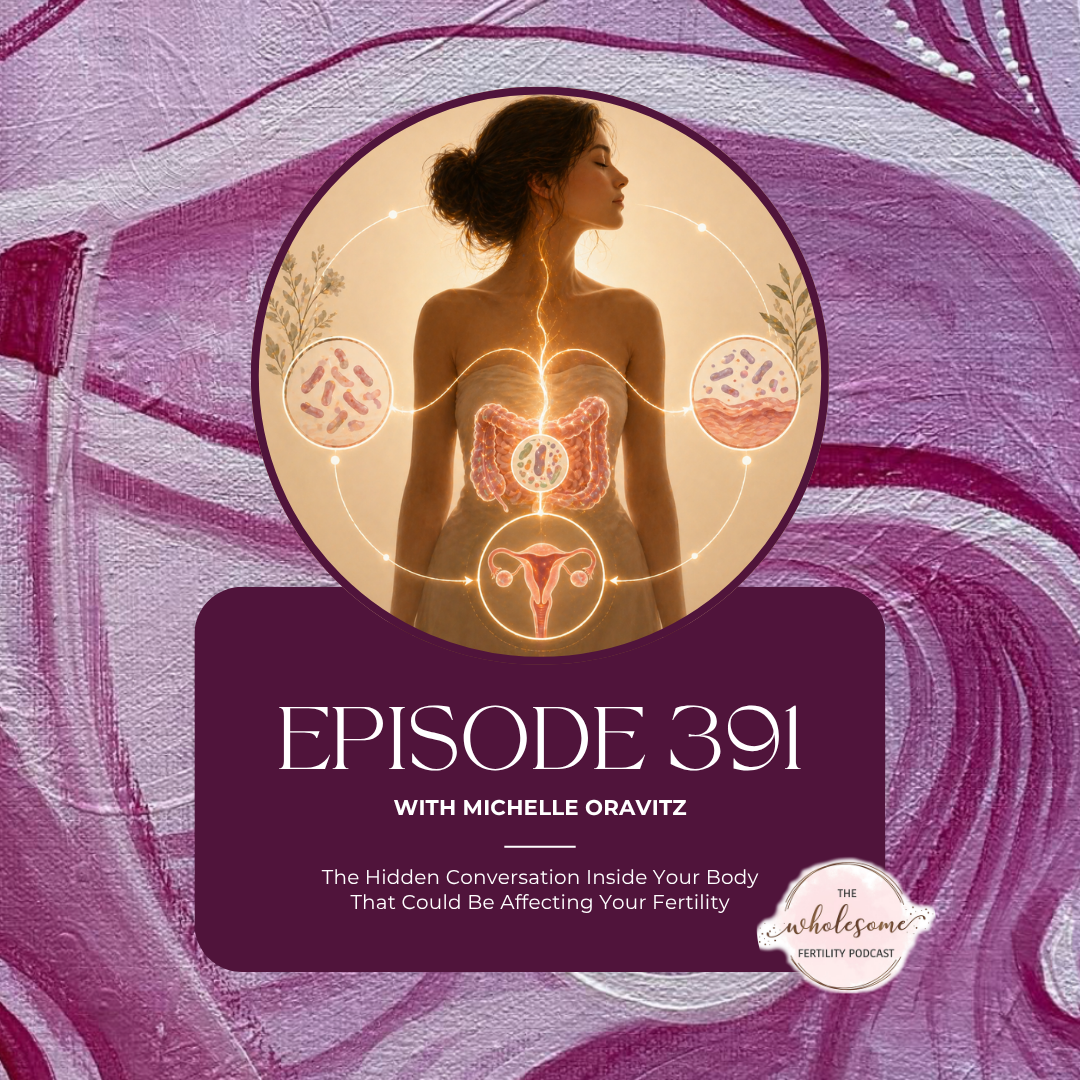
Ep 391 The Hidden Conversation Inside Your Body That Could Be Affecting Your Fertility
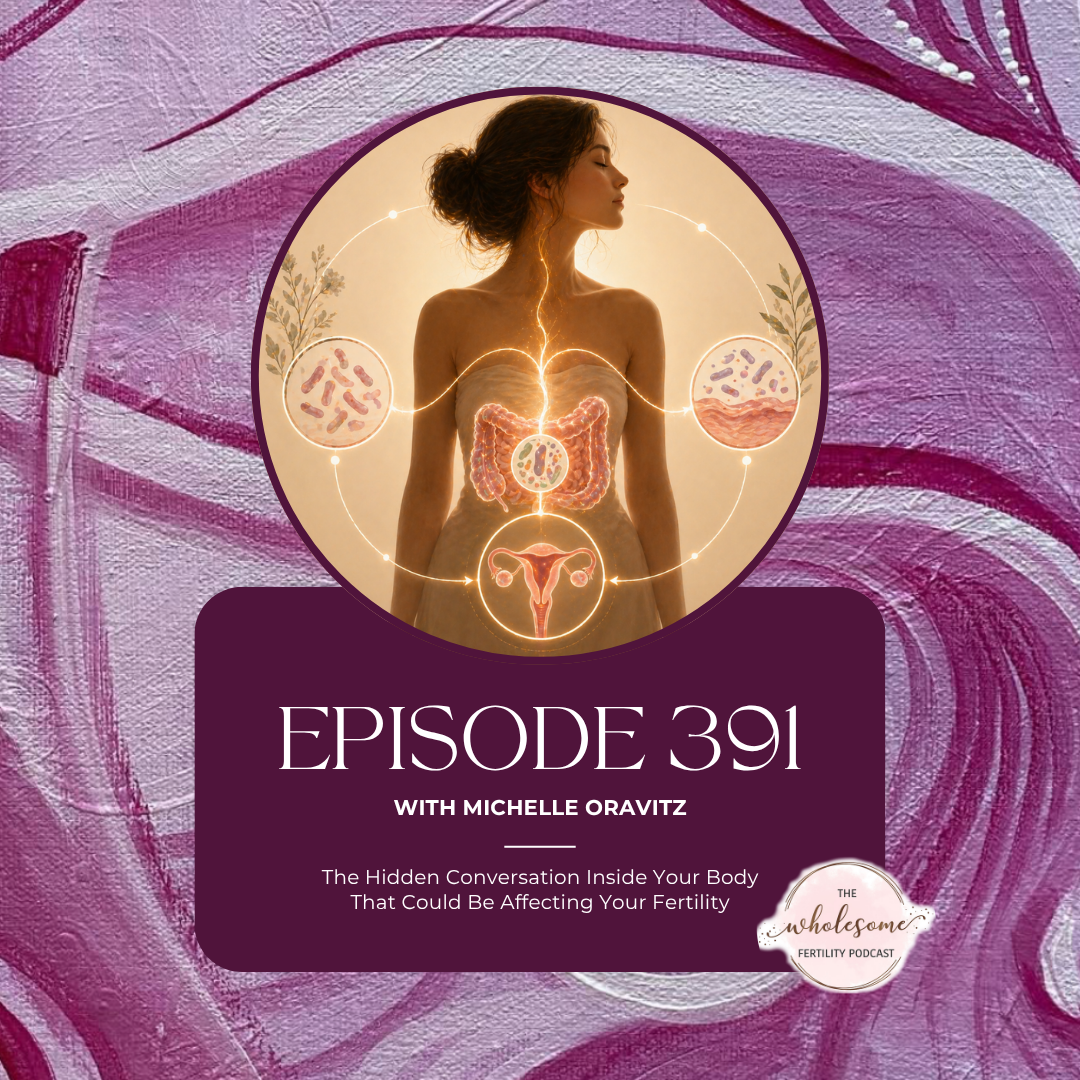
There is a quiet conversation happening inside your body that may be shaping your fertility more than almost anything else you have been told to focus on. It is happening in your gut, your reproductive tract, and your uterus. Until recently, science assumed the uterus was sterile. We now know it is not, and the bacterial communities living in these three places are in constant communication with one another, influencing your hormones, your immune response, and your ability to conceive and carry a pregnancy.
In this solo episode, Michelle walks you through what the research actually shows about the gut, vaginal, and uterine microbiomes, why this is one of the most overlooked pieces of the fertility puzzle, and what you can realistically do to support these ecosystems without falling into fear or expensive supplement spirals. You will learn why diversity is wonderful in the gut but not always ideal in the reproductive tract, how the estrobolome regulates your hormones, and how nervous system regulation, sleep, fiber, and fermented foods quietly shape the entire system. This is a grounded, science-backed conversation that gives you a clearer map of your own body.
Key Takeaways:
The uterus is not sterile. It has its own microbiome that influences implantation, pregnancy, and live birth rates.
A reproductive tract dominated by Lactobacillus is associated with significantly better fertility outcomes, including higher IVF success and lower miscarriage and preterm birth rates.
Diversity in the gut microbiome is healthy. In the uterus and lower reproductive tract, the opposite is true. A quieter, Lactobacillus-dominant environment is what supports fertility.
The estrobolome, a collection of gut bacteria, regulates how your body metabolizes and clears estrogen. When it is off, estrogen can recirculate and contribute to issues like endometriosis, fibroids, and irregular cycles.
Roughly 70 percent of your immune system lives in your gut, and gut inflammation can show up as uterine inflammation, affecting implantation.
Antibiotics, hormonal birth control, chronic stress, poor sleep, and harsh products like douches and scented washes all disrupt these microbiomes.
Foundational support is simple and accessible: a wide variety of plant fibers, real fermented foods, consistent sleep, nervous system regulation, and leaving the lower reproductive tract alone.
Microbiome testing is now far more accessible and gives you specific information about your own body, so you can stop guessing and make targeted choices instead of throwing every wellness tool at the problem.
Disclaimer: The information shared on this podcast is for educational and informational purposes only and is not intended as medical advice. Please consult with your healthcare provider before making any changes to your health or fertility care.
Research and Resources Cited:
The endometrial microbiome and its impact on reproductive outcomes
Evidence that the endometrial microbiota has an effect on implantation success or failure
Lactobacillus-dominant vaginal microbiome and pregnancy outcomes
Ready to discover what your body needs most on your fertility journey?
Take the personalized quiz inside The Wholesome Fertility Journey and get tailored resources to meet you exactly where you are:
https://www.michelleoravitz.com/the-wholesome-fertility-journey
For more about my work and offerings, visit: www.michelleoravitz.com
Curious about ancient wisdom for fertility? Grab my book The Way of Fertility:
https://www.michelleoravitz.com/thewayoffertility
Join the Wholesome Fertility Facebook Group for free resources & community support:
https://www.facebook.com/groups/2149554308396504/
Connect with me on social:
Instagram: @thewholesomelotusfertility
Facebook: The Wholesome Lotus
Disclaimer: Some of the links shared are affiliates but this is at no cost to you and can even get you discounted prices!
-
Speaker 2: [00:00:00] Welcome back to the Wholesome Fertility Podcast. I'm your host Michelle Orbits, and today we're going into one of the most important conversations around fertility. We're going to talk about the microbiome, but not just the gut microbiome that you've probably heard about, but the vaginal microbiome and the uterine microbiome, and the conversation that is constantly happening between all three of them.
This is one of the fastest moving areas of reproductive science right now, and almost no one is translating it for the woman who actually needs to hear it. So that is what I want to do today. I want to give you a clear, honest picture of what's happening inside your body and why it matters for fertility and what you can actually do about it.
So let's get started.
Welcome to the Wholesome Fertility Podcast. I'm Michelle, a fertility acupuncturist here to provide you [00:01:00] with resources on how to create a wholesome approach to your fertility
journey.
Speaker 3: Let me start with a piece of context that I think is going to surprise some of you. For most of modern medical history, the inside of the uterus was assumed to be sterile. The thinking was that the cervix acted as a gatekeeper and that the bacteria found inside the uterus must be a sign of infection.
That assumption is wrong. Research over the last decade has shown that the uterus has its own resident microbial community. It is much smaller and quieter than the gut or the reproductive tract, but it is there. And the composition of that community appears to influence implantation, pregnancy maintenance, and even early pregnancy loss.
So we're not talking about one microbiome anymore. We're talking about three. The gut, the lower reproductive [00:02:00] tract, and the uterus. Each one with its own dominant species. Each one shaped by what you eat, how you sleep, how stressed you are what medications you've taken, and what your hormonal environment looks like.
And here is where it gets really interesting. These three communities are not isolated. They're in constant communication. Let's start with the lower reproductive tract because this is the one with the clearest fertility implications. A healthy reproductive microbiome is dominated by a single strain of bacteria called Lactobacillus.
In women whose reproductive microbiome is more than 90% Lactobacillus, fertility outcomes are measurably better. IVF success rates are higher, miscarriage rates are lower, preterm birth rates are lower. And when Lactobacillus drops below the threshold and other bacteria start to take up more space, we see what is called dysbiosis.
And [00:03:00] dysbiosis in the environment is associated with implantation failure, recurrent pregnancy loss, and chronic inflammation. This is not a small effect. In some studies, women with non-Lactobacillus dominant reproductive microbiome had implantation rates roughly half of those with a healthy microbiome.
And here's what almost no one talks about. A lot of standard fertility workups do not test for this. You can do round after round of blood work, ultrasounds, and hormone panels and never have anyone look at the bacterial environment your embryo's actually trying to land in. The lower reproductive tract is not just a passageway.
It's actually an ecosystem, and that ecosystem is talking to the uterus on the other side of the cervix all the time. Now let's go up one level into the uterus itself. This is the newer research, and it's still being refined. But what we are seeing consistently is that the [00:04:00] uterine microbiome influences something called endometrial receptivity.
Receptivity is just a clinical word for whether the lining of the uterus is in a state where an embryo can successfully implant. In a study that's been replicated several times, women whose uterine microbiomes were dominated by Lactobacillus had significantly higher implantation, pregnancy, and live birth rates compared to women whose uterine microbiomes had more bacterial diversity in the wrong direction.
This is counterintuitive. In the gut, we actually want diversity. A diverse gut microbiome generally is a healthy one. But in the uterus and in the lower reproductive tract, the opposite is true. We want a quieter, more lactobacillus-dominant environment, and that is really an important distinction because if you've heard about the microbiome health in general, you've [00:05:00] probably heard the message that diversity is a good thing, and it is, but only in the right place.
Now let's talk about the gut, because the gut is the through line that connects all of this. Your gut microbiome influences your hormones in several specific ways. There's a collection of gut bacteria called estrobolome that helps regulate how your body metabolizes and clears estrogen. When the estrobolome is functioning well, estrogen is processed and eliminated in a healthy rhythm.
When it's not, estrogen can recirculate, build up, and contribute to conditions like endometriosis, fibroids, PMS, and irregular cycles. Your gut also produces and influences neurotransmitters that affect the HPA axis, which is the stress response system, and the stress response system is in direct conversation with the reproductive system.
So when the gut [00:06:00] is inflamed, when it is dysbiotic, when it is leaky, the downstream effects show up in places that have nothing to do with digestion. They actually show up in the cycle, in the lining, and they show up in implantation. So this is why so many women are doing everything right on paper, eating clean, taking prenatals, tracking their cycle, and still feeling like something's off.
Because the gut is the upstream piece that Often people don't really get tested. So how does this conversation actually work? There's a direct migration. Bacteria from the gut can travel and influence the reproductive microbiome. This is part of why women with chronic gut issues often also have recurrent imbalances in the reproductive tract.
There is hormonal signaling, and the gut influences estrogen. Estrogen influences the lining of the reproductive tract, and that lining is what feeds lactobacillus. So a gut [00:07:00] imbalance can cascade upward into the reproductive imbalance without even direct migration. And there's also immune signaling.
Roughly 70% of your immune system lives in your gut. That immune system communicates with the immune cells in the uterus, which are heavily involved in implantation. A chronically inflamed gut creates a chronically inflamed uterus, and there is nervous system layer too, which I always come back to. The vagus nerve runs through the gut and signals up to the brain, which then signals down into the ovaries and the uterus And when the gut is distressed, that distress travels along this pathway.
Everything is connected by design. So what disrupts these microbiomes? A short list, because this is where the practical part starts. Antibiotics, especially repeated courses, can disrupt all three microbiomes for months or [00:08:00] even years. This doesn't mean antibiotics are wrong. In many cases, they can save lives.
But what it does mean is recovery from them takes intentional support. And hormonal birth control changes the reproductive microbiome in measurable ways. Some women bounce back quickly when coming off of it, but others can take a year or more. Chronic stress also shifts the gut microbiome through the gut-brain axis.
The bacteria in the gut respond to your nervous system because your gut has its own nervous system. And diet also matters, especially fiber, fermented foods, and the absence of high amounts of processed sugar and emulsifiers. Sleep matters as well. Alcohol matters. And one more piece, douching, scented products, and harsh soaps disrupt the lactobacillus dominance that you actually want to protect.
The body is self-cleaning, so we don't [00:09:00] really need to do extra to clean it. Here's the part where I wanna keep things grounded Because the wellness world tends to turn this into a long list of expensive products, and that is not where I want to take you. The foundation is fiber. A wide variety of plant fibers feeds the beneficial bacteria in your gut, which then sets the conditions for everything downstream.
Aim for diversity, so different colors, different plants, different sources of fiber across the week. Fermented foods that are actually fermented. Real sauerkraut, kimchi, kefir, plain yogurt with live cultures, full fat, of course. A small amount of daily dose does a large amount once a week. And sleep. The gut microbiome has its own circadian rhythm, and it is disrupted by inconsistent sleep, so this is one of the most underrated interventions.
And nervous system regulation. The gut microbiome in your gut respond [00:10:00] to your vagal tone, so the vagus nerve is the bidirectional communication between your enteric nervous system, which is the nervous system of your gut, and your central nervous system, which encompasses your brain. So the bacteria in your gut respond to your vagal tone.
Slow exhales, time outdoors, and real rest are all microbiome interventions, even though they may not look like they have any connections to your gut. And for the lower reproductive tract specifically, leave it alone. No douching, no scented products, breathable underwear, and gently unscented cleansing on the outside only.
I would even go as far as Try to avoid tampons, and if you really must, if you really must and you have things to do, then use organic ones only. So here's what I want to leave you with before the close. So much of what I've seen in my work is women doing all the right general things and still feeling like they're missing information.
[00:11:00] Because general advice can only take you so far. At some point, you need to know what is actually happening in your specific body. That is what microbiome testing offers. So instead of guessing whether your gut or reproductive environment is supporting your fertility, you can actually look. You see what is dominant, you see what is missing, you see what is overgrown possibly, and then you make targeted decisions instead of throwing the whole wellness toolkit at the problem.
This kind of testing has become much more accessible in the last few years. It's not as out of reach as it used to be, and the information it gives you can change the entire direction of your fertility journey, which is why I wanna mention before we close that this is something that I now offer in my practice and online.
I work with women on both gut and reproductive microbiome testing, and we use those results to build a real specific plan rather than a [00:12:00] general one that might not be as effective. So if this is something you've been wondering about, you can find out more information through the links in the show notes, and I would absolutely love to support you.
Your body is not a mystery. It's an ecosystem, and ecosystems can be tended to. The microbiomes inside your body are listening to how you live, responding to how you eat and how you sleep, and how safe your nervous system feels. They're not asking for perfection. They are asking for consistent care and nurturing.
So if this episode opened something up for you, you might wanna share this with a friend who's on a similar path. And if you're ready for more specific support, you know where to find me
Speaker: So that concludes today's episode. You can find all of the links mentioned on the episode notes. If you're enjoying these episodes, please take a moment to share and leave a review. Reviews mean everything to podcasters, and I really enjoy hearing from my listeners. You can find me on my [00:13:00] website at www.michelleorbitz.com.
You could also reach out to me on Instagram, and I love getting DMs from my listeners. My handle is @thewholesomelotusfertility. I thank you so much for tuning in today, and I hope you have a beautiful [00:14:00] day.
EP 390 The Inflammation Code: How Ayurveda, Elemental Design, and Turmeric Support Fertility
Dr. Shivani Gupta returns to the podcast to share what she has learned since writing her new Hay House book, The Inflammation Code. In this conversation we explore why inflammation is rising so dramatically in modern life and how that plays into fertility, hormone balance, and overall vitality. Dr. Shivani breaks down the three doshas in Ayurveda, which she calls Elemental Design, and explains how understanding your own makeup of air, fire, and earth can help you choose the foods, rhythms, and rituals that actually nourish your body. We also talk about Mental Inflammation, circadian living, the healing power of nature, and why modern life keeps so many women stuck in survival mode. Dr. Shivani shares the science behind turmeric, why absorption matters, and when to use it and when to pause it during IVF and transfer windows. This is a grounded, practical conversation about returning to ancient wisdom in a way that feels doable in real life.
Key Takeaways:
Inflammation is rising because of environmental toxins, processed foods, chronic stress, and constant mental stimulation. The body is living in survival mode rather than thriving.
Ayurveda teaches that each of us has a unique Elemental Design made of air, fire, and earth. Knowing your primary and secondary doshas helps you choose foods, rhythms, and rituals that bring you back into balance.
Mental Inflammation is a real physiological state created by constant phone use, email, and sympathetic activation. It feeds physical inflammation, and physical inflammation feeds it back.
Living in rhythm with nature’s circadian clock is one of the most powerful and free tools we have. Walking outside, eating seasonally, and sleeping from 10 to 2 supports lymphatic clearance and reduces inflammation.
Preparing the body for conception through gentle detoxification, nourishment, and tissue health is the same work that supports vibrancy through perimenopause. A vibrant body is a fertile body.
Turmeric is one of the most powerful natural anti-inflammatories we have, but absorption matters. Black pepper and healthy fats increase bioavailability significantly.
Turmeric can support fertility conditions linked to inflammation such as endometriosis, PCOS, and recurrent implantation challenges, but it should be paused during IVF cycles and transfer windows because it thins the blood and can thin the uterine lining.
Supplementation should be phased with the guidance of a practitioner. Every season of the body calls for a different protocol.
Guest Bio:
Dr. Shivani Gupta is an Ayurvedic practitioner, turmeric researcher, and speaker who blends classical Ayurveda with functional medicine to help women calm inflammation, balance hormones, and restore energy. With a Master’s in Ayurvedic Sciences and a PhD focused on turmeric, she translates ancient wisdom into simple daily rituals, including Elemental Design personalization, Mental Inflammation resets, gut and estrobolome support, and spice-based micro-habits. Her new book, The Inflammation Code (Hay House, February 2026), is a practical, non-diet system for cooling chronic inflammation to improve brain fog, bloat, pain, sleep, and mood. Dr. Shivani is the host of the Fusionary Health Podcast and creator of the Emmy-nominated TV show Vibrant Health with Dr. Shivani Gupta. Learn more at shivanigupta.com.
Connect with Dr. Gupta:Instagram: @dr.shivanigupta | https://www.instagram.com/dr.shivanigupta
Facebook: @theshivanigupta | https://www.facebook.com/TheShivaniGupta
YouTube: @dr.shivanigupta | https://www.youtube.com/@dr.shivanigupta/videos
Pinterest: @theshivanigupta | https://www.pinterest.com/theshivanigupta
Website: https://www.shivanigupta.com
Disclaimer: The information shared on this podcast is for educational and informational purposes only and is not intended as medical advice. Please consult with your healthcare provider before making any changes to your health or fertility care.
The Inflammation Code book: https://www.theinflammationcode.com
Fusionary Formulas: https://www.fusionaryformulas.com (code WHOLESOMEFERTILITY for 15% off)
7-Day Inflammation Detox Challenge: https://www.7dayinflammationdetox.com/optin1641313075014
The Inflammation Code Podcast: https://podcasts.apple.com/us/podcast/the-inflammation-code/id1680587836
Ready to discover what your body needs most on your fertility journey?
Take the personalized quiz inside The Wholesome Fertility Journey and get tailored resources to meet you exactly where you are:
https://www.michelleoravitz.com/the-wholesome-fertility-journey
For more about my work and offerings, visit: www.michelleoravitz.com
Curious about ancient wisdom for fertility? Grab my book The Way of Fertility:
https://www.michelleoravitz.com/thewayoffertility
Join the Wholesome Fertility Facebook Group for free resources & community support:
https://www.facebook.com/groups/2149554308396504/
Connect with me on social:
Instagram: @thewholesomelotusfertility
Facebook: The Wholesome Lotus
-
[00:00:00]
Michelle Oravitz: Welcome back to the podcast, Dr. Shivani. I had you, um, on episode 231 a while back, but I know since we last spoke, so much has changed. And, um, last time we talked about turmeric and your supplement and how you, um, have a special formulation to make it extra absorbable in the body, because that's always been like, um, I guess a challenge that supplement companies had.
But catch us up, talk to us, because you have just, um, released a book called "The Inflammation Code," which is incredibly important for anyone who's trying to conceive. It seems to be that inflammation is on the rise, and it's, uh, something that we're just hearing about all the time, and I know that there's so many different factors, so I'm so excited to dive in.[00:01:00]
Dr. Shivani Gupta: For sure. Um, so much has happened. I mean, you know, when you are in alignment, living your dharma, aligned with your exact purpose in life, I think That's where the universe keeps bringing all the magic in. And so about two years ago, I got a call from Hay House that said, "We want you to write this book." And I was like, "What?"
My entire life dream, the reason I got the master's and the reason I got that PhD in turmeric was I wanted to know Ayurveda at this level that I could then teach it and write books to impact the world. And so when this book deal came along, I was like, "What? I get to write a book for Hay House? I get to teach about Ayurveda?"
And the feedback was, look, I know, like in my case, I want the world to know Ayurveda, but I'm actually more interested in us understanding how to live in that rhythm that Ayurveda teaches, the circadian rhythm. And so I took a lot of [00:02:00] the Ayurveda concepts that are incredible, and I renamed them, and I simplified them, and I took what I've been doing with women for the last decade in my programs and in one-on-one work- And put it into the book in a very attainable way.
And so this whole book is "Know Your Dosha," which I renamed "Elemental Design." So it's know your elemental design. That is your guiding principle to knowing the blueprint on you. You are more air, fire, or earth, or the most beautiful combination of the three. And our job as Ayurvedic practitioners is just to show you your most balanced place, how you feel most vibrant.
And then in the book, I got to teach about circadian rhythm and gut health and the Sattvic diet from Ayurveda, this yogic diet. And I got to talk about self-care rituals, which is one of my favorite pieces of Ayurveda. And then I did, of course, give a tap chapter to turmeric and the super spices, 'cause turmeric is my favorite [00:03:00] core topic that I, of course, think people should know about when we're talking about inflammation.
But the book is really like my, my love letter for all of us as women of the lifestyle we can live that gives us what we want. Because what we're asking for is what each of us wants to call in in this life. But if we're not getting there, it's just a lack of understanding how to be our most vibrant, energetic selves.
That's my theory. And so I'm always seeking, like, how do I show you how to build ojas or vibrancy or strength or finding your alignment again, so you have that reserve and that energy to do all that you want and live your most balanced life?
Michelle Oravitz: Love that. Love it. Um, and of course, we're gonna dive deeper on what doshas are, just in case people are hearing it for the very first time. It's really fascinating, and it's amazing 'cause it really kind of puts the ba- the power back in people's hands. Because once they really understand their own body and it starts to m- and it's very intuitive, it [00:04:00] makes a lot of sense, then they're able to say, "Oh, you know, so this is what my element tends to be, and this is what I need to do to balance it."
And it's a lot more, um, empowering. It's something that really people can do and take on in their own lives to better their life and help their, you know, improve their health. Um, but before we get into that, I do wanna talk about why is it that you think that so many people are s- dealing with so much inflammation in this day and time, like this time of life?
Dr. Shivani Gupta: Mm. Inflammation is increasing across the board in our society because of so many different environmental factors, but also so many lifestyle choices that we're making. And so I look at it as first, where are we when it comes to corporations, big food, big pharma, big chemical? And we're not really in a [00:05:00] good place in modern day times right now.
I mean, we're living in a society where everything is factory farmed, no regard for the land really having the vitamins, minerals, and richness we need for a healthy microbiome. So we're really eating food that's depleted and lacking. Then when it comes to our chemical burden in general, between the pesticides and the herbicides on the food, but also every single aspect of our lives is contributing to more microplastics, ingesting toxins by breathing, water, the surfaces around us.
And so there's an environmental toxin burden on the body that's so tremendous at this point that the body's just trying to hold strong against it. And that's not, that's not gonna lead to vibrancy. That's gonna lead to survival mode. So if the body's got so much coming at it and the body's like, "Oh, hey, Shivani, between the plastic water bottle you drank out of, the alcohol you consume," maybe I had a [00:06:00] glass of wine last week on a trip, "between the food that's completely lacking in what I need but is pesticide-ridden, I mean, how am I supposed to function and be thriving?"
And so I look at, uh, that the environmental toxin burden first and try to figure out where can we reduce that. Like, where can we bring that down as much as possible? And then in addition, we are what we eat, and we are everything that we consume. And so that's where it gets multifactorial as well- What are you eating?
Is it seed oils and processed foods, or is it healthier, fresher foods that are anti-inflammatory and more nourishing? Oftentimes, our diets right now are very inflammatory. Between the seed oils, the top inflammatory foods, some of which include gluten and dairy and alcohol and sugar, um, all of those can really add up to a pretty inflamed body.
And then finally, in my book, I wrote a chapter on a topic I called Mental Inflammation. [00:07:00] I was asking the universe for a way to explain that in Ayurveda we teach that you must stand guard at the doors of your mind and really have a, a intentional practice around that. So in Ayurveda, we teach yoga and pranayama, which is deep breathing and, and really making sacred space in our day.
And the modern-day lifestyle has us instead picking up our phone every five seconds and jumping onto social media, jumping onto email. So that mental friction, mental stress causes this mental inflammation, we can call it being in our sympathetic nervous system as well, but never being in rest and digest, never being settled, grounded, or centered or aligned.
And that mental inflammation can cause physical inflammation. Physical inflammation then causes the mental inflammation, and we're stuck in feedback loops. So I think it's multifactorial why we as a society are so inflamed, but the fact that [00:08:00] we are so inflamed is why we are dealing with chronic disease and distress and frustration when it comes to our health, especially in women's health, all the way through the spectrum of our health journey.
Yes.
Michelle Oravitz: Yeah, absolutely. And another thing, um, something that I love so much about Ayurveda is they actually talk about eating local foods because your body, um, is so connected with the environment and the climate, and that if you're eating certain foods that are local, those foods are actually meant to balance out the climate that you're in.
And that's something that is really very unique. I remember, um, learning about and thinking it was just so amazing, but we don't have that anymore.
Dr. Shivani Gupta: No. Well, the fa- the farmlands are being sold for high profits, especially, and we're both here in South Florida, where, you know, land is worth a lot. It's, it's Florida at this point. There's so much movement and growth and... [00:09:00] source local fresh food, we're in big trouble because we are circadian beings, and as circadian beings, we really need that alignment with With nature's clock, with our circadian arou- surroundings, with the season that we're in, which is what you're talking about.
So yes, absolutely, we need this ability to order fresh, source fresh, um, go to the farmers markets on Saturdays. That is the most rich, nourishing, balancing food for us.
Michelle Oravitz: Mm-hmm. Yeah, for sure. I, I feel like I need to do more of that myself, like, 'cause we have homestead here. There's so many things that you can get, but, um... and there are farmers markets. Like, you just have to dig deep and, and look around. But, um, you know, there's certain squashes and foods during wintertime that are actually meant to balance you out so that you're able to sustain your s- your, you know, your body's able to keep its own heat and, you know, they're, they're heating.
It's, it's just amazing how [00:10:00] nature works. It's just like a puzzle, and it's so smart.
Dr. Shivani Gupta: It's true. It's so true. I mean, Ayurveda teaches, just like Chinese medicine, which you also practice, Ayurveda teaches that nature is the ultimate healer, and nature holds all this wisdom, and we're meant to live in this beautiful symbiotic relationship with nature, and nature heals all things. And so any time there's a problem, I just go outside.
I walk outside, I move in nature. I know breathing in nature is my way through any challenge, any problem, any mental frustration. And oftentimes in modern-day life, we're just sitting inside of our box, our car, our building, our room, completely disconnected from nature, and then wondering why we don't feel good.
But our microbiome, our, our biome in general, needs to interact with nature to be its most healthy. Putting our feet in the earth, just touching n- nature is going to bring us into balance and, and we think it's too [00:11:00] simple, so we don't do it. We're instead chasing these bigger solutions. I go to all the biohacking conferences, and It's like PEMF mats and infrared saunas and, and all this tech, and I'm like, "You know, your tech is just doing exactly what nature does."
Now,
Michelle Oravitz: for
Dr. Shivani Gupta: accelerate? Yeah. Nature will give it to you for free.
You want some red light? Go walk in the morning and the evening. That is the sun giving you your red light in the exact light, right spectrum at the exact right proportions that we need, 'cause Mother Nature created it perfectly in her infinite wisdom.
And instead we're like, "No, no, no, I need to be indoors to do my this tool, that tool, that tool, that tool to get through the homework checklist." And so I always keep both in mind. I'm, I'm a big fan of modern science and how It's proving ancient Ayurveda to be true.
and so I do have an infrared sauna and I have some of these things, but it's very much about, okay, I'm gonna accelerate healing by using the tool, [00:12:00] but do I still do the daily practices and the daily rhythm that are gonna get my body to stay in the frequency and vibrancy that I crave?
Michelle Oravitz: Yes. And then you also talked about yoga as being part of Ayurveda, which I don't think a lot of people realize. Yoga is not its own thing. It's actually a branch of healing. It's a modality of healing that Ayurveda used, you know, throughout history, um, as the physical therapy aspect of Ayurveda.
Dr. Shivani Gupta: It's true. Most people don't realize that yoga and Ayurveda.
are sister sciences, and, and part of any Ayurvedic practitioner's work is going to be giving homework around deep breathing, yoga, and things like that. Here, because we live in the US, a lot of times I don't give that homework because a lot of people don't wanna do yoga.
They think it's too hard. It's just not something they are into. But the yogic stretches and the way we gently [00:13:00] detox the body and, and move and flow is part of any healing journey and staying in balance. It's part of our lifestyle rituals.
Michelle Oravitz: I would say it's hard not to do it because it makes your life more difficult when you don't move. And I, uh, yoga's just, I, I find it to be an intelligent... It ha- it still has the intelligence intact. It's an intelligent exercise, and it moves your lymphatics and also the fascia. It stimulates the fascia, which stimulates healing.
You know, so it's, uh, you know, Chinese medicine, they'll do more like qigong, qigong, um, and that kind of movement. But movement in general is so important, uh, to help also alleviate a lot of the mental inflammation as you talked about, because sometimes we try to address mental states with the mind that's already in that state, so we're spinning in circles rather than [00:14:00] really, like, moving through it and knowing, realizing that we do actually process a lot of the emotions in the body.
Dr. Shivani Gupta: True. True. You know, I went to India years ago. I went probably two years prior to having my first child, and when I went to India, I thought, "You know, fertility is a big issue. I wanna show up so healthy when I'm ready to conceive this child." And so when I went to India, I did a three-week Panchakarma treatment, which is this profound detox.
It's like, you can call it the oil change of all
Michelle Oravitz: where did you do it? 'Cause I, I also did it in India. I went to Mysore.
Dr. Shivani Gupta: You did? Okay. So we went to Bangalore. So it was me, my mom, and my sister, and I knew that the next big project I was gonna do was conceive this healthy, Organic baby who I was, like, preparing for-
Michelle Oravitz: baby.
Dr. Shivani Gupta: like, I, I was really, I had an organic cotton children's clothing company at the time, and so I was going to all the conferences, and we were still at the beginning of those stages of BPA-free bottles [00:15:00] and non-toxic baby lifestyle, which we have so much more of that now.
She's 16 this year. So 17, 18 years ago, it was a different ballgame of what was accessible. And I created an organic cotton children's clothing company that was a very luxury product line back then. And it was just so fun to be in that space and learn about it pre having kids. So then I was, I was acutely more aware of all the different issues that happen in children, 'cause I was studying Ayurveda, and so many people would come to me and say, "My kid just had this injury from, you know, from different medications or different things that they were taking."
Kids were always having chronic health issues. All my husband's friends, my husband's seven years older, so all of his friends, I could see the kids all had allergies, eczema, um, ADHD, different issues. And I thought, "Hmm, if this is what's coming for me, I need to show up to really create this healthiest baby possible."
And so when I did Panchakarma and Ayurveda, it's basically a really big [00:16:00] detox, and the philosophy is if the body shows up healthy and your tissues are healthy and you are so vibrant and everything is coherent, which is a word you like to use around being healthy, and I love that word, and we're aligned, then what we're gonna have is a very healthy pregnancy.
The body will bounce back well and all of those things. And so I've always been a big fan of let's detox and prepare, let's nourish and get the body's tissues and everything so healthy. Let's show up like we are going to a marathon, like that strong and healthy, and then we embark on the project. And so that's how I showed up to conception of Anya, my-- I call her Anya Rani, Anya the Queen.
And then later when it came to this phase, like right now I'm in perimenopause at 45. So now that I'm in this transition, I'm like, it's the same work. Whether I show up vibrant and healthy and robust to go through the transition into motherhood, or I show up vibrant, healthy, and [00:17:00] robust so I can keep brain energy and body energy online in this moment.
In, in Ayurveda, that's the exact same work we do for vibrancy. Fertility is just a vibrant body, is how we look at it. So, so Yeah.
that's, it, it's been quite a journey of understanding how to build the most healthy, fertile body for the two kids I had, but then also to keep that level of ojas strength and vitality later on for the later years as well.
Michelle Oravitz: Yeah, and it really does make a difference. And you do have a glow, so you, you look younger than your age. We talked about that. You really do. Like, it... And I think that that's what it is. You're literally preserving. Like, the number means nothing. Like, I just like, you know, yeah, there's like a range and all of that stuff.
You could also bring back your biological age. You could bring it back. You can actually, like, make yourself younger. And, um, there's so many [00:18:00] things that you can do. That's the empowering aspect of it, which I love. Um, let's talk about doshas. What are doshas and, and how, why is it important for people to understand their own dosha?
Dr. Shivani Gupta: For sure. I mean, this is a, one of the most central concepts in Ayurveda. We teach that each and every one of us has our own individual mind-body type, and that type is unique to you. It was decided at birth. We call that your prakruti, like the way you were born, which is your template, your blueprint for life.
And the doshas are based on the five elements of nature, so air, ether, fire, water, and earth. And I know in Chinese medicine you have your own five elements, and so it's beautiful that both sciences understand that the elements are the key and have different languaging around how to support people in that way.
And so I took the doshas and thought, "Okay, I'm gonna teach you guys agni, ama, ojas," like [00:19:00] there's 500 Sanskrit words and they have such profound meanings. Can I simplify any? So I renamed dosha's elemental design, and so your elemental design is your makeup of those elements in the proportion that you are.
And so there's three body types, vata, pitta, and kapha. Here in the West, we pronounce them vata, pitta, and kapha. And vata is air and ether. So a vata person is gonna have this tendency physically to be taller and shorter than anyone in their demographic. So think tall and lanky, think small and petite.
This kind of person is made up of the elements of air, so it could be a beautiful breeze that's just always in motion in a beautiful way, or could be something like a tornado if really out of balance. And so keeping that in mind, it could also be a ceiling fan, could be something that's in motion constantly and consistently, but never knows how to stop.
And so when you take that understanding of air, ether, and you move it into [00:20:00] the person, what that means is someone who's always in motion. Their energy's always in motion. Every movement in the body is guided by this vata energy. And so this is someone who probably can't take a job where they have to sit still.
Typically, it's your endurance athlete, your marathon runner. This is someone who has a tendency towards constipation 'cause of dryness in their system, tendency towards anxiety, tendency towards insomnia, poor, disturbed, light sleep. This is someone who can usually go all day long surviving on like coffee, a green juice, some celery, and then they get to dinner and they're
Michelle Oravitz: Which is like the worst thing for vata, 'cause the greens make it colder. Like, it's like, uh... They always eat salads. It's really the raw,
Dr. Shivani Gupta: They're like, "Let me eat raw, cold. everything. Let me never ground my energy, never do warm or heating." So it's funny how our tendencies can be so exacerbating and throw us further out of
Michelle Oravitz: Like the pitta with the fire, they [00:21:00] love spicy. Like...
Dr. Shivani Gupta: Yep.
I know. I'm, I'm addicted to chilies. It's, it's rid- ridiculous kind of how we do the thing that imbalances us most and don't catch it.
And so the homework for that Vata crew is let's eat food, people. Let's eat three times a day. I know you like to be those big intermittent fasters. Let's just try our Ayurveda way for once, and you get to see how you feel. And so I bring a lot of healthy fat, those fall foods you mentioned. So seasonality is such an important piece of understanding your constitution, when your season's gonna be the most exacerbated or out of balance, and really digging in more in that season to balance yourself.
So fall season is when Vata gets out of balance. And what does the universe give us? Fall foods, squash, nutmeg, cinnamon, like the most herbing, the most grounding spices and herbs and drinks and lattes, pumpkin, all happens in the season when you need it most. And so it's really about tuning in and awareness so that you do [00:22:00] those things that make you feel the most nourished.
Then you have Pitta. Pitta people are all fire. It's fire with some water. And so what that means is you could be a beautiful, healthy campfire that processes, digests, and assimilates, or you could be like a forest fire or a volcano that erupts. And so when you take that analogy and start to understand the Pitta person, this is someone who's medium-bodied, tendency towards reddish hair, gray hair.
I mean, reddish skin, reddish hair, or graying, early graying hair. This is someone who's usually of a muscular build. They like to move. They like to lift. They're always trying to... Their personality is very much the leader. They're organized, sharp, perceptive. Um, they love to speak and teach. They're usually the ones who are very passionate and ambitious.
And a pitta person when out of balance is kind of like that volcano that explodes. They burn out, explode. People closest to them are [00:23:00] collateral damage. They're frustrated, they're angry, they get bitter. And so pitta people, I teach them, treat yourself like a nuclear reactor. Stay calm, stay cool. Pittas love hot, oily, spicy food.
They tend to love fried food. They tend to run inflamed. So when I talk about inflammation, it's usually this like pitta person or pitta imbalance where we're inflamed and there's heartburn and inflammation going on in the system. And the homework is those cool, calming foods. So summer season is when pittas get most out of balance, and everything nature gives us in summertime is usually cooling and calming.
It's part of why I teach time as me time. I am a pitta, and so I need a couple reminders in my day, calm down. What are we doing to stay dis- what are we doing to stay cool, calm, and collected instead of just being on a racetrack and trying to go 200 miles an hour and never stopping on that track? And then finally, the third body type is called kapha, [00:24:00] and a kapha person is Earth. and water.
So this is someone who's so earthy and grounded. This is someone who is bigger boned, stronger, round face, round eyes, oily curly hair, oilier skin. This is someone who is able to lift heavier. Like they're just a stronger constitution. It could feel like a very mountain energy in someone or a very caretaker loving energy, grandma energy that feeds and loves everyone.
It's that friend who, who's in the group who is always worried about everyone else and not themselves, who, who just wants to care for everybody. And so kapha people can struggle with a sluggish metabolism, struggle with depression or feeling low, being really resistant to change. Kapha people get the most, most phenomenal sleep.
They get this like deep slumber. Kaphas can sleep for eight to 10 hours and have a really hard time waking up in the morning. And once they finish their day and they sit down [00:25:00] If that's where the day ends, you typically cannot get the kapha off the couch. And it's about a kapha person understanding, this is my nature.
Just 'cause modern life says we need side hustles and weekend hustles and 18 hustles, doesn't mean that that's everyone's type. And so, so much of what I teach my kapha clients is honoring thyself, know your nature. And so homework for kapha is exercise and move in the morning to get your energy up and moving, and then also eating warm, cooked foods, not the raw, cold foods, avoiding dairy 'cause it can cause that congestion, that water element in the system.
And so once you understand your body constitution, each of us is made up of all three. Usually we have a primary and a secondary. Some of us are tridoshic or balanced in all three. But starting to understand your primary and secondary is so powerful because then you can start really understanding how to shift your lifestyle habits and calibrating into what we call the most sattvic [00:26:00] aspect of your constitution.
So, for example, I'm a pitta-kapha, and in pitta, I have a big tendency to, to go so far so fast and burn myself out completely. And so I-- my lesson in life is how to, like, not do that. Sometimes I still do it. And then kapha, it's like what is the sattvic aspect of it? The, the most beautiful, pure aspect of that constitution is just wanting to love and serve and take care of everybody.
And so staying in that balanced version of those two constitutions allows you to stay healthy and vibrant and supported and feel aligned. And then if we drop down into kind of the heavier aspects or the, the more challenging aspects of those, then we might not feel like our best self. So there's a lot there, but that's kind of like a highlight of the constitutions.
Michelle Oravitz: Yeah, it's definitely so fascinating, and it's really funny 'cause I'm like, I, I think I'm all three. I mean, I know that, um, I used to be more [00:27:00] vata kapha. Mm-hmm. I feel more fire. Maybe it's just over time, but it's interesting how you can ebb and flow throughout your life.
Dr. Shivani Gupta: Yeah.
You can, and you can have different, um, life events that happen. When I had kids, that really slowed down my life and I became more kapha. If you're ever in a caretaker mode, you become more kapha. And so It's just interesting, you're right, that how we ebb and flow through those transition points and then want to come back to what feels like home in our bodies.
And so I have that quiz, the Elemental Design quiz, on my website at drshivani.com. And when people take it, sometimes they email me back and they're like, "How did you know that about me? How did you know I, like, love all those things and love those foods?" I'm like, "This is 5,000-year-old
Michelle Oravitz: so amazing. It never goes out of style.
Dr. Shivani Gupta: Yeah. It's never-- It's always there for us in such a beautiful way.
Michelle Oravitz: Yeah, it's wild because, you know, you look at like modern science and things, um, things are discovered and then like a couple years later they're like, [00:28:00] "Oh, well, they're debunked." They're like something else. It d- it doesn't really work like we thought. But Ayurveda and Chinese, they, they've been around and they still work, and the reason is, is because their anchor is nature.
Dr. Shivani Gupta: Right, right. You can't go wrong.
Michelle Oravitz: Really wild. Amazing. And so let's, uh, talk a little bit about turmeric because you've done a lot of research around turmeric and, um, so there's the curcumin, which is in, it, it's in turmeric and in some, some supplements have turmeric and some, I guess, extract the curcumin. Can you break it down like what, what it is, what it does,
Dr. Shivani Gupta: For
Michelle Oravitz: what are some of the issues that supplement companies have when it comes to absorption?
Dr. Shivani Gupta: Absolutely. So I was doing my master's in Ayurvedic sciences, and I was in this herbology class, and the professor started explaining the benefits [00:29:00] of all the super spices, ashwagandha, brahmi, shatavari, uh, cinnamon, cumin, coriander. I mean, we have this treasure chest of herbs in Ayurveda, and I know in Chinese medicine as well, ginger.
I mean, ginger's a powerhouse. We should all be consuming ginger in some form most of the year. Not every day, but most of the year. It's, it's so beneficial. Maybe not in your hottest season, but it's just so beautiful. So when I learned about turmeric, I thought, you know, I grew up watching my entire family suffer with diabetes, watching the last 20 years of everyone's life spent in and out of hospitals trying to save their lives.
Why is it that as a society we aren't using turmeric so much earlier in the game as a preventive? Because turmeric is a powerful antioxidant, anti-inflammatory. It's one of the most potent natural inflam- anti-inflammatories we have. It's antiviral, antibacterial, antifungal, and it functions like this [00:30:00] ultimate janitor.
It goes into our body and cleans house on everything that doesn't belong there. Zombie cells, malignant cells, senescent cells, all the things causing oxidation in the first place. It gets rid of the bad bacteria causing dysbiosis in our gut. But then it also does the good side. It's healing our gut from leaky gut.
It's making sure it leaves all the good stuff in place. It supports when we're having insulin sensitivity, it supports those pathways to support us. We have less insulin resistance, and the body's functioning better. Inflammation also means when we're holding onto excess weight in the body, that excess weight causes more inflammation.
It puts us in a catch-22 cycle, and turmeric goes in there and heals with that as well. So there's so much to it in terms of the benefits of turmeric. I truly believe we should all be taking turmeric almost every day. We're supposed to cycle with turmeric as well. It is a warming spice, but it's so potent in healing as a natural tool.[00:31:00]
What most people don't know is out of the entire turmeric plant, only 3% to 5% of it is the curcuminoids, and we know the curcuminoids are the most effective part at helping us reduce inflammation. And so most people tell me, "I'm juicing my turmeric. I buy it fresh." And I'm like, "That is great. If you have no big health issues, go for it."
It's very warming in that form. For me, it burns. I can't take turmeric ginger shots. It hurts too much. But it is gonna give you the natural benefits. We know raw forms of most plants is beneficial. But in ancient Ayurveda, we always took the raw plant and dried it into the spice. And so when you take that dry spice of turmeric, that's your kitchen culinary turmeric, every Indian household uses it.
India is the largest consumer of turmeric as a powder. We use it in our cooking, and it is beneficial. As Indians, we're using it in everything. It's going in every lentil, every bean, every dish. So we have this cumulative effect of using it, and we're also using it with [00:32:00] black pepper or a healthy fat, which increases the absorption.
So black pepper increases that absorption 2,000%. The healthy fat is gonna help it go into the body and cross the blood-brain barrier, so that has its own benefits. But still, kitchen turmeric, the culinary spice sprinkled on your chicken, is not enough to give you enough of that 3% to 5% to really make a difference.
And we kicked off talking about how all of modern-day life is really inflammatory. So if we wanna meet life where it is in terms of the toxin burden and the things and the foods that are affecting us, we need, in my opinion, an equal and opposing force to reduce at least that inflammation as we're gonna do all our good habits to win at inflammation as well.
And so that's where that extract matters. Now, when it comes to supplementation, there's a lot of variation of quality in the supplement world. You can buy a $10 supplement, a $20 supplement- $300 supplement. There's quite a range. [00:33:00] And so there's a group of supplements built for integrative practitioners and functional medicine doctors, and that world is full of very potent supplements, and that's where I play.
So once I finished my PhD, everyone was like, "Well, if you're gonna tell us all to take turmeric all day, you should make your own." And I thought, "You guys are nuts. That's insane." But I found this incredible factory, this incredible team, and I said, "Look, I would be interested in making my own turmeric, but only if it was better than anything else on the market, and we could turn around and go to every doctor's office and tell them, 'Look, every time you tell someone they have pain or chronic joint pain or any of these issues, I want every doctor to say you can take turmeric with that.'"
Because I was a patient, and when I would go in, they'd say, "You can take NSAIDs 24/7 for 10 days, and you'll be healed." And what I learned was you didn't heal me. You just got rid of my pain For that time period, and I had stomach aches after. And so my formula that I built, I built two formulations. One is [00:34:00] a pure Ayurvedic formula, and one follows the modern science.
That combo was put into hundreds and hundreds of doctors' offices, and they all said, "This is incredible. Like, I cannot believe what my patients are telling me. This is nuts, but this is great." So that's been what I've been doing for 11 years now, is sharing the power of turmeric. And then now I share it online 'cause everyone's like, "Well, I want the turmeric too.
Why is it only in doctor's offices?"
Michelle Oravitz: Amazing. Um, as far as fertility goes, I mean, there can be a lot of benefits. Um, the one thing that I have heard is, uh, prior to IVF or transfers and a high dose, it can thin the uterine lining.
Dr. Shivani Gupta: Yes,
yes. Be careful. When we're talk... Yeah. When we're talking about IVF, we do Have to think about turmeric as it's a very direct and strong turmeric. Yeah. Yeah. It's a very powerful herb. So I think of it more as if [00:35:00] we're talking about endometriosis, PCOS, recurrent in, you know, implantation failures, we know inflammation can be pa- playing a role.
We know it's a core mechanism in why we struggle in some of those issues, and we know that? curcumin's gonna inhibit NF-kappaB, COX-2. It's gonna reduce, you know, so many of the inflammatory factors. It really impacts over 30 different inflammatory factors, and so it can really play a role there. So with endometriosis specifically, we have a lot of scientific studies, PCOS, implantation as well.
We know that if we are anti-inflammatory beforehand, it can really support us. But I do agree with you. When we're in the phase, we should come off of curcumin. Curcumin is a vasodilator. It will thin the blood, and we don't wanna have it playing a role in that moment when we're, we're really in the, the fire of it all.
Michelle Oravitz: Yes. So important. And, um, I really want people to hear this because [00:36:00] just because it is something that we would wanna avoid around the time doesn't mean it should be something that we totally cancel out because it has tremendous benefits and actually can really make this, um, improve chances of, of success.
Now, um, this is the same for any herb. It's the same for any kind of medication. It's important to balance it out, and this is why it's so important to work with people because... that know what they're doing, practitioners, because, um, there are different phases that we go through life and there's different preparation phases we should be considering, and also some things that are good for one phase are not good for another.
So that's why any kind of herbal supplement, all of these things, um, people like you and I, we learn about how to use them, which is why, again, it's so important to really understand because it has a time and a season [00:37:00] just like anything.
Dr. Shivani Gupta: Right. And that's the thing is so many of us are taking supplements, and when we go to a practitioner, we might pick up the first protocol. Then we go to the next practitioner, we pick up another one, another one. Yeah. And what I, what I'm seeing is a lot of doctors will call me and they're like, "This patient's taking 28 supplements.
There's no way this is okay for them. What do I do? I wanna take them off of everything." And I always say, "No, there's, there's different categories here." We have our foundational stack of what we need to be taking based on our blood work, basing-- based on modern-day life not giving us the micronutrients and minerals we need.
You can't take away people's foundation stacks just 'cause they're on too many things. But I think it is worth looking at what season are you in and what else do you need? Is it your longevity stack you need to take a pause on? Is it a treatment stack that needs to shift based on the phase of treatment?
So what you're talking about is when someone's really in that moment of pursuing IVF, it might be six [00:38:00] weeks, eight weeks, we need to come off of turmeric, wait, and then bring it back in based on where we're at. And so really that phasing of supplementation does need to be done with a practitioner, so the practitioner can guide that care and not have us just continually take everything we've ever taken forever.
Michelle Oravitz: Yeah, for sure. as far as the book, "The Inflammation Code," what are some of the tools that you take the reader through in order to help?
You had mentioned, um, a little bit of an overview in the beginning, but anything that you, uh... Because I'm sure that as you wrote the book, you did a lot of research and you probably learned a lot, 'cause I know that writing a book, the whole process of it, you're learning so much as you're writing. You have an idea of what you wanna talk about, but then you do research and so many things come up, and some of the things are really fascinating.
Was there anything that specifically for you surprised you as you were writing?
Dr. Shivani Gupta: You know, circadian [00:39:00] rhythm is an idea that came from Ayurveda, and in this modern day moment, we're really talking about circadian clock and how we should live on our circadian clock in a very surface level way. So right now we're talking about blue light, and blue light's bad, and don't have blue light on after 8:00 or 9:00 PM, and blue light blocking glasses, and blue light blocking screens, and it, it's just interesting to watch the, the modern, very reductionist approach to doing things.
But when I, I dove into the science, it talked about really what I see as in the future being circadian medicine that will be practiced across all of Western medicine, and at some beautiful wisdom level, it's already being practiced and has always been practiced in the ancient wisdoms. So it was interesting to see how much science is already being found on all of our cells have circadian clock genes in them.
And if the body [00:40:00] understands timing that well, no wonder as he- as human beings, we're meant to live on our circadian clock, and when we defy it, we're kind of eroding our health. And ancient Ayurveda said we must sleep from 10:00 to 2:00 on that circadian clock during that pitta time of day. That's a time window.
And it taught that these fires and this body really clears out the lymphatic system and the inflammation at that time. And I was taught that. I already, I already knew that, and I live by it. I don't sleep at 10:00 all the time, but maybe 10:30 is my latest. But the fact that we have these circadian genes that are kind of begging for us to understand How much living in nature's rhythm is the most important thing.
And we think in modern day life, I don't have time. I've gotta do 100 things 'cause I've gotta finish by 9:00, and I ebb and flow with that. So last year when I was in book launch mode, I [00:41:00] broke that tenet all day. I worked till 10:00 o'clock, then I'd run to take a shower and try to sleep. My sleep quality was all over the place, and I definitely burnt out after that experience.
Oh Yeah.
I could feel the difference.
'cause every morning I'd wake up tired. And now I'm back to honoring everything in my book. I'm just living according to exactly what I teach, and my body wakes up happy, lighter, joyful, less aches and pains. My mind is clear. I'm, I'm just so much more pure in my heart and mind because I'm in this alignment.
And it's such a testament to modern science is gonna call it circadian genes and the clock genes and, and call it so many scientific names. But Ayurveda said alignment comes from living in rhythm with nature. The more you can do it, the better you'll feel. So the more I do my circadian walks, is what I call it, but my morning walk, my evening walk, my midday walk, the [00:42:00] more I put myself in nature and let it heal all things, the better I feel.
So, so I love both, both ways of saying it
Sometimes we need the scientific way to kind of ground into ourselves the why, but then once we put it into the practice, we get to feel not just the physical benefits, the mental, the emotional, the spiritual, the, the things that you and I as ancient wisdom practitioners want for people, but it kind of takes them going deeper and deeper into the more subtle for them to realize the power of that coherence and alignment.
Michelle Oravitz: I love that. That is so great. So for people listening and fascinated and wanna learn more about you and about your supplements and about your book, how can they find you?
Dr. Shivani Gupta: For sure. So my website is my name, drshivani.com, S-H-I-V-A-N-I. I'm on Instagram as [00:43:00] @dr.shivanigupta, so I love playing on Instagram if you?
wanna come DM me and hang out. And on my website, you'll find links to "The Inflammation Code," my book. My podcast is called "The Inflammation Code" as well. And then my supplements and Ayurvedic formulas are at fusionaryformulas.com, and we made a special code, wholesomefertility.
We'll give everyone 15% off.
Michelle Oravitz: Oh, amazing. And I'll have all of this information in the episode notes if you guys wanna find it. Um, Dr. Shivani, I really enjoy talking to you. I enjoyed it last time. I enjoy it this time. Every time I see you, it's always a blast. And, um, for sure we have to get together 'cause we are neighbors. And thank you so much for coming on.
This was such a great episode.
Dr. Shivani Gupta: Awesome. Thank you for having me
[00:44:00]
Ep 389 How to Improve Egg Quality in 90 Days (Science Meets Ancient Wisdom)
The egg that will ovulate three months from now is starting to mature right now. In this solo episode, Michelle dives into one of the most hopeful conversations in fertility: the 90 day window of egg development. Both ancient wisdom and modern science agree that what you do during this window can directly influence the quality of the egg that eventually releases.
Michelle walks you through what’s actually happening inside your ovaries during those three months, bridges the modern research on mitochondria with the Chinese medicine concepts of Jing and Blood, and shares the five practical pillars she uses with her patients to support egg quality from the inside out.
Whether you’re trying to conceive naturally, preparing for IVF, or thinking about your fertility for the future, this episode is a foundational one. You have far more influence over your fertility than you’ve ever been told, and this episode shows you exactly how to work with your body during the window that matters most.
Key Takeaways:
• Egg development spans roughly a 90 day window, and the environment of your body during those three months directly shapes the quality of the egg that ovulates.
• Eggs are the most mitochondria-rich cells in the body, which is why mitochondrial health is the foundation of egg quality.
• The Chinese medicine concepts of Jing (essence) and Blood are describing the same phenomenon modern research calls mitochondrial health and ovarian blood flow.
• Pillar 1 — Nourish with real food: prioritize protein, healthy fats, antioxidant-rich vegetables, iron-rich foods, and warming cooked meals.
• Pillar 2 — Protect your mitochondria: CoQ10 (ideally Ubiquinol), omega 3s, consistent 7 to 9 hours of sleep, and personalized supplementation under a practitioner’s guidance.
• Pillar 3 — Support blood flow: acupuncture, gentle movement, abdominal massage (like Mayan or Arvigo), warmth over the lower belly and back, and no ice water around your cycle.
• Pillar 4 — Regulate your nervous system: extended exhale breath work, time in nature, reduced screen time, pockets of silence. You cannot out-supplement a dysregulated nervous system.
• Pillar 5 — Reduce your toxic load: swap plastic for glass, upgrade skincare and cleaning products, eat organic from the dirty dozen, filter water, and skip handling receipts.
• Your body is asking for partnership, not perfection. One day does not make or break an egg; a pattern of loving care over 90 days is what shapes the environment.
Disclaimer: The information shared on this podcast is for educational and informational purposes only and is not intended as medical advice. Please consult with your healthcare provider before making any changes to your health or fertility care.
Fertility Detox (free ebook) https://www.michelleoravitz.com/fertility-detox
The Wholesome Fertility Journey (memberships + calls)
https://www.michelleoravitz.com/the-wholesome-fertility-journey
Ready to discover what your body needs most on your fertility journey?
Take the personalized quiz inside The Wholesome Fertility Journey and get tailored resources to meet you exactly where you are:
https://www.michelleoravitz.com/the-wholesome-fertility-journey
For more about my work and offerings, visit: www.michelleoravitz.com
Curious about ancient wisdom for fertility? Grab my book The Way of Fertility:
https://www.michelleoravitz.com/thewayoffertility
Join the Wholesome Fertility Facebook Group for free resources & community support:
https://www.facebook.com/groups/2149554308396504/
Connect with me on social:
Instagram: @thewholesomelotusfertility
Facebook: The Wholesome Lotus
Disclaimer: Some of the links shared are affiliates but this is at no cost to you and can even get you discounted prices!
-
Michelle Oravitz (00:00) Welcome back to the Wholesome Fertility Podcast. I'm your host, Michelle Orovitz. And today we're diving into one of the most hopeful conversations I get to have in my practice. Because here's something that both ancient wisdom and modern science agree on. You have a 90 day window where you can actually shape the quality of your eggs. That's not hype, it's biology. And once you understand what's happening inside your body during those three months, you realize you have so much more influence over your fertility than anyone has ever told you. So let's get to The egg that you will ovulate three months from now is starting to mature right now. Right now Inside your body a small group of follicles are beginning a 90 day journey toward ovulation And the environment they develop in during that window is shaping the quality of the egg that eventually releases, which means if you give your body even a little bit of intentional care over the next three months, you can actually support the health of that egg. I work with women who are trying to conceive naturally with women preparing for IVF. And I'll tell you, some of the most beautiful shifts I've witnessed happened when women stopped fighting against their bodies and start partnering with this 90-day window. So here's what we're going to walk through today. First, I'll explain what's actually happening inside your ovaries during those 90 days, because most of us were never taught this. And once you understand it, everything else makes sense. Then I'll bridge the modern research on mitochondria with the ancient Chinese medicine concepts of Jing and blood. These two worlds are describing the same thing in different languages. And I love showing that to people. And then I'll give you five practical pillars you can start working with today. Whether you're trying naturally, preparing for IVF, or just thinking about fertility down the road, this is foundational. So let me start with what's actually happening in your ovaries because again, most of us were never taught this in school it's kind of wild when you hear it. Your ovaries contain what are called primordial follicles. These are tiny resting excels that have been sitting quietly in your ovaries since before you were born. were literally born with all of them. Every single month, a small group of follicles get recruited to start developing. In reproductive biology, we call this folliculogenesis. It's the waking up of the eggs that will potentially ovulate in the coming months. And from the moment a follicle starts developing, approximately 90 days for that egg to reach the point where it can actually be ovulated. That's a big deal. Research suggests that the most sensitive window of development is the final 90 to 100 days, though earlier stages matter too. And during those 90 days, that egg is not just sitting there waiting, it's going through massive change. It's building its cellular machinery. It's developing mitochondria, which are the energy powerhouses of the cell. It's essentially getting ready to do one of the most extraordinary things a cell can do, which is support the beginning of new life. And here's the part that I really want you to hear. That egg is deeply affected by the environment it's developing in. The blood flow to the ovaries, the nutrients in your bloodstream, the hormones circulating through you, level of inflammation in your tissues, your sleep, your stress, everything in your body is feeding into the quality of that egg. This is exactly why the fertility specialist who are really paying attention will tell you to start preparing three months before you tried to conceive or three months before an IVF cycle because that window actually matches your biology. Okay, let me go a little bit deeper into the science because once you get this, else I'm going to say will make more sense. Eggs are actually the most mitochondria rich cells in the entire human body. A single mature egg contains hundreds of thousands of mitochondria. Most cells in your body may contain a few hundred to maybe a few thousand Eggs have hundreds of thousands. And the reason is because the egg is carrying the energy supply for the very beginning of embryonic life. After fertilization, the embryo depends entirely on the mitochondria that came from the egg. So in a very real way, the health of your mitochondria is the foundation of your future embryo's energy. Now here's where it gets important. Mitochondria can get damaged by something called oxidative stress. This is what happens when you have too many free radicals in the body and not enough antioxidants to balance them out. and oxidative stress in the ovaries is directly linked to lower egg quality. It tends to go up with age and with chronic inflammation and environmental toxins and with long-term stress as well, which is a lot to hold, I know, But here's the good news. this is really the whole point of this conversation. Mitochondrial health can be supported with the right nutrients, with sleep, with movement, with reducing your toxic load. You have real tools I'm going to get into them in a minute. Now I want to bring in the Chinese medicine lens because this is where it gets really beautiful for me. ancient system describes the same exact phenomenon we just talked about, just in a different language. In Chinese medicine, the foundation of your fertility is something called Jing. Jing is usually translated as essence. the deep reserve vitality you inherited from your parents and it's the substance your reproductive potential is built from. It governs growth, it governs development, and it governs the quality of your reproductive material. Jing is considered it's also something you can either deplete or preserve. Overwork depletes it. Chronic stress depletes it. Not enough sleep depletes it. Constant stimulation depletes it. Rest, nourishment, stillness, warmth, these preserve and support it. And alongside Jing, Chinese medicine really emphasizes blood, not just blood in Western medicine sense, but blood as a substance that nourishes all of your organs, including your ovaries and your uterus. When your blood is strong and abundant, your reproductive tissues are well fed. When your blood is weak or deficient, your ovaries aren't getting what they need. So here's what I love. When you read the ancient Chinese texts on fertility, they talk about nourishing jing and building blood. When you read modern fertility research, they talk about mitochondrial health and ovarian flow. These are the same ideas. One is the body's deep essence. The other is cellular energy. They're both describing the quality of your reproductive material. The ancients understood through observation and lineage what modern science is now confirming with microscopes and metabolic studies. The 90-day window isn't a new idea. The Chinese have been working with this timeline for centuries. Okay, so now let me get practical. These are the five pillars I use with my patients to support egg quality during a 90 day window. This isn't a quick fix. It's a way of living into your fertility for three months that matters most. Pillar one, nourish with real food. I'm not going to give you a complicated diet, but I will say this. Prioritize protein at every meal because protein is what your body uses include healthy fats from wild fish, olive oil, avocado, and nuts because your hormones are literally built from fat. Lean into leafy greens and colorful vegetables because they carry antioxidants that protect your eggs from oxidative stress. Including iron rich foods like grass fed red meat, lentils, beets, Iron is essential for building blood. And please eat warming cooked foods more than raw, especially if you tend to run cold. In Chinese medicine, we say the uterus likes warmth. That is not a metaphor. It's a real thing. And stay away from extremes, extreme dieting, extreme fasting, highly processed foods. They all disrupt the hormonal environment that your eggs depend Pillar two, protect your mitochondria. CoQ10 is probably the most well-researched supplements for egg quality. Multiple studies have shown it supports mitochondrial function in the eggs. Ubiquinol is a more bioavailable form of CoQ10. Now, I always recommend working with a practitioner on dosing, but about 200 to 600 milligrams a day is what is commonly used in fertility protocols. But again, always talk to your doctor. before starting anything. Other helpful mitochondrial supporters include omega-3 fatty acids, NAC, alpha-lipoic acid, vitamin E. But please, please don't start taking everything. These really do need be to you and your situation. So again, speak to your doctor before starting any supplements. And honestly, sleep is mitochondrial work, 7-9 hours in a dark room with consistent timing will do more for your egg quality than most supplements on the shelf. Pillar 3. Support blood flow. Your eggs cannot thrive without good circulation to your reproductive organs. Without blood flow, they don't get the nutrients or oxygen that they need. Acupuncture has been shown to improve blood flow to the reproductive organs. Gentle movements like walking, yoga, swimming, all support circulation. Also self-abdominal massage like Mayan or Arvigo abdominal therapy works amazing. What I want you to avoid is over-exercising during this window. High intensity training can actually pull blood flow away from reproduction and warmth really does matter. Keep your lower belly and your lower back warm, especially during your luteal phase and your period. oil packs on the lower abdomen are a beautiful traditional practice with a long lineage and definitely, definitely if you are trying to conceive, avoid the luteal phase. So if you want to do castor oil packs and you're actively trying to conceive, the best time to do this is after the bleed and right before ovulation. And skip ice water, especially around your cycle. I know it's not a trendy thing to say, but your body will thank you. Pillar four, regulate your nervous system. I cannot say this enough. Your eggs are developing inside a body that's either in a state of safety or a state of When your body feels safe, it prioritizes reproduction and growth. When your body is in a sustained threat state, it suppresses reproduction. This isn't psychological, it's physiological. So practices that really help during this window are things like breath work, especially with long extended exhale, gentle movements, time in nature, reducing screen time, especially first thing in the morning, especially the news. and right before bed. finding pockets of silence throughout the day. And if you're carrying stored stress or trauma, working with a practitioner on that. This pillar is often the most important and it's the one most people skip. If you do all the food and all the supplements but you stay in chronic fight or flight, you're swimming upstream, You cannot out supplement a dysregulated nervous system. Pillar five, reduce your toxic load. Endocrine disrupting chemicals are everywhere in modern life. They're in plastic containers, conventional personal care products, pesticides on your food, certain cleaning products, and some of them specifically affect your ovaries. You don't have to do this perfectly because it literally is impossible. But during a 90 day window, it's worth making some intentional shifts. Switch from plastic to glass storage, upgrade your skincare to clean products, eat organic whenever you can, especially for the produce with the highest pesticide load. So look for the dirty dozen and avoid those. filter your water and skip handling receipts at the register because they do contain little consistent shifts really do add up. Before you go and try to do all this perfectly, I do want to say something really important. Please hear me on this. The point of this window is not to add more pressure to your already full plate. If you approach these 90 days with rigid perfectionism and anxiety, you're actually working against yourself. Your nervous system is reading your effort as a form of and your body will respond accordingly. What we're really going for is presence, nourishment, Showing up for your body the way you would for someone you love deeply. Not with punishment, not with shame, but with care. Some days you'll do all of these things and it'll feel so aligned. Other days, you'll eat pizza and stay up too late watching a show. And that is also completely okay. One day doesn't make or break an egg. A pattern of loving care over 90 days is what shapes the environment. Your body isn't asking for perfection. It's asking for partnership. Okay, let me leave you with a practical way to begin. I actually created something called the fertility detox. It's a free ebook that walks you through how to reduce your toxic load in a way that's realistic and sustainable. It's one of the clearest starting points for this work. And you can grab it at michelleorbits.com forward slash fertility dash detox. If you want to go deeper with me over time, You can also look at the Wholesome Fertility Journey, and that is where you can find all of my memberships. meant to support you exactly where you are. calls with me. You'll find all of the information if you go to www.michellorbits.com forward slash the dash wholesome dash fertility Journey. And you can find all of the information in the episode If this episode resonated with you, would so appreciate it if you took a moment to leave a review on Apple Podcasts or Spotify. Reviews are what helps the show reach the women who need to hear these conversations. if you haven't subscribed yet, go ahead and hit follow so you don't miss an episode. Remember that the egg that matters most for you right now is developing this very moment. You have 90 days to shape its environment and you have more influence over this than you have ever been told. Thank you so much for being here. and I'll see you next time.
Ep 388 Low AMH: What It Actually Means (And What It Doesn’t)
If you’ve recently received a low AMH result and feel like your body has already betrayed you, this episode is for you. In this solo episode, Michelle walks you through what AMH actually measures, what it cannot tell you, and why so many women with low numbers still go on to conceive, some with help and some without.
You’ll learn the critical difference between egg quantity and egg quality, what a low AMH does not mean, which factors can actually influence your number, and what to do if your results came back lower than you hoped. Michelle blends holistic and medical perspectives to help you move out of panic and into partnership with your body.
If you’ve been told your AMH is too low, or if fear is making big decisions for you right now, this episode will help you come back to yourself, understand your body more deeply, and reclaim your sense of possibility.
Key Takeaways:
• AMH is a proxy measurement for ovarian reserve (egg quantity), not a predictor of natural conception or egg quality.
• Egg quantity and egg quality are two different things. A low AMH does not mean your eggs are not healthy.
• A low AMH is not a diagnosis of infertility, early menopause, or a failed future. It is one data point among many.
• Several factors can influence your AMH, including vitamin D status, thyroid function, autoimmunity, chronic stress, environmental toxins, and hormonal contraception.
• Egg quality is influenceable during a 90 day window through nourishment, mitochondrial support (like CoQ10), sleep, blood flow, and nervous system care.
• Fear makes poor long term decisions. Before committing to an aggressive treatment plan, pause, breathe, and look at the full picture of your health.
• You are not broken. A lower number on a lab report is not a verdict on your worth as a woman or your potential as a mother.
Disclaimer: The information shared on this podcast is for educational and informational purposes only and is not intended as medical advice. Please consult with your healthcare provider before making any changes to your health or fertility care.
Free chapter of The Way of Fertility (book)https://www.michelleoravitz.com/thewayoffertility
Top 10 Fertility Boosting Tips Ebook:https://www.michelleoravitz.com/mytop10fertilityboostingtips
Ready to discover what your body needs most on your fertility journey?
Take the personalized quiz inside The Wholesome Fertility Journey and get tailored resources to meet you exactly where you are:
https://www.michelleoravitz.com/the-wholesome-fertility-journey
For more about my work and offerings, visit: www.michelleoravitz.com
Curious about ancient wisdom for fertility? Grab my book The Way of Fertility:
https://www.michelleoravitz.com/thewayoffertility
Join the Wholesome Fertility Facebook Group for free resources & community support:
https://www.facebook.com/groups/2149554308396504/
Connect with me on social:
Instagram: @thewholesomelotusfertility
Facebook: The Wholesome Lotus
Disclaimer: Some of the links shared are affiliates but this is at no cost to you and can even get you discounted prices!
-
Michelle Oravitz (00:00) Welcome to the Wholesome Fertility Podcast. And today we're talking about something that brings so many women to my often in a state of complete panic, a low AMH result. And if that's you, If you've been holding a number in your hand and feeling like your body has already betrayed you, this episode is for me to you. I want to walk you through what AMH actually measures and what it does and not measures and why so many women with low numbers go on to conceive, some with help and some without. So let's get started. If you just got your AMH results back your number was lower than you hoped? I want you to pause whatever you're doing and stay with me for the next few what you're about to read online, what you might have already been told and what you're feeling right now, do not tell the full story of your fertility. Today, we're going to talk about what AMH actually means and what it cannot tell you and what you can do if your number came back low, Whether you're trying naturally or preparing for IVF, this matters. I've spent years walking women the exact moment you may be in right now. The moment of getting a number back and wondering if it means your story is over. It does not, and let me explain. I will cover five things. What AMH actually is and what it measures, the difference between egg quantity and egg quality, which is the most important distinction most women never hear, what a low AMH does not mean, and the factors that can influence your number, some of which are reversible, and what to actually do if your number came back low, both from a holistic lens and a medical one. If you stay with me to the end, I will also share something you can take home with you to start supporting your body today. So AMH stands for anti-malarion hormone. It's a hormone produced by the small follicles in your ovaries, the ones that are in the early stages of When your doctor measures AMH in a blood test, what they're essentially doing is getting a snapshot of how many resting follicles you is what is important to understand. AMH is a proxy. It is an estimate. It gives your doctor a rough sense of your ovarian reserve, which is the pool of eggs you have left. Ovarian reserve is a quantity measurement. It tells you approximately how many eggs you have. It doesn't tell you how the quality of those eggs are. It doesn't tell you if you can conceive. It doesn't tell you whether your cycles are regular. It doesn't tell you anything about your hormone balance, your ablation, your fallopian tubes, your uterine lining, or your partner's sperm health. In other words, AMH is one piece of a much larger puzzle. The reason AMH gets so much attention is because it's useful for one specific thing. It helps fertility specialists predict how many eggs you might retrieve during an IVF cycle. That is what it is primarily designed to do. If you're planning IVF, it helps your doctor know how to dose your medications. But here's the part so many women never hear. AMH has not been reliably shown to predict your chance of natural conception. Let me say that again. Your AMH level does not tell you whether you can get pregnant naturally. Research has shown this clearly. Women with low AMH can and do conceive, and I've seen this in my own as long as they're still ovulating. This is one of those moments where the number gets elevated to a verdict really it's just data. Now we get into the most important distinction, quantity versus quality. Quantity is how many eggs you have. Quality is whether those eggs are chromosomally healthy and capable of becoming a thriving embryo. Here is what the research has shown, and this is really important. Egg quality and egg quantity are not the same thing. You can have high AMH and low quality eggs, or you can have a low AMH and have excellent quality eggs. The two are related, but they're not interchangeable. What actually drives egg quality is not the number on your lab report. It is the environment those eggs are developing in, the blood flow to your ovaries, the mitochondrial health of each egg cell, the nutritional status of your body, the inflammatory load that your body's experiencing, the hormonal balance, the nervous system state, And here's the hopeful part. Quality is Influensible. The 90 days before an egg is ovulated is the window of development during which the environment of your body directly affects the egg's health. I will talk more about that in future episodes, but I want you to hear this now. If you've been told your AMH is low, that does not tell you anything about the quality of the eggs you have. Not one thing. A 38-year-old woman with low AMH still has eggs, and the eggs she has are developing right now. The question is how well are they being nourished? Let me take a few minutes and name what low AMH does not mean. Because I know that if you're watching this, you may have already gone to some dark places with a number. and I want to help bring you back. A low AMH does not mean you're infertile. It means your ovarian reserve is lower than average for your age, which is a different thing entirely. A low AMH does not mean you cannot conceive naturally. as long as you're ovulating regularly. You are capable of getting pregnant. A low AMH does not mean you are going into early menopause. It can be one indicator that is the window is shorter, but it's not a diagnosis of imminent menopause by itself. A low AMH does not mean IVF will fail. It may mean fewer eggs are retrieved per cycle, but egg quality matters more than quantity. And some women with low AMH have excellent IVF outcomes. A low amh does not mean you're broken. This may be the most important one. You are not broken. Your body is not feeling you. A lower number on a blood moral verdict on the worth you have as a woman or potential mother. I've watched so many women collapse under the weight of this number, not because the number itself determined their outcome, but because the way it was delivered left them feeling hopeless. If that is where you are right now, please know that the hopelessness is not evidence. It's a state and state shift. especially when you learn empowering information. Now let's ask about the factors that can influence your AMH number, this is where a lot of women are is the biggest factor. AMH naturally declines with age. That is expected, but there are other variables too. Vitamin D status. Research has consistently shown a relationship between low vitamin D and a lower AMH. If you live in a place with limited sun exposure or you've been indoors for most of the last few years, your vitamin D may be lower than you realize. This is correctable. Another reason might be thyroid function. Subclinical thyroid issues can affect ovarian function and AMH. A full thyroid panel, not just TSH, is worth asking for. So conditions like Hashimoto's and certain autoimmune issues can affect AMH levels. And then there's chronic stress and nervous system dysregulation. When your body is under a sustained state of fight or flight, resources are redirected away from reproduction. That does not just affect your period. It can affect the health of your follicular pool over time. Environmental toxins also play a role. Endocrine disruptors and personal care products, plastics, and certain foods can interfere with hormonal signaling. This is a slow process, it matters. and hormonal contraception. levels can appear artificially suppressed while on hormonal birth control. If you recently stopped, give your body at least three to six months to reestablish its own rhythm before trusting this number. medications like chemotherapy or certain medical treatments significantly impact ovarian reserve. simply have a genetic predisposition to a smaller reserve and that is not something to judge or fix, it's information. Here's what I want you to hear. If your AMH is low, it's worth asking, what else is going on in my body? Not to chase the number, but to support the whole system that the number is reflecting. So what do you do if your number came back low? First, breathe. I know it sounds simple, but your nervous system is reading this as a threat right now, think clearly in a threat. So take a slow, deep breath through your nose and an even slower Your body needs to know it's safe before it can hear anything else. Second, do not make big decisions from fear. A lot of women, when they get to this number, panic and move straight into aggressive IVF cycles. Sometimes that is the right call, but sometimes it's Give yourself a week before you commit to anything big. Third, investigate the whole picture. Get a full thyroid panel, including TSH, Free T3, Free T4, and thyroid antibodies. Check your vitamin D and check your iron as well. You'll also want to look into your inflammatory markers. Look at your cycle carefully. Are you ovulating? Is your luteal phase long enough? These are questions a good functional practitioner or integrated fertility doctor can help you answer. Fourth, focus on egg quality, not AMH. I'm going to keep coming back to this point because it matters. You cannot meaningfully change your AMH in most cases, but you can absolutely support the quality of the eggs that are still developing. That means nourishing your mitochondria. CoQ10 is one of the most studied supplements for And so is good sleep, healthy fats, and consistent blood sugar. It means supporting blood flow to the ovaries, acupuncture, movement, certain herbs and stress reduction all play a role here. caring for your nervous system. When your body feels safe, it prioritizes fertility differently. This is not woo, this is physiology. And fifth, do not do this alone, whether that means working with a fertility acupuncturist, a functional medicine doctor, a reproductive endocrinologist, or a combination of all of Find people who see you as a whole person, not a number on a chart. I want to share something with you I've had patients come to me with AMH levels in the low decimals. I'm talking really, really low. They have been told to move directly to donor eggs. They had cried in their cars in the parking lot of their fertility clinic. And some of those women after several months focused nervous system work, cycle support, nutritional changes and acupuncture went on to conceive naturally. and others through IVF. Some after being told it was statistically improbable. I'm not telling you this to promise an outcome. I cannot do that and neither can anyone else. I'm telling you this because the number you're holding in your hand does not write your story by Your story is written in what you do next and how you care for your body and whether you choose fear or whether you choose presence and whether you let one number define you or whether you meet your body with curiosity and love and ask it what is actually happening here. If this resonated with you, I want to offer you two things. The first is a free chapter of my book, The Way of Fertility. It goes much deeper into this holistic framework and the way your body actually conceives. You can download it at michelleorovitz.com forward slash the way of fertility. The link is in the description below. The second is my top 10 fertility boosting tips ebook, which gives you a practical starting place if you want to begin supporting your body today. That is at michelleorbitz.com forward slash my top 10 fertility boosting tips, also linked below. If you found this episode helpful, please share. and give us a review because it helps so many other people like you find this podcast. So thank you so much and I'll see you next time.
Ep 387 The Fertility Organ Nobody Is Testing
What if the missing piece in your fertility puzzle isn't your hormones, your eggs, or your uterus, but your gut? A growing body of peer-reviewed research is now showing that the gut microbiome directly regulates estrogen metabolism, immune function, and systemic inflammation, and when it is out of balance, all three can go sideways in ways that no standard fertility panel will ever catch.
In this episode, Michelle breaks down the science behind the gut-fertility axis, introduces the estrobolome (the community of gut bacteria responsible for metabolizing estrogen), and explores how Traditional Chinese Medicine has understood this same connection for thousands of years through the liver, the spleen, and the pattern of damp heat, and what you can actually do to start supporting your gut today.
Key Takeaways:
Your gut microbiome directly controls how much active estrogen is circulating in your body, and dysbiosis can push it too high or too low.
Standard hormone blood tests cannot show how your gut is metabolizing estrogen over time.
A dysbiotic gut shifts the immune system into a reactive state that can interfere with embryo implantation.
When the gut lining becomes permeable, inflammatory signals travel through the bloodstream and directly affect the reproductive organs.
Healing the gut through food, movement, and nervous system regulation addresses the root cause rather than chasing symptoms.
Disclaimer: The information shared on this podcast is for educational and informational purposes only and is not intended as medical advice. Please consult with your healthcare provider before making any changes to your health or fertility care.
For the Be-Calmm Protocol, click here: https://www.michelleoravitz.com/be-calmm
Ready to discover what your body needs most on your fertility journey?
Take the personalized quiz inside The Wholesome Fertility Journey and get tailored resources to meet you exactly where you are:
https://www.michelleoravitz.com/the-wholesome-fertility-journey
For more about my work and offerings, visit: www.michelleoravitz.com
Curious about ancient wisdom for fertility? Grab my book The Way of Fertility:
https://www.michelleoravitz.com/thewayoffertility
Join the Wholesome Fertility Facebook Group for free resources & community support:
https://www.facebook.com/groups/2149554308396504/
Connect with me on social:
Instagram: @thewholesomelotusfertility
Facebook: The Wholesome Lotus
Disclaimer: Some of the links shared are affiliates but this is at no cost to you and can even get you discounted prices!
-
Speaker: [00:00:00] Episode number 387 of the Wholesome Fertility Podcast. Welcome to the Wholesome Fertility Podcast. I'm your host, Michelle Orbit. Today we're going somewhere that most fertility conversations unfortunately never go, and I think it might be one of the most important places we can look at when standard answers aren't adding up.
We're talking about the gut. A growing body of peer reviewed research is now showing that the gut microbiome directly regulates three things that are absolutely foundational to fertility, your estrogen metabolism, your immune function, and your systemic inflammation. And when the gut is out of balance, all three of those systems can go sideways in ways that no standard fertility panel will ever catch.
We are also going to look at how traditional Chinese medicine has understood this connection through the liver, the spleen, and the concept of [00:01:00] damp heat, and what you can actually do to start supporting your gut fertility axis right now. I'm excited to dive in, so stay tuned.
Speaker 2: Your gut microbiome is the vast ecosystem of bacteria, fungi, and other microorganisms that live in your digestive tract, somewhere around a hundred trillion of them, and far from being passive passengers. These microbes are actually involved in every system in your body. They help you digest food. And absorb nutrients.
They produce vitamins. They train and regulate your immune system. They [00:02:00] communicate with your brain through the gut brain axis. And as research published in the journal Life in May, 2025 makes clear they play a direct and significant role in reproductive health through what scientists are now calling the gut reproductive.
Axis. The key concept here is dysbiosis. That's the word to describe a microbiome that's out of balance. Too many harmful microbes, not enough beneficial ones, or simply a loss of diversity. And dysbiosis has now been linked to a wide range of reproductive disorders, PCOS, endometriosis, recurrent implantation failure, and unexplained infertility.
Not as a side effect, but as a potential. Contributing cause the estrogen connection meet the estrobolome. This is the piece I find most fascinating and it's one most people have never heard of. There's a specific subset of gut bacteria [00:03:00] responsible for metabolizing estrogen. Scientists call this the estrobolome and the health of your estrobolome directly determines how much active estrogen is circulating in your body.
Here's how it works. Your liver processes estrogen and packages it for elimination. It gets sent into the gut where it's supposed to be ext extracted, but certain gut bacteria produce an enzyme called beta glucuronide. Which essentially unwraps the packaged estrogen and releases it back into circulation in a balanced gut, this process is carefully regulated.
The right amounts of estrogen get recycled, and the rest is eliminated. But when the gut is dysbiotic, beta glucuronidase activity can become dysregulated. Either. Too much estrogen is reactivated and recirculated, which can contribute to estrogen dominance. Heavy periods, endometriosis and [00:04:00] PCOS or not enough can be contributed to low estrogen, poor follicle development, and thin uterine lining.
Either direction is a problem, and the same standard blood tests that tell you your estrogen level on a given day. Tells you nothing about how your gut is handling estrogen metabolism Over time. A 2024 review in frontiers and immunology put it clearly, gut microbiome dysbiosis has been directly associated with altered estrogen levels, which can disrupt normal female reproductive processes, including the menstrual cycle and fertility.
Now, let's bring Chinese medicine into this. Because the TCM framework for estrogen metabolism is remarkably aligned with what research is describing. In TCM, the liver is responsible for the smooth flow of QI and blood and critically for detoxification and metabolism, including what we might now [00:05:00] recognize as.
Hormone processing. The liver governs the menstrual cycle when liver cheese stagnates or liver blood is deficient. Estrogen related symptoms arise. PMS clotting, irregular cycles pain, and the kind of hormonal imbalance that affects fertility, but the liver does not work in isolation In Chinese medicine, the liver and the digestive system are in constant relationship.
A stressed, overwhelmed liver will invade the spleen in the stomach. That's a classic TCM pattern called liver overacting on the spleen and further dysregulating the entire system. What we're now seeing in research is the psychological mechanism underneath that ancient observation. The gut microbiome and estrogen metabolism are linked.
And in TCM, the liver and the gut have always been understood to be in direct relationship. The second major pathway between [00:06:00] your gut and your fertility is immune function. Approximately seven to 80% of your immune system lives in your gut. The gut associated lymphoid tissue, sometimes referred to as gult, is where a huge proportion of your immune cells are trained, regulated, and deployed.
And the composition of your gut microbiome is one of the primary factors determining how your immune system behaves. A healthy, diverse microbiome promotes immune balance. It supports the production of regulatory T cells, immune cells that create. Tolerance and prevent the immune system from attacking things it should accept.
It produces short chain fatty acids like butyrate that reduce inflammation and help maintain the integrity of the gut lining. A dysbiotic microbiome does the opposite. It increases pro-inflammatory signaling. It [00:07:00] shifts the immune system towards a more reactive, less tolerant state. Now think about what that means for fertility.
Successful embryo implantation requires a very specific immune environment. The uterus needs to be able to tolerate a semi foreign entity, the embryo, and create conditions for it to take root. If the immune system is in a chronic state of dysregulation and inflammation, that tolerance is compromised.
The research from 2025 found that immunological disruptions driven by gut dysbiosis have been directly linked to unexplained infertility and recurrent implantation failure. In Chinese medicine, this maps to the spleen. The spleen and TCM is the root of what we call postnatal chi. The energy produced through digestion that nourishes every other system in the body.
The spleen governs transformation and transportation, taking in what the body needs and moving it where it needs to go. [00:08:00] It also governs the integrity of what we might now call the gut lining, and it plays a central role in the body's capacity to hold and nourish, including holding a pregnancy when the spleen is deficient through poor diet.
Chronic worry, overwork, or the consumption of too many cold, raw, or D producing foods. Digestive function weakens cheap production declines, and the body's capacity to create a stable, receptive environment for implantation is reduced in practice. I often see spleen treat deficiency in so many of my patients.
Fatigue. Loose stool or bloating, poor appetite, cold hands and feet, a tendency toward anxiety and overthinking. These are not separate issues in TCM. They are all part of the same pattern and they connect directly to reproductive health. The third pathway is inflammation, and this one ties everything together.
Chronic low grade [00:09:00] inflammation is one of the most. Commonly cited factors in unexplained infertility. It affects egg quality, disrupts the uterine environment, impairs implantation, and contributes to the development of conditions like endometriosis and PCOS. And a Dysbiotic Gut is one of the primary drivers of chronic system inflammation.
Here is one of the key mechanisms when the gut lining becomes permeable, what sometimes is called leaky gut. Bacterial components like lipopolysaccharides, LPS can enter the bloodstream. LPS is a potent trigger of the inflammatory immune response. Once it's circulating systemically, it activates inflammatory pathways throughout the body, including in the reproductive organs.
The 2025 research review described this as microbiome translocation the process by which gut bacteria or their byproducts cross a compromised gut barrier [00:10:00] and drive systemic inflammation from the inside out. In Chinese medicine, we don't use the word inflammation, but we have language for it. We call it heat or damp heat.
What happens when the liver and spleen are both compromised and the body begins to accumulate what it cannot properly process or eliminate? Liver cheeses, stagnation generates heat over time and spleen deficiency generates dampness. When heat and dampness combine, you get damp heat. A pattern that is in TCM associated with pain, inflammation, reproductive disorders, and a body that is struggling to function cleanly.
What the microbiome research is describing compromised gut barrier, systemic LPS pro-inflammatory immune activation, disrupted hormonal signaling. Is the biochemical picture of what Chinese medicine has been calling damp heat and liver spleen disharmony for thousands of years. So what do you actually do with all of this?
I wanna [00:11:00] be clear that healing the gut is not a quick fix. It is foundational work, but it is also some of the most meaningful work you can do for your fertility because you're addressing root causes rather than chasing symptoms. Here is where I focus with my patients and my online clients. Nourishing the gut lining.
The integrity of the gut barrier is everything. Foods that support this can include bone broth, cooked vegetables, fermented foods like keifer and sauerkraut, and the adequate fiber to feed beneficial bacteria in TCM. Warm, cooked and easy to digest foods are the cornerstone of. Spleen support, raw salads, ice drinks, and heavily processed foods are considered damaging to the spleen chi.
And from a microbiome perspective, they're often low in nutrients that support beneficial gut bacteria and gut lining integrity, support estrogen metabolism through the liver. This means reducing the burden on the liver [00:12:00] wherever possible. Limiting alcohol, minimizing processed foods and environmental toxins and eating foods that support the liver Detoxification like cruciferous vegetables, like broccoli, cauliflower, and Brussels sprouts, dark leafy greens and foods rich in B vitamins in TCM, we also support liver chief flow through movement.
The liver loves movement. Gentle, consistent exercises. Walking, yoga, Qigong helps chi move and prevents stagnation that disrupts both hormonal processing and digestive function. Diversify your microbiome. A diverse microbiome is a resilient microbiome. This means eating a wide variety of plant foods, aim for as many different vegetables, fruit, legumes, and whole grains.
As you can across the week, it means including prebiotic foods that feed beneficial bacteria, garlic, onions, lees [00:13:00] asparagus, oats, although you wanna make sure that you rule out sibo, which can be done with a breath test. Because some of the foods mentioned can also exacerbate that. So you might wanna look into spore based probiotic, which are safe in SIBO and can also support the microbiome.
You also wanna address the nervous system. I keep coming back to this because it connects everything. Chronic stress directly disrupts the gut microbiome. The gut brain access runs in both directions. A dysregulated nervous system disregulates the gut and a dysbiotic gut sends inflammatory signals. Up to the brain.
So nervous system regulation is gut work. They're the same conversation. Acupuncture has documented effects on gut motility, gut microbiome composition, and systemic inflammation. From A TCM standpoint, it directly addresses liver chief stagnation, spleen deficiency, and damp. The three core patterns underlying the gut fertility [00:14:00] connection.
I have seen meaningful shifts in digestion, cycle of regularity and overall wellbeing in patients who prioritize this work. If you have been carrying a diagnosis of unexplained infertility, I want you to hear this unexplained. Does not mean untreatable. It means the standard tools haven't found the answer yet.
The gut is a place worth looking. It's a fertility organ, not metaphorically, but physiologically. It regulates your hormones, it trains your immune system, and it determines the inflammatory environment. Your reproductive organs are living in every single day, and it can be healed with time, with intention, and a holistic approach that treats the whole body as an intelligent, interconnected system that it is.
That is the work if you want a structured place to begin supporting your body. For fertility, including nervous system regulation, which as we talked about is deeply connected to gut health. I created the B com [00:15:00] protocol. It's a free ebook, walking you through nervous system tools that are grounded in Chinese medicine and modern science.
You can download it at michelle orbits.com/b-com with two m's, and you can also find this in the episode notes if this episode. Resonated with you. Please share it with someone who needs to hear it. Subscribe if you haven't yet, and I will see you in the next one.
[00:16:00]
Ep 386 New Research Proves It's Not Just About Your Eggs
What if the key to improving egg quality has less to do with the egg itself, and more to do with the environment it lives in? In this episode, Michelle Oravitz breaks down a landmark study out of UCSF that used cutting-edge 3D imaging to map entire human and mouse ovaries at the cellular level, and what the researchers found is reshaping everything we thought we knew about ovarian health.
The study revealed that eggs are not scattered randomly throughout the ovary. They live inside communities made up of blood vessels, nerves, and support cells, and that surrounding environment actively shapes how eggs mature and how long they last. Even more striking, the researchers discovered that sympathetic (fight-or-flight) nerves are woven throughout the ovary and play a direct role in regulating which eggs receive the signal to grow.
Michelle also explores how Traditional Chinese Medicine has been describing this exact system for thousands of years through the framework of Kidney Jing, Liver Blood, and Qi flow, and how these ancient concepts map with remarkable precision onto what modern science is now confirming.
This episode will shift the way you think about fertility. Your ovarian ecosystem is not fixed. It is alive, responsive, and shaped by how you live every day.
Key Takeaways:
Egg quality is shaped not just by the egg itself, but by the entire microenvironment surrounding it, including blood vessels, nerves, and support cells.
Fight-or-flight nerves inside the ovary directly regulate which eggs receive the signal to mature.
Ovarian blood vessel health is one of the first things to decline with age, reducing the nutrients and signals follicles need even when eggs are still present.
The ovarian environment is dynamic and responds to what you eat, how you sleep, how you move, and the state of your nervous system.
Traditional Chinese Medicine has described this system for thousands of years through Kidney Jing, Liver Blood, and Liver Qi stagnation, concepts that map directly onto what modern science is now finding.
Practical support focuses on improving circulation, nourishing Kidney Jing, regulating the nervous system, and reducing inflammation
Disclaimer: The information shared on this podcast is for educational and informational purposes only and is not intended as medical advice. Please consult with your healthcare provider before making any changes to your health or fertility care.
For the Be-Calmm Protocol, click here: https://www.michelleoravitz.com/be-calmm
Ready to discover what your body needs most on your fertility journey?
Take the personalized quiz inside The Wholesome Fertility Journey and get tailored resources to meet you exactly where you are:
https://www.michelleoravitz.com/the-wholesome-fertility-journey
For more about my work and offerings, visit: www.michelleoravitz.com
Curious about ancient wisdom for fertility? Grab my book The Way of Fertility:
https://www.michelleoravitz.com/thewayoffertility
Join the Wholesome Fertility Facebook Group for free resources & community support:
https://www.facebook.com/groups/2149554308396504/
Connect with me on social:
Instagram: @thewholesomelotusfertility
Facebook: The Wholesome Lotus
Disclaimer: Some of the links shared are affiliates but this is at no cost to you and can even get you discounted prices!
-
Speaker: [00:00:00] Episode number 386 of the Wholesome Fertility Podcast. Welcome to the Wholesome Fertility Podcast. I'm your host, Michelle Orbitz. If you've ever been told your egg count is too low, your A MH isn't where it should be, or your egg quality is a concern, today's episode is going to shift something for you because a landmark study published in the journal.
Out of UCSF is changing the entire conversation about what egg quality actually means, and what I've found is something Chinese medicine has understood for a very long time. It's not just about the egg, it's about the entire ecosystem. The egg lives in today, we're breaking down that research, what it means for your fertility and the practical steps you can take to nourish your ovarian environment from the inside out through the lens of both modern science and traditional Chinese medicine.
So if you wanna learn [00:01:00] more, stay tuned.
Speaker 2: For decades, the conversation about female fertility has centered almost entirely on two things, how many eggs you have and how good they are. That's what a MH measures. That's what antal follicle count tells us. That's the framework most conventional for fertility care is built around an egg. Quality and quantity absolutely matter.
I'm not dismissing that, but Dr. Diana Laird. A professor of obstetrics, gynecology and reproductive sciences at UCSF and her team wanted to look deeper using cutting edge 3D imaging technology. They mapped [00:02:00] entire ovaries at the cellular level in both mice and humans, and studied nearly a hundred thousand cells across different ages.
What they found changed the picture entirely first. Eggs are not scattered randomly throughout the ovary. The way scientists assumed they're clustered in specific pockets surrounded by supporting cells, blood vessels, nerves, and connective tissue, and as the researchers put it, then environment around the egg may influence how long it last.
And how well it matures. The egg does not exist in isolation. It lives inside a community and that community matters. Second, this is the part that genuinely surprised the researchers. They discovered that the ovary is wired with sympathetic nerves, the same nerves that are involved in fight or flight response, and when those nerves were removed in mice.
Fewer eggs matured. Even though there were more [00:03:00] eggs in reserve, the nerves were helping to regulate which eggs get the signal to grow. Third, they identified a cell type in the ovaries called glia. These are support cells usually associated with a brain and the nervous system. Nobody expected to find them in the ovary, and yet there were actively participating in the ovarian environment.
And finally they found that with age. It isn't just egg numbers declining, the entire microenvironment changes, fibroblasts trigger inflammation, connective tissue scars, nerve density increase in ways that may be disrupting communication rather than supporting it. As Dr. Laird said, and I love this quote.
Ovarian aging is not just about the egg cells, but their whole ecosystem. Here's why this matters so much, especially if you've been told your egg quality or reserve is a concern. The conventional model essentially treats [00:04:00] eggs. As fixed, you have what you have, and while you cannot create new eggs, this research is showing us that the environments those eggs live in is not fixed.
It's responsive, it's dynamic, and it can be influenced. Think about a seed. Two identical seeds can have very different outcomes depending on the soil they're planted in. One soil is rich, well-nourished with good drainage and the right minerals. The other. Is depleted, dry, full of inflammation, and the seed itself hasn't changed, but the environment it's in determines everything about what it can become.
That is the ovarian ecosystem, and this research is telling us that the health of that ecosystem, the blood flow, the nerve signaling, the inflammatory environment, the supportive cells, is not just a background detail. It's central to fertility. Now, here's where Chinese medicine has been ahead of this conversation for a long time.
In [00:05:00] TCM, we do not think about fertility in terms of isolated parts. We think about the whole body as an interconnected system, and we assess the quality of that system through the lens of Qi blood, jing, and the organ networks. Let me walk you through how this maps onto what the UCSF research found. The kidneys in Chinese medicine are the root of reproductive vitality.
They store what we call jing, often translated as essence, which governs growth, development, reproduction, and aging. Jing is the deep constitutional resource. That determines the quality of our eggs, the thickness of our uterine lining, and the overall reproductive capacity. When kidney jing is depleted through chronic overwork, stress, poor sleep, nutrient deficiency, or simply the natural aging process, the entire reproductive ecosystem suffers not just the egg, the whole environment.[00:06:00]
This maps directly onto what the UCSF. Study found ovarian aging is not one thing declining. It is a system depleting across multiple cell types, tissues and signaling pathways simultaneously. That is Jing deficiency described in the language of cellular biology. In Chinese medicine, the liver stores and governs the blood and blood nourishment is fundamental to egg quality and reproductive health.
The liver also governs the smooth flow of chi throughout the body. And when liver chi stagnates, blood flow becomes compromised. Remember what the UCSF research showed about blood vessels? A companion study found that the earliest signs of ovarian aging. Began in the ovarian blood vessels, vascular aging, weakens the ovarian environment, reducing the signals and nutrients the follicles need, even when the eggs are still present.
In Chinese medicine [00:07:00] terms, this is the liver blood deficiency and liver cheese stagnation affecting the fertility ecosystem and the treatment approach. Acupuncture, blood nourishing herbs. Movement Stress regulation is specifically designed to restore that circulation. The third piece is chief flow, and here is where that UCSF finding about sympathetic nerves becomes truly remarkable.
From a Chinese medicine perspective, they found that sympathetic nerve. Fight or flight nerves are woven throughout the ovary and they regulate which eggs receive the signal to mature. When the body is in a chronic state of sympathetic activation, those nerve signals become dysregulated. The ovarian ecosystem receives confused instructions.
In TCM, the free flow of QI is what allows every system in the body to communicate clearly and function well. When Q is stagnant, particularly when there's liver chi stagnation from chronic stress, that [00:08:00] communication breaks down the follicular environment becomes less hospitable. The body is in contraction rather than expansion.
This is not metaphor. The UCSF research is showing us the cellular mechanism behind what Chinese medicine has been saying has been observing for thousands of years. So what do you actually do with this? The most important shift is this. Stop thinking about equality as the only variable infertility and start thinking about the entire ecosystem.
Ask yourself, what is the quality of the environment my eggs are living in right now? Here are the areas I focus on with my patients and online clients. The research is clear that vascular health is one of the earliest and most significant factors in ovarian aging. In Chinese medicine, we call this nourishing and moving the blood.
Practically, this looks like regular, gentle movement, walking, yoga, swimming to support [00:09:00] circulation to the reproductive organs. It means staying well hydrated. It means eating blood nourishing foods like dark, leafy greens, beets, lentils, grass fed red meat if you eat it, and deeply colored berries and acupuncture has measurable effects on blood flow to the ovaries and uterus.
This is not a claim I'm making. There is published research on this and from a TCM standpoint, it makes complete sense. Nourishing Kidney essence and Jing. This is the foundational work. Deep rests, adequate sleep, reducing the drain on your system wherever you can. Foods that support kidney Jing include bone broth.
Walnuts, black sesame seeds, kidney beans, eggs, and warming. Cooked foods that are easy to digest, and this is important. Jing is depleted by chronic stress, by pushing through exhaustion, by a nervous system that never fully rests. You cannot pour from an [00:10:00] empty vessel and you cannot nourish an ovarian ecosystem that is constantly running on empty.
Here is where the sympathetic nerve finding becomes so personally meaningful to me. The UCSF research is literally showing us that the nerves inside your ovary are involved in regulating egg maturation, and those are the same nerves that respond to chronic stress when we work on nervous system regulation through breath work.
Acupuncture mindset practices, reducing the constant state of urgency that the fertility journey can create. We are not doing something soft and peripheral. We're directly influencing the signaling environment inside the ovary. This is real. This is physiological, and it is why I am so passionate about bringing this work together.
The UCSF study found that fibroblasts in the ovaries begin triggering inflammation and scarring years before it appears in other organs. In Chinese medicine, [00:11:00] this pattern correlates with what we call heat in the blood, or accumulated stagnation, creating inflammation over time. Anti-inflammatory nutrition matters here, reducing refined sugar, processed foods, alcohol, prioritizing Omega-3 fatty acids, antioxidant rich vegetables and foods that support the liver in processing and clearing what the body no longer needs.
What I love most about this research. And why I wanted to make this video is that it challenges the fixed passive narrative that so many women receive about their fertility. You're not just a number on a lab report. Your body is not a static snapshot. Though ovarian ecosystem is alive, responsive, and in conversation with everything you eat, how you sleep, how much you move.
What your nervous system is doing all day long. Yes, age is a factor, and yes, some things are beyond our control. I will never tell you otherwise, but [00:12:00] the environment those eggs are living in, that is something you can actively, meaningfully influence. And that is worth everything. I hope this episode gave you a new way of thinking about your fertility.
One that feels less fixed and more full of possibility because that is the truth that both ancient medicine and modern science keep arriving at. The body is not broken. It's an ecosystem and ecosystems can be nourished. If you want a practical place to start, I created the BComm protocol, ways to Support your Nervous System, regulation and fertility from the inside out.
It's grounded in both Chinese medicine and modern research and is designed to give you something concrete and real to work with right away. You can download it at michelle orbits.com/b-com with two m's, and you can also find it in the episode notes. If this information resonated with you, please share with someone who needs to hear it and subscribe if you haven't [00:13:00] yet, and I will see you in the next one.
[00:14:00]
Ep 385 Your Nervous System Is Running Your Fertility (And You Don't Even Know It)
Could the missing piece in your fertility journey have nothing to do with hormones, and everything to do with your nervous system? In this episode, Michelle Oravitz explores the powerful overlap between polyvagal theory (modern neuroscience) and Traditional Chinese Medicine (TCM), revealing why both systems point to the same root cause: a body that doesn't feel safe enough to create life.
Michelle breaks down how the three states of the nervous system, ventral vagal (safety), sympathetic (fight-or-flight), and dorsal vagal (shutdown), map directly onto foundational TCM concepts like smooth Qi flow, liver Qi stagnation, and kidney deficiency. She also explores the profound heart-uterus connection, known in TCM as the Bao Mai, and how a settled heart and regulated nervous system create the internal environment most supportive of conception.
This isn't about relaxing more. It's about active, body-based regulation, and Michelle shares practical tools including acupuncture, herbal medicine, breathwork, and movement to help you get there.
Key Takeaways:
Your body will not prioritize reproduction when it feels unsafe, and safety is a biological requirement for conception.
Polyvagal theory and Traditional Chinese Medicine map the same nervous system states, just in different languages separated by thousands of years.
Both modern science and TCM confirm a direct heart-uterus connection, meaning a settled heart creates a more receptive environment for conception.
Regulation is an active, body-based process and not simply relaxation or telling yourself to calm down.
A slow, extended exhale is one of the fastest ways to activate the ventral vagal pathway and shift your nervous system state.
Your nervous system filters the present through every past experience, including old stories about your body being broken or not enough.
Disclaimer: The information shared on this podcast is for educational and informational purposes only and is not intended as medical advice. Please consult with your healthcare provider before making any changes to your health or fertility care.
For the Be-Calmm Protocol, click here: https://www.michelleoravitz.com/be-calmm
Ready to discover what your body needs most on your fertility journey?
Take the personalized quiz inside The Wholesome Fertility Journey and get tailored resources to meet you exactly where you are:
https://www.michelleoravitz.com/the-wholesome-fertility-journey
For more about my work and offerings, visit: www.michelleoravitz.com
Curious about ancient wisdom for fertility? Grab my book The Way of Fertility:
https://www.michelleoravitz.com/thewayoffertility
Join the Wholesome Fertility Facebook Group for free resources & community support:
https://www.facebook.com/groups/2149554308396504/
Connect with me on social:
Instagram: @thewholesomelotusfertility
Facebook: The Wholesome Lotus
Disclaimer: Some of the links shared are affiliates but this is at no cost to you and can even get you discounted prices!
-
[00:00:00] [00:01:00]
Speaker: Welcome to the Wholesome Fertility Podcast. I'm Michelle, a fertility acupuncturist here to provide you with resources on how to create a wholesome approach to your fertility journey.
Polyvagal theory was developed by Dr. Steven Porches, a neuroscience who has spent decades studying the vagus nerve and how your nervous system responds to threat and safety. Here's the simplified version. Most of us grew up learning that the nervous system has two modes, fight or flight, which is the sympathetic system kicking in when there's danger and rest and digest, which is your parasympathetic system.
Bringing [00:02:00] you back down. But Porches discovered something much more nuanced than that. He found that the vagus nerve, the longest nerve in your body, running from your brainstem all the way down through your heart, lungs, and digestive organs actually has. Two distinct branches and they do very different things.
The older branch, what he calls the dorsal vagal, is the most primitive survival response. It's what causes you to shut down, freeze dissociate, or go numb when a situation feels. Completely overwhelming. Think of an animal playing dead. That's dorsal vagal. The newer branch, the ventral vagal is what governs social connection, safety, and regulation.
When this branch is active, you feel calm, but alert. Present, connected, open, and then there there's sympathetic activation, that familiar fight or flight response, heart racing, mind spinning, body brace for danger. [00:03:00] Porches calls this the social engagement system, and what he discovered is that our nervous system is constantly scanning the environment, not consciously, but automatically asking, am I safe?
Can I connect? Do I need to protect myself? He calls this process neuroception. Your body's always listening, always evaluating completely beneath your awareness. Now, why does this matter for fertility? Because reproduction is not a survival function. Your body will not prioritize creating new life when it believes it is under threat.
Full stop. Here's where it gets really interesting. Chinese medicine does not have a word for the nervous system the way that Western medicine does, but when you look at the core principles of TCM, chief Flow stagnation, the organ systems, the Heart Chen connection, you realize that this medicine has been mapping out the same terrain for [00:04:00] thousands of years, just in a different language.
Let's start with Qi. Qi is life force Vitality, the animating intelligence of the body. And in Chinese medicine, the most fundamental principle of health is this. QI must flow. When Qi flows freely, the body is able to get back into balance. When she stagnates, when it gets blocked, suppressed, or stuck, that's when symptoms appear.
Now, think about what chronic stress does to the body. The muscles brace, the breath gets shallow, the digestion slows. The menstrual cycle becomes irregular, the mind races or shuts down. Sound familiar? In TCM, that pattern has a name and it's called liver cheese stagnation, and it shows up in the majority of people I see.
The liver and Chinese medicine is responsible for the smooth flow of teeth throughout the entire body. It governs emotional processing, especially frustration, anger, and [00:05:00] unresolved stress when we are chronically in a state. Sympathetic activation. The liver chi gets stuck and stuck. Liver chi disrupts the menstrual cycle, affects blood flow to the uterus and creates that tight contracted bracing quality in the body that is the opposite of what fertility needs.
Now let's talk about the heart. In Chinese medicine, the heart houses the sheen, often translated as spirit or consciousness. The sheen is your sense of self, your mental clarity, your emotional presence, and here's something that I find profound. The heart in TCM governs the uterus through a channel called Bow Mai.
The heart and uterus are in direct communication. When the shen is unsettled, when the heart is flooded with anxiety, grief, fear. Or overwhelm that disturbance, travels down the bowel, mi, and affects the uterine environment. And what does polyvagal theory tell us? That the [00:06:00] vagus nerve connects the brainstem directly to the heart.
That a regulated nervous system begins with a regulated heart. These two systems are describing the same thing. Let me map this out even more directly because I think that once you see it, you can't unsee it. Ventral vagal activation. That state of safety and social connection porches describes, looks a lot like white Chinese medicine calls smooth chief flow.
The body is open, the breath is full, the mind is clear. There's a quality of ease of presence of being able to receive. That is the state in which conception is most supported. That is the state. Where the uterine lining is well-nourished where hormones can communicate clearly where the body feels safe enough to carry life.
Sympathetic activation, fight or flight maps closely to what TCM calls liver chi stagnation and heart fire. The body [00:07:00] is braced, contracted hot. Reactive chi is moving, but moving erratically forcefully in the wrong direction. Dorsal vagal shutdown. That frozen collapse, numb state maps to what TCM calls.
Kidney deficiency, deep depletion, or what we might call a disconnection between the heart and the uterus, through the bmi. The life force has gone quiet. The body has pulled inward to conserve. Now I wanna make clear that none of this is about blame. These are protective responses. Your nervous system is doing exactly what it was designed to do, but when these states become chronic, your body gets stuck in protection mode.
Fertility suffers. Not because something's broken, but because your body is listening. So what do you actually do with this? First I want you to understand that regulation is not relaxation. This is a really important distinction. Polyvagal informed approaches are not about taking a bath. Or telling yourself to calm [00:08:00] down.
And Chinese medicine is not about passive rest either. Both of these systems understand that true regulation is an active process. It happens in the body through the body. In Chinese medicine, we use acupuncture to directly, I. The nervous system stimulating specific points that activate the vagus nerve, calm the s sheen, and move stuck qi.
The research on acupuncture in the autonomic nervous system is genuinely compelling at this point. We use herbs to nourish the kidney essence, support heart, blood, and anchor the she when it feels scattered or anxious. We use breath work because the breath is one of the most direct access points we have to the vagus nerve.
A slow extended exhale activates the ventral vagal pathway. And TCM conscious breathing has been used for centuries to regulate QI and calm the heart. We use [00:09:00] movement. Gentle rhythmic movement because the vagus nerve responds to rhythm, to co-regulation, to the feeling of the body moving through space safely.
And perhaps most importantly, we work on the story that the nervous system is carrying. Because Neuroception is not just about responding to what's happening now, it's filtering the present through every past experience, every message absorbed about your body being broken or behind, or not enough changing.
That takes time. It's absolutely possible. Here's the thread that ties all of this together. Your heart is the center in modern science. It's the primary organ of vagal communication in Chinese medicine. It's the seed of the she and the governor of the uterus through the B ma. When your heart is settled, when your nervous system is regulated, when the she feels safe, that signal travels [00:10:00] down to the uterus, to the reproductive system.
To the body's capacity to receive, to hold, to grow. This is not wishful thinking. This is physiology, meeting ancient wisdom, and they are arriving at the same conclusion. Fertility is not just a hormone problem, it's a whole body state. And the nervous system is at the center of that state. I know that the fertility journey can feel like a constant chase.
More tests, more supplements, more protocols. And I'm not saying that those things don't matter, they absolutely do. But if the container, your body, your nervous system, your internal environment is stuck in a state of chronic. Protection. Adding more inputs won't create the shift you're looking for. The work is in the regulation, in creating safety from the inside out and helping your body understand on a physiological level that it is okay to be here, that it is safe to open.
That is the work I'm so passionate [00:11:00] about, and this is the work I wanna support you in. If this resonated with you and you want a place to start, I created something called the. Be calm protocol that's calm with two ms. It's a free ebook that walks you through a protocol I use with my patients to support nervous system regulation and fertility from the inside out.
It's grounded in both Chinese medicine and modern neuroscience, and it's designed to give you something practical and real to work with. You can download it@michelleorbits.com slash b dash. Com with two M's. The link is also in the description below, and if you found this helpful, please share it with someone who needs to hear it.
Subscribe if you haven't yet, and I will see you in the next one.
Speaker 2: So that concludes today's episode. You can find all of the links mentioned on the episode notes. If you're enjoying these episodes, please take a moment to share and leave a review. Reviews mean everything to [00:12:00] podcasters and I really enjoy hearing from my listeners. You can find me on my website@www.michelleorbit.com.
You could also reach out to me on Instagram, and I love getting dms from my listeners. My handle is at the wholesome Lotus Fertility. I thank you so much for tuning in today and I hope you have a beautiful [00:13:00] day.