
EP 402 Pregnant After 40: How She Reversed an Early Menopause Diagnosis with Rebecca Rumsey
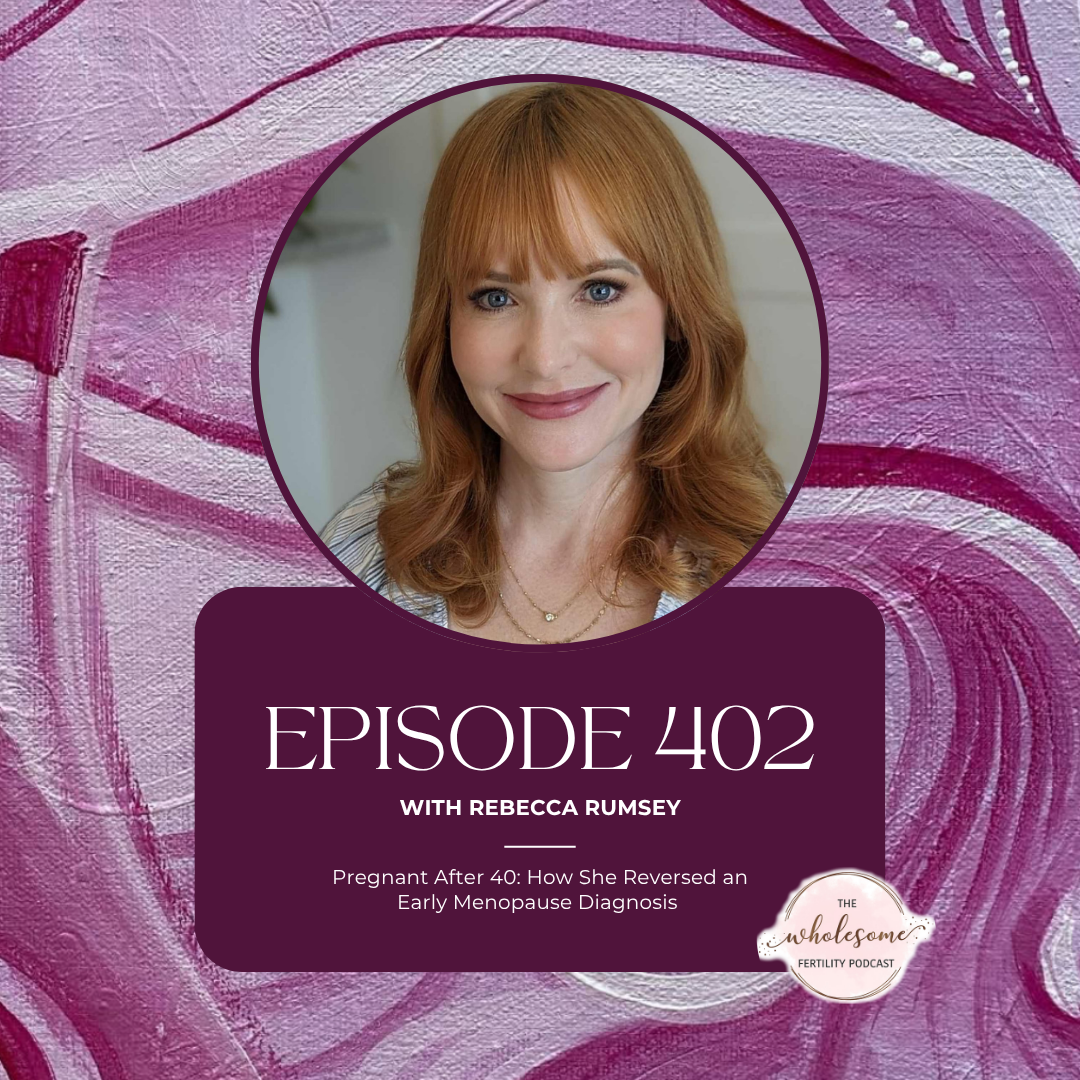
At 41, Rebecca Rumsey was told a concussion had pushed her into early menopause. Her cycle disappeared, her FSH climbed, and her hormones went quiet. Instead of accepting that her chance to become a mother was over, she spent a full year rebuilding her health from the foundation up, and went on to conceive both of her sons naturally in her mid 40s.
In this conversation, Rebecca and Michelle talk about why fertility has far more to do with your biology than the number on paper. They get into the real, practical shifts that made the difference, like adding nourishing animal foods back into her diet, supporting her nervous system, protecting her sleep, and paying attention to light and circadian rhythm. They also explore the parts of this journey that rarely get talked about, including the pressure that builds around the fertile window, the loneliness so many women carry, and the quiet confidence it takes to trust your own knowing when the world keeps pointing to your age.
If you have been told your numbers are too low or your window has closed, this is a grounded, hopeful reminder that your body is not broken, and that you have more influence over your fertility than you have been led to believe.
Key Takeaways:
Your biological age matters more than your chronological age. Fertility responds to how you care for your body, not simply the year you were born.
AMH is not the whole story. It fluctuates often and, outside of IVF, says little about your ability to conceive. Cervical mucus, cycle quality, estrogen, and progesterone tell you far more.
Hormones are built from cholesterol and healthy fats. For many women, adding nourishing animal foods like eggs, grass fed butter or ghee, and quality meat supports hormone production in a way a depleted diet cannot.
Nervous system regulation is the front door. Doing less can feel uncomfortable when you are used to pushing, but calming the stress response is often what allows the body to shift.
Light and circadian rhythm influence fertility. Morning sunlight, dimmer evenings, and less blue light at night help lower cortisol, which otherwise suppresses the sex hormones.
Sleep is foundational. It supports hormonal health, gut health, mood, and the body's ability to repair and regenerate.
Five minutes of meditation a day is enough to begin. The discomfort of sitting still is part of the work, and the brain starts to shift within about a week.
Joy and community are real fertility factors. Connection eases isolation and is linked to better outcomes, something research on group support has shown.
Confidence and self trust change everything. Living in your truth and releasing the fear of judgment are part of the healing, not separate from it.
Guest Bio:
Rebecca Rumsey is a holistic fertility expert helping women over 40 navigate complex fertility challenges using a science based, holistic approach. After being told she was in early menopause at 41, she went on to naturally conceive and have two children at 44 and 46. She now guides women worldwide in optimizing their health and improving their chances of pregnancy, often after being told it was not possible.
Connect with Rebecca:
Website: https://www.rebeccarumsey.com/
Instagram: https://www.instagram.com/fertileafter40/
Disclaimer: The information shared on this podcast is for educational and informational purposes only and is not intended as medical advice. Please consult with your healthcare provider before making any changes to your health or fertility care.
Ready to discover what your body needs most on your fertility journey?
Take the personalized quiz inside The Wholesome Fertility Journey and get tailored resources to meet you exactly where you are:
https://www.michelleoravitz.com/the-wholesome-fertility-journey
For more about my work and offerings, visit: www.michelleoravitz.com
Curious about ancient wisdom for fertility? Grab my book The Way of Fertility:
https://www.michelleoravitz.com/thewayoffertility
Join the Wholesome Fertility Facebook Group for free resources & community support:
https://www.facebook.com/groups/2149554308396504/
Connect with me on social:
Instagram: @thewholesomelotusfertility
Facebook: The Wholesome Lotus
-
[00:00:00]
Michelle: Welcome to the podcast, Rebecca. I'm so happy to have you
Rebecca: Thank you so much for having me. I'm grateful to be here
Michelle: So the first time I met you, you were on my recent summit, and I had such a great time talking to you. I think your story is so inspiring, and actually, as a matter of fact, some of the people which include my patients were, like, really happy I had women like you, over 40, pregnant or a pregnancy after 40 that actually had had that in their life and were such great examples because I think it gives so many people so much inspiration.
It totally shifts the paradigm, and I'm so excited to really get started in our conversation about that. But I'd love for you to share your background for people who are hearing about you for the first time.
Rebecca: Yeah. So when I was 41, I had a concussion that I was told led to early menopause. So I lost my cycle, my [00:01:00] FSH was extremely high, and all my hormones just went totally quiet. So I spent a year doing deep holistic work to restore my health and fertility, and I got my cycle back and my hormones to a really amazing place, and I was able to conceive my boys at 43 and 46.
And that's really what drives my work today, is helping women understand that fertility is so much more about our our health than it is our chronological age, and that we have so much more control over it than we've been led to believe.
Michelle: Well, we were just talking in the pre-talk, you look a lot younger than your age, and I think that it really comes down to biological age. age really is just a number. yes, there's definitely things that happen around certain times of our lives on average, but we're really not statistics, and you can preserveyour youth.
You can really preserve it, cellularly. And I remember when we last spoke, we had such great conversations, and what I loved about our conversation is, first of all, there's more to you than [00:02:00] just, somebody who conceived later in life. You also knew a lot about your health and nutrition, and you did a lot of amazing things.
And I think that you also focused on things that are missed a lot like circadian rhythm, lights. so I thought that was just so empowering, like a lot of what you shared in the summit. so I'd love for you to kinda talk about that aspect of your background and that... and how that really impacted how you were able to help yourself because I think so many people are feeling so lost, especially if they don't have a health background, and then thinking that they can't really do much.
I love the fact that you did, also I don't love the fact that you had challenges, but it is really nice that you came from having challenges to getting yourself to beyond, I guess, like even way above what, what's expected at your age at the time.
Rebecca: Yeah. So I actually had big challenges at two different points in my life. when I was in my early mid-30s, I also lost my cycle then [00:03:00] too. and I'm prone to health conditions, so I'm someone who really has to take care of my health. so back at that point in my mid-30s, I had been a vegetarian for, maybe 20 years at that point.
so I had to add animal foods back into my diet. Excuse me. and that was really the only way that I was able to get my cycle back. I tried to avoid that. I was very, passionate about being a vegetarian at the time. so I tried everything I could to not have to do that, and ultimately that is what I had to do and to get my cycle back.
in my 40s, when I was then ready to become a mom, I spent an entire year preparing my body. So I started with detoxing my home, and I did like a really deep dive detoxification. I went through everything from I even replaced my couch. I put a organic pad on top of my mattress. I bought, two air purifiers.
I bought new, I have very basic skincare, so I just use, oils on like, you know, jojoba oil and rosehip seed oil on my skin. I swapped out my shampoo for natural shampoo. I stopped doing my nails. [00:04:00] I stopped coloring my hair. I later found non-toxic versions of things for those, but at the time I, I really went all in, because for me, just becoming a mom was non-negotiable.
Like, I wanted to make sure I did everything I could. I ate more. So, I had been in the fitness world, a nutritionist for a long time, and was on the leaner side, so I gained like 10 to 15 pounds. I stopped exercising so intensely. I started really supporting my nervous system. So I'm not someone who naturally likes to meditate and do yoga, so I really...
but I am someone who loves manifesting, so I love visualization and deep breathing and really focusing on belly breaths. so I really doubled down on those things. And I did actually start incorporating some meditation into my life. I did, you know, like five minutes a day of meditating, and just really becoming more aware of the stress, you know, when I'm starting to feel like you know, chest breathing or thinking about, "Am I gonna be able to get pregnant?"
Or, you know, all those scary thoughts that most women have when you're trying to conceive in your 40s. becoming [00:05:00] really aware of the tape in my head and then, you know, replaying that tape with something more positive. I'm putting the power back in my hands. I'm taking care of my health.
I will become a mom. And once I really told myself, "I'm gonna become a mom. No matter what, I'm gonna become a mom," that really took a lot of the pressure off for me and I think kinda let me breathe, because I had so much, I think, you know, I had to do it naturally, and ultimately I was able to do it naturally, but it doesn't have to be that way.
There are other ways of becoming a mother that for me felt very empowering to really acknowledge that and accept that. so yeah, then the nutrition, I, like I said, I ate more. So I ate a lot, I ate a lot of things like ground beef, eggs, butter. You know, our hormones need cholesterol, so I really ate a lot of cholesterol-rich, healthy sources of cholesterol.
So your grass-fed butter. I ate like three to four eggs a day. I ate grass-fed meat. then things like avocado and tons of vegetables and berries, and really just every single aspect of all the things that I, I teach online, I did for an [00:06:00] entire year, and then I was able to conceive, my first baby on the first try
Michelle: Amazing. okay, so, I've been doing this for a while, and I can just imagine in my head people are asking, was your AMH low? Like, 'cause a lot of people are very focused on
Rebecca: Yeah, so it, it was low, prior to doing all these things. , When I had the concussion, my FSH went super high and my AMH went high. by the time I did-- I'm sorry, my AMH was low. By the time I did all these things, I tested my AMH and it was like 1.2, so it was actually quite good at that point.
I don't pay too much attention to AMH, as I'm sure you know, it fluctuates a ton. I don't think it's that important of a marker unless you're doing IVF. So I wasn't so fixated on my AMH. it was more about, you know, the quality of my cervical mucus and my cycle and my estrogen and my progesterone.
Those were kind of the, the numbers I was focusing on more, and all those looked good. Yeah.
Michelle: Yeah, because I think that a lot of people do get hyper-focused and, and it's not, uh, obviously it's something, not something that's coming from them. It's coming [00:07:00] from really reacting to what the doctors are focused on, and usually the doctors are focused on that because, those doctors are people who do IVF
Rebecca: Exactly. They only know that one number is like for them. FSH and AMH are like the two numbers they really focus on.
Michelle: Yeah. And so, so I think that that's important to realize that I've seen people get pregnant naturally with beyond small numbers. And so that's kind of like what I want to, uh, get out there because I think that people get so worried that if it's really, really low that they can't conceive.
But you had mentioned really important things because, you know, the diet, everything that you're doing really works on the quality over the quantity,
Rebecca: Absolutely.
Michelle: and it matters to have that
Rebecca: Yeah. I mean, AMH, it really doesn't matter. People with 0.003 are still getting pregnant, you know? And the studies show that it, it's really pretty inconsequential, unless you're doing IVF, of course. So yeah, people can stop focusing on the AMH. I really-- With my clients, I barely [00:08:00] even look at AMH.
I really don't even care about it.
Michelle: Yeah. Yeah, which is why I wanted to mention that, because I think that so many people, like whenever I'll get emails, that number always comes into the conversation. And of course, you know, there's even been studies that show that, high FSH, low AMH doesn't really impact the fact that people can get pregnant.
So
Rebecca: Naturally. Yeah.
Michelle: correct. Yeah, naturally. And then also I found it really interesting that you were talking about eating animal protein. I find the same,, challenge and it's difficult, especially if it's something that is like so belief driven and people are really feeling like empathy for animals. And so it is very hard for people to overcome that.
however, the reality is it really does make a difference on your hormones,
Rebecca: Yes, absolutely. That's what it is for me. I really, I just have a hard time with the concept of [00:09:00] eating animal products. In my 30s when I, when I dealt with that, my mom at one point said to me, "It's you or the animals." 'Cause I was, I was a mess. I wasn't able to work. I had no energy. I was, just really suffering.
And I was like, "I'm not-- I can find a way. I can do this." And she was like, "It's you or the animals. You gotta make a decision." And so within, I would say, two weeks of eating animal products, I came back to life. It was like a miracle
Michelle: Yeah. It literally is. , And it's crazy 'cause I have a friend who's a vegan. Oh, now she's vegetarian. Now she's eating eggs. She wasn't
even eating eggs, so it got even, like, really, She was very depleted. But then she has dogs, and I was like, "Well, what do you feed your dogs?" I'm like, I, I hate to say it, but it's,
Rebecca: Yeah.
Michelle: can't survive on a vegan diet, and they usually are not fed a vegan diet.
Rebecca: Yes
Michelle: but, you know, I could laugh with her because she's one of my best friends, and it was fine. But, in some aspects we really do need some, at least some animal protein. Like, even if y- you're a vegetarian, you're having [00:10:00] eggs, just something
Rebecca: Yes. As long-- Eggs and fish I can do a lot with. Like, we can do so much with your health with just having those two things. And butter. I actually, butter is like a fertility superfood
Michelle: It really is. Ghee especially,
Rebecca: and Ghi's amazing. Yeah
Michelle: Yeah
and it really does, um, there's a lot of nutrients that cannot get absorbed into the body without it. And like you said, there's a lot of hormones that can't be repr- produced without the fats
Rebecca: Yep
Michelle: Yeah, very important. And then you were talking about meditation.
Another thing that I liked, that you said was that you didn't like meditation, but you actually did in fact start meditating, which I love that you're saying these things because I just feel like it's going to inspire people listening. I can't tell you how many times I hear people, many times it's my patients that I work with for many, like, year- sometimes over a year, and they say they don't really like meditation.
"It's not for me." And then of course I convince them that it's for everybody. And eventually I get in there [00:11:00] after I pester them enough to at least try five minutes a day. And eventually... 'Cause what people don't realize, and this, the science backs this up, like, is the f- the aspect of meditation, like the phase of meditation that you're resistant, that you don't like, that's uncomfortable, is actually very productive.
It's a productive part of meditation, and it's a very necessary clearing that happens. So it's really you learning how to sit with something that's uncomfortable. And when you do that and you realize you survive, that actually opens up, another level of consciousness. And it also trains your mind to not be as reactive to life circumstances when that does arise, which of course supports your nervous system because then you're more steady in the face of challenges.
'Cause it's not about removing the challenges or the stress, it's about our ability to adapt. When we're able to adapt, [00:12:00] then our bodies don't get hit by the impacts of stress as much
Rebecca: Yeah, absolutely. And I think too, telling people just five minutes, and that's what I told myself. And you can do anything for five minutes, you know? and then it's becomes more enjoyable once you do it long enough. You're like, "Oh, that's actually kind of nice." And I was doing-- I really, I tried many different apps and I actually really liked, Calm.
I think it was Calm or maybe it was Headspace. I can't remember which one I actually liked the most. But there was a man's voice that I, I became to like, "Oh," I looked forward to then hearing his voice, and I would do 10 minutes and sometimes 15 minutes. But, for me, just as long as I did five at least once a day, we were good
Michelle: Yeah. And the studies show that five minutes a day, only just five minutes a day actually does make an, a significant impact on your brainwaves. Like, they really do see a difference within a week. So it's such a short... It's amazing how the body thirsts for it, that even if you give it a little bit, it'll start to make the transformation.
[00:13:00] I think that's incredible. Yeah, for sure. And then, you had also talked last time about light,
Rebecca: Oh, yes. I didn't mention that. Yes.
Michelle: really important because I think that's a newer thing that people are discovering, and our reproductive system really responds to light in such a huge way.
It's almost like, a way for it to be triggered
Rebecca: Yes. Well, anytime, in our 40s, our cortisol increases naturally. And so, and things like blue light also increase our cortisol. And when our cortisol is up, our sex hormones get suppressed. So it's so important to just bring down, you know, calm the nervous system, bring down the cortisol.
And so I became really, all lights in my house was very, very dark. I- we had some red lights. I had, you know, the salt lamp. I don't know if you know, the little salt lamps. I had a couple of those, and then I put red light bulbs, in like one in the living room and one in the bedroom, and then two salt lamps, and that was all the light we got.
Even the refrigerator light, I even turned that off 'cause if you had to open the fridge, I didn't want that bright light. And [00:14:00] then I-- well, I always do this, but I have my phones and my computer on the, the amber light. , And then of course just trying not to use those in the evening once the sun is down, which I know is not always possible , for most of us.
But as much as you can, you know, just avoiding the computer and the, , and your cell phone. And yeah, and just, and doing... I actually use a Kindle, the Paperwhite Kindle, not the one with the blue light, but , it's the non-blue light Kindle. And just going back to the basics, reading before bed, not looking at your phone, being in darkness.
It's very powerful
Michelle: It is powerful and it also improves the quality of sleep and the depth of your sleep, which improves so much. It's so regenerative for your body
Rebecca: Yeah, so foundational for our hormonal health, our mental health, every- our sleep, every- sleep is everything. It's number one, really
Michelle: Yeah, and it actually impacts gut health
Rebecca: Yes, it impacts everything
Michelle: Yeah, it really
Rebecca: sleep is king. I say gut health is king, but actually probably sleep is king
Michelle: Oh yeah. No, sleep is everything. And also, waking up and getting sunlight [00:15:00] too, and that's where, that's the one time we actually like cortisol.
Rebecca: Yes. Yes. So first thing in the morning, going outside, even if it's just, you know, five to 10 minutes, getting that sunlight within the first hour of waking is so important to reset your circadian rhythm
Michelle: And what were some of the things that you, think were really impactful? 'Cause I know you did a lot of things, but what were some of the things that you really found like this is something that I can't do without
Rebecca: I don't know. That's so hard to say because, yeah, I feel like everything works together and it's really, you know, I tell people make simple shifts, you know, start small and then they can kind of grow. But I feel like it all works together. So it's like you can't remove the nutrition piece, you can't m- remove the nervous system piece.
It all needs to be together. Yeah, I just think it's all so important. I can't pick
Michelle: Yeah, no, it's true. It's true. As I was asking you the question, I'm like, wait, there's something... Because sometimes it is, I feel like the stress piece or the mindset
Rebecca: that's true. Okay, that's one
Michelle: in the sense, the reason why I say that is, because without that, you can't think as [00:16:00] clearly or you can't get in tune with your body sensations when you're eating and, like, your body's telling you something's not...
I don't know. That's just, yeah.
Rebecca: You're absolutely right, and I can tell you a, a very too personal story about that. I was so stressed out before I started really kinda letting go and accepting the fact that I was gonna be a mom no matter what, and really digging into the nervous system part of it. Prior to that, I was so stressed out that we couldn't even have sex.
We would miss our fertile window because I was, like, so stressed. I would be crying. I was just like, yeah, I was so stressed. And you saw-- It took letting go, calming my nervous system for me to even be able to try to have the baby. So once I got past that, then yeah, we were able to conceive right away.
So that was-- You're right. That is the most important piece,
Michelle: It's kind of like this thing, it's, it's sort of like this, the entrance. It's like that front door.
Rebecca: Yes.
Michelle: course you have to open the door and go into
Rebecca: Yes.
Michelle: know, get all the things, but I'm like, if you don't... 'Cause I've seen, I've seen people skip that door and [00:17:00] come to me and they're like, "I'm doing everything and I, you know, I can't, nothing's working."
And then you can see their shoulders are up and, you know, of course from a Chinese medicine perspective, liver chi is really, like, stagnated and so many things going on, and we do a lot of, nervous system work. But yeah, that aspect of it, of really tuning in and listening to yourself, and in a sense having that self-compassion, like, I deserve to feel peace, I deserve to feel good, that's at the foundation.
So maybe that was kind of, like, the thought that I had in my mind. But yes, absolutely everything matters. It really all does. 'Cause actually, as a matter of fact, if your gut health is out of whack, it doesn't matter. I mean, I guess meditation can impact your gut, but it impacts also how you feel mentally.
Rebecca: Yes. Yeah,
Michelle: So it's kind of like-
Rebecca: everything. I find that, you know, for a lot of my clients and myself included, it, it is the hardest part to do, the nervous system work because you feel like, "Oh, I'm taking a break." You always wanna be doing, doing, [00:18:00] doing. But this is like actually doing less.
So I think it can be the most challenging piece and the most often overlooked piece as well.
Michelle: Yeah, and I think it's definitely a shift in perspective for sure because we're so conditioned
so what happens is too, with the nervous system, is that it kind of works behind the scenes. It's not something that we can really tangibly, like, measure, and we're so conditioned to go after it. I worked in New York City in the corporate world before I went into the healthcare business, and, completely was, you know, rewarded for staying up.
Actually, there was a time we had a project, I stayed up till 1:00 in the office in New York, and
I still had to take a train home. I was like, it was a one-time thing, but you know, there were times where things were really late, and you felt rewarded. You were like a rock star, part of the team, you know? Like doing all this stuff and like getting no sleep, and that's cool.
Rebecca: It's true. That is the mindset in the United States particularly, and probably all North America and [00:19:00] Canada too, is that mindset of we have to work, work, work, go, go, go, don't stop. You know, I live in Spain now, and one of the things I love about this country is the, people, I always say that they're, they're here to live.
Like, they're not here to do like we are in America. We're do, do, do. They're-- People are here to actually live and enjoy life and be slow and just sit around at a cafe for a few hours with their friends and family and, you know, just living life and enjoying life. It's such a huge shift, and I'm, I'm very much an American in that I'm go, go, go, do, do, do, and that's why it's really important for me to be someplace like here to...
So beautiful reminder, I am here to live. My life is to be living and not doing
Michelle: Yeah, I guess in some senses, I mean, Florida , is a little different than the rest of the United
Rebecca: Yeah.
Michelle: in the sense that it has so many different cultures, and there is a little bit more of that kind of Mediterranean culture aspect of like the, you know, Spanish and... I mean, it's Latin, but Latin comes from the Mediterranean.
You know, they're [00:20:00] coming from Spain a lot, and so it influenced that aspect, I guess, into the culture,
Rebecca: Wonderful
Michelle: is really nice. And it took a little time to get used to, to be honest with you, like to learn how to slow down the pace, and I'm still working on my patience driving, like I'll be honest. but yeah, it really does, , it takes time to get attuned to it, and I think one of the biggest things about nervous system regulation is getting attuned to your body's communication because the moment you start to really get in tune with your senses, your, your present moment, you know, just really what your body's communicating with you, that's when you start to increase that connection.
It really is kind of like this, line of communication that can often get lost over
Rebecca: Yeah, you're just ignoring it. Just bypass, bypass, keep going, keep going. And I hear that from clients even, you know, in their intake form, it's like, "How do you deal with stress?" And an [00:21:00] answer is often, "Keep going. Keep pushing," you know?
Michelle: So my other question for you, and I don't know that we actually talked about this, we may have at the summit, but Did you have, during this time, when you were saying that you felt, like, such a drive to go and get pregnant, and you just knew some- there was a knowing in your heart that led you to the boys.
Rebecca: Yes
Michelle: That to me, just in my experience, is real. Like, I really think that there is a communication or, like, connection with a spirit baby. There's something that happens. I know, depending on people's backgrounds, you know, they may not believe in that or, everybody has a different perspective.
But I really do personally believe that there is a calling that you get, and it's not random. It's not just you waking up one day deciding, "I wanna be a mom." I think that there's something else that's calling you to do that, to fill that role. Did you have that, and how did that come about if you did?
Rebecca: Well, [00:22:00] so first of all, when I turned 40, we had like a family party, and we went to Palm Springs and rented this house, and my sister-in-law, who's 12 years older than me, was like, "So are you ever gonna have kids?" I didn't have a boyfriend or anything at the time. And I was like, "Yes." And she's like, "You're 40 now."
I'm like, "Don't worry, I'm gonna have kids." And I just knew, like, I'm going to have children. I met my husband like the next week. And then, you know, we had some setbacks, then I had the concussion. I had to spend a whole year healing from that. But I just knew, like, this is non-negotiable. I am going to be a mother.
But I really thought I was gonna have a daughter. I really was convinced that there would be a girl in there. I don't think I wanna try to have another child. I think we're good with two.
Michelle: But you know what? It could be the, you know, the daughter-in-law
Rebecca: Yeah, it could-- That's what I think, too. It could be a daughter-in-law or a grandbaby or whatever it is.
I know there's more girls in my future. Right now I'm surrounded by boys. But yeah, , I feel like, you know, they've always been with me, and I, when my kids look at my pictures of, you know, way before I had them, like, "Oh, was I in your belly then?" Like, "Yes, you were in my belly," 'cause they were in my belly.
They've always been there. They've always been with me. And it is such a beautiful [00:23:00] thought that you know, you've had them your whole life.
Michelle: That's true. It is amazing. It's really amazing to think about, like the eggs are just there, and then actually the mom, your mom carried
Rebecca: Yes. It's, it's incredible. It's so cool
Michelle: So, yeah, I think that that is a really important aspect of it. It's just that kind of like, that knowing. And to, I guess, have the confidence.
I think that it takes a lot of courage to stand on that knowing, like in the face of people being like, "Well, you're 40. Like how could... You're not even w-" You know what I mean? Like, so it's amazing that you had that bel- that you kinda stood strong with that belief despite sort of the, the numbers or the in- you know, information or the data
Rebecca: Yes. I think if there's one thing I could inject into my clients, into all women trying to have babies, it's confidence. Because so often they get, I've had clients who are scared to even tell their doctors that they're trying to conceive because they don't want their doctor to think, you know, something bad about them.
Which to me is like, it's so heartbreaking. You know, if [00:24:00] we're-- I feel like it's so important to live in our truth, to be who we are, express it openly, and not have the fear of what other people think. And if people have judgments, that's their problem. You know, that's, that's not our problem, that's their problem.
We are who we are. We're all different. We all have different timelines, different stories, and we're not here to judge other people's stories and timelines. So just that confidence and living your life as it feels best to you is how you should be living your life and letting go of all the judgments.
'Cause yeah, I, I don't care about the judgments. For me, I am now like thinking, "Wow, I'm 50 with a five-year-old and a three-year-old. That's amazing. Wow." I'm sure lots of people have judgments about that. You know, no one, you know, well, people, of course, internet trolls like to tell me things, but, people I'm close to don't say anything.
But even if they did, that's their thing. You know, that's not, that's not my thing to worry about.
Michelle: Yeah. I think that whenever you, hit those boundaries of reality for other people, it's weird. But even if it's a good reality or a [00:25:00] good boundary that you're shifting, even if it's a g- a good thing, people get very protective of their reality, and people don't like change. And it's interesting how you see that.
You see that a lot just with the dogma of even medicine, just, like, everything that happens, anybody who comes in, even if they have... I follow Joe Dispenza, that's like we were talking about, the male, meditation, the male voice. I, as soon as I hear his voice, I'm like, he's already got me.
I'm so, like, programmed. But so I, I do a lot of his meditations and a lot of what he does, he's got backing, he's got proof, and people still don't like it. It's interesting
Rebecca: It is very interesting. You're absolutely right. People, a lot of people don't wanna see outside of their, of their norm
Michelle: Yeah. I love that. I love that you're, you're shattering the norms. I love that. That's what I, I actually love to bring people onto the podcast that are shifting the [00:26:00] norms to more expansive, better ways of living and are also just, going out... Because I do think that we're moving into this kind of, longevity time.
I think, you know, science is kind of making itself available in that sense. Things are being discovered to show us how to make ourselves younger, and I think that that is going to shift and impact also fertility into older years. And I see... I think that that's where we're headed. I think that the sooner collectively we could just allow that shift to happen by accepting it to be a reality, the, the faster it's gonna be
Rebecca: Yeah, the world is changing very quickly. You know, I get a lot of comments when I have troll-type comments. People say, "Oh, you're gonna be 60 when your kid's whatever age, and 70." And I'm like, "You know, my mom turns 84 tomorrow actually, and she comes to visit us in Spain all the time. She helps with the kids.
She's so vibrant and healthy." And I'm like, "Well, 60's young. My mom's 84 and she's super [00:27:00] healthy." Like I'm not-- You know, I know nothing is guaranteed. We have-- There are no guarantees for sure. But, you know, my mom doesn't do anything advanced. She just does the very basic, you know, nutrition, exercise, good, nice mindset, prioritizes joy.
and she's a super vibrant woman.
Michelle: Prioritizing joy to me is like everything.
Rebecca: Yeah, and it, she has a very, very positive mindset, and she's had positive attitude, and she, she doesn't really pay attention to the negative comments. She just focuses on the positive, always thinks she can do it, and I feel like that's everything. Like, you're right.
That's like, it's a, it's a youthfulness. It keeps you young, I think.
Michelle: I think also community.
Rebecca: In community, yes. Oh, absolutely. Yes.
Michelle: is something that they have down way more than we do here in, you know, the US. There's a lot of isolation and, and so a lot of these European countries, they sit out late. They don't, they don't f- just finish food and leave.
They just sit and talk and, uh, they sit there for hours. I remember when I went to [00:28:00] Spain, it's j- you could sit there for three hours having dinner, and it's just like, uh, nobody asks you to leave.
Rebecca: No, not at all.
No.
Michelle: around. It's expected.
Rebecca: You're not allowed to use your computer though at a lot of these restaurants, which I think is really cool. You're not allowed, or at coffee shops, no computers. Um, yeah, it's like
Michelle: communicate with other
Rebecca: Yeah, exactly. Exactly. But yeah, you go to the bars here, which I think we've done twice, um, in the year that we've lived here, and there, there are as many people who are over the age of 50 and 60 as there are people who are in their 30s.
It's very much like you see people in their 70s, you know, just hang-- And it could be, you know, 1:00 in the morning, and the bar is half, half the people are like 55 to 80, and the other half are like 30, 40, maybe some 20s in there. But it, the age is viewed so differently here. It's not like, you know, when you're old, you have to stay home, be quiet.
You know? You keep living life[00:29:00]
Michelle: I love that. I know because I had a friend of mine who was from Spain. He was actually my, my healer massage therapist. I loved the, the wonderful, wonderful guy. And he, um, and he moved back to Spain, and he... I remember him mentioning when he was here that he was very lonely. He, he'd be very lonely, and, like, it was just not the same because he'd wanna, like, get together with friends, and it wasn't, it wasn't the same.
Everybody's busy all the time. And there, he felt like it was just a, a huge community, his family, like, all the people in the, you know, the community that he grew up in, and then friends that he had. It was just so easy to get together with people
Rebecca: It's so easy. Like, I go into my weekend having no plans. Like in America, you have your plans like, you know, six weeks in advance, I feel like, when you have kids. I would have no plans and I, by the, by Sunday night, like, "Wow, we did so much. We saw so many friends. We went to the beach. We went to this. We had a picnic.
We went out to this restaurant." Like, we did so many things going into the weekend with zero [00:30:00] plans. It's like you just, people just get together and it's just not, it's not so much of a thing. It's just kind of expected
Michelle: Yeah, and I do think that that impacts fertility really to make it full circle, because there was a study that talked about community, kind of like group therapy sessions or people coming together and connecting and supporting one another and doing better and having better outcomes. I believe it was, uh, linked with, um, Ali Domar, Dr.
Ali M- Domar, I believe. Th- um, they did one study on, like, group therapy.
Rebecca: Oh, yes, I do remember that study.
Michelle: y- yeah, it's incredible. And I think that, like, really the, it's the community that we need, and I think that a lot of, um, a lot of people on this journey really have that connection. So I think that's another kinda silent one that doesn't get as much attention
Rebecca: Yeah. And a, and a lot of time people are kind of in isolation on this journey that, you know, they don't wanna talk about it and they feel uncomfortable, so they're even that much more isolated and, and lonely in [00:31:00] their heads.
Michelle: Yeah. Especially even if it is that they're, you know, friends are getting pregnant, they're not,
and they don't wanna go to events. They feel, like, out of place or uncomfortable, and then it, it really becomes so isolating. It, it could be really difficult, but I've seen with group, connections, memberships, like when people come together and they start talking to each other, and I'm sitting there sort of like, "You know, any questions you guys have?"
And I love the fact that the... Like, I'm just there, and they're connecting with each other, and they're lighting up just talking to each other and having the connections, and I'm like, "This is beautiful. This is what people need. They need to know I'm not alone, and like somebody else is going through the same thing as me."
And then sometimes even, like, giving each other tips on how they manage the difficulties and yeah, so that's another... Yeah
Rebecca: Yeah, and it all goes back to joy. It's part of the, the joy thing we were talking about earlier. Yeah, exactly
Michelle: and so, uh, that's actually, in Chinese medicine, you know, the heart [00:32:00] has a, plays a really important role on conception. But, um, heart-brain coherence and heart math now it's kind of like coming to, learn that there really is something connecting the heart and the brain, and that that can impact also, how we deal with stress and our nervous systems and it's, it's pretty wild.
Rebecca: It is. It's so powerful
Michelle: Awesome. So how do you work with people if people are interested in wanting to work with you?
Rebecca: so I have the master class, where I have an online community as well, and I'm in there answering questions, and giving people guidance. I also, work one-on-one with clients. , Yeah, that's, yeah, the two main ways.
Michelle: So worldwide.
Rebecca: Yes. Yeah,
Michelle: with the, with technology these
Rebecca: Yeah.
Michelle: yeah, that's the good thing about technology.
Rebecca: Yeah, it's amazing. It's so cool to see people from all these different countries and, you know, learn about their cultures. It's, it's... I, I love that part of it.
Michelle: And you guys, she has a great Instagram. I follow her. [00:33:00] I love your content
Rebecca: Oh, thank
Michelle: that you
create. I think it's incredibly inspiring. It's just, you're such a great, uh, example of what could be in, in such a vibrant way and, um, I really, I really love the information you're putting out there and really what you're contributing to the community
Rebecca: I appreciate it. Thank you
Michelle: Awesome.
So if people would like to reach out to you, how can they find you?
Rebecca: On my website at rebeccarumsey.com and then @fertileafter40 is my Instagram
Michelle: Awesome. Perfect. Well, thank you so much, Rebecca. It's always a pleasure talking to you
Rebecca: nice talking to you.