
Ep 406: Nourishing Fertility: Food, Digestion, and the Middle Ground
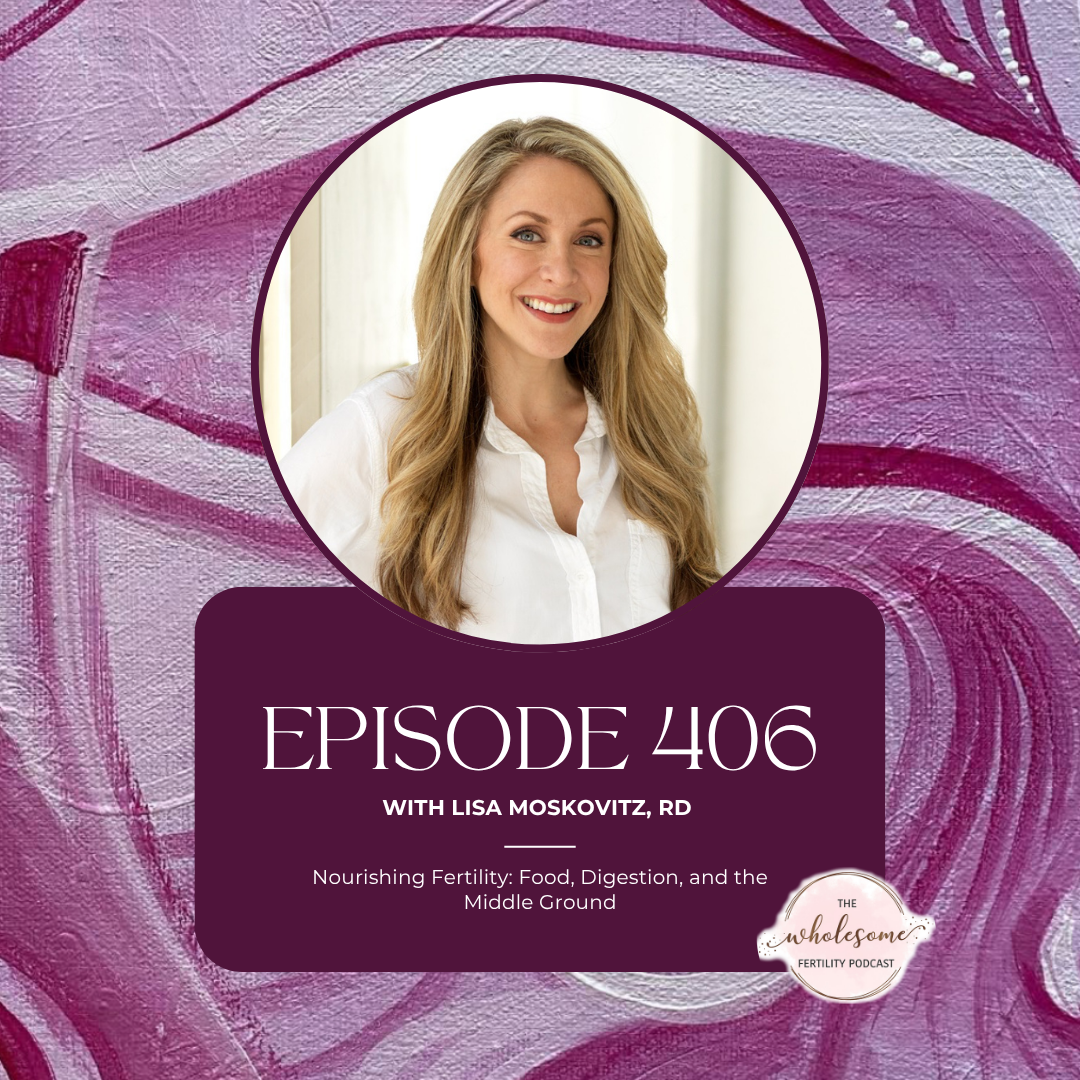
When you are trying to conceive, few topics feel more overwhelming, or more contradictory, than nutrition. In this episode, Michelle sits down with registered dietitian Lisa Moskovitz, founder of The NY Nutrition Group and author of The Core 3 Healthy Eating Plan, for a grounded and refreshingly realistic conversation about how food actually supports fertility.
Lisa shares her own path to motherhood, which included irregular cycles, PCOS-like symptoms, pregnancy loss, and eventually three children through a mix of IUI, IVF, and natural conception. Drawing on that lived experience and years of clinical work, she offers a nuanced look at what truly moves the needle. Together they talk about why being too restrictive can work against fertility, the research behind Mediterranean-style eating and full-fat dairy, the nutrients that support egg quality, how digestion determines whether your body can even use the food you eat, and why meal timing and your circadian rhythm matter more than most people realize. This is a conversation about doing less of the wrong things, meeting your body where it is, and finding a middle ground you can actually live with.
Key Takeaways:
• Nutrition genuinely supports fertility, but the aim is nourishment and balance, not perfection or control.
• Extremes on either end backfire. Being too restrictive, too underweight, or over-exercising can disrupt hormones as much as the opposite.
• Mediterranean-style eating with full-fat dairy has the strongest research behind it for fertility and hormone health.
• Digestion matters as much as the food. A food is only as healthy as your body can absorb it, so bloating and GI issues are worth addressing.
• Simple foundations move the needle most: a few fertility-friendly foods (avocado, whole eggs, lentils, wild salmon, leafy greens), a twelve-hour overnight window instead of aggressive fasting, and a prenatal started a few months before conceiving.
Guest Bio:
Lisa Moskovitz, RD, is the founder of The NY Nutrition Group, a large group nutrition practice in NYC, and the author of The Core 3 Healthy Eating Plan, a guide to finding your healthiest, happiest weight. As an experienced dietitian based in Manhattan, Lisa has first-hand insight into what people struggle with the most and what moves the needle. She has a no-nonsense, evidence-based, and realistic approach to nutrition that sets her apart from the average influencer. Lisa also speaks from personal experience, having navigated her own fertility journey through irregular cycles, pregnancy loss, and ultimately three children.
Disclaimer: The information shared on this podcast is for educational and informational purposes only and is not intended as medical advice. Please consult with your healthcare provider before making any changes to your health or fertility care.
Ready to discover what your body needs most on your fertility journey?
Take the personalized quiz inside The Wholesome Fertility Journey and get tailored resources to meet you exactly where you are:
https://www.michelleoravitz.com/the-wholesome-fertility-journey
For more about my work and offerings, visit: www.michelleoravitz.com
Curious about ancient wisdom for fertility? Grab my book The Way of Fertility:https://www.michelleoravitz.com/thewayoffertility
Join the Wholesome Fertility Facebook Group for free resources & community support:https://www.facebook.com/groups/2149554308396504/
Connect with me on social:
Instagram: @thewholesomelotusfertility
Facebook: The Wholesome Lotus
-
# TWF: EP 406 Lisa Moskovitz
[00:00:00] [00:01:00]
Michelle: Welcome to the podcast, Lisa. So happy to have you[00:02:00]
Lisa: Thank you for having me. I'm excited to be here. This is one of my favorite topics, so looking forward to it
Michelle: Amazing. I'm excited to pick your brain, but before I do, I always like to start with an origin story so people, uh, listening can get to know you and how you got into the work that you're doing.
Lisa: Oh, for sure. I could say, you know, I love sharing this story because when I was dealing with my own difficulties, it was so helpful and healing and comforting to hear other people going through something similar. But I for sure had my own journey with it when I was thinking about starting my family.
We had some ups and downs. I was on birth control pill for a very long period of time, as a lot of women are. And when I-- we got married, I married my husband in 2016, we-- I immediately wanted to jump into the family planning part because that is my personality, and I can't just, like we talked about before, be patient with anything.
So I was like, "That's it. We're gonna have kids. Let's do it." So, long [00:03:00] story short, that is not the way it happened at all. I ended up having very irregular cycles, definitely PM- MOS, at the time it was PCOS was thrown around, even though kind of inconclusive. I had some symptoms of it with the irregular cyc- cycles and the cystic ovaries.
And so, although again, when you get off birth control pill, you can definitely experience like a temporary PCOS or a temporary version, of just having cystic ovary. So, essentially, that's what kicked off my whole, you know, new mentality and approach and appreciation, right? It was a lot of highs and lows.
We-- It took us a little while, to, you know, eventually get to the place where I now have we n- I now have three kids. But I ended up doing an IUI with Clomid, so I ended up going to a fertility clinic and ended up going, doing an IUI with Clomid for my, for my twins, who are now [00:04:00] eight years old. and then we decided we were ready to have another one.
We weren't done quite yet. And this time around, I actually did get pregnant naturally, but that ended up in a miscarriage, and then I again ended up s- and then at that point, I was a little older, and I didn't wanna wait to kind of do the whole thing again. So we did another IUI, and that ended up in a miscarriage.
And so because of my, yep, because of my advanced maternal age, the doctor at the time just said, "Look, you could have another one because your egg, you know, we know egg quality starts to diminish after the age of 35," which is so young. But when it comes to fertility, scientifically it is not. We're considered geriatric pregnancies.
So,
Michelle: I hate that term.
Lisa: I hate that term. Like, can we just say mature? We could say
Michelle: Yes.
Lisa: could say, you know, advanced. So, so I ended up doing IVF for, for my third, and we, we did have great results. I did incorporate a lot of nutrition principles, [00:05:00] and I did Really focus on my diet, supplements, but also not driving myself crazy because I know how easy it is to do that.
And when we want something so bad, we do everything we can to make it happen. But what's the worst part of all of that is a lot of it is not in our control. And so really challenging, right? To know there's things you can do that could help, but at the end of the day, it's not a guarantee. And you can go through all of that Which is a lot emotionally, physically, financially, and we ju- you just don't know, right?
Like, it's the not knowing that was the hardest for me. Like, if someone just said, "If you do this and this, it's gonna be a lot on you, gonna go through all this stuff, but you're gonna have a baby," it's so much easier to go through it. When you don't have that guarantee, wow. Like it is, you know, every day is a s- it could be feel like a, a big [00:06:00] struggle.
I mean, you're just trying to d- I was just in a place of like constantly trying to distract myself. Like, I'm like, the busier I can stay and the more that I... Because if I sat down for too long and thought about it for too hard, it would just be too much, you know, mentally, again, emotionally and mentally.
so that was our journey. So we ended up doing IVF and, and, I know that not every, not everybody is, fortunate to say this, but it wor- you know, it worked for us. And I know not, not, it not doesn't always work for people, and some people get pregnant on their way to do IVF, or they get pregnant when they completely stop trying at all.
and so God has a crazy plan for all of us is what I learned at the end of the day. Like, just do what you can to keep yourself healthy and grounded and stable. And yes, nutrition matters, speaking as a dietician, but we cannot control, you know, the outcome is the reality. So, so I, I try to help my own clients find something in the middle, you know, of like, let's, again, do what we can.
If you're underweight, we [00:07:00] definitely wanna make sure you're eating enough. If you're a very active person as a female, that can work against you for fertility, so we wanna be careful of how much exercise you're doing. So the things that we are taught that are healthy for us with fertility can work against us.
So like, again, being too restrictive with eating, over-exercising, being slightly underweight, and not having enough body fat can all affect our sex hormones and affect our fertility.
yes, on the flip side, having a, you know, being in a larger body and being completely sedentary and eating, you know, very little fiber and protein and anti-inflammatory fat, also not good.
But we ch- we try to start with where you are and just find a little bit of a healthier, a healthier ground. So that's always like the first thing that I, I talk about with my patients is let's just start slowly with baby steps. Look at what you're doing, and then build on that, because nobody's going to have a perfect diet or be at a perfect number on the scale or BMI chart, which I think is BS for a lot of reasons anyway.
Um, or, you know, [00:08:00] maybe have perfect blood work all the time. So let's just start. We have to start, start somewhere.
Michelle: Yeah, absolutely. 100%. And I, I saw your reel, you talked about, which I found really interesting, about how Jenny Mollen, getting off GLP-1s, it caused her a lot of irregularities in her period. And I thought what you said was actually very true, that everybody's different. While it can help some people, you, you really need to look at the person as an individual and know that nothing is a one-size-fits-all, uh, for everybody.
Lisa: Right. Absolutely right. you know, GLP-1s are huge right now. It does come up a lot with fertility. from what I understand and I've seen before, women can stay on GLP-1s usually while they're trying to conceive. I think with, with certain situations though, it, it is advised to stop. I mean, the biggest concern, right, is that if you have to do IVF or anything like [00:09:00] that, you know, going, getting anesthesia, they really want you off for some time.
but there was that whole headline that came out, I think late last year, about how women getting, falling pregnant naturally a lot more often on GLP-1s because You know, it, for those that have that underlying insulin resistance or metabolic syndrome or again, are, are a little bit, uh, uh, at a higher weight than what's healthy for their body, losing weight in a healthy way and, and reducing your blood sugar, keeping your blood sugar more balanced, it really can have a huge influence and impact on how you ovulate, period, menstrual cycle regularity, and fertility in general, progesterone levels, which is very important to keep an, a healthy pregnancy going.
So there's a lot of things that it can benefit from, but of course, if you're taking it too far or losing too much weight, then, you know, the opposite can happen. [00:10:00] And not to mention going on and off of these medications can usually, and that's what the Jenny Mullen story was about, temporarily disrupt your hormone delic- very delicate hormone balance.
And so some, some women can notice, you know, shorter periods or bleeding, h- heavy bleed after they stop. and so nothing should be taken lightly, and all of these should be conversations between you and your provider, but it is bet- it's your body, your choice, and, you know, as long as you're under the supervision of a experienced doctor, then great.
You know, then you, you can decide. But I know a lot of women will say to me, "I really wanna lose weight before I try having a baby." You know, it's a big priority or concern, and so of course I will say, "Okay, let's see how it goes." But I know that sometimes it, it doesn't-- weight loss, you know, you don't have to wait until you're whatever, you know, is deemed your healthiest [00:11:00] weight in order to have a healthy pregnancy either.
It matters more about how you're taking care of yourself, how well you're eating and sleeping, and are you getting in a little bit of activity here and there. That will matter more for fertility and healthy pregnancy than the number on the scale. Because again, I know women, they're thinking, "Okay, I'm gonna gain a lot of weight in pregnancy.
I don't wanna start at a higher weight, and then all of a sudden now I'm like double the weight that I wouldn't wanna be at to begin with." But if you, you know, it's-- God has a plan, so again, the more that, if, especially if you're, you're at a, a, a more advanced maternal age, then you don't wanna push it off too long either because egg quality is, it is, that is a real thing.
It's not to make anyone feel bad or age shame anyone, but, you know, the science tells us that our, our, the quality of our eggs does start to decline as we get older. And as somebody who's been through two miscarriages, you know, I would do anything to help prevent someone else from going through that 'cause it is real- it is really hard.
For anyone that's been through it probably knows it's You know, I [00:12:00] still, you still get flashbacks of like, wow, that feeling never goes away entirely of what that felt like. So, so again, I, you know, it, I think that each person, it really depends, but I would definitely say if you're slightly underweight, at the lowest weight you've ever been, if you're really actively trying to lose weight and on a more restrictive eating plan, which I would consider eating less than like 13 to 1,400 calories a day, for sure under 1,200 is, is quite restrictive.
Nobody over the age of two years old should be eating less than 1,200 calories for a long period of time. We're just not gonna get all the nutrients we need. And there are very important nutrients that can help with egg quality. So we know that there are a lot of nutrients that our bodies need for just baseline need, but also for fertility and pregnancy.
So things like folate and iodine and, choline and, omega-3, vitamin D, [00:13:00] iron is super important. and so antioxidants are really what has been shown to help with egg quality a lot. and NASA-- So, so I don't wanna go too much into supplements because I really stress how important it is to have a more personalized approach with that because we don't know what medications, you know, th- supplements should not just be taken, loosely or, or they should be, you know, should not be, just because it's over the counter doesn't mean they're all safe and they don't come with side effects.
and if the, if you're taking any medications, there could be interactions, but there are a lot of supplements out there that I will put my patients on if I think they're important. but definitely the, what we know as far as nutrition goes, as far as diet goes, is that more of the Mediterranean style eating is where it's at for fertility, along with full fat dairy.
Dairy gets a bad name, and even though I feel like we've come, we've stopped attacking it so much, it's still people really have this belief that dairy is bad [00:14:00] and that they should be eating fat-free if they're eating dairy. But actually fat-free dairy, like a fat-free yogurt versus a full fat, the fat-free can increase your blood sugar way more than the full fat.
That's one of the reasons why we recommend full fat. And then the fat in the dairy also helps absorb the vitamin D, and that is very important for, for fertility. So, uh, full fat dairy with Mediterranean style, and I can go into the specifics of that, but that's th- the general recommendation and that's where the research shows has the best outcomes for fertility.
Michelle: Yeah, absolutely. And I think the big thing is, is that it's anti-inflammatory and it's real food, whole food. It's kind of back to the basics, but it also has the olive oils, the fish, you know, all the, all the amazing things that can really lower inflammation but are also very supportive to the body. I love the Mediterranean diet just because I like it.
But
Lisa: Does it taste good?
Michelle: yeah, it tastes, it tastes delicious. It tastes like real food.
Lisa: Yep. Exactly. It does, [00:15:00] right. And that, and that is a thing too. I actually did an interview this morning for a media outlet, and they were asking me about, about candy and about how, like, all, all these new companies, candy companies now are, are creating candy that has functional ingredients in it.
Like, you can get protein from candy, you can get fiber from candy, you can get iron and, you know, omega-3. And it's like, why are we getting all this from candy? Like, the whole point is eat candy because you like it and it tastes good and it feels like it satisfies you, and then get your nutrients from real food.
So that is the way I feel about anything, you know, that's not whole fresh foods, is that it's okay. There's room for ultra-processed foods, right? And to eat foods that you enjoy just because you wanna eat them and just because they taste good. That's the only reason you're eating it. As long as it's not replacing these other nutritious, important, whole fresh foods.
That's the key. [00:16:00] So everything has a place, but we al- and we always wanna be focusing on what we could be eating more of, but that's where our body will feel the best. You know? Like if I could tell you like three, four foods to eat every day, I would tell you for, especially for fertility, I would say avocado, hands down my absolute favorite.
I just did a reel about that the other day 'cause I just love avocado. So many nutrients, magnesium, antioxidants, um, fiber, uh, so just a lot going on in there. Anti-inflammatory fats. I would also say eggs, whole eggs. The yolk is nature's multivitamin. Literally is a multivitamin at its finest. Best source of protein.
You get choline, you get iodine, vitamin D, iron, B vitamins, zinc, everything. Vitamin A to zinc is what I say about yolks. So don't discard, don't throw it. It's like with the m- the way I compare it is if taking out the yolk is like opening up your multivitamin, your gel capsule, dumping, opening up, pouring the powder in the garbage can,
Michelle: [00:17:00] I love that.
Lisa: then closing it up and then eating it.
Same thing. Why are we doing that?
Michelle: That's so... That is really good.
Lisa: That's what it is. And so yes, there's saturated fat, which is where people start to get concerned, but it's only a couple grams, and most people, even with heart disease, can have around 10 to 12 grams of saturated fat a day. So it's only making a dent. So obviously if you're having eggs fried with bacon and, you know, creamy coffee and, you know, then more fried food later, then that's a problem.
But yolks are not usually-- for, for most people, not, not the biggest one. So, um, so we have avocado, eggs, um, be- lentils would be my third favorite choice for people. Um, lentils are a great source of plant protein, again, also folate, um, also iron, also-- So especially for those who aren't big meat eaters or vegetarian, you can get a lot of things rec- you can recover a lot of nutrients from lentils as a vegetarian, like a lot-- fills in a lot of the gaps of things we might not be [00:18:00] getting, um, otherwise because meat is the best source of some things.
So anyway, so that's my other one, has a good source of fiber, good for blood sugar. And, um, probably my fourth I kind of want to add a fifth one, but my fourth would m- would be salmon, especially wild salmon if you tolerate it. I know it's, it's a little fishier, but salmon just because of that omega-3, so good for you.
Calcium, vitamin D, um, omega-3, protein, zinc. You could also replace that with tuna, tuna salad, things like that. Sometimes more economical, sometimes more convenient, and not everybody likes it. Um, and then if I had to do one more, I would say like a dark leafy green just because, you know, we-- most people could use more and, and that's very potent antioxidant.
So I, I will often tell my clients who are like, "Well, that's a lot, and I don't think I have time for that." I mean, technically you could take at least two of those things and put them in a blender and make like a [00:19:00] smoothie. So if you had, you know, even five minutes, you can throw in some avocado and some kale or spinach and then add some other superfoods like chia seeds, frozen wild organic blueberries, which lasts a very long time.
They're more economical and affordable than the fresh ones that tend to go bad pretty quickly and, you know, make a smoothie for yourself once a day. That's m- usually my, my top hack for my patients who are really focusing on fertility and just say like: Look, life is busy. I don't have time to sit in the kitchen and grocery shop, and food is expensive.
So, you know, take the produce that's about to wilt, that's starting to look a little, you know, like it's, it has maybe one more day or two in the fridge. Take that, make a smoothie out of it. Get a good protein powder that you like. Um, there's a lot of good ones now. There's Just Ingredients, which is very simple one.
Naked Whey. Um, um, what's the other one? Um, a pro-- uh, Protein Lab or tr- uh, Trans... Ugh, I'm forgetting the name of it. It's like [00:20:00] Translab or something like that. But there's a lot of good one. Like there's a lot of ones that have stuff in there we don't need, but there's a lot of good quality protein powders out there.
So if you're, if you tr- if you struggle with getting enough protein. Um, but that, those would be some of my, my, my top recommendations and then, you know, also very Mediterranean influenced, right? And then, you know, at every meal, as much as you can, think to yourself: What do I want to eat? What's gonna satisfy me?
But how can I work, make this work better for my body? So is-- can I get a little bit more protein? Can I get a little bit more fiber? Can I find a little bit more s- of a anti-inflammatory fat? So those three nutrients there whenever possible, those are the questions. So find something you like, but then think about how could I add more of these, you know, ingredients.
So if you really want like tacos, then like get tacos, but think about, okay, maybe I can add beans and guacamole and some fresh, uh, tomatoes. I know nobody wants to eat lettuce right now, but like
Michelle: [00:21:00] Yeah.
Lisa: a lot of raw vegetables for that matter, and we should still be careful. But I'd actually just said that the cyclospora outbreak, not to go into a tangent, that's a whole other topic, is starting to, to, uh, fade out.
Yep, so.
Michelle: Mm-hmm. Fade out. Yeah, I'm not hearing as much about it, which I'm happy about. We were-- Everybody was like, "Don't eat raw foods." Like, 'cause nobody knew what was going on.
Lisa: and nobody knows what's going on. I know. They're still seeing new cases because the problem is, is that you could have eaten something from like three weeks ago and it can like now produce symptoms. But they're saying that the, that there's less new cases now. So anyway, hopefully that's h- that's the trend.
Um, but we, we will see. So, you know, that's just giving people an idea of like, how could they take foods that they like? "I really want pasta." Okay. Can we mash up an avocado with a little olive oil and vinegar and make that like a sauce? Like you can almost make like a creamy dressing with like a little Parmesan cheese and then throw in some, some sauteed spinach or cooked broccoli in there, and then maybe, you know, you top it with [00:22:00] your, with your chicken meatballs or turkey meatballs.
So these are the ways that we can meet in the middle because I, I, I believe that a healthy diet has to incorporate and include foods that you like to eat. Otherwise
Michelle: for sure. Yeah, without a doubt. Um, and another thing is too, is for some people, some people have food sensitivities or, or they're not really processing the food correctly or the nutrients correctly because of that. Um, what has your experience been and, and kind of what are the ways that you'd approach that for some people who feel depleted regardless, or they get really bloated
Lisa: I love that you brought that up because I think one of the things p- most people don't realize is that a food is only as healthy as our body can properly digest and absorb it. So if you're having digestion issues, you-- we could be eating the same way and it's very healthy for me, but it's not so healthy for you because it's turning up and activating these GI issues, which means your body's not properly breaking it [00:23:00] down, which means it's not properly able to absorb the nutrients in the food.
And so it can look like just, you know, gas, bloating, diarrhea, um, constipation. So anyone that has even slight or mild GI issues, I never dismiss that because it's telling us something is going on, and because of that, you might not be getting the most out of your diet, which would suck even more after all the time and the money and the effort we put into it.
We wanna get the most. We wanna actually know it's, it's helping. So definitely addressing GI issues is very important. I always say with GI issues and any like sensitivities and how we kind of put it all in the same category 'cause a lot of it is the same even though technically, you know, allergies are immune, immune-mediated, it's an immune response.
Sensitivities could be more insidious, meaning you could have a, a sensitivity to something, but it might not show up or you might not have a reaction until a little while later, depending on how much you're consuming, how [00:24:00] often you're consuming it, and what else is going on. So s- sensitivities are much harder to detect, but if we think it's something along those lines.
Obviously allergies, you gotta go to an allergist and get tested. That's more serious. You would know. You would have an immediate like skin reaction, hives, swelling, throat closing, scary stuff, not something we mess with. But with sensitivities, um, I would-- we would usually start, and similar with intolerances, s-start, which is also a little different, we would start with an elimination diet.
I don't like to always jump to taking everything out because again, that could do more harm than good. It's really restrictive. It might not be necessary. So for people that, again, it's more digestion issues related, like that's what's showing up, there are certain diets we know could be more effective, like the FODMAP diet,
Michelle: Mm-hmm.
Lisa: um, which is basically an acronym for certain types of fermentable fibers in our diet that just are harder to break down and therefore they [00:25:00] trap more water or more air, and they cause more of these issues.
Uh, so we usually, uh, recommend that for people who are diagnosed with SIBO, which is a small intestinal bacterial overgrowth, or IBS, just irritable bowel syndrome, which is often just like a cop-out diagnosis. We don't know what else is going on. You have IBS, but
Michelle: Right.
Lisa: So that's, that's one, like, official kind of elimination.
Sometimes though we'll just do a modified one based on what I know about the person. So we might look at gluten, we might look at dairy, we might look at, you know, certain types of, um, of gra- other types of grains outside of gluten. We might look at, you know, even just r- too many raw, rough vegetables at one sitting can be an issue for people.
So there's different things that we would ma-- beans, onions, garlic, those can come up a lot, too. Um, and then we work from there. But we start with the least restrictive, the least amount of supplements, and the least amount of tests that we need to until we need to. So I-- [00:26:00] we say, "Let's start off this way, see how you feel," and we can slowly add.
There's always more things we can test. There's always more supplements we can try. There's always more behavioral modifications, like eating slowly, not eating right before bed, making sure you're managing stress because there is a very strong direct pathway from our brain to our gut. If
Michelle: Mm-hmm
Lisa: we're very stressed, then it will absolutely affect our digestion.
It actually can affect us both ways, like digestion issues can cause mental health issues and vice versa.
Michelle: Yeah
Lisa: um, all of that we definitely consider and then maybe explore like probiotics. I'm more of a fan of probiotics than digestive enzymes. People-- but some people do w- find them to be really helpful.
So again, depends, digestive enzyme, probiotics. Um, sometimes it's an acid issue. Sometimes we have to look at is it a low acid or high acid issue? So sometimes we just need more fiber in your diet that you're more regular, [00:27:00] regular and regulated, like that's, that's what we need. So sometimes it's just you need to move your body more, drink more water.
So all of those things can come up. GI is definitely the most complex thing, but for certain it can come up with fertility. You know, for GI issues, again, we're talking your body isn't absorbing all the nutrients it needs. Your body's under stress, um, and so we don't wanna ignore anything there
Michelle: Yeah, for sure. And one of the things that I feel like is one of the most simplest things is literally chewing your food because you're getting enzymes through your saliva, and you're really setting it up. It's kind of like all of the different steps that it takes for your body to digest. That's the first step.
And you could literally, um, set up your, the rest of your digestive system for success if you just chew your food and, and allow yourself to be more mindful, because even when you're looking at your food, it causes you to salivate. So these are all subconscious things that happen [00:28:00] naturally for a reason, but when we're watching TV or we're doing something that's causing us to be more even in fight or flight, then that is not a very good or conducive state for digestion
Lisa: Yeah, absolutely. For sure. It starts with the chewing and, um, and, and even where, how before we even start chewing, are we sitting down? Are we relaxed? Are we paying attention? Are we, like, eating in front of the refrigerator or, like, while we're running out the door? Because all of that also has an effect.
So not that we're gonna do all these things perfectly all the time, but sometimes, like, we s- we, we jump to like, "Oh, I must have a gluten sensitivity or intolerance," when, like, all we needed to do was just sit down at the table and eat instead of like, you know, eating like animals like a lot of us do because we're just busy and don't have time.
So, like, that's what I notice a lot is that we wanna look for, like, the most specific, complex thing possible and say, "That's probably my issue," and then spending all [00:29:00] this time putting yourself through all of that for no reason when all we needed was just to go back to the basics. And so that's kind of how I look at it with fertility as well is, like, we wanna always look for a diagnosis or, uh, one specific supplement, or maybe it's because I'm five pounds overweight.
And the truth is, is maybe it's a little bit of all of that, but probably is just more of you need to just work with your body, be patient. Again, I say that as someone who did not find that easy going through it myself. But I always say too, like, if you're, if you're not getting pregnant this month, as hard and horrible as that feels, it's just not your baby.
It's not, you know, God is saying, "Nope, that's not, that wasn't your baby yet, so we're waiting for that, your perfect baby." And that was, like, the only thing at the time that I think helped a little bit. But it is a very arduous and hard, hard journey to go through. Um, but for sure, I would say that, you know, one foot in front of the other and starting with these simple lifestyle [00:30:00] changes, um, but also if you are dealing with any symptoms like GI issues, you know, intolerances and sensitivities can show up as GI issues, um, disordered eating, eating disorders, uh, you know, insulin resistance, irregular per- like, all of that we wanna address as quickly as possible.
So I always recommend that. Take a prenatal, like, three to six months before you start conceiving. Um, take a prenatal before you go off birth control pill because your body can be a little depleted on birth control pill, and so if you get off of it, it can add fuel to the fire. So I always say, like, take that prenatal before you go off so that you have a good foundation.
Michelle: That's very smart, actually. Um, and people don't realize that you can get really depleted on your nutrients with, um, on the birth control, and it also impacts your microbiome. So that's, uh, that's huge. So it's really important to kinda at least get back to, like, your baseline [00:31:00] afterwards. Yeah.
Lisa: 100%, exactly. Right. So there are these little things that are in our control, and then there's a lot that's not. So focus on the little things that you can do today a little better. Um, and then I-- from there, you know, you'll, you'll see more momentum and, and hopefully if nothing else, right, like taking care of yourself is so important because sometimes you do have to wait a little bit longer.
You know, sometimes it's not always, doesn't always end up in like a conceiving naturally or conceiving the way you thought and so, or having a child the way you thought. And so, you know, taking care of ourselves mentally and physically is so important. I know it's hard, but it's, it is very important.
That's where I try to help my patients too.
Michelle: And also you had mentioned, um, not eating too late at night. Um, I'm really big on the whole circadian rhythm when it comes to your food because like your body actually preps differently to digest at different times of the day
Lisa: Yes, absolutely. For sure. The circadian rhythm is getting more attention lately. You know, the basically our internal clock of [00:32:00] getting up, going to bed. So meal timing, and there is a whole connection with the circadian rhythm and fertility and also with, uh, with our metabolic health in general. Meal timing is a big one for that.
So that's where meal timing, timing comes in. So trying to have meals, what that means is having meals somewhat consistently throughout the day. So being a little bit routine with like, okay, I'm gonna get up, I'm gonna eat my first meal within one hour, maybe two hours max of waking, and then trying to eat every like three to five hours after that, and then giving yourself like a 12-hour break between the last meal of the day and the first meal of the day.
You don't need to have a whole, you know, 18-hour window or what do they say? 16-hour window rather is like the traditional 16/8, um, which is like the, the popular intermittent fasting. In fact, for women in their reproductive years, especially those trying to conceive, not r- it's not recommended at all. It's recommended to avoid doing that 'cause it can disrupt your hormones, um, your, your female sex [00:33:00] hormones.
Anyway, so the 12-hour window is I, I-- what I believe is not only a good compromise, but also effective enough. So you get the benefits of what that like kind of not eating right before bed does for you, which is it brings down your insulin levels. It also helps t- to give your digestion, um, and your digestive system a rest, which is also important, um, for proper bacteria balance and to prevent GI issues the next day, like bloating, reflux.
So if you eat breakfast around 7:00 a.m., maybe you, you kind of say, um, uh, you know, call it like 7:00 p.m. the night before is when you say, "Okay, we're gonna shut things off now." So that's what I usually recommend for people, and then trying to, again, eat kind of regularly throughout the day. So that also supports the circadian rhythm, which again, is very important for how our body functions and communicates and performs, you know, in every, in every aspect.
Michelle: Yeah, and also, um, I saw that information on [00:34:00] how your insulin, you, you get a lot more, um... I guess your metabolism isn't as strong when the sun goes down, so you're a little m- you, you kinda get more prone to,
Lisa: a little bit more insulin resistant as, yeah, to closer to, to bedtime. Mm-hmm. Right
Michelle: which is interesting because Ayurvedic medicine talks about how the sun contributes to Agni, which is your digestive fire.
So the biggest meal of the day should actually be when the sun is out the strongest. That could be like any 12:00 to 2:00, which typically we'll do the later meals as big meals. So I always found that really interesting. It's like your body's primed to digest the most during that time.
Lisa: Right. Right. Absolutely. Yep.
Michelle: Awesome. So this is such a great conversation and very important, and I always say like digestion and nutrition and really like our ability to convert those [00:35:00] nutrients into our body is one of the most important things. But it also could be such a game changer depending on what you're doing. Like you can really shift a lot.
You can, uh, shift insulin resistance and, um, help PMOS and many, many different types of fertility conditions through diet. So diet's incredibly important and it's such an important topic to talk about when it comes to fertility health, uh, because it can really move the needle. Uh, for people interested in learning more about you, how can they find you?
Lisa: Thank you. Yes, absolutely. So my, my private practice is called the New York Nutrition Group or the NY Nutrition Group. Um, we do have physical offices in Manhattan, but we also do telehealth across the country, and we do accept most major health insurance plans. So we can pretty much see clients wherever they are, and we, we take all the major insurances, even some, uh, Medicare and Medicaid plans.
[00:36:00] And, um, we have a team of about 26, 27 dietitians, uh, at this time. So we have someone for everyone, whether it's like a personality fit, which I need when I ever meet with a provider. I wanna make sure we have a good personality match, um, and their, and background. So sometimes people come in with for certain specialty requests.
We do have dietitians that specialize in prenatal health and fertility, functional nutrition, disordered eating, GI, complex GI issues. Functional, you know, nutrition would probably be around the same. We kind of group those together now. Um, but yeah, please reach out and w- we would love to meet with you. I offer discovery calls on...
For anybody that's not ready for a one-on-one, I also have a book called "The Core Three Healthy Eating Plan" that's available on all major, um, book outlets, including Amazon. So for somebody that just wants a little bit more insight into my philosophy or just wants like something more, you know, i- just like a simple, general, gentle guide, that's a good, a good [00:37:00] next option for you.
Michelle: Amazing. Well, Lisa, this was such a pleasure, and you shared some great information. So thank you so much for coming on today
Lisa: Yeah, thank you also. Appreciate it