
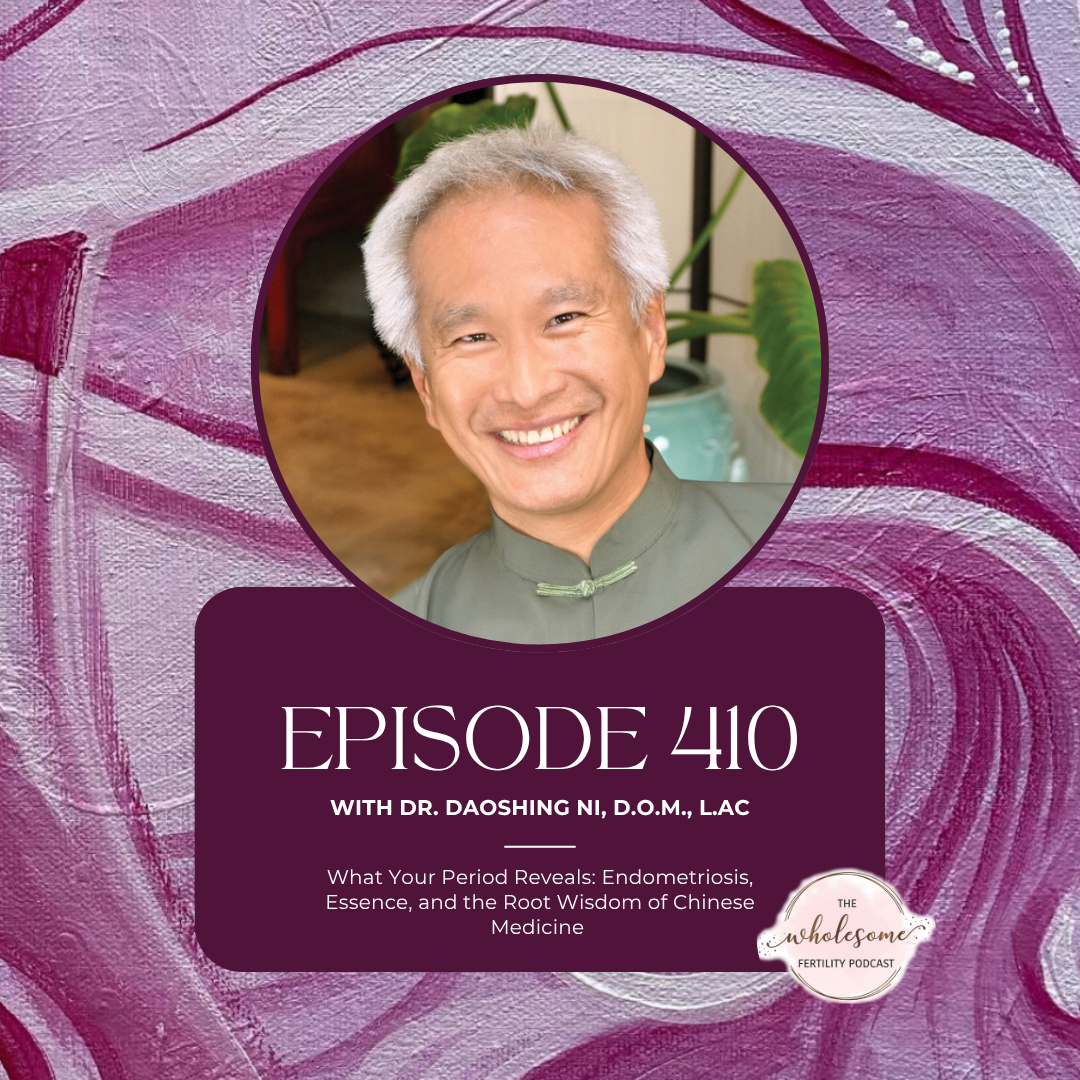
Episode Description:
In this episode, Michelle sits down with Dr. Daoshing Ni, known to many as Dr. Dao, a second-generation doctor of Chinese medicine with more than forty years of experience in women's health. Together they explore one of the most overlooked sources of insight a woman has: her own cycle. Dr. Dao explains how the color, flow, timing, clots, and spotting of a period each point to something specific about hormones and circulation, and why so much of what women are told to accept as normal is actually the body asking for support.
The conversation moves through endometriosis and why Chinese medicine sees it as far more than a single pattern, the deep link between gut health and the menstrual cycle, and the meaning of Jing, or essence, the foundation we inherit and the reserve we build through nourishment and rest. Dr. Dao also shares why blood is considered a woman's foundation, and why food, not herbs, comes first when rebuilding it.
This is a rich, grounding conversation for any woman who has ever wondered what her body was trying to say. The through-line is simple and freeing. Your symptoms are not random. They are a language, and once you learn to read them, you can begin to work with your body instead of against it.
Key Takeaways:
Your period is a monthly report card. Color, flow, clots, timing, and spotting each reveal something specific about your hormones and circulation.
Endometriosis is rarely one pattern. In Chinese medicine it is often blood stagnation layered with dampness, cold, heat, and deficiency, which is why it calls for a whole-body approach rather than a single fix.
The gut and the cycle are deeply connected. Digestive symptoms in childhood can foreshadow period pain later, and calming the gut early can soften how conditions like endometriosis show up.
Jing, or essence, is your foundation. Part is inherited and part is built through digestion, nourishment, and rest, and it underlies both fertility and the quality of your cycle.
Blood is a woman's foundation. Because we bleed each month, blood can quietly run low, so food comes first. As Dr. Dao puts it, use herbs to treat and food to nourish.
Guest Bio:
Dr. Dao is a Licensed Acupuncturist in the State of California and a Diplomate of Chinese Herbology NCCAOM. He has been active in the TCM profession as well as professional organizations, serving as an examiner for the California Acupuncture Committee and participating in the Chinese Herbology Exam development for NCCA. Well known and respected for his special interest in reproductive and gynecological conditions, Dr. Dao is an active member of the American Society for Reproductive Medicine, The Menopause Society, and the American Society for Nutrition. He is a co-founder of Yo San University of Traditional Chinese Medicine, and currently a faculty member, trustee, and co-department chair for the reproductive medicine doctoral degrees program.
Dr. Dao is co-founder of Tao of Wellness (pronounced Dow of Wellness, the same sound as Dr. Dao's name), a multi-generational integrative medicine clinic founded by his father in 1976 and celebrating 50 years of practice this year. He is the author of The Tao of Fertility and co-author of Sitting Moon: A Guide to Rejuvenation after Pregnancy. He is also the recipient of the American Fertility Association's Visionary Award and the Lifetime Achievement Award at the 2018 Integrative Fertility Symposium.
Disclaimer: The information shared on this podcast is for educational and informational purposes only and is not intended as medical advice. Please consult with your healthcare provider before making any changes to your health or fertility care.
Ready to discover what your body needs most on your fertility journey?
Take the personalized quiz inside The Wholesome Fertility Journey and get tailored resources to meet you exactly where you are:
https://www.michelleoravitz.com/the-wholesome-fertility-journey
For more about my work and offerings, visit: www.michelleoravitz.com
Curious about ancient wisdom for fertility? Grab my book The Way of Fertility:https://www.michelleoravitz.com/thewayoffertility
Join the Wholesome Fertility Facebook Group for free resources & community support:https://www.facebook.com/groups/2149554308396504/
Connect with me on social:
Instagram: @thewholesomelotusfertility
Facebook: The Wholesome Lotus
-
# Audio\_TWF\_410
[00:00:00] Episode number 410 of the Wholesome Fertility Podcast. Welcome to the Wholesome Fertility Podcast. I'm your host, Michelle Orbits, and today my guest is Dr. Tao Xing Ni, who many of you know simply as Dr. Tao. He is a second generation doctor of Chinese medicine and a licensed acupuncturist with more than 40 years of clinical experience, and he has spent his career focused on women's health, fertility, and reproductive conditions like endometriosis.
He is the author of The Tao of Fertility, a co-founder of Yo San University, and part of the family behind Tao of Wellness, a clinic celebrating 50 years this year. If you've ever looked at your period and wondered what it was trying to tell you or have been told your pain is just something to live with, this conversation is going to open your eyes.
Dr. Tao and I talk about what your cycle [00:01:00] reveals, how the gut and womb are connected, and why your essence and your blood are the true foundation of fertility. I learned so much from this, and I loved speaking to incredible masters such as Dr. Tao, and I know that you're gonna find so much benefit out of this episode as well.
So let's get into it
Welcome to the Wholesome Fertility Podcast. I'm Michelle, a fertility acupuncturist here to provide you with resources on how to create a wholesome approach to your fertility journey
MICHELLE: Welcome to the podcast, Dr. Dow. I'm so excited to have this session with you
DR. DAO: Thank you so much, and it's an honor to be on this podcast session with you. And, ~~uh, ~~I appreciate you letting me, ~~uh, ~~spending some time with me and, ~~uh, ~~sharing my, ~~uh,~~ experience and knowledge. Thank you
MICHELLE: [00:02:00] Yes, it's a pleasure. ~~So, uh,~~ before we get started, I would love for you to tell the audience a little bit about yourself, how you got into the work that you're doing.
DR. DAO: Thank you so much. I am a licensed acupuncturist in the state of California, as well as a doctor of Chinese medicine, and I've been in practice since... Oh my God, it's been a while now, about 42 years now. And, ~~uh, um,~~ and so I started as, ~~uh, ~~like every other professional Chinese medicine people, we get trained as a general medicine, and eventually I, ~~uh, ~~got into, ~~uh,~~ women's health, ~~um, uh,~~ specialty.
And ~~so, um,~~ when I was in, ~~uh, ~~Beijing and Nanjing, China, I did my residency, ~~um,~~ advanced internship in both Nanjing and Beijing in, ~~uh,~~ in different areas. And one of the particular area that I spent a lot of time with was women's health. ~~Um,~~ and also I started because when I was working with my father, ~~uh,~~ he's also a [00:03:00] doctor of Chinese medicine.
~~Uh,~~ he saw a lot of women's, ~~uh,~~ health issues, ~~uh,~~ patients, and one day he actually referred me, ~~uh,~~ referred one of the patient to me, and she was trying to get pregnant, and, ~~uh, ~~I was very helpful to her, and she was able to conceive a child. And then, ~~uh, uh,~~ later on, she came back, and we, ~~uh,~~ helped her to conceive another child.
And ~~so, um... ~~And the patient heard about me in helping them with reproductive medicine, so that's how it got started. It's all words of mouth. And then, ~~uh, um,~~ and before that, I was actually working more in the area of endometriosis, a lot of pelvic pain, ~~uh, ~~dysmenorrhea issues. That was also one of my major topic that I, ~~uh, ~~work with also with patients.
So anyway, that's how I got started. ~~Um, ~~and it's, ~~uh, it, ~~it was wonderful.
MICHELLE: Amazing. ~~Um,~~ it's so exciting to speak to somebody who is actually, ~~uh, ~~has generational acupuncturists in his family. So that's a very cool [00:04:00] experience to have. And I was wondering, ~~um, ~~we talked about-- Actually, since you mentioned endometriosis, I think it's an important topic because we're finding so many people have it these days, and I don't know if it's because now we're finding out about it and it's always been like that, or is it something that's more on the rise maybe because of endocrine disruptors contributing?
~~Um, you know,~~ the world isn't the same as it used to be, so who knows what's causing it. ~~Um, ~~what are your thoughts about that?
DR. DAO: ~~Well, ~~I think if you look at the ancient classics, ~~uh,~~ as I study the classics a lot, dysmenorrhea, painful periods, is one of the major signs and symptoms of endometriosis. ~~Um,~~ it's prevalent in the ~~old, ~~old times. It's equally as prevalent as today. So in some ways, I would venture to say endo's been around for a long period of time.
I'm not so sure if we are like dramatically [00:05:00] more than before,~~ uh, ~~but we can venture to say our diagnosis has been better, ~~uh,~~ and we can diagnose endo, ~~uh,~~ much... ~~Uh, ~~we have more tools now to diagnose now. We have, ~~you know, ~~recently there are some blood tests, ~~uh, ~~that we can look at some biomarkers. ~~Um,~~ in the old days, not old days, it's~~ like ~~five, 10 years ago, we look at Recetiva tests on endometrial lining, and you can see if there's any presence of endometriosis in the endometrial lining.
So there are more and more, ~~uh,~~ modern technology and tests that it can actually, ~~uh,~~ be able to diagnose more. But at that time, 1980s, ~~um, ~~it takes on the average about seven to eight years to diagnose somebody who is endo. ~~Um,~~ and the reason being the gold standard for diagnosis was laparoscopy, and so you had to do a surgery to be able to, ~~uh,~~ really diagnose.
So a lot of women at that time doesn't necessary and don't want to go through surgery [00:06:00] so early on in their life, and that's a lot of times contribute to the ~~late,~~ late diagnosis. And ~~so, um...~~ But a treatment of the endometriosis has been going for centuries in Chinese medicine. ~~Um, ~~so that's, ~~um, ~~yeah, ~~it's, it's,~~ it's a challenging, ~~um,~~ difficult, and a disease, but if you start managing them early, your results are much better.
MICHELLE: Yeah, for sure. And ~~so, um,~~ typically I know with Chinese medicine, ~~uh, uh, it,~~ it's blood stagnation, blood heat. ~~Um,~~ typically those are ~~kind of ~~like the most common ones. But of course, as we know, there's many different patterns that can cause a symptom. That's why we look at the root cause. ~~Um,~~ can you describe-- 'cause sometimes I do talk ~~kind of~~ like in, in, ~~um,~~ Chinese medicine speak for people, and maybe we can ~~kind of~~ explain it in lay terms.
'Cause I think people are interested in how we perceive it in the body as what the cause ~~or,~~ or what the underlying, ~~uh,~~ tendency or pattern that typically you'll see for the most [00:07:00] part with endo.
DR. DAO: Yeah. ~~I, ~~I actually see it as in the Western medicine sense, I see it as a autoimmune disorder. ~~Uh, we kind of ~~see that, ~~you know, it,~~ it's the endometrium, ~~um... ~~The endo-endometrium did not grow inside the endometrium. It went outside of the uterus, and it grow in different part of the pelvic cavity, and sometimes can even go as far as the stomach, the lung area.
And so we see that, ~~um,~~ it's our body, for some odd reason, not able to get rid of these endometrial implants that goes outside of endometrium. On top of it, we don't know why it goes outside of it, and we don't know why our body just allow it to proliferate. So a lot of these things creates a lot of inflammatory symptoms.
~~Um,~~ in Chinese medicine, ~~uh,~~ we say that there are five major syndromes, ~~uh, ~~to endometriosis. It ranges from a situation of qi defic-- ~~uh,~~ qi, ~~uh,~~ excess, ~~um,~~ blood stagnation situation. We [00:08:00] often say that the endometriosis is a blood stagnation issue. Okay? ~~Uh, ~~but because the blood stagnation has been going on for a while, it start to develop a secondary pathogenic issue.
We call secondary pathogen. So instead of blood stagnation, now we have stagnant blood. Okay? Stagnant blood. So it's more severe form of blood stagnation. And so a lot of time when we treat this kind of condition, we don't just simply using qi circulating herb or blood stagnation relieving herb or acupuncture treatment.
We also have to deal with, ~~uh,~~ associated symptoms, associated syndromes such as stagnant blood, such as stasis. There could be a damp retention. There could be a water retention. It could be cold retention, heat retention. And so there's several things that you wanna look at, and a lot of times you are not gonna see one syndrome.
You're gonna see [00:09:00] multiple syndrome all combined together. It's a mixture of them. And sometimes you'll see in deficiency cases, so that's what gets even more complicated. And so you get deficiency and excess syndromes at the same time. So when you formulate a treatment plan, you have to deal with some of the deficiencies as well as the excess symptoms at the same time.
MICHELLE: Yeah. And that, that's where it gets complicated, ~~kind of, uh,~~ feeds onto each other. ~~I, ~~I do explain it sometimes to people ~~kind of~~ like in lay terms on the podcast, because it is very empowering to understand that sometimes if you're too deficient, ~~you know, uh, ~~certain things can accumulate and then it becomes like excess and, ~~you know,~~ in simplified terms, of course.
~~You know, ~~it can get really intricate, intricately woven as, as we see it. But typically, I also see the same thing. ~~Um,~~ there's a lot of autoimmune components, and I also see a lot of gut health components. ~~Um,~~ yeah, ~~that's a,~~ that's a huge thing. ~~Um,~~ do you [00:10:00] see that as well?
DR. DAO: Actually, gut component is very interesting because a lot of the endo patients, as ~~you know, ~~they start to having this issue when they go into adolescence or menarche, when they start having their menstruation starting. But even before their menstruation starting, as we say in their childhood, you will see some of these patients are the patients who tends to have gastric, ~~uh,~~ digestive abdominal issues, where they tends to get more bloating, more gas,~~ uh, ~~fluctuation of appetite, ~~uh, ~~stomach pains, bowel movement issues, allergy issues.
You'll see a lot of those kind of symptoms. ~~Uh,~~ and a lot of time ~~it's, it's,~~ it's... I always tell my patients, "Don't wait until you have menopause to treat." A lot of times when a child having these stomach issues, start treating them right away, because if you treat this [00:11:00] issue and the stomach calms down, then the likely, ~~um, ~~the endo flare is gonna be so much more mild or more moderate.
MICHELLE: ~~Mm-hmm. ~~So you see ~~kind of like ~~a spleen qi, ~~um, ~~component to it as ~~sort of~~ the deficiency that can ~~kind of~~ cause the excess?
DR. DAO: Yeah. Yeah. Yeah. You can see deficient... What happened is that when it's deficient, when something's deficient, and so it's almost like the spleen does not have enough energy, enough qi to do the transformative power,
MICHELLE: Right
DR. DAO: transformative action, like it cannot digest or assimilate the food well. So when it doesn't digest and assimilate ~~well, ~~things get stuck in there.
Okay? So you get more bloating, you get more borborygmus gas, and you get, ~~uh,~~ just pains when things don't move very well. Constipated, and if you constipated long enough, you're gonna switch to diarrhea, and you're gonna go through that whole cycle all over again. You gradually get constipated again, and then boom, you have diarrhea.
And you go gradually build up [00:12:00] again, constipated again, you get boom, diarrhea. So it's like a vicious cycle
MICHELLE: Yeah. Interesting. And then, ~~um,~~ I know also there's a-- I feel like this is definitely a sign of the times is, ~~um...~~ And I know that they probably had this, of course, throughout history, but liver qi stagnation, I feel like it's even more so now because, ~~uh, ~~because also many people don't give themselves enough time to get more in yin state.
There's so much yang, there's so much doing, there's so much pressure that people are constantly doing. They don't have enough time to actually allow their bodies to ~~kind of ~~get into,~~ I mean, ~~Western medicine says parasympathetic state because we're always active typically, and also the world now demands it.
And also ~~we're,~~ we're so overloaded with information, which can also injure our spleen or digestion. And so do you typically see that? Is that people-- I at least see, like, when people come in for the first time, they get even [00:13:00] more tired after the treatments, and their body ~~kind of~~ really lets go because it wants to regulate itself.
So they almost, ~~like,~~ ignore their fatigue, and then all of a sudden the body's ~~like, "No, no,~~ no. We're gonna rest." It kind of triggers that feeling of tiredness because your body's trying to regulate itself.
DR. DAO: Yeah. I think for women, ~~um,~~ emotional suppression or weakness or problems is not a this century problem. ~~I mean,~~ the last hundred, hundred years ago, your woman who, ~~uh... ~~There's very little women's rights, and
MICHELLE: Yeah, this is true. Yeah, you're
DR. DAO: are almost like married off as a commodity. So in some ways,~~ um, I mean,~~ they have a lot of emotional resentment and fear.
And so I'm not so sure if we are only seeing more liver problem, liver, ~~um,~~ qi stasis in this century. We see a lot of them also in the old days. At least documentation have show us that. So I would [00:14:00] say that emotional issues does im- impact, ~~um, ~~does impact the outcome of the endo pain. But wi- vice versa is true.
If you are in a lot of discomfort, bloating, gas, and pain, ~~I mean,~~ if I feel that way all the time, I'm gonna be irritable.
MICHELLE: ~~Right.~~
DR. DAO: Not gonna feel good. ~~I mean,~~ having that, it's a problem. And so I can see that the emotional component of it is really part of the physical component. I don't separate them out.
MICHELLE: Yeah. And then,~~ uh,~~ let's talk about jing. It's one of my favorite topics because, ~~uh, ~~I explained it's something that ~~we, ~~we can support. It's one of those things that we inherit. ~~Um, ~~so for people listening, ~~you know,~~ just, I love diving into, ~~you know,~~ your expertise and how you explain it. I would love for you to really explain what jing is and why it matters really for both men and women, and what people can do to support it.
'Cause some people don't, ~~um, you know,~~ they don't [00:15:00] come in with a big, huge jing ~~bank,~~ bank account, as we say, like inheritance. ~~Um, ~~maybe they have a little less and they have to ~~kind of ~~work more to support and ~~kind of ~~conserve what they have, but how that impacts reproduction.
DR. DAO: ~~Well, ~~Jing is what we call, if you translate from Chinese is essence. Is the essence that fun- it's a foundation for our life, okay? Is what brings to this, ~~uh, ~~existence. So we say that Jing is really two parts of it. The first part of it is genetics, is what we have received from our parents. And what we have received our parents, it could be genetic coding, but also how we fare during gestational time.
The nurturing, the nourishment we get during the gestational time. The smooth labor that we're gonna have that help us to transition from a fetus~~ in the, ~~in the, ~~uh,~~ bu- in the mother's, ~~uh, uh,~~ tummy all the way now into a child, [00:16:00] into an infant, ~~uh, ~~coming out of mommy. And so the whole positive is very smooth, and we get good nourishment, then that is going to be what we called before labor, before birth, or we call it before heaven essence.
MICHELLE: ~~Mhm~~
DR. DAO: It's the essence that we got from our parents and our ancestors. Because the genetic coding also makes a difference. Genetic trait makes a difference. If your parents has a lot of IBS, a lot of irrit- irritable bowel, they have endometriosis, then the likelihood there's gonna be some percentage of likelihood you can inherit those traits, okay?
So what Chinese medicine does is look at generational treatment. So what that means is that I would treat the mother who has endo, and knowing ~~that,~~ that the child coming might have endometriosis, I start look at their digestion when they are one year old, two year old, three year old, four year old. And I start look at their period when they stuck in their period at 12 or 13, and I treat [00:17:00] right away when they have dysmenorrhea.
And so that way you're trying to really trying to eventually work that out of the genetic pool,
okay? So in Chinese medicine, we call that generational treatment. ~~Um,~~ and so that's one. The second essence is called a after-heaven essence. So after your birth, how well are you nourished? Do you eat properly?
Do you have good nutrition, good food? ~~Um,~~ if your digestion's good, you can assimilate well, then your after-heaven essence is gonna be great. ~~Uh,~~ you're gonna grow really nicely. You're strong. You don't have all these allergy symptoms. You don't have all these gastric symptoms, and that's going to be a strong after-heaven essence.
So those are ~~kind of~~ divide into those two essence situations.
MICHELLE: ~~Mm-hmm. ~~Yeah. And then also, ~~um,~~ let's talk about spleen qi and why it's so important to be mindful when we're eating.[00:18:00]
DR. DAO: Spleen Qi, along with Lung Qi and Kidney Qi are probably the three musketeers of our body. I call it the three Qi musketeers. There's of course the Heart Qi also, but the Heart Qi is very much nourished by all the other things. So if you look at Spleen Qi, it really has a lot to do with food essence and has a lot to do with nutrition, Fen Fu.
And when we talk about nutrition, I'm not just talking about having a balanced re-nutrition of different vitamins, ~~uh, ~~different minerals, ~~uh,~~ protein, carbohydrate, and fat. I'm not just talking about that. I'm also talking about how we assimilate them. We can eat very good balanced food, but if our body don't digest well, don't assimilate ~~well,~~ we are not getting the benefit regardless.
And so one of the thing that I do with a woman's health is actually look at your assimilation factor. How well do you digest? How well you obs-observe- absorb, and do you have any [00:19:00] gastric symptoms that we don't need, such as gas, bloating, pain? We don't need any of those. And why you have them, we need to get rid of it.
MICHELLE: Yeah, for sure. And then also how looking at the screen while you're eating can impair your digestion because our-- the
DR. DAO: You're paying attention
MICHELLE: Yes, the spleen governs the thought, so overthinking, over, ~~you know,~~ overworking can really impair that digestion. That, ~~uh,~~ it, which is fascinating to me, the whole mind-gut connection, because now the science is catching up to what Chinese medicine has been saying for thousands of years, which is that, ~~um,~~ we have an enteric nervous system running from the mouth all the way down through the whole, ~~uh,~~ tract, digestive tract that has, ~~uh,~~ that communicates with the brain, which is really fascinating to think because Chinese medicine has always said that thinking is very much related to our digestive system.
DR. DAO: [00:20:00] Yes, it is. And when we are born, when we are a little baby, you realize it doesn't matter if you're a little baby or big adult, ~~you know, ~~the center of your body is really your stomach, your gastric area, okay? And that is really fundamentally that's your nutrition source. That's your food source. It's in the sense that your whole body relies on it.
Your brain needs that nourishment. Your limbs to be able to function and grow and have strength, have balance, all relates to that food, that nutrition that's gonna be transformed and distribute the energy and the food essence throughout our body. So number one thing, as we are born, it has to be nutrition, have to be how we assimilate food.
So that spleen function that you were talking about is most important after we are born.
MICHELLE: Yeah. And also, ~~um, ~~let's talk about actually a very interesting conversation because when I first went to Chinese [00:21:00] medicine, I was amazed at how in-depth the practitioner was asking me about my poop.
DR. DAO: Yes
MICHELLE: why is that so important? And so I wanna ~~kind of~~ break that down for people because that's not a question that people are gonna get asked most of the time when they go to the doctor.
DR. DAO: Yeah. And so the stool, there's actually stool index, okay? Where you actually see different type of stools. Like there are dry stool that's pebble-like, and there's small pebble, larger pebble. They all mean something. They might mean that it's dry, you don't have enough moisture, ~~um,~~ and, ~~uh,~~ you may not have even enough fiber so that can bulk.
Because a fiber can bulk it up, but a fiber can also retain some fluid to keep your bowel movement moist and able to move through your intestines. So for example, that's one type. The other type is the opposite around. You have diarrhea, you have loose stool, and you have watery diarrhea, you have muddy diarrhea, and you have undigested food diarrhea.
Okay? So they are [00:22:00] all totally different. If you have food that's un- not digested, so that means that your issue of your digestion's up higher. It could be for your small intestine and large intestine. The enzymes are probably questionable, and you need to look at that. But if you have, ~~um,~~ muddy, ~~uh,~~ muddy, just like digested but muddy, you don't see any undigested particle, food particles, then that means it's most likely still a large intestinal issue.
That's IBS issue, irritable bowel syndrome issues, and that's all issue of your body is having a difficult time, ~~uh,~~ learning how to digest ~~and,~~ and pass it out.
MICHELLE: Yeah. It's so fascinating. And then also, ~~um, ~~for women's health, I remember when I first went to the acupuncturist and, ~~uh, you know,~~ I went because I had irregular periods. That's how I got into this work, because I was so blown away after many years of not really having answers, how Chinese medicine can help so strong...
~~I mean,~~ so simply.~~ It,~~ it really didn't take [00:23:00] a long time for my periods to start getting regular. But what I was also blown away was with the importance of what your period looks like can tell you so much about what's happening inside the body. So there's, ~~uh, ~~certain things like clots. ~~I,~~ I never even paid attention to those things.
What the color is, how the flow is. Those are things that can give us so many insights onto how the blood is running inside, like what the qi is like. ~~So, uh,~~ for people listening, of course, I'm, I know that there's a huge range, but for people who are interested in saying, ~~"Hmm,~~ like I wonder why I get brown spotting before I get my period," and they wanna learn more, ~~um,~~ can we cover those?
DR. DAO: Absolutely. I think menstruation is one of those unique, very unique processes a woman have that men doesn't have. It's, a woman's body is very [00:24:00] much designed and quite complicated, designed in the sense of being able to receive and carry a child. Menstruation is that part of a process. If we break the menstruation into two parts, it's really ovulation and menstruation.
Okay? In fact, frequently it's the ovulation that drives menstruation. What that means is most of the time when you have menstruation, it's really caused by you had that ovulation. Okay? Of course, there are situation where you can have menstruation, but you did not have ovulation, but those situation is not as common.
They are more rare, okay? Most of the time you have a menstruation because you have ovulation. Okay. So going back to this, Chinese medicine pays a lot of attention to this. They look at their cycle dates. Are you 28 to a 30-day cycles? Okay. Because if you are getting shorter cycle, like if you're a 28-day cycle and now you're [00:25:00] going to 27, 26, 25, 24, so what's going on is that you're going to a pre-perimenopausal situation, or you're actually going into a perimenopausal situation where that your cycle is no longer stable and it's getting shorter.
Okay? And ~~so,~~ for example, cycle day makes a difference. For example, if you get like 35-day cycle, ~~well,~~ you're ovulating ~~kind of ~~late, right? You're probably ovulating at like day 20, 25, and, ~~uh,~~ or that your luteal phase is way too long. But, ~~uh,~~ most of the time it's because your follicular phase is delayed.
And what does that mean? ~~Well,~~ that's, that maybe the egg quality is not as good. Okay. Maybe there's some ovarian cysts in there that's blocking your ovulation. So that also turns into a egg quality not as good. So those are ~~kind of ~~issue we see clinically, ~~uh,~~ with egg quality infertility issue. And as when we regulate their ovulation on time, that's when they naturally get pregnant, for example.
MICHELLE: ~~Mhm~~
DR. DAO: And so cycle day [00:26:00] is important, and then you can look at on the flow too. You just say earlier, like brown spotting. All right? So you look at this, ~~well,~~ first day, let's say when you get your period, if you're brown spotting for one day, not a big deal. That's pretty okay. A lot of women does that. That seems to be pretty normal.
Now, if you start having brown spotting two days and three days or four day, even five days before you start your period flow, then what that means is that your hormone, ~~uh,~~ level wasn't stable. Your hormone level dropped too quickly and things start to come out too early. And so that spotting could be a form of estrogen deficiency, could be a form of progesterone deficiency also as well.
So once you have the spotting, in Chinese medicine, we are trying to eradicate that spotting. So one day spotting before your period seems to be pretty normal. You start getting to two, three or four days spotting, that is starting to have some issue. Now, the flow itself should be pretty heavy on day one, day two, [00:27:00] if I count day one as your flow day.
Day one, day two, and a little bit of day three. Day three usually kind of winds down. And you get a spot for about two days or three days at the end of the day, at the end of a period. So anywhere from five to seven day period is pretty reasonable. Now, if you start to go too short, like you start to get ~~like ~~two or three days, that's kinda short.
If you start to get more than 10 day, more than eight days, ~~uh,~~ that's a little bit too long. And so those are kind of things you wanna look for. And then you look at the quality and like the color. The color can make a difference. You're supposed to have bright red color. It's supposed to be nice and fresh and good blood.
But if you start to get dark and brown, it's not very well oxygenated, so that means is that the hormone level may not be as strong, may not be as good. And ~~so, uh, ~~for example, that. And then you get pains. Okay? When ~~you get pain,~~ you get pain before your period start, you get pain during your period, you get pain after your period.
So there are different type of pain that you look at, ~~uh, ~~when you treat a patient. [00:28:00] A lot of endo patient pain is they usually have a little discomfort before their period starts, and a lot of time the most severe pain is on their day two and day three, and that's what it's quite a bit. ~~Um, ~~so that's pain.
Clots can also mean something. If you have a lot of clots, it could be you are having polyps or that you're having fibroids. So you even want to do an ultrasound to check, see if you have those kind of issues, for example. Yeah. I hope this
MICHELLE: r- ~~yeah, ~~yeah, for sure. I think it's good for people to hear because people see it, they think it's normal. I did myself before I started learning more about this. But also, I think a lot of people have the false idea that pain is normal, and in Chinese medicine, it's actually not normal. Or if they get constipated before their period or they get diarrhea during their period, that's normal.
It's not really normal. It's actually, ~~um,~~ it's not horrible or it's not bad, I-- but ~~it's, ~~it's definitely [00:29:00] showing imbalance
DR. DAO: Yeah. So when a patient comes in, they say they have some discomfort, but it's not really painful, I would say, "Okay, that's all right." If you have a few hours of discomfort and it's not progressive, it's not turning to pain or going for a longer period of time, then it's all right. It's okay. It's when somebody who has pain start to be like, "Oh, I need to stop working.
I cannot walk. I need to lie down, or I need some hot water bottle on my tummy." ~~Uh,~~ when you start to interrupt your lifestyle, then that, that's an issue. There ~~may, ~~may be a pathological issue behind it
MICHELLE: Yeah. Very fascinating. And then as far as food energetics, I would love to talk about that because in some ways, food almost... f- ~~uh, ~~some of the Chinese herbs are actually food. So how, ~~um,~~ can food energetics be helpful? And, ~~you know,~~ a lot of times I'll talk about, ~~like, ~~with people who are blood deficient, if they wanna build the blood, we can do [00:30:00] that.
We could borrow from organs like beef organs. ~~Uh,~~ the organ meats are incredibly beneficial. ~~So, um,~~ I know it's a ~~very, ~~very broad topic, but talk about the importance of the energetics of food and how that can be supportive of fertility health.
DR. DAO: ~~Well,~~ that's an important topic. ~~I mean, ~~we talk about in Chinese medicine that a woman is really foundationed by blood. So you need strong blood. And a lot of women, as they bleed every month, they get a little blood deficient. And so in Chinese medicine, we often say use herbs to treat, use food to nourish.
Okay? So in so many ways, when you deal with blood deficiency, diet comes first. Okay? What is she eating? ~~Uh, ~~she's anemic. Can... If she's not vegetarian, can we eat a little bit more meat? ~~Uh, ~~can we eat more meats that's got B12, that's got more iron? ~~Uh, you know,~~ all that kind of thing gets into consideration.
Okay? If [00:31:00] they are vegetarian, can we do some supplementation? ~~Um,~~ so those are like such as iron supplements, right? Such as B12, non-animal product B12 supplements. ~~You know,~~ those are kind of things you wanna look at. Folate, it's also very important in this kind of situation. ~~Um,~~ then you start to venture into herbs.
You can give them herbs, give them some syrup, give them some pill to help them to conquer, ~~uh,~~ this situation.
MICHELLE: And typically, do you also rotate with the cycle? ~~Um,~~ different foods, different herbs with different phases of the cycle, do you find?
DR. DAO: I actually don't. I used to when I started out. I think all of us as a student of Chinese medicine, ~~uh, ~~we started out, oh my God, we need to use this follicular phase, divide it into two, ovulation time, luteal phase, and menstrual time. Four times, right? Out of four weeks, every week's gonna be different. Okay?
And I used to practice that way and... But I don't [00:32:00] do it as much like that anymore because what I do is I just tweak the formula a little bit,~~ uh, ~~according to the cycle dates that the patient's having
MICHELLE: So they'll use ~~kind of like ~~one general, ~~uh,~~ formula, balancing formula, and then you'll just tweak it depending...
DR. DAO: Correct. Because like for example, a lot of doctors say, "Hey, ~~you know, when,~~ when you're, ~~uh,~~ bleeding, when you're flowing, you wanna make sure you got some blood activating herbs, some qi circulating herbs so that the flow is gonna be really nice and smooth." And I say, "Yeah, I can add a little bit Chuan Xiong into, ~~uh, uh,~~ the Gou Qi Zi into your formula, but I'm not gonna go crazy.
I'm not gonna change the whole self formula. I still want to nourish the body."
MICHELLE: Yeah, got it. And what are your thoughts about avoiding tonifying herbs during the period?
DR. DAO: ~~Um,~~ you can still do that. You can still do that when somebody's weak, okay?
MICHELLE: I see.
DR. DAO: who is not weak, of course, you may not want to do so much of it. Especially if
MICHELLE: has ~~like~~ a anemia
DR. DAO: it's astringent herbs. [00:33:00] You s- they don't wanna use astringent herbs
MICHELLE: They don't want to use astringent herbs
DR. DAO: You don't want to, you don't want to use astringent herbs, ~~uh, ~~during your menstruation because you want the menstrual flow to be smooth
MICHELLE: Got it. And then, but ~~like~~ if somebody's, ~~um,~~ really very severely blood deficient, you can help with tonify.
DR. DAO: can absolutely apply it even throughout the menstrual time.
MICHELLE: ~~Yeah,~~
DR. DAO: In fact, it's necessary because that's a time where they feel the weakest
MICHELLE: Yes, this is true. ~~Um,~~ speaking from experience
DR. DAO: Yeah
MICHELLE: a very, ~~uh... I,~~ I te- I've always had a tendency to be blood deficient, and then it's over time gotten to the point where now it's starting to show as anemia. So now I have to really be a lot more conscious of, ~~you know,~~ organ meats ~~and,~~ and also certain, ~~um,~~ certain formulas.
But it really is important to kinda get ahead of, because the body changes too
DR. DAO: It is. So I treat, if I treat a patient like you and who is deficient and bleeds a lot, I actually [00:34:00] start tonification even before you start to get your period. You cannot wait until you get your period. You gotta take care of your body before you get your period.
MICHELLE: ~~Right. ~~'Cause it takes a little time for the blood to get produced.
DR. DAO: Exactly. Exactly. It's a little time. Yes
MICHELLE: Yeah, it's so fascinating. I always found the, ~~you know, ~~the whole blood thing so fascinating 'cause before knowing this, ~~I mean, ~~'cause ~~I,~~ I very clearly remember because I changed my careers, ~~what,~~ what pre-studying Chinese medicine was like, how my mind worked and afterwards.
But before that, I didn't realize, ~~you know,~~ what does blood have anything to do with it? How important your blood is and how important ~~it, ~~it nourishes, especially for a woman. ~~Um, ~~I think blood is a really significant factor.
DR. DAO: It's key. It's key. Yeah. Totally. ~~And, ~~and the blood, an interesting thing is what people don't recognize is that the change in your blood flow in your menstruation is not [00:35:00] just the blood itself, because in Chinese medicine we clump blood and hormone together. And so when you're having declining blood flow, a lot of time it's not blood deficiency for sake, it's more yin deficiency.
You start having essence deficiency, which creates the blood deficiency. So a lot of time you gotta go backward, one step backward. Oh, it's the essence that's declining
MICHELLE: Yeah. And that's the beauty of Chinese medicine is really ~~kind of ~~going back, tracking back to seeing really the root, with understanding ~~the,~~ the patterns. And, ~~um, ~~and interesting, ~~you know,~~ so one of the things that you can know is if you have really healthy hair, like thick hair shows, ~~uh, ~~blood.~~ If,~~ if your hair starts to shed, that could be, ~~um, I mean, ~~it could be many things, but a lot of times a blood deficiency.
DR. DAO: Yes. Correct. ~~Mm-hmm~~
MICHELLE: ~~Um,~~ so interesting. So if people, ~~um,~~ are interested in learning more about you and your work, how can they find you ~~and, ~~and do you have [00:36:00] any offerings for people maybe outside of California?
DR. DAO: I actually, ~~um, ~~I usually do a lot of telehealth video consults with my patients and with a patient that I know, my existing patient. And I-- if I have new patient for telehealth video consult, usually they have to be referred by one of my patients. And so they could contact my office, and we might be able to set something up for them.
~~Um,~~ and, ~~uh, um,~~ and that, that's what I do. And they can contact our office. ~~Um, ~~we have a phone number, 310-917-2200. They can call us directly, or they can go on our website, and our website there's a place you can inquire, and that's www.taoofwellness.com, and that is T-A-O-O-F-W-E-L-L-N-E-S-S.com. ~~Um,~~ and we have two offices here, and we have, ~~um, ~~[00:37:00] we have one, two, three, four, five, ~~um, ~~doctors.
We work together as a group
MICHELLE: That's wonderful. So I'll have all of this information in the episode notes if anybody wants to find it or~~ kind of ~~missed the spelling. This way you know exactly you're going to the right place. And, ~~um, ~~this is just such, so much fun. I always really enjoy, especially somebody with your knowledge and your experience and your lineage.
I love picking your brain, even if it's, ~~uh, ~~things that I've learned to hear from you and to get your perspective is really so valuable for me. ~~So, ~~and I know that the listeners hearing all of this information, I feel like is very empowering for people to really understand their body and that their body is giving them signs and it's not random, and it all, like really all parts of it matters.
~~Um,~~ so thank you so much, Dr. Dao, for coming on today.
DR. DAO: It's my honor and privilege. Thank you so much, and it's a great spending time with you also as well. [00:38:00] Thank you
Speaker 2: So that concludes today's episode. You can find all of the links mentioned on the episode notes. If you're enjoying these episodes, please take a moment to share and leave a review. Reviews mean everything to podcasters, and I really enjoy hearing from my listeners. You can find me on my website at www.michelleorbitz.com.
You could also reach out to me on Instagram, and I love getting DMs from my listeners. My handle is @thewholesomelotusfertility. I thank you so much for tuning in today, and I hope you have a beautiful day.