
Episode Description
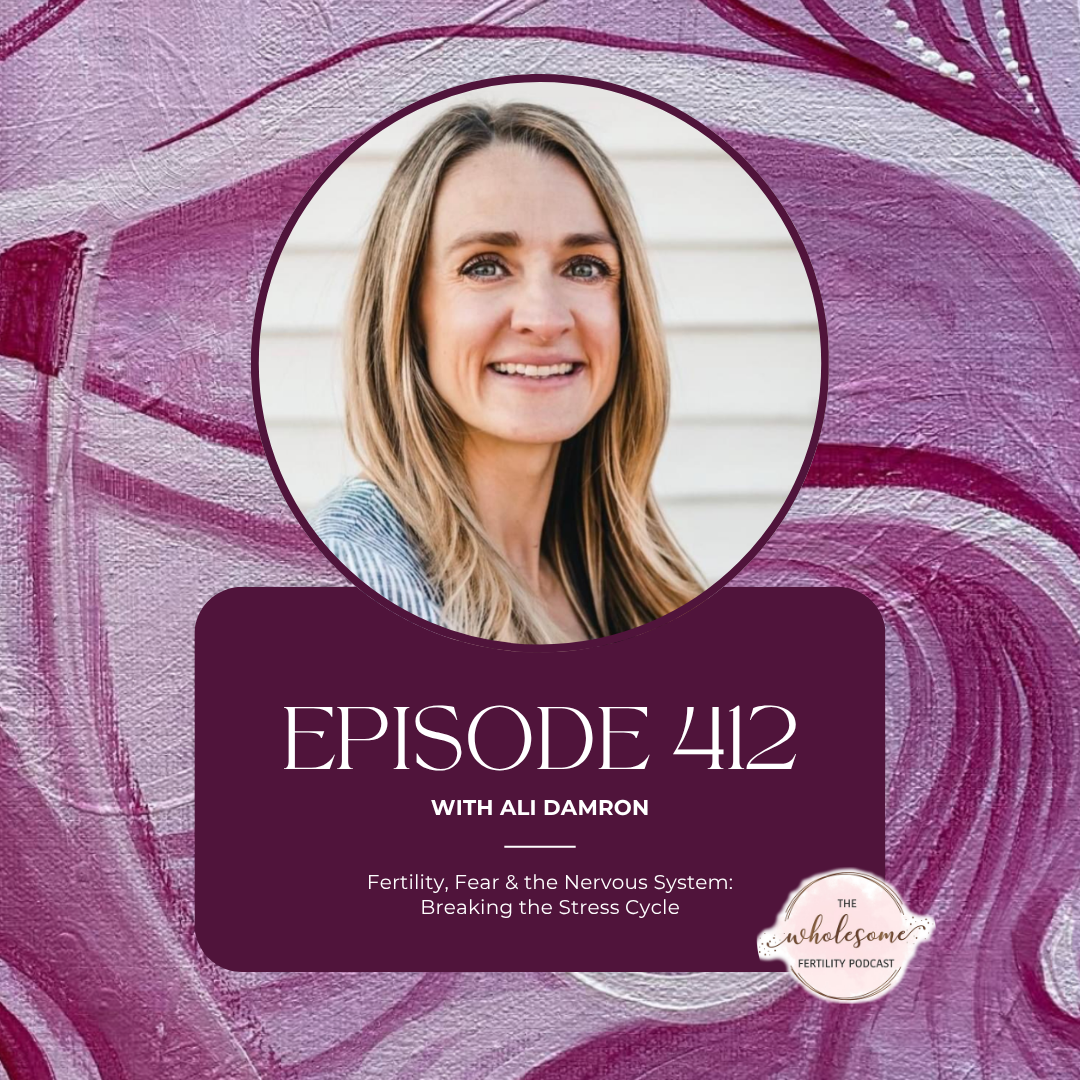
On today’s episode of The Wholesome Fertility Podcast, I am joined by Ali Damron, acupuncturist, nervous system practitioner, and host of The Ali Damron Show, to explore the powerful connection between the nervous system, chronic symptoms, stress, and fertility.
Ali shares her own experience with chronic back pain and how discovering the role of neuroplasticity and the brain-body connection completely changed the way she understood healing. We discuss how the nervous system can become sensitized over time, causing the brain to perceive more and more experiences as threatening—even after the original stressor or physical injury has passed.
We also explore how these patterns can show up during the fertility journey, especially when fear, uncertainty, pressure, and constant monitoring become part of everyday life. Ali explains why trying to constantly “fix” ourselves can sometimes reinforce the brain’s perception that something is wrong, and why creating safety doesn’t mean eliminating stress or difficult emotions.
In this episode, you’ll learn practical ways to work with your nervous system, recognize fearful thought patterns, name and process emotions, and begin shifting from resistance and hypervigilance toward greater trust in your body.
Key Takeaways
Nervous system regulation doesn’t mean feeling calm all the time—it means being able to move through stress and return to a sense of safety.
Chronic symptoms can sometimes become reinforced when the brain continues to associate certain sensations or experiences with danger.
Fear, monitoring, frustration, and constantly trying to “fix” a symptom may unintentionally keep the brain focused on the perceived threat.
Fertility struggles can create significant fear, pressure, and catastrophic thinking, making nervous system support an important part of emotional well-being.
Naming and acknowledging emotions rather than suppressing or fighting them can help reduce the nervous system’s perception of danger.
Healing can involve changing your relationship with symptoms and emotions rather than waiting for everything to feel perfect before living your life.
Guest Bio
Ali Damron is a neuroplastic symptom practitioner, hormone expert, licensed acupuncturist, and certified personal trainer with a deep passion for helping women reclaim their health and vitality. As a wife and mother to two boys, she brings both professional expertise and personal insight to her work. Through her virtual practice, Ali supports women around the world in balancing their hormones and improving their moods, sleep, energy, and periods. She works 1:1 with patients, offers digital courses, and shares valuable insights through her podcast, The Ali Damron Show, and her YouTube channel. Ali’s approach integrates the powerful connection between stress, the nervous system, and physical health, helping women feel empowered and well from the inside out.
Connect with Ali
Website: www.alidamron.com
Facebook: www.facebook.com/groups/alidamron
Instagram: www.instagram.com/alidamron
Youtube: https://www.youtube.com/@AliDamronWomensHormoneExpert
Podcast: www.alidamron.com/itunes
Disclaimer: The information shared on this podcast is for educational and informational purposes only and is not intended as medical advice. Please consult with your healthcare provider before making any changes to your health or fertility care.
Ready to discover what your body needs most on your fertility journey?
Take the personalized quiz inside The Wholesome Fertility Journey and get tailored resources to meet you exactly where you are:
https://www.michelleoravitz.com/the-wholesome-fertility-journey
For more about my work and offerings, visit: www.michelleoravitz.com
Curious about ancient wisdom for fertility? Grab my book The Way of Fertility:https://www.michelleoravitz.com/thewayoffertility
Join the Wholesome Fertility Facebook Group for free resources & community support:https://www.facebook.com/groups/2149554308396504/
Connect with me on social:
Instagram: @thewholesomelotusfertility
Facebook: The Wholesome Lotus
-
# TWF 412 Ali and Michelle (Audio)
[00:00:00] Episode number 412 of the Wholesome Fertility Podcast. Welcome to the Wholesome Fertility Podcast. I'm your host, Michelle Orbits, and on today's episode, we're gonna talk about symptoms that stick around because the body learned to stay on guard, and not because something is really wrong. Ali Damron knows this from the inside out.
At 25, while she was in acupuncture school, she developed back pain that lasted five years. She tried everything, acupuncture, cupping, PT, chiropractic massage, and eventually injections and epidurals. Then on her honeymoon, the pain disappeared, and as soon as she landed, it came right back. That clued her to Dr.
John Sarno's book, Healing Back Pain, and it changed the direction of her healing and her career. Ali is a neuroplastic symptom practitioner, hormone expert, licensed acupuncturist, and certified personal trainer. Through her virtual practice, she helps [00:01:00] women around the world with their hormones, mood, sleep, energy, and periods.
She also hosts the Ali Damron Show, and in this conversation, we talk about how the brain can learn pain and other symptoms, and why fear and constant monitoring keep them going. Where attention goes, symptoms grow. Ali explains the difference between a dysregulated nervous system and a sensitized one, and why breathing exercises sometimes don't help when it- the body feels too unsafe to take them in.
We also get into the pressure so many women carry, the anger we've been taught to push down, and why 'stop stressing' is one of the least helpful things you can say to a woman trying to conceive. You'll also come away with a simple tool you can use today, naming what you feel. Ali shares how putting a word to an emotion, even one as heavy as anguish, can help calm the dangerous signals in your body.
If you've been [00:02:00] working hard to fix yourself and still feel stuck, this episode offers a different way in. It starts with changing how you respond to what you feel so your body can get back to what it already knows how to do, which is heal. So let's dive in
Welcome to the Wholesome Fertility Podcast. I'm Michelle, a fertility acupuncturist here to provide you with resources on how to create a wholesome approach to your fertility journey
Michelle: Welcome to the podcast, Ally. I'm so happy to have you.
Ali: Thank you so much for having me. It's a pleasure to be here
Michelle: Yes, so as I always start with a podcast I always love to get, like, a person's origin story and what got you into the work that you do. I already mentioned I love the fact that we both love talking about the nervous system. Totally up my alley, so,
Ali: Perfect
Michelle: No pun intended.
Ali: [00:03:00] Yes, absolutely. So I think I have, like, lots of beginnings in my own life, as I'm sure many people do. But what got me into more nervous system work was when I was in acupuncture school, actually. I was about 25 years old, and I started having chronic back pain. And I went through all the traditional things.
I, I was doing acupuncture and cupping. I went to PT and chiropractic. I went to massage and all the things one would do for back pain, and then started down the Western medicine route of epidurals and injections and things like that. And this pain lasted, like, five years. And I started to notice over the course of time with patterns that, you know, if I...
On my honeymoon, for example, I had no back pain. It just went away. And I didn't even think I'd be able to go on a plane that long. And when I landed, it got right back. And, you know, when I was, like, on vacation or whatever, it just, it would, like, get better and worse. It never fully went away, but it did get better.
And I was, like, [00:04:00] sitting in despair one night about it, like, "Gosh, I'm, you know, young. This is so miserable. What am I gonna do? These certain things will help really temporarily, but this is really not fun." And my husband actually Googled stress and back pain 'cause he was like, "It's all stress." And I had been told in my life that it was, "Yeah, stress is probably exacerbating this.
You're, like, kind of a high type A type of person." But I was like, "Well, I don't know what to do about that. I don't know, do I sit in meditation all day?" Like, you know, these things are here. I had kids by this point, too. And so I was like, "I don't, I don't know what to do about that." And this doctor's book, Dr.
John Sarno's book, "Healing Back Pain" came up, and
Michelle: That's an amazing book
Ali: ordered it, and I read it cover to cover. And I was like, "Oh my God, this is it. This is me. I see myself on every single page. This is exactly what's going on." And so that started my journey into healing my own chronic pain. And it was a lot of trial and error and ebbs and flows with [00:05:00] that.
But I will say from then, which was at this point, gosh, probably 13 years ago or so, to now, there's so much more research, so many more strategies for it, so much more information on how the nervous system creates chronic pain and chronic symptoms- Mm-hmm ... that it's not really... Like, we have studies about it now and all kinds of things.
Whereas back then when I was doing it, it was, like, more g- like we were all kind of like paving the road together. Like, we knew it existed, and we knew that the nervous system created this, but we didn't really know how or why necessarily and, you know, how to make it completely better. But lo and behold, over the course of a...
I mean, it kind of ebbed and flowed for a while, so honestly probably took me a year or two to fully recover. It would never take somebody that long now, most likely, by the strategies that we have and we know how to treat it better. But I don't have back pain now. I have not had back pain- in over 10 years for sure.
And I just, it just [00:06:00] took me down this rabbit hole of healing that. And then also in my career, I was really into fertility at that point and women's health and postpartum. And then, you know, people would come with like air quote, "adrenal fatigue" or PMS or... And you know, we had kind of learned in school like, okay, stress and like the liver qi.
And like I just started to notice like, oh my gosh, could all of this, all of my world, so to speak, kind of come together and create like this is all the same thing? And so through the last decade of my practice, I have realized that like many of these things can be treated in the same way. And there are so many overlapping correlations to how we look at fertility or PMS or perimenopause symptoms, insomnia migraines, like all these different things.
And so I'm really passionate about treating physical chronic conditions in this way now.
Michelle: I love it because I see a lot of that [00:07:00] myself, just even with like the heart housing the mind and, and heart-brain coherence is coming out that is fairly-- it's new research. And so there's a lot of research that shows it, and to me, I just think about like flow. You know, kind of we, we always talk about liver qi stagnation with when qi stagnates, which obviously we need the qi to flow in order to feed our body and have it function really well.
But when it doesn't and it stagnates, it actually creates pain because there's more resistance and more constriction in the body. So it's all about like having that flow. So yes, it could cause pain, but it can cause so many other problems too. So it really comes down to like having that harmony and how to get to that harmony.
And typically, what, what is harmony? It's a really well-balanced nervous system.
Ali: Yeah. Yeah, and I think, you know, harmony, finding safety, like different crowds of people say it in different ways, but [00:08:00] really somebody asked me this the other day of like, "What does safety feel like to you?" And it just, it feels like you're flowing with your life. Like, right? Like you're, you've dropped the sword.
You're like not swimming against the stream. It just feels like, and it doesn't last all day every day. I think that's a common misconception, right? Of like regulating your nervous system, that you should always feel cool, calm, and collected, and everything should feel great all the time. But I do think that, I don't think that that's accurate or realistic, but I do think that what is, is allowing even the hard things to be there without fighting them.
So even days that do feel stressful, even days that do feel overwhelming or through grief or anger, like not fighting it so much. And I think that's where like things become you know, in disharmony or in Chinese medicine or in the nervous system world, like become sensitized or dysregulated, is when you're [00:09:00] constantly fighting your life.
Michelle: Yeah, for sure. I always say, like, there's-- it's impossible to eradicate stress. You can't eradicate stress. But what you can do is improve the way your body adapts. So, you know, you're driving, you're in sympathetic, you have to be 'cause you're super alert, but then you come home and then you're able to kind of regulate and come back.
And so that's really the key. It's kind of like that muscle, the regulation muscle and the adaptive muscle. And and that's what they're finding with heart rate variability. It really actually shows how strong of a vagal tone you have and, like, your ability to bounce back. So it's not, So the-- Which I love because it's so empowering to think that, like, we're not actively trying to change what is.
We're just you know, bringing the power back to us. So we can't change and then we can't depend on what circumstances we have, but we can depend on our ability to adapt.
Ali: Yeah. I think one thing that I see a lot in keeping [00:10:00] people stuck is like fixing, right? And so, you know, I could talk about this in so many different areas and go on for days, but I think, you know, even in like the health space, when a metric, right, your HRV or your lab test or something is off, or you're not feeling...
You know, like you're s- not sleeping great, your energy's off, your anxiety's higher, you know, whatever chronic pain there is, whatever symptom, a lot of us by nature want to fix, right? If we feel uncomfortable or discomfort, we want to fix that discomfort, and that's wired in our brain. But I think that when we are frustrated by things, fix things, are fearful of things, focused on things, we know that that dials up the brain and makes your brain more hyper-focused on things because you're telling it like, "This is a really big deal.
We need to monitor this. Stay on high alert for it." And that actually can perpetuate the cycles of things. And so I think that there's a really fine line, even in more [00:11:00] like the functional medicine world or fertility world or whatever, where you are trying to optimize labs and, you know, hormone levels and things like that to do that, but without so much intensity of, "I'm broken.
I need fixing. I have to do all of these things to fix myself," because I do think that that really increases adrenaline and cortisol and all the things that, you know, people tell you are causing the things in the first place.
Michelle: Yeah, it's so fascinating 'cause like, do you ever think about how a lot of the Buddhist philosophies or like, way of life really speak to this?
Ali: I found that actually after I found... So Dr. Sarno called this TMS, tension myositis syndrome. Now there's different verbiage. Sometimes we'll call it, you might hear like neuroplastic syn- sy- symptoms or central sensitization. But after that I did kind of go down this path of like Buddhism, and I'm not Buddhist, but I love their philosophy.
And at first I was like, "Oh my gosh, this is so negative, like [00:12:00] life is suffering." But I'm like, it's just like allows you to like flow through. There are s- times where life is suffering. There are hard times in life to where it's temporary, but can you flow through that and just accept that it's a tough time right now, and it's going to get better without just, you know, like trudging through it with so much resistance
Michelle: Yeah, and what I love about it is it actually gives you the tools, 'cause it says you know, yes, there's suffering, but the suffering comes from desire and resistance. It's really the push and pull. So when we're trying to push away what we don't wanna feel or when we pull really tightly what we really so badly want, in those spaces of like being against what is and not being in acceptance, that's when we create that resistance.
But it makes so much sense for what we do, you know, how we learned and how like everything really in Chinese medicine is based on the Tao, and so it's all related. [00:13:00] Taoism, Buddhism, but they're based on very similar, you know, traditions
Ali: Yeah
Michelle: and it's it's just fascinating.
So what are some of the things that you were mentioning? You were mentioning some research that has been, you know, shown recently that's really showing that there is a correlation with the nervous system and also like how we think and how we can connect to create more regulation in our body.
Ali: So there's so many studies now. One of the be- like best ones in my opinion, or the biggest ones that I can recite at the top of my mind is called the Boulder Back Pain Study. And this study was done by Dr. Schubiner, who's really a popular physician in the mind-body space. He's an MD. He was like in the world of, I forget what his background was, but a lot of them are like orthopedic surgeons, gastroenterologists, and neurologists. And I feel like he was one of the three. But anyways, he and this guy, Alan Gordon, who is a psychologist [00:14:00] who started the Pain Psychology Center in Beverly Hills, those two went out and did a study in Boulder
So the Boulder Back Pain study had I think about 50 people, and they were trying to figure out how many people in a standard group of people with back pain, chronic back pain over... Many of them had back pain for, like, decades, but their definition of chronic was over six months.
And how many people had neuroplastic pain for one of those, and for two, could heal from... We did-- or they did a strategy called somatic tracking or pain reprocessing therapy. And what they found, they thought, you know, there is gonna be, like, several that don't actually have neuroplastic pain, it's actually structural, and we're not gonna be able to treat them.
And they found that actually nobody did not have neuroplastic pain of all the chronic back pain. And this goes into, like, herniated discs, disc degeneration, spinal stenosis, arthritis, [00:15:00] scoliosis even the things in, specifically in back pain, a lot of it shows up on MRIs or imaging, right? And people are like, "Ugh, you're gonna have to have back surgery, and you're gonna have to, you know, do these decompression therapies and whatever."
And so they did it with people who all had that on their imaging. And what they found is over eight weeks, they did two sessions a week of somatic tracking, which is pain reprocessing therapy. And they found that, I believe, I may get the numbers wrong, but it's like, I think it was 72% to 80% were completely pain-free by the end.
An extra, like, 10% maybe had reduced pain, and then maybe, like, 10% didn't respond. But it was, like, an amazing study that showed how many people... And they go on, they're on interviews all the time. Dr. Schubiner just had a book come out that's was called "Unlearn Your Pain," and he has done a ton of interviews recently and has gone on to say, you know, people with chronic symptoms, meaning over three to [00:16:00] six months of symptoms that have not responded to treatment as one would expect, those people who have those are 90% of them are due to neuroplastic pain or symptoms.
So other symptoms can be things like tinnitus in the ears anxiety, insomnia, OCD vertigo dizziness, POTS, long COVID. I'm trying to think of other ones that aren't pain. Heart palpitations. Like, there's a really, really long list of these types of symptoms from just back pain, which is what, like, Dr.
Sarno originally named.
Michelle: Wow, that's really crazy. So just for people who first listening that aren't as familiar with the lingo, what's neuroplastic pain?
Ali: So neuroplastic pain means that pain is learned. So neuroplasticity in our brain means that our brain is constantly learning and unlearning things. When you think about it, like in the personal [00:17:00] development mind or, or space, they call it like the growth mindset. But really, you know, when you think back to neuroplastic or neuroplasticity at work, think about when you were studying in acupuncture school, and you could like recite every single point, what it did, where it was located.
Now, you probably use your common points and would really have to like rack your brain to remember all of that because you're not taking boards now, and your brain has deemed that as like something it can let go and direct those neurons in your brain to things that are more pertinent to today's life for you.
And so what happens is we learn where those points were, your sixth-grade history class, we learn things. Your brain deems them as important to remember. And then as time goes and your brain's like, "Nah, we don't need to know this anymore," it just sort of like goes back into your brain somewhere where you know you learned it at one point but probably can't recall it very well.
So that's-- Neuroplasticity is at work all around us, right? We learn and unlearn every day, all day. [00:18:00] So in the world of neuroplastic symptoms, what can happen is we actually can learn our pain or our symptoms as well. So there's lots and lots of ways to explain this and lots of examples. But for example, if somebody has whiplash, they get in a car accident, they get whiplash, they structurally have that tissue damage in their head, in their brain, their neck feels tight.
They're gonna have pain because the brain will send pain signals as danger signals. "Hey, your tissue is damaged. We're working on a healing process. Please take it easy. Don't, you know, do something crazy." As the healing process that passively happens in our bodies takes place, those pain signals with time will decrease, right?
And so kind of going back to like that three to six-month mark tissue should heal within that timeframe, really all of it. Even if like we break our femur, right? Like which is the biggest bone in our body, it can heal. And so what happens sometimes is when we get that [00:19:00] whiplash, if we get into a state of high fear, frustration, monitoring of it, preoccupation, a lot of attention, "Oh my gosh, am I gonna be okay?
Did I get a concussion? Is this gonna go away? What's wrong with me? Oh my gosh, is it better or worse? Oh no, I turned my head this way." Your brain learns those pain signals from your brain and says, "Okay, this is really important. Keep this going." And so we say in the world of chronic symptoms and pain that chronicity becomes chronic from attention and fear
Michelle: Ooh, that's so interesting
Ali: Yeah.
So when you give something a lot of attention and fear, your brain's gonna keep it going for you. And so, you know, even in, like, a place that there was actually tissue damage or structural damage from this car accident where you got whiplash, long after all of that is actually healed, you can continue to still have pain.
It's not structural, it's not tissue, [00:20:00] it's all healed. It's just we have 44 different pain centers in our brain that basically it's like a glitch, have learned to stay activated where there is no tissue damage and no need for pain anymore
Michelle: That's fascinating 'cause I'm really applying this in my mind to fertility.
Ali: Yeah. Yeah
Michelle: You know, and it, it kind of like, I guess you can almost say it's almost like an identification with a situation that has come, but it has impacted you so strongly that y- you know, it really kind of lingers. And, and you had mentioned that there were other things that were looked at, like anxiety or other types of conditions
Ali: long COVID is a really good area of research. We have a good number of research studies that long COVID, again, after a normal healing phase would happen, that long COVID is actually a neuroplastic condition. And you think about COVID in general, how much fear was around it, it makes sense that [00:21:00] people are terrified of the symptoms that COVID caused
Michelle: So with fertility, I mean, there's a lot of fear you know, around the whole-- and there's a lot of-- To me, it's also like I kinda see the whole identification aspect of it, is that y- you know, you start to identify with that condition, and then the brain's like, "Oh, okay, this is what it is." And then it just it continues.
Ali: I see that i- in fertility, in, you know, we can talk about even just like perimenopause and hormones and how that manifests there. In, you know, chronic pain or, or anxiety sufferers, depression people, like... And it's not our fault. It's, it's more we've gotten this label, generalized anxiety disorder, PTSD, and people just kind of like internalize that.
And there is a, you know, you talk about
Michelle: unconsciously, yeah
Ali: Yeah, and you talked about it on my podcast with the nocebo. If you're told you have generalized anxiety disorder, and this is something that you're gonna have to medicate or deal with for the rest of your life, like that's [00:22:00] the message that you're gonna give yourself,
Michelle: Yeah, definitely. 'Cause we're not islands. I mean, we really need people. I think we're wired to really believe the people in our community and the people in our circle, and if we give importance and trust in a person of authority, that has a hypnotic effect
Ali: Yeah, 100%. I mean, myself with back pain, like chiropractors told me that, "I don't know why your adjustment's not staying, you know, in or whatever. Yeah, you're gonna need to just come here for three days a week for the rest of your life to manage this back pain." And, you know, sleep with pillows and like doing all these, what we identify as avoidant behaviors, meaning that you're doing these things to avoid the pain or the sensation.
It was making it worse and worse and worse and worse. I did not-- When I bent
Michelle: so much focus on it too.
Ali: Yeah. Totally. You know, I, I originally s- it started where I bent over and picked up a weight. I was a personal trainer at the time, and I didn't have any fear. I was like, "Oh, my gosh, that hurts really bad." Like [00:23:00] assuming that I always heal from everything, everything's going to be fine.
And a few days later, it w- wasn't getting better, really, and so I went to a chiropractor. And I think back to that, and if I would've just... I didn't know any of this at the time, but if I wouldn't have done any of those interventions, it would have gone away faster
Michelle: Yeah. It's like the letting go. It, and it, it's the fixing. It goes back to that fixing. It's just you get hyper-focused on it
Ali: Yeah. I mean, for me with that situation, I was like monitoring it. I was like constantly like, "Oh my gosh, is it worse? Is it better? Oh, I did this activity. Oh my gosh, I walked on cement. I didn't stick a pillow between my legs." Like it was a whole long thing for me for years that just kept reinforcing it over and over and over and over in my brain
Michelle: And it gets stuck in your nervous system, and that's that brain-body connection because it-- your nervous system is a highway of information. That's how I see it. And so what are some of the things that you've looked at? 'Cause I [00:24:00] know you're very intrigued by that. That's been s- like a, an area of real focus for you.
What are some of the things that you've learned on how to implement more regulation in the nervous system?
Ali: So I am a big fan of, again... So A, I'm gonna define regulation or dysregulation and sensitization. So with dysregulation, our nervous system all day long should ebb and flow out of, you know, rest and digest, bottom baseline like you were talking about when you got out of the car, to fight or flight, and be able to constantly come in and out of it, right?
And so you do feel dysregulated, you're late, you get a bad email, and you go in the car. And then once you're done with that stressor, you get a complete resolution of that stress cycle. It comes all the way back down to rest and digest, where you feel safe. What happens sometimes is the nervous system gets sensitized, meaning that it perceives more and more things as dangerous in your life.
[00:25:00] So it could be symptoms, it could be people-pleasing, it could be emails, overstimulation, being overly responsible, having too much on your plate. Like, there's lots of reasons that the brain starts perceiving our external and internal world as dangerous. And so it doesn't let that baseline come back down to full rest and digest anymore.
It, like, keeps it up here, so you're that much closer constantly to full on fight or flight. And that's why people say that they feel so triggered all the time, right? Like, their kids do something annoying one time, and they know that logically they shouldn't react so strongly, but it just, like, sets them up into fight or flight because their baseline's so high
Michelle: Got
Ali: So that's like one thing that I like to define for people is that dysregulation and sensitization are different.
When the brain is sensitized, everything is going to set it off. It's like when you're walking across the street from someone that your brain is perceiving as sketchy, your brain's gonna notice every single thing that person [00:26:00] does. And so when your brain is sensitized, meaning that baseline's up here, it's gonna notice every single thing in the world.
Not anything's gonna get by it, right? It's like an overprotective parent. So what we wanna do when we are dysregulated, meaning that you have that baseline, is you can do the tools. You can do the breathing, you can do the somatic tracking, you can do the reassurance, you can do the slowing down, going on a leisure walk, being out in nature.
Those things will work to help dysregulate your nervous-- or sorry, re-regulate your nervous system. But when somebody is sensitized, those tools don't work because it, it just, it's too scared to do the tools, basically. So, you know, like I said, if you're breathing with a person that was really scary on the side of the road, like it's not gonna do anything for you.
And so in those cases, what I like to do is we have to reteach the brain that you're safe. We have to give it messages all day, [00:27:00] every day, that everything is okay. And so what we-- what I do is first, generally people a-are coming to me for symptoms like insomnia, low energy, brain fog, pain, digestive stuff, bloating, IBS, all kinds of different things.
But I always tell them, "The first thing we have to do to get rid of those symptoms is to change your response to it." So if you have anxiety and you're tired of being anxious all the time, we have to change the response from fixing, focusing, fearing, being frustrated, forlorning about this anxiety. We have to teach your brain, even though I'm anxious, I can still go live my life.
I can still go do things that bring me joy. I can still go live out my values. I can still parent the kids and go to work even though I'm anxious. And so basically, the less fear and attention you give the anxiety, the more your brain's gonna be like, "Okay, we're safe even though this [00:28:00] exists." And so the hard part for people is, and myself included when I had back pain, I was like, "My life will be perfect once this back pain goes away.
I have no issues. I feel great. I just need this back
Michelle: That's a human condition.
Ali: And it had to be opposite. It had to be, you have to go live your life, not care that the sensation is there, and then the sensation goes away. You're like desensitizing. You're telling your brain, "This is not a dangerous thing anymore. We can let this go."
And so I say that first. That's always the first side of the coin, is changing your response to the symptom itself. Uhum Then I always say, the reason that symptoms exist in the first place is because your brain is perceiving too much danger in your life. Where else is the danger? I think from working with people for 10 years on this and my own journey and talking to, you know, hundreds of colleagues about this all the time, I think for a lot of women particularly, it's pressure.
Michelle: हम्म
Ali: Self-induced internal [00:29:00] pressure for body image, for parenting, for being a woman, for being a business owner, careers, relationships. I think it's so much pressure. And I think that pressure just creates like this pressure valve, and eventually your nervous system feels like it's gonna blow, and so it starts to create symptoms for you.
You're not sleeping. You're exhausted from carrying too much in our life. We get really tired. We get foggy in our brain. Our, you know, immune system and digestive system are suppressed when we're in fight or flight all the time. Starts to create issues there. Again, chronic pain exists because of this. Hormonal imbalances.
We all know that when cortisol is high, hormones tend to go low or dysregulate. So I think that, you know, long term, really looking at the areas that people's brains are perceiving danger, repressed emotions are a big one will help their body to not continue to create symptoms for them.
Michelle: Yeah, that's so interesting. I mean, so many thoughts came into my mind, but I, I remember [00:30:00] when I was younger also, just like corporate world not listening to my body, like not eating when I was hungry 'cause I wanted to, you know, be a certain shape, and it's just all of these things, and we're sort of like used to, I guess it's become like a default to not listen to the body.
Like if you're tired or if you have your period and you're, you know, and we're, we have a completely different cycle than the men and, and, you know, the kind of pushing through, pushing through, pushing through like all the time. It's become so default that, that you know, eventually your body's gonna be like, "Hey, this is too much.
I'm not able to mis- maintain this." Yeah.
Ali: You know, Dr. Sarno explained it, and again, we've come a long way to kind of like expand our thought on how this works, but Dr. Sarno said basically that the symptoms started because of repressed emotions, mostly anxiety and anger, which I think is realistic. A lot of women, I think, are very angry. We don't wanna admit that.
No one wants to be the angry woman. [00:31:00] But the amount of pressure on us is incredibly anger-provoking to somebody.
Michelle: Yeah. Yeah, for sure
Ali: and so, you know, when you continuously repress, repress, repress, you tell your brain, like, "This is too scary, too intense, too dangerous to deal with. Shove this down." But eventually, like, kinda like a reservoir, it just overflows and, you know, I bent over, picked up a weight, and my back pain began for five years.
And so that's another way that we can kind of explain it. It's a little bit, You can think of it as like distraction symptoms. And for me, I will s- I will say that resonated a ton because when I got back pain, that's all I thought about. It was incredibly distracting from everything else in my life.
Michelle: Mm-hmm.
It's so
Ali: do? What treatment? What doctor? Oh my God, it's still here. I can't run anymore. I can't do this. How am I gonna sleep tonight? Like, that's all I thought about, so it was... It worked like a charm.
Michelle: Yeah, 'cause you feed whatever you're focusing on, and it's true. Like, [00:32:00] you know, your intention or your thought, like where you're directing your focus, you just keep making it bigger. And, and I f- I found what you said so fascinating about even the... I mean, this, it's, it's kinda like the basis of tapping, where you're accepting.
You're just acknowledging that it's there without trying to fight it. I, I apply that a lot just in life. Like if you know, if there's something that happens that scares me, I do it anyway. Like it's just kind of one of the things that I've learned to do because if I hide away from it, it just grows, and I've learned that.
You just learn that over time. So it's better to face things, and it's, it's almost like the idea of the obstacle is the way. But I found that so interesting how you were saying, "Okay, well, you know, if we can't fight it, like let it come for the ride." And if it comes for the ride and you're not like, resisting it, then it eventually will fade out 'cause you're like, "Okay, I'll see you.
You know, we learned from each other. Bye."
Ali: Yeah. Yeah. Yeah, totally. And it's [00:33:00] interesting, like these symptoms, there's a lot of assessments at, at different places online that you can take to determine are your symptoms coming from a neuroplastic process. And they behave really different than like a structural symptom. They... And again, this is sort of an overgeneralization, so I don't want anyone to freak out if they are like, "Well, mine don't behave like this."
It still could be, but usually they come and go, and mine was pretty much chronic, like every day. But like I said, I had these little inklings where, like, I was engaged on vacation. It, it felt better.
The fear was down. I wasn't so engaged in it. They can switch sides. They can switch qualities. They can, like, move around.
They can be worse on stressful days. They can be better with a loving or caring practitioner, like the placebo. They can kind of like migrate over the body. So it started off as back pain, and then now it's IBS, and then it's headaches, and then, you know, it's whatever else. And [00:34:00] so there's all kinds of like specific questions that I ask my patients about their symptoms first and say, "Okay, even if you answer like one answer correct on this, there's a good chance it's coming from this process."
Michelle: That's so
Ali: don't work like that
Michelle: So how do they where are online assessments that they could take?
Ali: I use one, or I'm a practitioner at a place called Symptomatic.me. They have one. They also have a big list of chronic or, like, common chronic symptoms that people get, so you can see if yours is on there. And then I love, there's a guy on YouTube, his name's Dan Buglio @PainFreeYou. He's wonderful.
He went through 13 years of chronic back pain, similar timeframe to when I did. Does a daily YouTube video, and he has a website called Pain Free You that he has an assessment as well.
Michelle: It's just fascinating 'cause you can apply it to everything. It really it's a lot of just like the mind-body experience and anything that persists or it, like a state [00:35:00] that is uncomfortable. You know, you can really apply it to everything. And I, I find it so fascinating, and I'm, I'm very big on the mind-body and, and that our minds really do make such a difference.
And I've even seen studies that show that the people you work with, their states can impact you and your body. Like their, their emotional states or their, you know, what they believe in. They've done studies on a placebo, but it was a placebo also on the dentists on pain medication, and they believed that the-- They didn't know what they were taking, the patients were taking.
They thought they were taking painkillers, but they were taking a placebo or they were taking even pain block, pain pill blockers. So, and, and the ones that really believed that their patients did better.
Ali: Yeah, I know. There's been so many things and I'm like, "If it's placebo, who cares? Like, it's
working."
Michelle: yeah, yeah, it works
Ali: Yeah. No, I think it's, it's incredible. And as [00:36:00] I continue in my own career, like I said, I, like, went through this chronic pain thing and then it was, like, an anxiety thing for me. And then, you know, I started to wonder if...
Because then I was, like, learning all about hormones and fertility and perimenopause and postpartum and all of that. And consistently, you know, in all the education and courses and whatever, it was, like, talking about cortisol and adrenaline, and I was like, "Well, that's what this is over here." And so it's been really fascinating and really so fun to put all of these different things together.
I'm big in, like, the grief world as well and, you know, kind of tying that in for a lot of patients around how can we use pain reprocessing therapy for grief and different other emotions or mental health things like anxiety or depression. And so it's been really cool just to see everyone's really talking about the same thing.
We're just like, need, like, a universal way to all tie it together, I think.
Michelle: Yeah, and I think a lot of people are experiencing that. Like, there's a lot of [00:37:00] anxiety. Like, I feel like it's on the rise. What are your thoughts on, as to why, just out of curiosity?
Ali: I think in general, I- anxiety is a brain perceiving danger, right?
And I think that technology plays a huge role in that. I think that, You know, I think about it a lot. Like, in generations previously, we got the 5:00 news or whatever, the morning news. We got the newspaper. We were not exposed all day to everything scary happening.
And right now, we are exposed to way more things, and we're exposed to it all day long. I really think that makes a big impact. I also think that just-- I mean, th- I am a fan of, like, learning about how technology is changing our brains, and, like, we know that technology has rewired our brains. We know about the dopamine impacts.
We know about how like, what blue light in itself does to our circadian rhythm and melatonin and cortisol and all of [00:38:00] that from a more hormonal standpoint. And we also know, you know, just there's a lot of conversation around it for youth and their mental health of how many screen time they have is leading to less desirable outcomes in their mental health, regardless of what they're looking at, just screens in general.
And then you get into what are they looking at? And adults are no different. I know that our brains are fully developed around the age of 25, but I, I mean, o- one of the biggest things that I treat in my practice all day is probably anxiety. That's probably the most common. And I really think technology plays a big role in that.
Michelle: Mm-hmm. Yeah, people are bombarded. It's even just the scary stories, that's one thing, and fine. You know, it could be just like the constant scary stuff that we get. But I think it's also the information overlo- overload because your nervous system, it, it's too much for our vessel to carry
Ali: Too much. I even think, so I mean, obviously everyone's [00:39:00] algorithm is different, but, you know, even like health and fitness, right? If you're constantly perimenopause is gonna be so terrible, oh my gosh, we're gonna have hot flashes, and this is gonna be such a bad thing, like you're ramping up fear every day, all day.
And most people who do it have a solution. They have something to sell you about it. It is what it is.
Michelle: That's
Ali: Some of them are valid, some of them are not. But even just, again, I think that's why perimenopause in one aspect has gotten so much worse symptomatically. Everyone's like, "Why didn't our moms talk about this?"
Well, they didn't talk about it because it was their generation, but also I don't think it was as bad
Michelle: My mom talked about it so much, it's really funny. She's like it was unusual. She s- she says that her mom didn't talk about it, or she would-- No, she said, "My mom was so smart. She would say stuff, but we didn't really even know what it was back then." So she would tell her, you know, the things that she was feeling.
My mom had it really bad. I'm 52 now, and I am not afraid of it, maybe because of what we studied. I think it's because of how we were [00:40:00] educated. I'm not afraid of it at all. I think that so long as you know how to balance your life, and I, I, I really... The meditation, it, the-- Meditation, listen guys, changes your life.
It is a superpower. It is you know, getting that, you know, plugging into a superpower. You literally can change your life. You can, you can reverse your age, I believe, through meditation. It really is. You're connecting to, like, a life force. So I think that that's that's a tool that I would say, like, even the people that think that it's not for them, they're the ones who need it most, in my opinion.
And not, not to, not to push back, but I think that yeah. There's-- I don't believe, you know, some people say it's not for everybody. I don't believe that. I'm
Ali: don't think there... I think it is for everyone too. And I will tell you, so I'm a pretty, like, analytical person. And I think that's why I liked, like, the TMS approach of first dipping my feet into it because [00:41:00] it was from a complete brain health perspective of, like, these centers in your brain light up when there are pain.
This is what happens when you have a thought and you reinforce it, these neural pathways. Like, for me, that really helped. And now I'm like, you know, like we talked about the Buddhism thing and meditation and the mind-body, but at first the mind-body was a really foreign concept to me.
Michelle: Mm-hmm.
Ali: I was like, "This feels real."
So 'cause people along the way told me that it could be stress, and I was like, "Well, this feels real physical to me. Like, I don't think so."
Michelle: Yeah. It's your reality. That's how you're experiencing it, 100%. And that's valid. Like, that's the thing. You gotta-- As we, as practitioners, we know that validating your patients in their experience, regardless of, you know, how we can see it in every which way, it's still, it's still their experience, and reality is perception, and it's absolutely that.
So there is no, like, one reality. You know, [00:42:00] and sometimes people need to ease into meditation or ease into, you know, you know, there's definitely different steps. But I think ultimately it's incredibly, incredibly
Ali: I think so too. There's very few things that are as well even like evidence-based as meditation of like what it does for aging and cellular health and all of that inside the immune system and the brain and the heart and all of it. It's, it's amazing
Michelle: Yeah. It puts you in a s-- it, it really helps regulate that nervous system, and I think that that's ultimately what it is. You can get to a state where your body's able to create that resonance and that harmony where it's, you know, it thrives in, in that state. It really wants to heal in that state.
And so ultimately, that's when everything starts to self-regulate, you know? And self-regulate because it's already intelligence. It knows, it knows what
Ali: That's
the thing that I tell people all the time about this, like neuroplastic symptoms. I'm like, "It's not realistic that your body wouldn't heal this." And, you know, [00:43:00] I think our culture, like there's so much chronic disease and so much chronic pain that it's just kind of like widely accepted now that like we've lost trust in our body.
But I'm like, if you break a bone or get a burn or a cut, like you literally don't do anything, and your body just goes to work and fixes it. There's just a, a virus, right? You fight that off. Like accidents, surgeries, like your body knows exactly what to do to regulate itself and to heal. And so it's so unrealistic that your whiplash from 10 years ago would not be the same or
your
Michelle: a good point. I really love how you're framing a lot of this because I, I don't often hear it the way you're framing it, and I think that it's a really great way to highlight just our-- I-- That's just such an obvious thing, yet we've come to accept chronic pain as being a thing. But y- you're like, "Wait, but that, you know, your body's supposed to heal it- itself.
It shouldn't be holding it on- [00:44:00] onto it for that long." But nobody really questions it 'cause it's just so common.
Ali: No. It's like I don't know what to do. And again, I do think, you know, back in the day we would call it like psychosomatic and that just, again, for me too, like people call that to me, it, it just did not resonate at all. I was like, "I don't know what you want me to do though." Like, "I don't know how to deal with this.
I don't know how to change this." And so that's why I really enjoy this whole theory and these exact, like s- how this is explained, I guess, because it-- there's-- you have to change your response to it. It is coming from danger. You lower your fear, lower your preoccupation and monitoring of it, and it eventually goes away.
There's like a path versus just like, "Yep, it's your stress that's causing this," people just don't know what to do with that.
Michelle: Yeah, yeah, because then you're like, "What do I do?" So I think that that, I think what, what-- And I wanna mention just for listeners, what Ally's saying [00:45:00] could be applied to everything, including fertility. Like, because I see it, I see it in my own work, that there is a state of re- surrender and, you know, we call it different things, but I really think that
Ali: Yeah
Michelle: you're putting it in a way that's very clear, that there really is a strategy to this, to getting that emotional freedom, let's just call it.
You know? It's like an emotional freedom. It's kind of unwinding and untangling the energy so that your body can be free.
Ali: And I do think, you know, I know that you do this for your patients, but when you tell a fertility patient or someone who just had a miscarriage, like, "Stop stressing, it's causing it," like what a disempowering, terrible thing to say to somebody. And so I tend to like break it into like, well, what are the thoughts?
Are the thoughts that you're never going to have a baby, that you can't do this, that you're always gonna miscarry? Like, let's talk about that, and then let's kind of call them out as like, "Well, your scared brain is sending you scary thoughts because it's scared and trying to protect you to, you know, pr- [00:46:00] or, or avoid the heartbreak of all of this."
And so I'm like, "Okay, so can we like recognize the thoughts are coming from what I call the anxious brain, and say, 'You know what? I'm catastrophizing right now, and this is really unhelpful.' Let's just direct your attention back to like disengaging from those catastrophic type of thoughts." And I just think like giving people what to do
Michelle: Mm-hmm.
Ali: of just don't stress
Michelle: Yeah,
Ali: will help them.
Michelle: I agree 100%. I, I feel like saying just relax is so dismissive because also you know, similar to what you were saying before, it's not about eradicating or moving out of something. Like, it's about I feel this and it's okay. Like, I feel... And, and so it's the val- that to me is like validation, and I think validation in itself is incredibly healing
Ali: Yeah, I do a lot of work. Have you seen thefeelingswheel.com?
Michelle: No,
Ali: Okay, so the feelings
Michelle: I'm learning so much
Ali: Yeah, the feelingswheel.com is something that I use very regularly. So like if I had a [00:47:00] fertility patient, for example, that came in and was, you know, really scared and really angry, she maybe saw a pregnant friend or whatever and just had all these things, I would pull out the feelings wheel and be like, "Hey, there's a lot of research that shows that even by identifying what this experience is in your body, it helps lower the danger signals."
So if you're like, "Okay, I am feeling anguish," at least you can understand what's happening from a physiological perspective, this chest tightness, this like swirling feeling, this pressure, that sort of a thing. And there's research to show is that that can help pull you out of fight or flight by just even saying like, "Okay, this is anguish and it's okay."
Michelle: Yes. It's like naming it. You're like acknowledging it. Amazing. Oh, that's great. I, I'm learning a lot. Like, it's definitely like a, a lot of really new information, which is very interesting. I, of course, like love the nervous system, love learning about it, but there's so many different ways to look at it.
And I think that [00:48:00] learning to look at it from different ways helps you really to understand it, because it is in, in a sense, very, very abstract type of topic because it's not something that you can really look at. Now I guess they measure it in some ways, but it's, it's also another thing that's really hard to kind of like...
You're not holding it and looking at it. So, so it's one of those really more abstract aspects of our consciousness or our being. So I find that so fascinating. So for people who wanna learn more about you, about your work, and also your, check out your podcast, how can they find you?
Ali: Yeah, so I am all over the internet at just my name, Ally Damron. That's my website. I'm on Instagram there. I have a YouTube channel at Ally Damron, and then a podcast called The Ally Damron Show.
Michelle: Awesome. So this is such a great conversation. Definitely loved the different perspectives, and I think that a lot of people listening are going to be getting a [00:49:00] lot of benefits. And I'll be checking out some of the books that you mentioned. They sound really fascinating.
Ali: out there. One of-- Just, just to kind of share this one of my favorite ones to get started is called "The Way Out" by Alan Gordon.
Michelle: Mhm
Ali: quick, you know, you can read it in one sitting kind of thing if you, if you wanted to. And it just gives you the, the nuts and bolts.
I always say when you're healing from chronic symptoms, the first step is to understand what's going on and kind of like buy in, like, "Okay, yep, this is me." Like I did with the book that I mentioned at the beginning. I had to be like... And it was so easy. I was like, "Oh my God, this is exactly what's happening here."
Like, there was no doubt at all
Michelle: And the book in the beginning, you mean the "Healing the Back"? "Healing Your Backpack"? "Healing Back..." You're s- so fascinating. Amazing. Thank you so much, Ally, for coming on. It was such a great conversation.
Ali: Absolutely. My pleasure
Speaker 2: So that concludes today's episode. You can find all of the links mentioned on the episode notes. If you're enjoying these [00:50:00] episodes, please take a moment to share and leave a review. Reviews mean everything to podcasters, and I really enjoy hearing from my listeners. You can find me on my website at www.michelleorbitz.com.
You could also reach out to me on Instagram, and I love getting DMs from my listeners. My handle is @thewholesomelotusfertility. I thank you so much for tuning in today, and I hope you have a beautiful [00:51:00] day.