
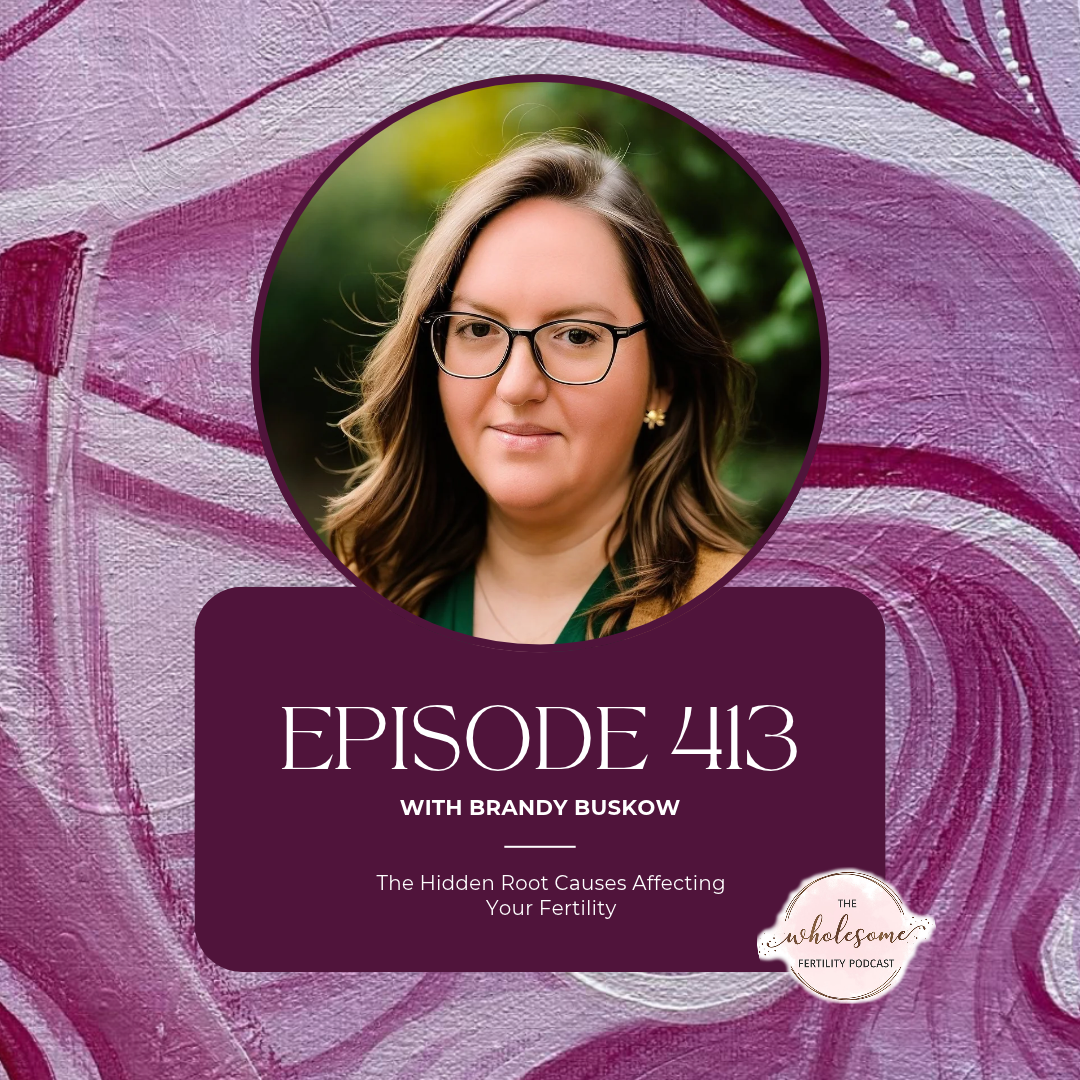
Episode Description
On today’s episode of The Wholesome Fertility Podcast, I am joined by Functional Diagnostic Nutrition practitioner Brandy Buskow to explore the hidden factors that may be impacting fertility beyond hormones alone.
Brandy shares her personal journey through debilitating IBS symptoms, anxiety, celiac disease, and thyroid issues, and how her own health challenges ultimately led her to functional medicine. We discuss why standard testing may not always reveal the full picture and how looking deeper at gut health, food sensitivities, thyroid function, detoxification, metabolic health, and stress can uncover important pieces of the fertility puzzle.
Brandy also shares her perspective on GLP-1 medications and peptides, particularly for women dealing with insulin resistance or metabolic dysfunction, and why these tools should be viewed as part of a bigger lifestyle approach rather than a standalone solution.
We also dive into the mind-body connection and how subconscious beliefs, chronic stress, anxiety, and the nervous system can influence the healing process. Brandy offers a simple but powerful practice for becoming more curious about your thoughts instead of judging them, helping create more space for the body and mind to work together.
Tune in for a fascinating conversation about looking beyond symptoms and uncovering what your body may truly need to heal and thrive.
Key Takeaways
There may not be one single root cause. Functional testing can help identify where function has been disrupted, including the gut, thyroid, detoxification pathways, metabolic health, and food sensitivities.
Fertility is about more than hormones. Supporting gut health, managing inflammation, improving sleep, reducing stress, and addressing nutritional deficiencies may also influence reproductive health.
Thyroid health can easily be overlooked. A standard TSH test may not always provide the full picture, particularly when autoimmune thyroid conditions are suspected.
GLP-1 medications can be a tool, not the entire solution. For certain people dealing with insulin resistance or metabolic dysfunction, Brandy discusses how they may support metabolic health alongside nutrition, exercise, and lifestyle changes under appropriate medical supervision.
The nervous system matters. Even when someone is eating well, sleeping well, and taking supplements, unresolved stress, limiting beliefs, or repetitive negative thoughts may create another layer that needs attention.
Approach your thoughts with curiosity instead of judgment. Asking, “What is this trying to tell me?” can help uncover what may be happening beneath the surface.
Guest Bio
Brandy Buskow is the Chief Operating Officer of Functional Diagnostic Nutrition® (FDN) and has spent more than 12 years helping shape one of the world's leading functional lab training organisations. A board-certified Health Coach, Master EFT Practitioner, Certified Hypnotherapist and FDN Practitioner, Brandy combines professional expertise with personal experience after overcoming years of chronic digestive issues and a significant health crisis. She specialises in helping people uncover the hidden stressors driving chronic illness and restore lasting health.
Website: FDNtraining.com/wholesomefertility
Connect with Brandy
Facebook - https://www.facebook.com/FunctionalDiagnosticNutrition/
Instagram - https://www.instagram.com/fdntraining/
YouTube - https://www.youtube.com/channel/UC7xDnEKCe9gKeWZ2vbE3C8w
Linkedin - https://www.linkedin.com/company/san-diego-natural-health-&-fitness-ctr/
Twitter - https://twitter.com/FDNtraining
Podcast - https://www.functionaldiagnosticnutrition.com/health-detective-podcast/
Website - https://www.functionaldiagnosticnutrition.com/
Disclaimer: The information shared on this podcast is for educational and informational purposes only and is not intended as medical advice. Please consult with your healthcare provider before making any changes to your health or fertility care.
Ready to discover what your body needs most on your fertility journey?
Take the personalized quiz inside The Wholesome Fertility Journey and get tailored resources to meet you exactly where you are:
https://www.michelleoravitz.com/the-wholesome-fertility-journey
For more about my work and offerings, visit: www.michelleoravitz.com
Curious about ancient wisdom for fertility? Grab my book The Way of Fertility:https://www.michelleoravitz.com/thewayoffertility
Join the Wholesome Fertility Facebook Group for free resources & community support:https://www.facebook.com/groups/2149554308396504/
Connect with me on social:
Instagram: @thewholesomelotusfertility
Facebook: The Wholesome Lotus
-
# TWF EP 413 Brandy Buskow
[00:00:00] Welcome to the Wholesome Fertility Podcast. I'm your host, Michelle Orbits, and today my guest is Brandy Buscow. Brandy is the chief operating officer of Functional Diagnostic Nutrition, also known as FDN, and she spent more than 12 years helping shape one of the world's leading functional lab training organizations.
She's a board-certified health coach, a master EFT practitioner, a certified hypnotherapist, and an FDN practitioner. And like so many of us who do this work, she started out as a patient. For years, Brandy lived with IBS symptoms so severe that she was afraid to leave the house, along with anxiety that grew into panic attacks.
After her pregnancies, everything flared, and the doctor told her she was simply a tired mom with three kids. It was her own digging that finally revealed what was really going on. What she'd been told was IBS turned out to be celiac disease, and there was a thyroid piece that standard testing had also missed.
[00:01:00] In this conversation, we talk about the gut-brain connection and why gluten can show up as anxiety, fatigue, or brain fog instead of just stomach pain. We get into why TSH tests on its own can miss Hashimoto's, and how gluten and dairy can keep the immune system fired up against the thyroid. Brandy shares the story of a client who got pregnant after six months of focusing on her gut, her diet, stress, and sleep without ever working directly on her hormones.
We also talk about GLP-1 medications and peptides, who they may help, and why they're not a one-size-fits-all answer. And then we go into the part that many people tend to skip, which is the nervous system, the protective beliefs running in the background that keep the body bracing for disappointment.
And if you've been told everything looks fine while your body is telling you something different, I think that you'll find a lot of clarity here. So let's dive in.
Michelle: Welcome to the podcast, Brandy. So happy to have [00:02:00] you
Brandy: Thanks, Michelle. I'm good. I'm happy to be here
Michelle: so before I get started, I always like to start with an origin story, of how you got into the work that you're doing
Brandy: Yeah, absolutely. I grew up in mo- you know, pretty conventional family, standard American diet, you know, all the regular things. But I had a health issues when I was really young. I had a lot of issues with tonsillitis and getting colds chronically, so I ended up getting my tonsils removed when I was seven or eight.
And then as I got into teenagehood, I started to experience a lot of IBS-type symptoms that really progressed in my early 20s to being pretty debilitating to the point that I wasn't able to leave my house because I was always afraid of, "Okay, am I gonna have an episode? Do I know where the bathroom is?"
And a lot of the conventional things that my doctors recommended really wasn't helping. You know, it was, you know, uh, try eating more fiber, take some [00:03:00] RestoraLAX, take some other things to try to help. And it, it helped a little bit, but it didn't, it didn't help all the way. And what that developed into is some pr- pretty severe anxiety in my mid-20s where I went on medication.
And I really didn't like the way it made me feel. And it just so happened that at that same time, my grandmother was really holistically minded. She was working with a naturopath, and I decided to talk to my doctor to ask her You know, could we try weaning it off and could I try, you know, some herbs and maybe some lifestyle to see if that would help?
And luckily, she was very open to that, so she helped me wean off the medication. I started taking herbs and realized, oh wait, there's a completely different way of doing things. And in... At the same time, while it was helping with my anxiety, I started to notice that it was helping with my IBS symptoms.
And so through diet and supplements, I was able to manage that for quite some time. And it [00:04:00] wasn't until I had my kids in my early 30s that a lot of those symptoms seemed to come back, and they got really bad after my second pregnancy. I had twins, and then 18 months later, I had, uh, my daughter, and I started getting severe panic attacks again.
My IBS was flaring. I had extreme body pain. And at that time, I went to the doctors just to see, you know, is there something else going on that I don't know of? And I was dismissed by several doctors, which was really discouraging. It was, "Well, you have three little kids. Your body's just worn out. You're stressed out."
And I remembered what I learned in my 20s with my grandmother and her naturopath and the herbs, and so I started doing research on my own, trying to figure out what was going on, because it was so debilitating at times that I would have panic attacks that I couldn't take care of my kids. So I knew I had to do something, and I happened to come across a podcast that the founder of Functional Diagnostic [00:05:00] Nutrition was on, Reed Davis.
And the way that he was talking about health really resonated with me. And I had been to a naturopath and different doctors, and they really weren't helping. So although we couldn't afford it, I decided to enroll in the FDN course, and as I was going through, it was, it was like this light bulb moment. I discovered that my IBS was actually celiac disease, and I had several food sensitivities, and it turned out that my daughter was actually very intolerant to gluten as well, and I was able to figure that out early on.
And so that just took me down the path of, okay, I need to take this information that I've learned and start helping other women who are also experiencing this, because I'd heard so many of them dealing with these issues but being told the same thing. "There's nothing wrong with you. It's just aging.
You're stressed out. You're tired. Get more sleep. Here's a, here's a pill that might help." And I wanted to change that, and I've been just dedicated to that [00:06:00] ever since.
Michelle: Yeah, that's so fascinating, uh, 'cause I'm actually sensitive to gluten myself, and I look back... So that's, that's something also a lot of people don't realize. Like, you don't have to have... I mean, celiac disease is really the extreme of it, but you don't have to necessarily have celi- celiac disease to be sensitive to gluten.
And I was sensitive to gluten. I used to be so tired. Like, I just had no energy, and it completely changed so much, uh, the bloating, everything. So it's pretty amazing. But I, I find, too, that it's more than just the gluten, especially in the US. Like, it's also how it gets sprayed with glyphosate. I mean, there's so many aspects to it.
But it's amazing how one ingredient can cause so much havoc, you know, in a person, and you don't even realize it's, it's happening.
Brandy: Yeah, it's not just gut symptoms. I've seen it with, you know, brain fog, [00:07:00] anxieties, skin issues, neurological things. There's so many different things that can tie back to being sensitive to gluten. Most people think, "Oh, my gut's gonna hurt," but that's not the case. Like you mentioned, you were tired, so it wasn't necessarily gut symptoms
Michelle: Yeah. And I, and I find it so fascinating when you were tying in or talking about how you had severe anxiety at the same time as the IBS, because there is such a huge correlation to the brain-gut connection and also the enteric nervous system. I mean, it really, like your gut has its own nervous system with hundreds of millions of neurons running through it.
It's really fascinating. But how you immediately felt that connection
Brandy: Yes. Yeah, it was, as soon as I started working on it and realizing that I had celiac disease and I cut all of the gluten out, slowly the anxiety started to lessen and lessen, and I was like, "Oh, well, that makes sense," because I [00:08:00] wasn't absorbing the nutrients that I needed. My gut wasn't getting what it needed to make the neurotransmitters, so of course I was feeling anxious.
I was nutritionally deficient
Michelle: Wow, it's so fascinating. So, so pretty much was that really only, the only thing? Was it gluten or were there other factors?
Brandy: It would definitely gluten. After I had my daughter, uh, it, I, I believe, but it wasn't diagnosed at the time, but it also triggered Hashimoto's storm. So I was having a lot of issues with my twins. I had issues with breastfeeding. They didn't check anything. And then when I had my daughter, the same thing happened, and I had a really great nurse that came in and said to me, she's like, "Have you ever had your thyroid checked?"
I said, "No." She's like, "You know, that's pretty common with multiple pregnancies. If you're not able to breastfeed and produce enough milk, definitely get that checked." Now, of course, I'm in Canada, so we went to get a test. They tested TSH. That looked fine. But looking back now, now that I know that I have [00:09:00] thyroid nodules, I was having a lot of those symptoms of kind of having that Hashimoto's flare, where I was swinging between hyper and hypo.
Almost this feeling when, of the hyper side, where it's like I wanted to jump out of my skin. It was like this internal vibration that just felt off. And again, it's one of those things that's frustrating because, you know, I've seen working with women with, with infertility, they can go years and years and years before somebody actually discovers, hey, there's a thyroid connection here.
So there was that in addition to the gluten. It just was kind of this perfect storm of things coming together and creating all these debilitating symptoms that, you know, unfortunately I look back on now, I didn't get to enjoy my kids being a baby because I was just dealing with making it through the day and trying to feel better.
Michelle: Oh, it's too bad. It's just, uh, it's awful when you don't really get answers. You go for so many years and you really don't have answers. And and actually really [00:10:00] important point that Brandy just brought up is that many times you can go to the doctor and if you do ask to get your thyroid checked, they'll just do a TSH, which is your thyroid-stimulating hormone.
And all that does is just see the numbers. And typically speaking the range of what is out there is a lot larger than it really should be, especially for fertility. So you could be a lot higher than you should be, and that would be still flagged as normal. Secondly, it-- for Hashimoto's specifically, that's not enough.
You need like a full thyroid panel to really look beneath the hood and make sure that there's no antibodies. And every person that I see that has Hashimoto's always, always I suggest a gluten-free diet
Brandy: 100%, I agree
Michelle: correlation with that. So do you feel like after you shifted all of that and changed your lifestyle, that that shifted and changed your [00:11:00] Hashimoto's condition?
Brandy: Absolutely. So I'm not on thyroid medication, but I did see a trend where my my antibody numbers are normal now, which is great, and I think I contribute that to dairy flee-- dairy-free, gluten-free, really working on the gut. And my thyroid nodules, which were continuing to grow, have actually started to shrink, which is great, and I think, again, it's attributing to gut work and doing all the things that we know in the functional medicine space.
It takes work, but it can happen. And now the-- when I do get symptoms, it's not very often. It's usually if I've gone through a really stressful period or I'm just coming off of getting sick, my thyroid will be a little achy for a couple weeks, and then it tends to calm down.
Michelle: It's amazing. I find functional medicine to be so powerful. Like, I find it to be very empowering because it puts the power back in your hands and it does it gives you things to do. It gives you tools. Because I had the same thing with Chinese medicine. It, [00:12:00] it-- they're very similar in that way, that they really look at the body and the bo- body's ability to heal.
There's a lot more hope based on lifestyle choices, but for so many years I was, uh, given the birth control pill for like 12 plus years. I had irregular periods, so it was very similar. "Oh, that's just the way your body is, and there's nothing that can be done." And, and you really take their word for it.
Like, you really don't think that there's another option. And knowing that you can actually change things that typically you're told that you can't change based on lifestyle protocols is amazing 'cause it's... I find it very empowering.
Brandy: Yes. Yes
Michelle: So talk about some of the functional testing. I always love f- functional testing 'cause it, it looks...
It, it's sort of like, the typical, like, unexplained infertility when they tell you, like, based on the, the mainstream tests that they do or, like, the more typical tests that you'll have at the doctor's, they test, but functional tests gets [00:13:00] a lot more in depth. So many times people with unexplained infertility will get functional tests, and then they'll find an explanation
Brandy: Yeah, this is the part that I love because with functional testing and the way we approach it as FDN practitioners is we're using it not to find a diagnosis, but we're using it to find out where has function been lost, and we're looking at the different body systems. And I mean, you know, in working with couples with infertility, every single person, there's no one root cause, but every person's weak link is going to be different.
When I was working with couples with infertility, we would run hormone testing. Now everybody wants the hormone testing because everybody assumes it's the hormones, right? So we would run hormone testing just because I wanted to see, okay, what's going on right now? How is stress affecting your hormones?
And then we would go deeper and look at the liver and detoxification. We would look at the gut. We would look at food sensitivities because we're [00:14:00] trying to find those areas of where is there some dysfunction, and what can we do with lifestyle to make changes? And so many times I have one example of this beautiful woman.
She was doing all of the... She did everything. She was doing all the things, and we ran a food sensitivity test, and her gluten was off the charts, and her thyroid antibodies were really, really high. So we hadn't gotten any of the other test results back, but we just removed gluten from her diet, and after 30 days, she went and had her thyroid antibodies checked again, and they were reduced by half.
And so we just continued to work on it. We worked on her gut. She had a lot of gut, uh, issues going on. She had a couple of bacterial infections. She had some leaky gut, and so we worked on that. We didn't even address her hormones. Like, her hormones were a little bit low, but we didn't even address hormones.
We were just working on lifestyle, diet, stress, you know, really good sleep, working on the gut, and she was actually able to get pregnant after [00:15:00] six months of working with us because we did all of the things systematically, and we didn't focus on, "Okay, do you need more estrogen? Do you need more progesterone?
What's going on with your hormones?"
Michelle: It's almost like taking that thorn out of your side so that the body's able to function again, and then it restores what it needs to. And so break it down actually for, uh, people because why is it specifically gluten that impacts the thyroid or impacts the thyroid's I guess response to overact or the immune system to overact and, and pretty much like target the thyroid?
Brandy: Yeah, so it's something called molecular mimicry, whereas the proteins in gluten and also dairy, dairy is very similar as well, the proteins look similar to, uh, the structures of our thyroid. So if there is any sort of autoimmunity already going on with the thyroid, when you ingest those things, the immune system can [00:16:00] see it and tag it and think, "Oh, this is the same thing," where the thyroid tissue is the same thing as the gluten, and we're sensitive to it.
So it start, starts attacking everything, and then it continues to attack the thyroid. And so if you remove the gluten and the dairy, which you- your body is already sensitive to, then that consistent stressor isn't constantly being put into the body, so then it starts to calm the immune system down.
And so the immune system starts to slow down in attacking the thyroid cells. And that's common for a lot of other issues, but very common with thyroid. And, and I too do the same as you. If I see somebody that has Hashimoto's, I tell them, "The best thing you can do from a diet perspective, take out gluten and dairy," just because that's gonna really quell a lot of the inflammation, and it's gonna help your immune system calm down a little bit so it's not overactive and attacking everything.
Michelle: Yeah. And also, I mean, if you're, if you're gut sensitive, if you're sen- sensitive in general it [00:17:00] can cause leaky gut and inflammation. I mean, it's so many different levels. So there's so many different factors really. And then let's talk about a very hot topic which a lot of people are curious about is peptides.
'Cause I know they're still kind of lear- learning a lot about it. It's not something that has been around for a long, long time. Like, so, so talk about how you would utilize those to help support your clients.
Brandy: Yeah. So for me, I am a big fan of the GLP-1s. I personally decided to go on a GLP-1 despite everything that I knew. I had a family history of type 2 diabetes, high blood pressure, sleep apnea, and so I was fighting an uphill battle, and I started seeing that in myself. My blood pressure started to creep up.
My insulin wasn't great. My blood sugar was fine, but my insulin wasn't great. And even though I was doing all the functional medicine things I knew to do, I knew that I had to change something. And so I did a lot of research, and in fact, [00:18:00] GLP-1s have been around for over 20 years. They've been used in obesity medicine for diabetes and have worked quite well, and a lot of the ones on the market now are almost as effective, if not as effective as bariatric surgery.
So there is a good-- there's good data behind it. There's some good safety profiles, and so I really like those. And the more that people are using them, the more that we're seeing it's affecting more than just blood sugar and satiety and, you know, how fast food goes the di- through the digestive tract.
We're also seeing improvements in things like inflammation. We're seeing improvements with the brain. We're seeing improvements in other areas. And so, if we're looking at just the fertility space, I mean, we know that there's a lot of women who maybe are going around and they're having issues with blood sugar regulation or insulin resistance or PMOS.
These medications can be really helpful for this population, not because we want [00:19:00] them to be on it for life, but it can be a tool in addition to what they're already doing with lifestyle to help manage that part and improve metabolic markers, which when you improve the metabolic markers, you increases the chances of, of getting pregnant.
And so, we're seeing a lot of success with that. And so when I work with clients who choose, it's, it's always a choice. I'm never like, "Hey, you have to go on it." It's a choice that they work with their licensed practitioner with, because I'm not licensed, I can't prescribe it. But if they choose to use it, I talk to my clients and educate them.
It's a tool. It's not gonna be the thing that solves everything. It doesn't mean you can't-- you have to-- you stop eating well and you stop working out. But it's going to give you that little bit of a boost while you're putting in all of the lifestyle. And one of the nice things about GLP-1s is because it quiets the brain, it leaves more room for you now to start making some really good lifestyle habits that you can take long term, and it's, it's that little bridge that helps you get there.
[00:20:00] So they're they've been around, like I said, for over 20 years. They're, they're really showing a lot of great things, and there's more and more studies coming out about how they're improving more than just obesity and blood sugar and metabolic markers.
Michelle: Yeah, and I, uh, do wanna mention for some people it could be really incredible, but other people not so much. So definitely talk to your doctor and don't you know, because it's not a one size fits all. Uh, but, but specifically what Brandy was mentioning is, is people who have insulin resistance and, you know, that's linked to PMOS or Type 2 diabetes runs in their family and they have that tendency, it could definitely be helpful for that.
However, if you don't have that, maybe not, you know, i- if it's not specifically your, uh, body type, it could be actually more depleting, so really depends on the person. But there's new peptides that are coming out that are definitely kind of like, uh, just starting to get studied. One being [00:21:00] one that they're th- they're looking into for endometriosis.
Have you looked into other peptides?
Brandy: I'm pretty familiar with o- obviously things like BPC 157. That has been used for a lot of people, especially with gut issues or joint issues. There's some other ones that people are using, like Tessamorlin. And again, there's not a ton of studies on it, but anecdotally, people are seeing a lot of improvements, and I think there's a lot of potential because we know that the GLP-1 medications, there's, there's all, there's research in there, and it is a peptide, and so we-- and peptides are essentially a chain of amino acids, and they're often peptides that our body or the amino acids our body already makes, so they're just enhancing them so that you're injecting them and, and they last longer.
So I think there's a lot of potential with peptides because we've exha- I wouldn't say we've exhausted, but there's a lot of medications out there that work sometimes and not all the time. Peptides seem to be [00:22:00] fairly safe for most people. Of course, there's always gonna be the exception. You have to talk with your doctor.
But I think there's a lot of potential there, and it's another alternative to some of the other medications on the market that maybe somebody's using, it got them so far, and then they're like, "Mm, I've hit a wall, and it's not really doing what I want it to do anymore." I think there's a potential there with peptides, and I think more research needs to go into it on what it can be used for and the best population to use it for.
Michelle: Yeah, for sure. And I know you also did a lot of work or like, uh, you have a background in, in hypnotherapy and EFT and also nervous system support. That's a big thing because I think that so many times we look at like s- the physical and like what we could do and all the, the diet, the supplements, which are very important.
But if you get everything right, but you're ignoring the nervous system, I think it's almo- it almost defeats the purpose.
Brandy: Yeah, you're right. And the reason I did [00:23:00] that was b- uh, because I had the issues with anxiety. I was trying to find a tool that I could use to acutely help when I was having a panic attack or I was having anxiety. And when I started working with clients, I realized that even though they were doing all the lifestyle things, like you said, going to sleep and eating right and taking supplements, they were still kind of hitting this roadblock, and I started to notice this common pattern that it was stress or the inability to deal with stress that was blocking them from moving forward.
So I started implementing those tools. I started with EFT, which is emotional freedom technique, or a lot of people know it as tapping. I started with that, and then I added hypnotherapy, and what I found was, is that as I was using that along with my knowledge as an FDN practitioner, I was able to get clients even further ahead.
They was... They were able to progress faster because we were dealing with the emotions that were coming up as they were [00:24:00] going through the healing process. So every person has some sort of emotions. Maybe it's past traumas. Maybe it's a limiting belief. Maybe it's a ruminating thought that they don't even know that's there that's actually keeping them stuck and keeping them sick.
With my infertility couples, it was very interesting. I, I kind of got to the point where I said, "Okay, we have to include this." And when we started talking about it, they started sharing things and these ruminating thoughts and these, these limiting beliefs that even though they were spending the money, they were doing everything they knew they could do, there was a part in the back of their brain that said, "Is this even going to work?"
You know, every month when they would do the tests and it would be negative, that was r- it was reinforcing to their subconscious mind, "This isn't gonna work for me." So we actually started to work on that and reprogram that and, and reframe the identity of, "Oh, okay, this can work," and, "Why is my body trying to protect me [00:25:00] by, by telling me it's not going to work?"
Oftentimes it's safety. You know, we don't wanna be disappointed. So the body, even though, you know, we know it's not helpful, it's trying to keep us safe, even if it means that it's harming us by giving us beliefs that aren't helpful to us. So we started to work through those things, reframe the mind, reframe the beliefs, even deal with some of the traumas, and then the body started to catch up and go, "Oh, thank you for saying that out loud.
Thank you for acknowledging that that's been there." All right, we're gonna process that and let that go, and now the body's gonna respond. And I like to kind of get the body and the mind to start working together instead of against each other and fighting each other, and then you start to see progress.
But people don't like to do that because it's the uncomfortable part, but it can be the most impactful
Michelle: Oh, big time. It's so powerful. Like it's, it-- and it's one of those things that you actually said it. You said two things. You were saying that it's one of those things that's behind the scenes. It's so [00:26:00] abstract that it's so hard to really pin down. It's y- you almost identify with your thoughts.
So you, you had also mentioned identity. You identify with your thoughts. You, you know, m- most of us identify with our conditions.
Brandy: Uhum.
Michelle: for 12 years, I identified for having irregular periods. It was just an identity, and you don't even realize that it becomes an identity that you adopt over time, and, and reinforcing that really does make a difference.
Now we're finding that the mind and your thoughts really does impact your physiology. I mean, that's the reason why placebo always got in the way of like testing when they were trying to like test things out or, or do studies. It was considered a nuisance to have placebo rather than seeing it as such an incredibly miraculous aspect of our health.
Brandy: Mm-hmm. Yeah, absolutely. It's, it's, it's amazing what our mind can [00:27:00] do, and when your mind is convinced of something, it doesn't matter what you do, you're not gonna un-convince it. It's-- I learned this in hypnotherapy from my mentor that I taught it to, is, is if you repeat something enough, whether it's true or not, the mind's gonna believe it.
And so you have to do a lot, undo that work to convince it otherwise. And we, a lot of times consciously, we don't even know that we're doing it, but we're reinforcing that belief, like you said, behind the scenes.
Michelle: Yeah. And it does-- We do it for a reason. It's, it's not because we're trying to self-sabotage. It's because, like you said, it makes us feel safe. So it's, it's a protective mechanism. It's actually like our, our mind trying to protect ourselves. You know, that's, that's where it comes from. So if you understand that, you can actually approach yourself with more compassion, which helps the whole process, 'cause I think a lot of people get hard on themselves 'cause then they're like: "Oh, you know, why am I doing this to myself?"
It's, it's not you doing it yourself. It's-- Everybody does this. It's, it's actually like our [00:28:00] human condition and like the way our minds tend to work. And and just sitting with your mind and really like looking into it, even though it's so abstract and it seems so like far away from what we normally see, it's still there and it's still influencing everything
Brandy: Yes. Yes
Michelle: So, what would you suggest if you can give like, some tips?
We'll talk first on the mindset. If, if people are going through this and they really do wanna work on feeling better and, and having less anxiety through the process, uh, and I know that you've gone through it firsthand, what were some of the things that you found really impactful on a personal journey that helped you get to the point where at least you got mental clarity so that you were able to find the right solutions?
Brandy: Yeah. The first thing that I recommend, it, it seems, it seems odd, but it's become curious. So when the thoughts keep coming up, just notice them, but be curious about them. [00:29:00] Don't judge them. Don't say, "Oh, I'm thinking this. Oh, there I go again." Like, "I'm-- I have these bad thoughts." Just be curious and go, "What is this trying to tell me?
That's interesting that this thought keeps coming up." And so the question that you wanna ask yourself when you're curious, when a thought comes up is, "Okay, that's interesting. What is this trying to tell me?" And you may have to do it a few times, and it takes practice, and you might get frustrated, but eventually what happens is when you start asking your brain a question, it starts searching for answers.
So if you say to your brain, "Okay, what are you trying to tell me?" Eventually the answer will come through. And for some people, it's, "Oh, my body isn't working right now because it's screaming at me, telling me I need to take a break, and I need to slow down, but I didn't hear it." So be curious first. Don't judge your thoughts.
Just be curious about it and just let it come, and then, like you said, be gentle with yourself. Don't beat yourself [00:30:00] up. Don't, don't try to fix it right away. Just be curious, be gentle, and go, "Hmm. Okay. That's interesting." When you start to do that, the door kind of opens up for new ideas that you've maybe been blocking to start coming in, going, "Okay.
Well, my body's telling me that the reason I feel this way or the reason that, you know, maybe my hormones aren't working, and I can't get pregnant is because I'm type A, and I'm stressed out at work, and I don't know how to relax, and I don't know how to take a vacation. Maybe I should do that and see what happens."
And then be open to what comes in, and you'll start to notice small shifts. They're little at first, but then they become bigger and bigger. And listen to that. Listen to your gut. I think, I think that's the easiest thing people can do. It takes practice, but it's very worth it, and the idea is be curious.
Come at it with curiosity
Michelle: Great advice. Yes, curiosity, you know, it, it allows us to come at it without judgment, and I think that that's the big thing about [00:31:00] curiosity and why it's so powerful is because we can still look at something without creating judgment. And I think that we can look at it a lot more clearly and really observe when there's no judgment
Brandy: Yes. Yes
Michelle: So for people listening that want to find out more about you, how can they find you?
Brandy: Sure. I mean, a great place to find me is actually at fdntraining.com forward slash wholesome fertility. There's a case study there that they can see where I'm working with a client, and I talk through, you know, what are the labs that we ran, what was going on with her, and how did I coach her and talk about some of the mental, emotional stuff and the lifestyle things to kind of get her moving forward.
So that's a great place. They can also find me on social media. I, I'm at your GLP-1 guide on the social media channels, and I'd love people to reach out anytime. Happy to answer questions or chat if anybody has questions.[00:32:00]
Michelle: Amazing, Brandy. Well, this was such a great conversation. Loved how you got yourself out of your own personal journey. A lot of us, of course, start out as patients ourselves, myself included, so I really relate to that, and I think that we definitely have our hearts into it, especially when we know what it means to have to go through the struggle ourselves.
So thank you so much for coming on and sharing your story and really sharing some great tips. So thank you so much.
Brandy: Thank you. Glad to be here