
Ep 365 Meditation with a Mission: How Self-Hypnosis Can Reprogram Your Life
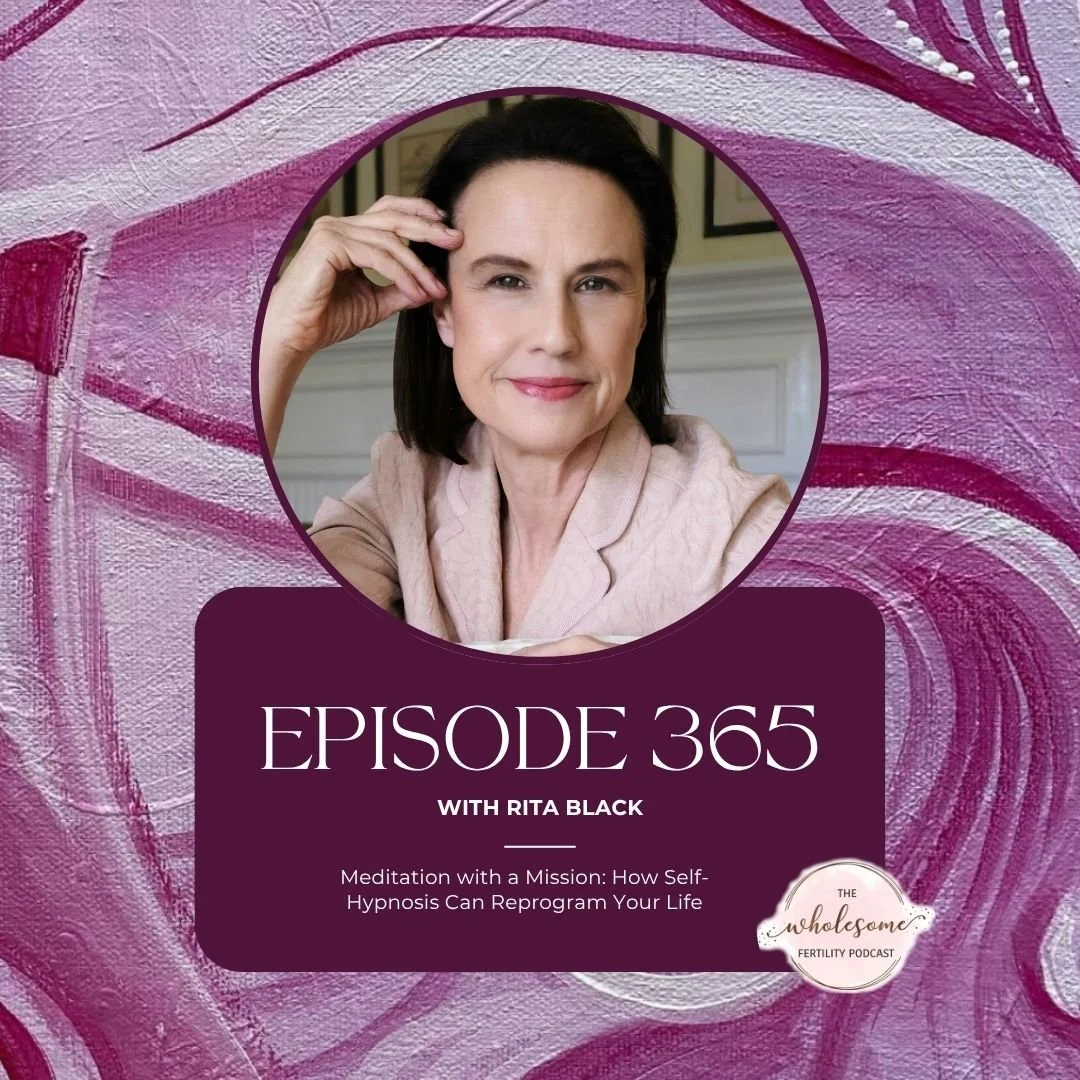
On today’s episode of The Wholesome Fertility Podcast, I’m joined by Rita Black (@shiftweightmastery), a clinical hypnotherapist and weight management expert, to explore how self hypnosis can transform your habits, health, and overall mindset. Rita shares her personal journey of quitting smoking and breaking free from emotional eating through hypnosis and how she has helped thousands do the same.
We dive into the science behind the subconscious mind, the difference between hypnosis and meditation, and how identity shapes your habits, beliefs, and even your physical health. Whether you are trying to change a behavior, reprogram limiting beliefs, or shift your mindset around fertility and well being, this episode will show you how to harness your mind’s power to create lasting change.
Key Takeaways:
How hypnosis works to bypass the conscious mind and rewire habits at the subconscious level.
The difference between meditation and self hypnosis and why the latter is “meditation with a mission.”
Why identity is the foundation of transformation and how it shapes behavior and physiology.
How subconscious beliefs can affect fertility, weight, and other health outcomes.
Simple daily self hypnosis and gratitude techniques to prime your brain for positive change.
Why quitting smoking or vaping is less about willpower and more about identity and subconscious programming.
Guest Bio:
Rita Black, C.Ht. (@shiftweightmastery), is a clinical hypnotherapist and renowned expert in smoking cessation and weight loss. She is the author of the best-selling From Fat to Thin Thinking: Unlock Your Mind for Permanent Weight Loss and the host of the Thin Thinking podcast. Through her signature online programs, Shift Weight Mastery Process and Smokefree123, Rita has guided thousands to harness the power of their subconscious mind to create lasting, healthy transformations.
She also offers two free resources to help you begin your own transformation journey:
Free Weight Loss Masterclass: How to Stop the “Start Over Tomorrow” Weight Struggle Cycle and Start Releasing Weight for Good - a 75-minute session that includes a light hypnosis experience to help you identify and remove subconscious barriers to weight loss. Join here
Free Smoking Cessation Masterclass: How to Stop Smoking Without Withdrawal, Cravings, or Weight Gain — a practical, empowering approach to quitting for good. - Join Here
Links and resources:
Visit Rita’s website here
YOU, the Non-Smoker? Yes, it's Possible - learn more here
Follow Rita on Instagram
Disclaimer: The information shared on this podcast is for educational and informational purposes only and is not intended as medical advice. Please consult with your healthcare provider before making any changes to your health or fertility care.
Ready to discover what your body needs most on your fertility journey?
Take the personalized quiz inside The Wholesome Fertility Journey and get tailored resources to meet you exactly where you are:
https://www.michelleoravitz.com/the-wholesome-fertility-journey
For more about my work and offerings, visit: www.michelleoravitz.com
Curious about ancient wisdom for fertility? Grab my book The Way of Fertility:
https://www.michelleoravitz.com/thewayoffertility
Join the Wholesome Fertility Facebook Group for free resources & community support:
https://www.facebook.com/groups/2149554308396504/
Connect with me on social:
Instagram: @thewholesomelotusfertility
Facebook: The Wholesome Lotus
Disclaimer: Some of the links shared are affiliates but this is at no cost to you and can even get you discounted prices!
-
Michelle: [00:00:00] Welcome to the podcast, Rita. I'm so happy to have you.
Rita: I'm really excited to be here, Michelle, and have a great conversation about the mind with you.
Michelle: Yes, the mind, it really uh, is so powerful, oftentimes ignored. We just talked about that
in the pre-talk, Oftentimes ignored because it's hard to really wrap your hands around, it's not something that you can touch and feel. It's something that can paint your perspective and you can't, you don't even realize it's doing that.
Rita: Yeah, I mean, our thoughts either own us or we own our thoughts, our habits either own us or we own us. And I have, interestingly, because I'm older than you, when I started my practice, it was pre cell phones
Michelle: Mm-hmm.
Rita: something that I noticed just like, why, you know, we, and this will be relevant to just what you said.
Is that prior to 2007 when the iPhone, I believe first came on the market people's brains were different than they are now. People are like uh,[00:01:00]
Michelle: is so true.
Rita: Much more short attention span. Everybody thinks they have a DHD, although it's just that our brains are overstimulated, overwhelmed the digital era now AI is just like taking it, ratcheted it up, just.
Crazy. And so I think we are gonna be entering into a new era of brain management. Like where, you know, we, we manage our health, but we also recognize from the moment we wake up, we're either managing our brain or our brain is managing us.
Michelle: so true. I wanna get to that. That is absolutely true. I actually find myself now. I'm like, I'm gonna write my copy. I'm gonna, you know, like I, I do get help of course, you know,
because you can't do everything. It's almost like I look at it like AI is an assistant, so, I'm still the CEO, I'm gonna, you know, manage my own creativity. And I used to probably rely a little bit more, and now I'm like, no, no, no, no. I'm gonna write this. I'm gonna think this. I'm, I'm finding myself like bringing that naturally back. And wanting to, [00:02:00] and wanting to kind of like, almost like assert my own uniqueness as a human
Rita: I think we are gonna find, I mean, because this is just, incubating stages of this, you know, as we human beings learn to interact with AI and our brains. I am doing the same thing as you. I am like, oh, this is kind of like a brain muscle, and if I don't keep flexing my brain muscle, I will get flabby and I won't be able to create my own copy, or I won't be able to come up with ideas.
I'll just become relying on this thing outside of me and until they create the brain shift that go in our
Michelle: Yeah, I know. Oh
God. It's like total
Rita: in steroids.
Michelle: Yeah, it's gonna be like insane.
So, so actually before we get started, I'd love for you to tell us your origin story.
Which I always love to hear just a little bit more about you and how you got interested in the work that you do, and specifically like how you [00:03:00] even niched on that.
Rita: Yeah, well I niched from the very beginning because I actually was somebody who was a pack and a half a day smoker, and I also struggled with my weight up and down the scale of 40 pounds and from a very early age. So I, I was in my early thirties and just a hot mess and had tried to quit smoking a number of times and, and sometimes successfully, like, I could get a year under my belt, but I would always, always, always go back.
And I just found it really hard and, and my husband smoked. And so anyway, a friend of mine went to a hypnotherapist and you know, this was in the nineties and. We're so much like even meditation people were not talking about it. It was just like, that was just going to, a hypnotherapist was still really outside the norm of some sort of, you know, like modalities, like acupuncture.
I know you do acupuncture. It's just like [00:04:00] all of that was still like, seemed really granola, hippie dippy, you know? Woo. And not practical application. And she said this, and I was like, hypnosis, like, you know, and you picture this guy with a mustache and a polyester jacket and he's waving a watch in
Michelle: That's gonna make you bark.
Rita: and he is gonna make you bark and collect like a duck.
And I was like, really? And she's like, I stopped in one session and I have had no cravings and I. Don't even care that, you know, like, I don't even want a cigarette. No regrets. I was like, huh, what? Okay, well maybe I'm a little more interested now. And so I went and saw the same hypnotherapist and you know, when you go to somebody who's not just somebody that heals you or is, you know, a practitioner, but that they're a teacher as well, they just really love what they do and they wanna.
Michelle: Yes.
Rita: You know, lay it all on you. And so this guy was really awesome. He was this older British gentleman. This was in Venice, [00:05:00] California. I live in Los Angeles. And and he explained how the mind worked to me. Like he, he, he wasn't just like, get in the chair and I'm gonna hypnotize you. He was like, this is why it's been hard for you.
I can explain kind of at the same time is that, you know, he was explaining like, I have this model behind me. For those of you listening audio, it's like only 12% of your mind is the conscious, critical, analytical part of your mind. That is the part of the mind that wants to quit smoking. The other 88%, the part of you that believes smoking, you know your beliefs.
So the part of my brain that believed. Smoking calmed me down and was great after a meal and helped me wake up in the morning. And all that power in my brain had given that was in my subconscious. And so was the patterns, like the pattern of smoking after a meal or when I got in my car or what have you.
and then just the identity of being a smoker. 'cause whenever I went to quit smoking, I was always a smoker who was trying to quit smoking. And [00:06:00] so my brain still. Thought of me as a smoker. And so what happened in the session was I, you know, so he explained that, over from birth until we're in our twenties, everything, our parents, teachers life experiences get imprinted in our subconscious.
And this critical filter is formed so that. Anything coming in, no matter if you're reading studies about how bad smoking is for you no matter how many people outside of you are telling you quit smoking, it's bad for you, et cetera. The other 88% is like, when am I gonna get my next cigarette? It doesn't
Michelle: Hmm. Yeah.
Rita: And, and so the part of your mind that is driving whatever behavior, whether it's smoking, whether it's overeating, or or nail picking or hair pick picking or any of negative habits. The conscious part of you is like, I want the change, but the subconscious is like business as usual. We is driving you to engage in that same behavior over and over again below your conscious awareness.
[00:07:00] So how hypnosis is helpful is it relaxes the critical filter. So suggestions can be given and really quickly, well, at least for smoking, weight is a little different. It's a little more slow because we can't stop food. But we can stop nicotine. We don't need nicotine in order to live. So, in that one session, I stepped into being a non-smoker.
So I stepped into a non-smoking identity. I shifted my focus to being a happy, healthy non-smoker. I let, it was like shedding of a skin, like, you know, snakes, sheds the skin. and I left that session and I was like. I totally get it. It's not like I forgot that I smoked, like I think some people think you take smoking out of your brain and you throw it away.
When you do hypnosis or somebody, you, you wake up out of this trance and go, I used to smoke. That's crazy. It wasn't like that, but I left the session going. I'm a non-smoker and, and I [00:08:00] just don't do that anymore. and so I was able to hang out with friends because this was the nineties. People still smoked in bars and, you know, around it wasn't, you know, it wasn't like,
Michelle: right.
So you were exposed to it. It's hard.
Rita: Yeah. And, and I just was like, that's something you do. I, I just don't do it anymore. And I wasn't like waving my hand and being an annoying non-smoker, you know, being shaming people about it. It was just like, okay, I, I don't do that anymore. So, so that was my first. Taste of hypnosis and, and what happened after that?
Because that was such a, like my, you know, one of those life shifting experiences where sort of the penny dropped and I was like, aha, I bet the same is challenging for my yo-yo dieting. You know, maybe. My conscious mind wants to lose weight and knows how to lose weight. Like I read every diet book. It wasn't like I lacked information, but this other subconscious part of my mind, my habits, my beliefs, even my identity.
[00:09:00] Like we, we start to, we really believe we're a weight struggler, and so we're always struggling against being a struggler and, and really bring that, that identity kind of locks us into this whole weight struggle world. And holds us captive. And so, that's when I started exploring hypnosis for weight management.
And, and the rest is history. I lost 40 pounds. I kept him off for 30 years. And, and have used hypnosis every day of my life, you know, for you know, do self hypnosis in the morning for just changing whatever I can about my life because there's always something I can make better, you know?
Michelle: talk about self hypnosis. 'cause that's always really, really
Rita: Yeah. Well,
Michelle: what is that? For
who have never heard of
Rita: Yeah, I mean, self-hypnosis, if you wanna think about it, it is sort of meditation with a mission, right? Like you're going into a relaxed state, but you are using your mind, and most of the time a [00:10:00] self-hypnosis session, you're gonna focus on what you wanna create. Like where you're gonna put your focus rather than what you're not going to do.
Because the brain doesn't really process negatives. It's like if we're like, I don't wanna go to McDonald's, it, here's, go to McDonald's. Right? Like, don't go to McDonald's. Right. So the brain, and, and if you ask, I mean, it's always amazing to me and maybe to you as well because I know I know you're working with fertility, but you know, a lot of times.
People, if you ask 'em like, well, what do you wanna create? What do you wanna do in your life? they're more clear on what they don't want versus what they do.
Michelle: So
Rita: So, so when we really actually sit and have to think about like, what do I really wanna create? And the way then. just doing that helps your brain get clear, get specific and, and the more specific you are for your brain.
'cause your brain is sort of like ai, it's like a, you can code it and say this is what I want. [00:11:00] Right. But you have to be specific. You have to be persistent, especially with things that. You know, like weight management is like, you have to keep going at it. It's not one and done. Like hypnosis for smoking cessation can be, but I think, so the way I coach people for a self hypnosis would be either to create a really clear vision of what you want and then have a.
I call it the movie theater technique where you just kind of play what you're doing, like what you don't want, like the behavior you're, you're not wanting to engage in. And you play that through a couple of times and you imagine it like you're watching a screen and you're watching yourself on the screen doing whatever, like, you know.
Snacking after dinner, like getting up, going to the cupboard, you know, eating, whatever. Right? And, and that's a pattern that the brain has gotten used to. So to interrupt that pattern, you are gonna say, well, what would I do instead? Because all the time we're like, well, I don't wanna eat after dinner. But you're not giving the, the brain [00:12:00] directions to what you want to do.
After dinner. Right? And so what we wanna do is, is then once we play out the scene that we, we've been doing, we, reverse, like hitting rewind on the tv and then you put in the behavior you do. And you play that over and over again like three or four times, and you just keep doing that. And, and the best time for self-hypnosis is the morning, especially like if you're working on a behavior during the day.
Because once you get to, like for instance, for night eating, once you get to the night, the train is left, the station, the, the brain is already engaged in that pattern. So you're not gonna change it in the middle of a pattern. But in the morning when you're in a relaxed state. Like athletes will practice the game in their mind ahead of time so that they get the moves in and, and their brain is already primed for that particular action.
If you're doing that early in the morning [00:13:00] and when you have the most willpower and your brain is at its highest sort of freshest state, and you're going tonight after dinner, I'm gonna sit, watch tv, I'm gonna get up and stretch. Maybe I'll make a cup of herbal tea. See yourself doing it, seeing yourself.
Practicing then going to bed, feeling light and aligned with myself and,
Michelle: Mm-hmm.
Rita: and then so you watch yourself do it a couple of times, and then you step into the movie screen and you feel. What it would feel like to go through, like for instance, the evening of, of fasting and that feeling brain gets engaged.
The reticular activation system gets engaged and, and that's really where the power is in the feeling brain. But it's, it's helpful to like see it and then engage another really easy and this, so I don't, I, if I wanna make a behavioral change, I will do that. Especially if it's very anchored into my day.
But if I wanna work on [00:14:00] myself, like if I wanna improve myself, like let's say what I do is I make a gratitude list as if those things already happened.
Michelle: Yeah.
Rita: And then I'll read it and, and this is something super simple that all of your, your listeners can do is you grab your phone, you grab the hit record, you write down the list of the things that you wanna create.
And don't make it overwhelming. Make it simple. Don't, you know, say. You know, I'm going to quit smoking and run a
Michelle: million mansion, you know?
Rita: and build a yeah. Million dollar reaction. You ha your brain has to kind of buy into it. It has to be believable enough that you can go, okay, I can, I can see this. You know, you know, I mean, you can project 10 years out into the future and say, and that's when my.
You know, Gulfstream jet will come and pick me up and take me to, you know, Greece or whatever, but, for this month, you know, I'm just going to see myself taking out the garbage after dinner and making sure that I, you know, walk and do the my healthy stuff. [00:15:00] So, so, but what, how I've slowly reiterated, you know, my life over the years.
It, it like, and this happens like with motherhood. 'cause I'm a mother, I'm an empty nester now, but I, raised two children and even when I was trying to get pregnant, because it was hard for me to get pregnant I started late, you know, and had my daughter when I was 37 and my son when I was 41.
And I, visualized that, I gave gratitude for that. But. So, so write a gratitude list of things that maybe are short term things that you can accomplish, but also things that you're really grateful for. Like, I'm always grateful for my health. I'm grateful for the health of my family.
I, you know, those, those kinds of things that are priming your brain in a positive, powerful way. I'm, I'm grateful that I'm exercising and having a healthy body. All those things. I, I usually focus on physical and mental and emotional health. I focus on the spiritual, like my connection to the universe. I focus on [00:16:00] money and finance and business goals.
You know, like I have like quadrants of things that I focus on, and I'll write them into my little list, and then I'll just simply hit record. I'll go to YouTube play a meditation thing, and I'll just slowly read. I am grateful that my body is healthy and strong. You know, I'm grateful that I have a powerful connection with my husband and we care for each other, you know, and those are like little daily reminders that remind my brain, oh yeah, you have this husband and you care for him.
And it helps prime my brain to be aware of all of those things in my life. And I think that that really, when I don't do it, I just, our brain is in survival mode. So it's kind of a wonderful,
Michelle: Yeah.
Rita: it is a pause before the day to just remember who you are and what you're up to in the world. And it primes your brain in a way that makes you a little extra aware and it moves you a little [00:17:00] forward.
And then you're gonna get into your day, you know, and it just is kind of, because we often wake up into a very negative head space. Oh, this isn't happening. And that's not happening because our, our brain is negativity biased. It is always gonna feed us negative stuff unless we work against it and say, no, no positive stuff.
Here we go.
Michelle: Yeah, yeah. Your mind. And that's why I want people like to hear this because sometimes we can judge ourselves for that, but that's actually like how your brain's wired.
However, your brain also, You are able to choose also.
Rita: yes.
Michelle: so you can actually take it to a place you wanna go.
But it's like when you're running, if you are running and then you look over to your side, you're gonna go in the direction that you're running or you're gonna bump into something. It's just better to look where you wanna go.
Rita: Focus is everything where you're putting your focus is your experience of your life, right? And so I, I [00:18:00] think starting the day with. Positive and, and I don't mean positive Pollyanna-ish, like it's so beautiful and life is great, but really grounded in you and grounded in what you connect with.
And, but just, but you're, you're just giving your brain that little extra. Focus and it's, literally chemical. You feel your body being flooded with the positive chemicals rather than cortisol and all the limiting chemicals that get flooded when we're like, it's dark outside and you know, I can't pay my bills and my husband's a jerk.
Michelle: yeah,
Rita: You know, so
Michelle: yeah. I know totally. And a couple of things came to my mind actually, as you were talking about identity. Identity I feel like is really like what's going to be driving the belief, the habit, and the protection or you know, all the things that
you have in there. So the identity is like everything.
[00:19:00] And I remember hearing that where they have like associative disorder, a personality disorder where they have, which used to be called multiple personality disorder, where the different disorders or the different personalities come in. Then whenever they come in, a person will have certain conditions, physical conditions, such as being allergic to orange juice, for example.
They'll get hives, another personality comes in, it's gone. They're not allergic. And the power of identifying. And then of course, in the fertility world. Women are given so many labels. They're going to their doctors, which kind of are hypnotherapist on their own, whether they're conscious of it or not. We know that with hypnotherapy, what works is having an authority figure of somebody that you really believe and trust like you put everything into. And then when a person like that will say, and, and they're, the thing is they're human and they have different opinions and they're not always [00:20:00] right. Because all of us have blind spots in all of us. Even if we're trained, up to the lazo, like we, you know, we
know everything. We're still gonna have our human perspective. So women will come in and they'll get the infertility, diag your infertile or infertility, and that identity
Rita: Yes.
Michelle: stays and, and it gets really stuck.
And I really wanna talk about that. I wanna talk about how. Your identity can impact your physical physiology.
Rita: Oh, a hundred percent. Yeah. It is so interesting with doctors because I think they also, and, and I'm not speaking to all doctors because doctors in a normal practice or in a normal healthcare institution I mean, in a way their brains have to sort of label you in order for them to like, oh, okay, well she's this and that.
I remember when I got pregnant at 37. For the first time, and then I was [00:21:00] labeled as elderly
Michelle: right, or geriatric pregnancy.
Rita: I just thought that was so hilarious. And my, my father-in-law is a doctor and he was like, yes, you're an elderly, you know, he's British. He's like, you're an elderly. Like not. But identity is very powerful.
And you know, something that. the physiology, I just know from behavioral change that when I work with people, we start with identity. And because we open up a new world, and I think in that wor new world and your brain, then your physical beingness comes into that because it's like for instance with smokers, I just was telling Michelle before.
We hit record that I worked with a man yesterday who was a vaper. You know, he had been vaping, he was actually sober. He had been, he actually is an addiction specialist, and he and his wife were just married. And she just found out that she was pregnant [00:22:00] and she had actually come in to see me like three months earlier to stop vaping.
And he was like, it's my turn now. I gotta, you know, now I'm gonna be a dad. I, I have to stop vaping. and I said to him, you know, just like you got sober, like you stepped into the sober identity, you didn't like stop. He was a heroin addict and, and an alcoholic. So, yeah. And he has been sober for 13 years and clean for 13 years, but,
Michelle: That's a hard thing to
Rita: oh my gosh.
Yeah. He was telling me, you know, it was such a story, but that I was like, you, you live in this world of smoking. And you have a relationship with it. And you have a relationship with yourself, right? So, and, and that's all wrapped up in your identity as a smoker or a vaper. And, this world, I call it the house of smoking, right?
Like you live in this house of smoking and when you're in this house. It's like in your subconscious mind, your cigarettes. I mean, and it's the same with with weight and food. [00:23:00] Your brain sees that as a relationship. it's like a friend or family, like your cigarettes or your vape is like a friend or family.
But you know, like, or, but the buddy it's is now the bully, you know? And the bully is like, you know, get outside and smoke. and it, doesn't care about you. It doesn't care about your health. It doesn't care about your future. It's because it's dopa, genetically driven.
Michelle: Yeah,
just like the phones are.
Rita: it's, the phones are ringing and it doesn't care.
It just wants you to do what it wants you to do. So I said, in order for us to, to, to, to shift, we can't like slap your hand and say, don't smoke. You have to leave that house. You have to, it's an abusive house and you have to create a new house, like with a foundation and a structure, and you have to change, you know, and that first step is identity.
You have to step into this, make the decision to be a non-smoker. And when you make that decision, I, and I was using for him the [00:24:00] analogy of he just got married, I said. The second you say, I do, you step into not doing marriage, but you are being a husband. And in that being, it changes your body. It changes your pain, and it changes who you are, how you breathe.
Just you know, your connection with your wife, the electricity that you bring to the, the relationship. It, it, it, all of these things get impacted. And, and he was like, oh, so it's an expansion rather than a contraction. And I was like, exactly. So you're stepping into this new place and you're seeing the world through the eyes of a non-smoker and that changes your brain, but it also changes your body.
And, and he was like, oh, okay. That, that, and then you, and then we talked about the structure because you know, we have the identity, which is sort of like the foundation of the house. And then the structure is the pattern or the habit, and then shifting that pattern from a [00:25:00] negative pattern to an engaged positive pattern, right?
Like being a non-smoker and creating your non-smoking self-care structure versus trying not to smoke after breakfast, like 'cause that creates a void in your brain. But when you're being a non-smoker, waking up as a non-smoker, having your coffee as a non-smoker, then it engages your brain in the beingness and the identity.
Michelle: right. That makes sense. So it's, it's kind of getting away from this resistant relationship with it.
Rita: And deprivation the idea, like without the word, without creates the void in your brain. Right. Or trying not to. And, and I imagine with fertility, it's, it's exactly the same. It's that. And, and I'm fascinated to hear how you work with that because it's a. It is a negative label and it creates yeah, a very limiting belief.
And once you kind of can break through and [00:26:00] see, I, I remember my, how my daughter, because my husband and I tried forever, forever to get pregnant. And it was serendipitous that I went to see my gynecologist. 'cause I was literally going, okay, the next step is. You know, a fertility treatment of some sort.
And she, she, you know, did an exam and she said, you know, you are ovulating right now. If you go home and have sex with your husband and you don't get pregnant, we'll know that there's a problem, but you could go, she, you know, planted that seed in my brain. It's. You could go home and get pregnant. And I was like, alright, I'm, I'll see you later.
And I ran home and I was like, I stopped my husband, whatever he was doing. I was like, alright. You know, but, and you know, sure enough I got pregnant. But it was like that belief that, 'cause I had been living in this very dark place and I was like, oh, okay. Like this is an opportunity. It can happen. I mean, I've been trying everything, you know, so it was powerful.
And the same with my [00:27:00] son, because it got even harder. I, it wasn't harder, it was just different being a woman over 40 because my ovulation cycle just got shorter. And so then I, I had to get more precise, but in that education and learning more about my body. That empowered me and that gave me a different, like, oh, I'm a woman who's empowered and creating her opportunity for pregnancy rather than I'm this old woman trying to get pregnant, you know,
Michelle: Right,
Rita: and
Michelle: which is, Why stories. This is one of the things that I find to be probably the most, one of the most powerful ways. To really open people's minds to own journey. Being successful is when they hear other people going through many years of struggle and then getting pregnant after 40. When they hear stories and they can see real life examples people overcoming something that they're currently in, I find that to be [00:28:00] like a really key factor, probably one of the most powerful, which is why like. together as a collective. Like memberships, people really love each other's perspectives and hearing from each other and connecting. 'cause when you, when you come at it from a collective and then see that there is this possibility, I think that that's kind of like that suggestion
from observing.
Wow, okay. Like this person who was going through exactly what I'm going through looked exactly like me, was. Able to after 40, and I had one really amazing story of a, a podcast guest at 46 randomly conceiving after years or spontaneously, you know, like after years and years, naturally. And she also knew, she kind of felt a call, like she felt intuitively like it was gonna be a girl.
She almost felt her when she was meditating, which is,
takes it to a whole other like, kind of, realm. But
it's really fascinating. So her story, I really landed with so many people [00:29:00] because. She's even tried egg donor and it didn't work,
and then it was just natural, like it just happened.
Rita: Interesting. You know, I to speak to what you were talking about is the collective unconscious with groups. Something our brain does and it's just part of probably being pack animals, I don't know, but we. See the people who are ahead of us in the road and our brain will literally on a, like an osmosis level, go, okay, I'm leveling up to that, whatever that leveling up me.
And it might be even physically. I have a friend I'll tell you a quick story. I'm 61 and my friend and I went to high school together and we recently connected at a reunion and hadn't seen her since high school and she told me. She and her husband were both professors, one at Yale, one at Harvard, like very highly educated people.
And they were back at I think his reunion in Harvard. And she was like [00:30:00] 45. They hadn't had children, like they were just very career oriented people, so they weren't necessarily trying to have a child, but, you know, they had a romantic passion and I, and then she was. She got pregnant. She didn't even know for three or four months.
'cause this is like a very heady woman who's in her head. And then she was like, somebody said, are you pregnant? They named their child ivy because of the Ivy League. I, I just thought that was so funny.
Michelle: That is funny.
Rita: but so she was 46 when she had her daughter. But I'll tell you another really quick crazy story.
'cause I know your listeners you know, want experience, strength, and hope. I had a client. Who was, and, and my friend Tam had never been told by all her doctors, oh, this is why she had never even tried to have a baby. 'cause she was told by all her doctors, you can't have, you won't be able to conceive, you won't
Michelle: Mm.
Rita: children.
And so she was like, okay. And then she, so she lived her life and like that. And then, but she got pregnant. And this other woman who was a client of mine, [00:31:00] same thing. Doctors are like, yeah, ain't gonna happen for you. So she just lived her life. She got pregnant at 53.
Michelle: Oh yeah, I've heard, I've heard stories like that.
Rita: Yeah,
Michelle: amazing. Amazing.
Rita: yeah.
Michelle: And it was a full term.
Rita: Oh yeah. And healthy. Healthy girl little girl. Yeah,
Michelle: Wow.
Amazing. I love, see, I love those stories. And then I always a lot of times I will start the conversation, especially if I have a new client or a patient that says you know, my, my time is up, or, you know, anything about their age, you know, well, I'm not getting any younger.
And then I tell them the, do you know how old? woman in the Guinness Book of World Records was to get pregnant, and they were like, no, 58.
Rita: Oh
Michelle: a woman in England of all places, because England doesn't have a lot of sunlight, so you're thinking like vitamin D deficiency. And she did. She got pregnant and had a baby, and it was, it was very random,
Rita: That is [00:32:00] crazy. I love that. Wow.
Michelle: Yeah. And it happened in China too. And you know they don't have IVF 'cause they only can have I think one child or there's like a
rule
Rita: correct. right, right.
Michelle: so it was an older couple. It was much older like, and it was just
Rita: Interesting.
Michelle: were not expecting That Yeah,
Rita: is fascinating. Yeah. Yeah. So I do think the collective unconscious is very powerful. Mm-hmm.
Michelle: yeah. Oh, for sure. And I think that that's probably one of the reasons why, you know, it takes a lot for us to do something different. And then even if we do, you know, there's innovation, the, you know, sometimes we wanna like stay in the what's comfortable and what's known. So you almost go against that innovative thought.
It's kind of like the world is round, you know, what do you mean the world is wrong? You know?
and and so, but we do that to ourselves in our own life, our own limiting beliefs.
Rita: percent.
Michelle: Yeah.
Rita: hundred percent. I love that. World is round. The world is flat. [00:33:00] Yeah.
Michelle: Yeah, exactly. So, so yeah, I mean, there's so many things that I, I think people can do. And what are some of the things that you offer.
Rita: I offer if people are interested in trying hypnosis, I do and, you know, are looking to get healthier. Weight management wise, I was struggling with weight. I have a free masterclass called How to Stop the Start Over Weight Struggle Cycle because we do get in a pattern of going on a diet, then going off and going on and going off and.
Becomes a habit. So we talk about breaking through the subconscious roadblocks that are keeping you in that pattern. And we do weight loss hypnosis, so that's a great one to try out hypnosis if you're interested in that kind of thing. I will give you the link and then I also, for those of you who are.
Have a loved one or somebody who is trying to quit smoking. I have how to quit smoking masterclass without cravings, withdrawal or weight gain. So it, it just, again, getting into how to use the mind effectively [00:34:00] to quit smoking because there's a lot of mythology around quitting smoking that just makes it seem so hard and it doesn't have to be.
Michelle: Oh, I love that because I do have a lot of clients that do do smoke and that their husbands smoke or, you know, so and it, it really, it throws a wrench in the whole fertility journey trying to conceive, 'cause it impacts men and women.
Rita: Right. I, I don't know that people realize a lot of time, and maybe you've educated your clients on this, but nicotine elevates your insulin, which then impacts your hormones. And so
Michelle: weight gain too.
Rita: it can like, and it, but the, the, the, a lot of people don't realize vaping does that too. So it's, I I think people think vaping is healthier because it doesn't smell and, you know, you aren't using something combustible, which is true.
But it
Michelle: But isn't it worse? Some people, I, I remember
Rita: oh.
Michelle: was [00:35:00] even worse 'cause of the chemicals.
Rita: The chemicals, but also most people who vape the, the, the dis distinction between the habit of vaping and the habit of smoking. And it's, it, you know, I remember, 'cause again, I was in a prac practice way before e-cigarettes and vaping came onto the market and when they did, I was like, oh my God, this is gonna be so horrible.
Because when somebody smokes, like, let's say half a pack a day, a pack a day. There's many, many times because you can't smoke indoors for the most part. There's many times to the brain, smoking's not an option because most of what drives smoking is dopamine, not nicotine. You know, people sleep through the night, they're fine without.
They're doses of nicotine, but the brain is dopamine driven through habit, and it will agitate the person for whatever. You know, you mentioned the ringing phone. It's like having a ringing phone. You wake up and you have the cigarette phone is ringing, and so with [00:36:00] smoking, you know, I finish a cigarette after breakfast and maybe it's not an option for a couple of hours while I'm at work, until I get to lunch or until a break or whatever.
Vaping because you can do it from the moment you wake up until the moment you go to bed, the brain is always
Michelle: Oh yeah, yeah, yeah. Yeah. So what happens is 99.9% of the people that I work with vape from, like they literally, it's by their bed. They vape from the moment they wake up until the moment they go to bed.
Rita: You know, with very little breaks in between. And so that amount of nicotine. And the amount of, and they think they're super addicted to nicotine. No, they're not. It's the dopamine that's driving the habit. But, but the nicotine is elevating their insulin so much that that is impacting their, the balance of their hormones.
So it does it that, and the chemicals, I don't know what the chemicals do, I'll be honest with you, but I know the elevated insulin levels, you know, are shown [00:37:00] to impact hormones, pre-diabetes, Alzheimer's, dementia. I mean, like, it's just. It's not any, in my mind, it's not any better than smoking. I mean healthier for sure.
Michelle: Yeah. for sure. So, yeah, I think this is gonna be actually a couple people that I'm thinking about to send them to you.
Rita: Oh, okay. Well, I, yeah, I have a program online. I have programs that are online and. They're, you know, very affordable and easy to access. So, but just, you know, if, if you are listening, if you're a male or a female and your spouse is the smoker, the one thing I would say is they, you know, the masterclass might be helpful for them because you, you can't, I get calls all the time, make my husband quit smoking.
I'm like, sorry. He needs to actually want to stop
Michelle: That's so true. Yes. That I, I kinda had a feeling you were gonna say that
Rita: Yeah.
Michelle: to come, needs to want
Rita: Yeah. But you know, once, once men especially understand, [00:38:00] I I, you know, dunno what kind of terminology I can use on this, but you know, I've had some very famous men who come in who are real tough guys. Like, 'cause I work in LA so I work with celebrities, I work with, you know, ALIST Superstars.
You know, some of them are like really tough guys. You are like, and they'll come in, they'll be like all macho and everything. And I'll be like, well, but you're the bitch of your cigarettes or you're the, you know, they're like, look at me, like, what? And I was like, yeah, they kind of control you and you, you just hop to it whenever they call.
And they're like, oh yeah, you're right. And it kind of uses that. And I'm sorry if I, if you have to blurb out
Michelle: Oh, No. It's Okay. Yeah.
Rita: But it's the perfect terminology for what it is because we become the slave of that thing. And when, you know, when you're saying, well, it's not healthy for you, the brain doesn't care.
But when you are like, that thing owns you and, and you don't have any say in the matter. [00:39:00] That starts to get under people's skin, that starts to bug them and, and their sense of themselves. So that's, that's a better tactic
Michelle: Hmm. Yeah, that's true. That's actually really true.
Rita: Than the health piece, which nobody cares about. So.
Michelle: That's true. When it comes down to it. I mean that dopamine and that,
Rita: Yeah. Dopamine doesn't care about your health, but it is your sense of yourself. Like going back to identity is very important. So if something is getting interfering with a positive sense of you, you're gonna wor you're gonna wanna work to, to move that thing outta the way. And it's so, it's a gr it's a great mind shifter.
Really
Michelle: Ooh, I like that. That's great. Awesome. Well, thank you so much. This is such a great conversation. Anytime I get to talk about the mind and.
Ask questions, Of experts like you. I love it because it's just so much fun. It's empowering. That's the cool thing
about it. I really find that it's empowering 'cause I think that we could [00:40:00] very easily believe that we are being controlled and we have no choice in the matter.
And to know that you do on things that I guess we considered very hard. But what I found also interesting you were saying about quitting smoking is that we. Almost buy into the belief that it's impossible
to do.
Rita: I, I have this saying, I say that the nicotine and tobacco industry are bankrolled by two words, addiction and withdrawal. This idea, I'm an addict and I'm helpless, and you know, it's hard. And then, and then withdraw is a very powerful word. And when we think of withdrawal, we think of heroin, withdraw, like we think of like sweating and convulsing and pain.
But everybody, you know, I point out to people. You go to bed and you go through the night and you aren't in pain and you are withdrawing from nicotine. You know, the moment you put out a cigarette or put your vape down, you're withdrawing from nicotine. I have [00:41:00] clients who only smoke during the weekend, not on the weekends, because they go home to their wives and you know, their wives say you can't smoke around the kids, so they'll just leave their cigarettes at the office for the weekend and they're fine for the whole weekend because in their mind.
It's not an option and it's not an option. So when it's not an option, the brain doesn't bug you for it. You're okay. You can nicotine, withdraw. Is actually really not a big deal. But what people do experience in the first couple days is blood sugar insulin reregulation, which does create brain fog, can create those feelings of hangriness.
But if you see it as a healing process rather than a withdraw process, then it's a lot easier to really put it in a powerful place in your brain rather than a deprivational place in your brain.
Michelle: Right. Yeah. That's such a great reframe.
Rita: Yeah,
Michelle: Um, and it shifts, it shifts everything.
So, Yeah, that's it's amazing and it's empowering and I know that there's gotta be somebody listening to [00:42:00] this right now that either is struggling with it or their partners are. So I think that this, this is a great thing to know that there is a solution
that may not be as painful as you think.
So,
Rita: yeah. It can be incredibly empowering. So if you're listening, I hope this gives you hope and you're way more powerful than you think you are.
Michelle: Yes, a hundred percent. Well, thank you so much.
Rita: Well, it was lovely. Thank you for having me on. I really enjoyed our conversation.
Michelle: Thank you so much. R. Awesome. So let me stop recording.