
Ep 372 When the Body Speaks: Trauma, the Nervous System, and Mental Health Recovery
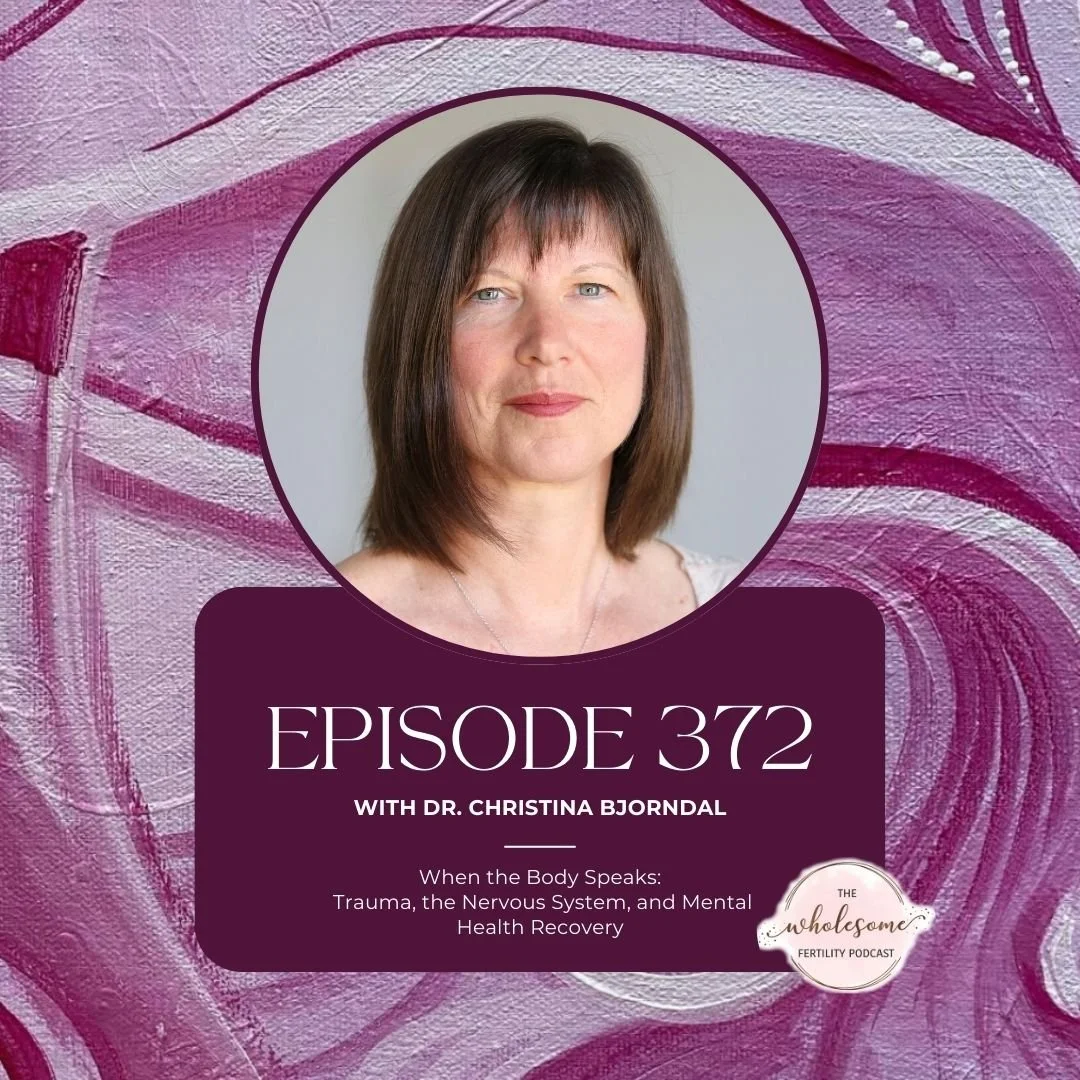
On today’s episode of The Wholesome Fertility Podcast, I’m joined by ( @drchrisbjorndal), a naturopathic doctor, author, and mental health expert, for a powerful and deeply honest conversation about healing beyond diagnoses.
Dr. Christina shares her personal journey through depression, bipolar disorder, suicide attempts, and recovery, and how those experiences shaped her integrative approach to mental health and whole-person healing. Together, we explore the profound connection between the mind, body, nervous system, and spirit, and why true healing requires more than symptom management.
In this episode, we talk about how trauma, nutrition, gut health, stress, and unexamined thought patterns can influence mental health and fertility. Dr. Christina also explains why labels can be limiting, how epigenetics shapes our health beyond genetics, and why cultivating self-compassion and safety in the body is foundational to healing.
This conversation offers hope, perspective, and practical insights for anyone navigating mental health challenges, fertility struggles, or the pressure to “fix” themselves instead of understanding what their body is asking for.
Key Takeaways:
Mental health diagnoses describe symptoms, not root causes
Healing requires addressing the nervous system, not just the mind
Thoughts directly influence physiology through stress hormones and immune function
Epigenetics explains how environment, trauma, and lifestyle shape health outcomes
Digestion and nutrition depend on nervous system regulation, not just food choices
Self-compassion and self-acceptance are essential, not optional, for healing
Hope and possibility are powerful forces in recovery and fertility journeys
Connect with Margaret Cali:
Website: https://drbjorndal.com
Instagram: @drchrisbjorndal
Facebook: Dr. Christina Bjorndal
Twitter/X: @drbjorndal
YouTube: Christina Bjorndal
Disclaimer: The information shared on this podcast is for educational and informational purposes only and is not intended as medical advice. Please consult with your healthcare provider before making any changes to your health or fertility care.
Ready to discover what your body needs most on your fertility journey?
Take the personalized quiz inside The Wholesome Fertility Journey and get tailored resources to meet you exactly where you are:
https://www.michelleoravitz.com/the-wholesome-fertility-journey
For more about my work and offerings, visit: www.michelleoravitz.com
Curious about ancient wisdom for fertility? Grab my book The Way of Fertility:
https://www.michelleoravitz.com/thewayoffertility
Join the Wholesome Fertility Facebook Group for free resources & community support:
https://www.facebook.com/groups/2149554308396504/
Connect with me on social:
Instagram: @thewholesomelotusfertility
Facebook: The Wholesome Lotus
Disclaimer: Some of the links shared are affiliates but this is at no cost to you and can even get you discounted prices!
-
[00:00:00]
Michelle: Welcome to the podcast Dr Christina
Christina: Thanks so much for having me.
Michelle: excited to have you so I met Dr Christina on a summit that we did and I really, really connected with your message, so I knew I had to have you on 'cause I felt like we had a lot in common and we, you had actually walked people through a heart connection, heart and womb, and I was like, okay, she's speaking my language. But I know you also have a lot of, experience in this kind of field and the science aspect of it. And and I would love for the listeners to hear your origin story. 'cause I always like to start with an origin story. I.
Christina: yes. it's important 'cause I, I actually haven't always been a naturopathic doctor and it's my own struggles with my mental health that brought me to become one. So in, in a nutshell, I was diagnosed with depression and that. I was prescribed medications and I then [00:01:00] actually swung into a psychotic episode while on those medications.
And so then I was diagnosed with bipolar disorder type one. And what I did with that is I was like. Well, that's not happening to me. Like, oh, what's this? And I'll, and I'll preface that with, I am adopted, so there is no ability for me to look to my left or my right to verify the truth of that. So I didn't accept the genetic theory, and I, and I do subscribe to the theory that genes load the gun.
Yes, but lifestyle pose the trigger.
Michelle: Hmm. I love that saying. That's a great way to say it.
Christina: Yeah, it does. And so, I was walking through the world with this mask though, which is not good in the sense that I was, playing the role or persona that I had it all together. And, but yet I was really struggling on the inside. And then, I had a suicide attempt that left me in a coma with kidney failure and I was on dialysis and told I would need a kidney transplant.
And that was really my, my origin story, if you will. Like, that was the rock bottom point for [00:02:00] me. And there was a, I was given a book to read about, by Maryanne Williamson called A Return to Love.
Michelle: I love that book.
Christina: Yes. And there's a beautiful quote about surrender and learning to, accept ourselves. And I realized that, goodness me, I'm walking through the world.
With a lot of stigma and shame about this diagnosis that I don't really understand, and a lot of depression, a lot of anxiety, had an eating disorder. And anyway, here we are. been on this journey of regaining my mental health, using a mind, body, spirit The approach I was using at the time was not, I just was medication upon medication and I wasn't getting better. That's really important to note, right? So anyway, so eventually I went back to school 'cause I was working in the corporate world and I reported to A CEO and I had a lot of stress and, and I went back to school to become a naturopathic doctor back to high school at 33.
And then here we are.
Michelle: So what got you into naturopathic medicine? Was that, I mean, part of [00:03:00] trying to figure out really what gets you better, more naturally, like, how did you specifically
Christina: Yeah, so that same best friend, we gotta, we gotta really love our best friends or, so she was a nutritionist and we, we had gone to university together, we raced on the UBC track team together and she was said to me, Chris, why don't you see a naturopathic doctor? And, and so I did, and interestingly enough, her and I and another colleague were gonna start an organic baby formula business.
And it was through the pursuit of that that I ended up at a Orthomolecular medicine mental health regained public forum. And I learned about a doctor named Dr. Abraham Hoffer. He's. Quite famous in Canada. He's passed away now, but he worked with Linus Pauling, who won two Nobel Prizes. One of them on his research on vitamin C.
So [00:04:00] I, and he was a psychiatrist, but he was nutritionally oriented. So I went to both of these practitioners, my, my naturopathic doctor, and the Dr. Hoffer, a nutritionally oriented psychiatrist. And lo and behold. Starting their protocol. had my first year where I was free from depression and anxiety, which I had not had in the 15 years.
Michelle: Wow,
Christina: Hmm. 15 years. Prior to that, I would, 70% or more of my time was spelled spent in a depressive state. And then I was like, okay, there's gotta be something to what these guys are doing. And the key thing for me was. me two years to get in to see Dr. Larry Chan, and a long time also to get in, to get, not as much time but wait time anyways to get into Dr.
Hoffer and he was 80 years old. And I'm thinking, my goodness, I know there's lots of people struggling here. Why is it taking so long for me to get help now? You, you know, when they, when I made [00:05:00] the appointment with Dr. Chan, I was like, they said it's two year wait. And I'm like, well, I'll make the appointment.
I don't know if I'm gonna be here. You know, like,
Michelle: Wow
Christina: and indeed I did have a second suicide attempt, you know, while I was getting, trying to get myself landed and grounded in, in this is in some other way to support myself. And he was, he's a acupuncturist first and foremost, you know? So then I realized, you know what, I had a great job with paying very well and I wasn't happy
Michelle: Mm-hmm.
Christina: Eventually, even when I became happy with the supplement support, I wasn't passionate about what I was doing. And so I wanted to make a difference in people's lives, and that's one of the reasons I made the change.
Michelle: That's pretty remarkable. What a story. And I, you know, it's interesting 'cause I'm listening to you and I'm thinking kind of similar. I have a similar path. I mean, I didn't have, I didn't have it as.
[00:06:00] Severe you know, like I, I, but I definitely suffered from depression and anxiety, like when I was younger and growing up and I had, I definitely had anxiety.
I never even knew I had anxiety. Now I look back and I'm like, I had
anxiety like I had fears and I. I even used to do things like a little bit OCD where I'd have to like tap things in a
certain way which would mean that things are gonna go well versus not go well. And so I know that I had some kind of anxiety and I didn't feel safe in my body.
I mean, and I, and I look back, I went and I went to an acupuncturist. One of the things I noticed was that not only were my symptoms, my physical symptoms resolving, but I started feeling better. Mentally. and then I also look back and I used to eat gluten and I went gluten-free and I found that I was less bloated, but then I realized like I'm less
anxious on a gluten-free diet.
So there's such a physical mental
[00:07:00] connection you know, you're treating your physical body. But, and we had talked about this, and this is I think one of the reasons why I really felt connected with you and like. Really your background and how you approach things is, is that there is such a somatic aspect of the mind, you know, like the, the experience in the body impacts the mind so much more.
And it's interesting because many people, I think just conventionally think that there is this separation, like the mind can't affect the body. But also the body can't affect the mind. So it's kind of this bi-directional relationship and really addressing it like you, you were saying physically and through diet actually made a difference on your mind.
Christina: what a concept.
Michelle: Yeah, it's
Christina: and I think it's really lovely to look at the shift and the changes that have happened. So when I was initially struggling, struggling, we'll say starting in 1980, [00:08:00] you know, it's, that's been a long, you know, several years, right? 45 years if I'm doing the math properly, and to see the.
Difference in, because there was, there was no conversation in 1980 about the microbiome, let alone any directional relationship. Right. Like, like you were saying back in 1980, it was deemed almost separate. You know, like we just were living from the neck up and we might as well just have little knees under our chins and, 'cause nobody was talking about,
Michelle: This
Christina: nobody's talking about the body.
Right. And, and so, but thanks to the work of, people like Steven Porges and Bessel VanDerKolk and, Gabor Matte and, and many others, I wish I could name some women. I should. Let's name some women, like, molecules of emotion, Candace pert. You know, there's such, such advances now, so we understand that there is, it's bi-directional.
So, and now I think the conversation should be in the research. If it's not, well, what, you know. Which microbes actually, 'cause the microbes [00:09:00] affect this way, and then that affects this way. So, and, and we don't really have to get caught up in, and this is where I get a little frustrated with, with Western science, and they're always so focused on what's the one cause or the one thing.
And, and you know, we're multifactorial beings and so, know, if you think about a tree, it doesn't have one root, right?
Michelle: a
hundred percent I love that. I love that. Like that's such a
Christina: A good visual, right? There's this massive ecosystem underneath the ground that we don't
see. We just see this beautiful tree. Now, the, that, who knows the root system could be diseased, and that's an akin to wearing this mask that we walk around with a big smile on our face when we are, when we're thinking about awful, doing awful things to ourselves.
But we have to be bringing these. Conversations into the open air about what's going on between here and here in terms of the thoughts or the emotions, and be able [00:10:00] to be vulnerable and authentic. And that is a shift that I, you know, we can thank Brenny Brown for that because I, you know, Oprah Winfrey because, oh, no, no, because back and again, 1980, boy, oh boy.
You know, don't say anything. Don't tell anybody. That's what I was told actually by my psychiatrist. Oh, you know what, Chris, do not tell anybody that you have this condition because and, and so I'm like, well, what do you mean? You know, like, then I walked outta that, that office feeling bad and dark and awful and, and
Michelle: like
Christina: she, and rejected and like a dark, like, don't you dare disclose 'cause people are not gonna like you.
And you know, wow. Like, that's awful. Right.
Michelle: Yeah. And little did we know that I think that so many other people are feeling the same way quietly. It's like, you too. You know? Are you also feeling this way? Like, you know, and everybody's afraid to talk about it. And you were right. I used to watch [00:11:00] Oprah Winfrey and she really helped me a lot growing up because. She put a name to it. She spoke about it, and she spoke about these topics that a lot of people wouldn't speak
about
Christina: right. I mean, I remember when she decided to do, at the end of every episode, a bit of a conversation about the soul. She got a lot of flack about that, but she can pursued and it's important. Nobody was discussing the soul or the spirit or, you know, anything like that. So I think that it's really important that we understand that, you know, we as humans, yes, the physical level, don't get me wrong, I mean, that's where I started very important.
But I'll tell you the one downfall with, with, i'm gonna, I'll take ownership of this. I wasn't disclosing to my doctors that I had an eating disorder as if you're a clinician listening to this, you need to be asking the right questions to the patient. And then it's all about creating that [00:12:00] safety in that therapeutic relationship so that the patient, even if you ask the right question, they will feel safe to answer it as well.
And so the sup and the reason I wanna mention that is because I did start on a lot of supplements, but they were propping me up and filling the nutritional gaps from my horrible diet, right? So I was a, I was a vegetarian eating no vegetables, so I was a carpentarian and a sugar addict.
Michelle: Yeah.
yeah. No, that's true. It's true. I, I went through that myself and if you don't really know what to eat and you become a vegetarian, you can be, you can really deplete yourself
Christina: big time
on so many nutrients that are so important for these pathways to work in our body. So I really like, I really wanna emphasize that too, because. I think one of the bad reputations that the functional medicine industry has is over supplementing and, and as a naturopathic doctor, I am not wanting to do that.
My goal is not for you to be [00:13:00] on these supplements. My goal is for you to obviously resolve the symptom picture that is presenting for you using modalities that are available to me. Not have you on 50 million supplements. That's not, that's not the end game here.
Michelle: Yeah, I mean, it's really interesting that you talk about how like there's so many, we're so multifaceted and sometimes we do get so hung up on the studies, and of course the studies can give us a lot of information, but there's so much behind studies. I mean, there's companies behind studies.
You don't know how it's skewed. I mean, there's so many other variables to the studies that it's hard to really decipher. Based on all of these different parts, while those parts can be really beneficial, I mean, there's one study that actually showed that, mental disorders were very much linked to the gut microbiome, and that's fascinating information.
It confirms what we, you know, we're, we're looking into, but we get too hung [00:14:00] up on it. Then we stop using. And I know that you also have a spiritual perspective and, and that intuition, when we stop connecting to that intuition and stop acknowledging that we do have a spirit. And that's what I love about Chinese medicine is they do actually acknowledge
the spirit of a person and that's part of the health. And so when we acknowledge that and see that there's something more vast, and yes, we can. Rely on studies, and yes, we can use it as close to the puzzle, you know, or pieces to the puzzle, but if we solely and completely ignore the aspect of us that is intelligent and that can connect to other things that have not yet been proven. Then that, I mean, can give us so much info. We can actually download information. I know this 'cause I'm a meditator. I know that I've downloaded information and every meditator will say the same thing. They understand that it's real. because you can't know [00:15:00] that until you're in that state of such deep receptivity that you're able to download information and it your body
Christina: Yeah, absolutely. And one of the. The simple statement that I love to say to people is, well, who is the teacher of science? Like, who is the teacher of science and its nature? Right? And, and so you know, we, of course, but, but some of the things that we study, like for example, just before I came on this interview with you, I was researching for this, my new book that I'm writing about my, about my eating disorder journey.
And there was a study about sleep and I, and I was thinking to myself. Wow. Like we really have to, we really have to sort of state the obvious here to people like,
Michelle: This is
Christina: did you need some sleep? Like, I'm like, okay. You know, so it just for me,
Michelle: All you need is one really bad night of sleep and you'll know that you need sleep because of how you feel. You
Christina: but I was like, how much money did they spend on this study? You know? I mean, of course, you know, [00:16:00] so sometimes I think. Really are we, do we really need to study everything under do you get what I'm trying to say?
Michelle: It's true.
A hundred
Christina: but the fascinating piece, you know, of course the microbiome is very fascinating interest and interesting and, and a sidebar about that for myself is I did a year of antibiotics when I was 14 to treat acne and.
Right. Yeah. And then my eating disorder started the year after, and then the me, and then the depression, anxiety, you know, it all, it all unfolded. Now is so interesting. And I think this just highlights the importance again, of asking the right questions. And one of them is, when do you think things started for you?
You know? And in my case, I just said 14, but I'm gonna go back even further to the in utero experience, right? It starts in utero for people And
Right. And if we have to bring in this idea that Western Medicine is trying to prove, probably right this second as we're [00:17:00] speaking of intergenerational trauma,
Michelle: Mm-hmm
Christina: there are studies about this done already, so
Michelle: there are, and I think part of them were Holocaust and, you know how you have,
Christina: well, even
Michelle: our DNA,
Christina: they did a study
Michelle: The DNA would have
information because we're evolving, so it, carries information so that you learn from your parents or whatever they had to learn, and sometimes with that learning comes the memory of
Christina: right. Yeah. Yeah. And, and the in utero experience is, is so important because when you were an egg in your, in the developing fetus of your mother, in her ovary, you were there. As a
single cell egg, in, in your, her, in your grandmother when she was carrying your mother. So people, sometimes you have to slow down and get your head around what, what I just said.
But it's, it's very important because I am adopted and I [00:18:00] have been so fascinated with this nature versus nurture argument, and because western medicine for. Many years, was very focused on the whole, the gene. Everything's about the genetics. And, and this is where, where I mentioned earlier that, you know, it's, it's actually epigenetics that's important.
And the work of Bruce Li Lipin, bringing that to the forefront and concept of psycho neuroimmunology. And in my own case. Whenever you ask a question, and the first question I asked after that psychotic event, which was very, alarming to me, and, and of course the people around me was, why did that happen and how did that happen?
And the answer I got was, well, it's genetic, nothing you can do. And I'm like, really?
Michelle: Yeah
Christina: No nothing because I don't, I don't wanna have, I don't really wanna experience that again, thank you very much. So there better be something else I can do other than the take drugs. 'cause [00:19:00] here we are, you know? And so I got told that there's nothing, nothing you can do, which means there's no cure.
But I didn't accept that. And what, what breaks my heart is that right as we were talking, people are being told that right now in a doctor's office.
Michelle: People listening to this, I mean, same thing, but on different, it's just
different levels different types of
Christina: And, and if we bring it to the conversation to fertility, how many women are told you're not gonna be able to conceive? And, and, and it's like, who are we to say
Michelle: It happens all the time. Like I can't even count, I can't even count it
Christina: I know. And that should not be like, I think as clinicians, our role is to bring. Hope and possibility and understanding of how the body works. And there is, I mean, this is, there's reasons and explanations for your, your symptom picture and your suffering, and we just, and if you aren't feeling better, I feel that it's because there's, we, somebody hasn't investigated, there's a [00:20:00] stone that hasn't been turned over yet.
Michelle: I agree. I, I really do. I
Christina: Yeah. Yeah.
Michelle: And it's just a matter of hope. Hope in the possibility because I think even doctors need to have hope and the possibility for
their patients and I think that when they don't it. Oftentimes does translate into the consciousness of the patient,
Christina: Absolutely.
Absolutely. Yeah.
Yeah. So it's been, um, you know, a beautiful journey to not only be able to then regain my mental health, but also to be able to help other people with, whether it's their fertility journey or out of depression or anxiety, even bipolar disorder, whatever it might be.
Because remember that these labels and my, book that I love to share about. Is called beyond the label. 10. Yeah. 10 steps to improve your mental.
Yeah. And, and the thing with it is that the label explains a constellation of symptoms, [00:21:00] but it doesn't tell me how you got there.
Michelle: Mm-hmm.
Christina: explanation is always rooted in some earlier experience that predates the diagnosis.
So it's, there's so much to us and there's, and that, that I'm saying that. Not from, for, for people to take it like, oh goodness. But to take it from a place of like, this is, this is where the answers lie, so it's the answer's there, we just have to figure it out. That's all.
Michelle: And it gives a lot of hope, like I said, and it's, you know what I love about talking to naturopaths. Is that they're very similar
minded I, their approach is very similar to acupuncturists, where we're always looking for
that root So rather than saying this is a symptom, it just is what it is. There's, we're always kind of digging, trying to figure out.
There's always, it's almost like a very, uh solution oriented field. And that's how I feel like there, that there is no one way to treat anything. And because I think that that is what. Gives way [00:22:00] to more possibility. If we know that there's not one way to treat anything and that not every person's the same, then there's less likely that we're gonna perceive our patients as a
statistic
Christina: That's right.
Michelle: and and that's where we start to dig and dig and dig and take
Christina: Yes. Yeah. And, many naturopathic doctors, depending on the school, they, they go to, and it's important that they go to a accredited program because I know that in the United States, they, not all states are regulated or licensed. So there are people that have done, haven't done proper programs, and, but in some of, like in my schooling in Canada, acupuncture is a modality that we are taught.
And, are licensed to use. So, but not all the schools have acupuncture. some of that's a separate four year program,
Michelle: Yes. Yeah, I have heard of that. but for that, you know, for the reason that there's just so,
such similarities in the medicines and I think the big thing is how we [00:23:00] view the body as being so forgiving. We really understand that the body's incredibly intelligent and that the body is self-healing. And it's just asking for something.
It needs something or it needs to remove something that's in the
way And and so there's always kind of that almost detective work that we do to try to like unravel and figure out what's going on. And as far as, the mind body connection, what are some of the biggest things or ahas that you found throughout?
And I know that this could be very vast, but like what are some of the big ones that come to mind?
Christina: Yeah. Well, I first, I just wanna add on one thing to what you said about adding things or removing things, and one of the things that we talk about in our. Osteopathic medicine is obstacles to cure. And, and they're, you know, so an example of an obstacle to, to cure, and I'm not saying this from a place of judgment, I'm just, it's just an observation is, is actually I can share a, a about a case.
I had this woman come to see me for depression and Lyme [00:24:00] disease but she was a very heavy smoker. And so at some point we got, you know, I worked, first and foremost was the depression and, and the Lyme. I wasn't very versed in Lyme. This is probably 15 years ago. Anyway, I found a colleague who was, and so she was helping her with that, and I was helping her with her mental health.
But then at some point I had to say, you know, I need to have a conversation with you about smoking because this is, this is an obstacle to cure. And anyway.
Michelle: Hmm. Yeah,
Christina: Yeah. And she was, so at this point, she was very focused on the Lyme. And then I said, you know, I'm really concerned about this chronic cough here that you have going on.
Could you please get that checked out? Because I didn't have, I didn't have access to diagnostics myself. I have to refer for that. Anyway, she got, so she, she went and she, she did a, chest x-ray and she had lung cancer. Yeah. And she died. so I remember saying to her like, we do not need to be focused on your Lyme disease.
We need to be focused on, so this is, it's a very good [00:25:00] example of an obstacle to cure. And that that obstacle, obviously, it, it took her life.
Michelle: Wow.
Christina: So it's, it's a, a very empowering story to acknowledge that we, we do have to have these conversations about things and they're hard conversations because, you know, it, we we're going into the area of addictions now, and, you know, so, mm-hmm.
Michelle: it's interesting you say that because like, what I find oftentimes is people get very, strict about their diet. They're strict about their supplements, they're strict about everything in their life, how to exercise, what to do, everything's a plus, you know, like down the line. However, though they're so focused on that, that they forget, you know, and I do think that there is an addiction to stress.
Christina: Yes,
Michelle: We don't realize that, but we can actually get addicted to
stress hormones, and Dr. Joe Dispenza talks about this often. We can get really addicted to 'em. It can make [00:26:00] us feel like we're in control. It's a fake sense of control, but it's not
real and it's not really helping us. So it's like we can do all of these other things, but until we address that. Foundation. That's kind of like the sabotage of everything else. We're not really
Christina: that's right.
Michelle: better.
Christina: Yeah, I mean, I, I will acknowledge within myself as somebody who is this type a overachiever, perfectionist type that you described. I mean, I, I had to let her go a long time ago because it's like, okay. Uh, But you do speak to, again, a very important point that I wanna talk about in my, in my new book, which is, is this journey to ultimately.
Acceptance and, and our industry, this industry of that, we were calling the health industry right now from a nutrition perspective, just that one modality. There is so much ad adversarial conversation going on. You've got carnivores on the one extreme and vegans on the other and everything in between.
[00:27:00] And I, I said to my best friend, I feel like the nutrition industry has bipolar disorder. Like there's just so much swinging and, and so. The conversation that I wanna bring to the table is who's, who's actually looking at the reasons behind why you wanna have a perfect body and where's that coming from, and why are we not actually accepting ourselves?
and are we creating more problems as clinicians by saying, cut out wheat, dairy, sugar, eggs, corn, inflammatory foods, and dairy. Are we, what, what kind of obsessiveness are we creating with? And I'm somebody who has been looking at this for a long time. So I went on a tangent to say, because in terms of Joe Dispenza, who I, I value and, love studying his work, I even had to say to myself, man, am I addicted to to drama?
when my life gets steady, do I actually go looking for something to make it unsteady?
That was a big [00:28:00] observation and, So anyway, I, we could talk, we, we probably are gonna have to have another call here because I'm like, we gotta go on that.
So, but I wanna answer your question about the mind body relationship and what were some of the a ahas for, for myself, and there is so many, but I think the biggest one was actually after my, so I've had three suicide attempts in total. And the last one was getting to be long ago, you know, as we continue on in time.
But it was in 2009, so it wasn't like it was, it wasn't last week obviously, but it was while I was practicing as a clinician, and I'm gonna mention this because this is, we, you, you work in the fertility space that it was in a postpartum state and, but it was so This conversation about mental health is important for every age group and every stage of our lives, but in particularly very critical in the postpartum window.
And I'm gonna extend the window though, because I don't think 12 months. I [00:29:00] think at the 12 month mark when they say you're out of the woods, so to speak, you're not, you're just getting into the woods. You're just getting started. So I really think the first five years postpartum is when women struggle, not within the first 12 months.
So I mean, you can struggle in that timeframe, but for me it was anyway, a little bit delayed, if you will. And then I know science, people listening might argue, we say to me, well that's not postpartum, Chris. But in my mind it really was, in that window. It was a very delicate, anyway, so my point being that.
The person who helps me the most was a colleague, another, another naturopathic doctor, who was the first person to teach me that. I do not need to believe every thought that I think.
Michelle: Mm.
Christina: So your thoughts create neuropeptides. Your neuropeptides affect the hormone, the glands, which produce [00:30:00] hormones. Then if we're talking about the adrenal gland, that produces cortisol, but there's also epinephrine and norepinephrine and, and those are more neurotransmitter based.
so let's just speak with cortisol, 'cause many people are familiar with that. That then feeds back up to the brain and says to the nervous system, stress or No stress, danger or safety, sympathetic or parasympathetic, and. So this is called psycho neuroimmunology, which is a fancy word to mean your thoughts affect your physiology.
So when he said, so he taught me this four R approach, which is the first R is recognize what you're thinking. Like, take the thought out. If this pen represents a thought, take it out. Look at it and ask, are you serving me right now? Are you sabotaging me? Are you hurting or helping? Are you inner critic based or inner cheerleader, bully, or friend?
Like What side are you on here? [00:31:00] What team are you playing for? You know, the stress team or the safety team? So most of my thoughts, if not 100%, 110% were inner critic, sympathetic, all about how, what a horrible human being I am. So then, so once you've recognized that you are having thoughts based in problematic thinking, then your next sec second step is to refrain from following them.
This is where meditation is so helpful. So I'm not saying to suppress anything, but I'm just saying we don't carry on the conversation. We just set the conversation down and then we, the third step is we relax into the body. We take two deep breaths, we connect with nature, we get out of our heads, if you will, because.
The egoic mind is a very busy place. It's busy in, in, in my head. It's very busy and there's a lot of traffic that's being directed, right? And it's like we need a little bit of a moment of a reprieve here. Just a little, little heartbeat of stillness. And you [00:32:00] get that if you give the egoic mind a job, you say, Hey man, look at that tree outside and then, oh, okay.
The ego, it does ultimately wanna serve you. But the problem with it is, it's. Space in the past, often in protecting you from the pain of the past. And we don't need that belief anymore now in this present moment. And so by doing the breath, then the four step is to reso resolve to repeat those first three steps over and over and over and over and over.
So when Dr. Hughes taught me this, I said to him, well, I, I'm gonna be doing this all day long, right? And he's like, perfect.
So.
Michelle: great
Christina: it's
a
practice
and just like we go to the gym, right, to, to get a nice toned bicep or do sit ups get a six pack, we need to go to spiritual gym.
Michelle: Mm-hmm.
Christina: Yeah. And so listen, and I remember saying to him, well, you're not gonna prescribe me some St.
John War. Like, come on man. Like, you just want me to, what is this gonna, this, you know, I was super negative. I was even like, [00:33:00] this isn't gonna help me. Which in and of itself is a problematic thought,
Michelle: Yeah. That's so interesting. It's all
Christina: Yep. And so that process, which I've now expanded because I'm I, you know, I'm still this recovering overachiever, I call it the seven Rs now, but really the first four, those are the first four.
So recognize, refrain, relax, repeat. The fifth step I add is related to what I was talking about in terms of psycho neuroimmunology. So we do wanna take that problematic thought we recognized and see if we can say something. Opposite. That is helpful because now this, I used to roll my eyes at people who would say, say to me, Hey, Chris, change your thoughts.
Change your life, or do an affirmation. I would be like, roll my eyes and probably stomp outta the room because I felt like people were implying that I was intentionally causing my issues with. You know, on purpose, but this isn't the [00:34:00] case. We have a subconscious mind, and it is constantly dialoguing, and we're not always aware.
But when you can bring that into your conscious awareness, then from that place you can create a new empowering belief that will carry you forward. And this is, you know, this is, you have to remember, I, I, when I'm listening to myself talk, I'm like, gosh, Chris, this sounds very simple. And honestly it is.
However, I mean, I've been doing this for. Daily since 2009, committed to this practice. So, and I know that if you commit to acknowledging what you're thinking and seeing if you can shift your thinking. The reason why this is so important is it shifts your physiology and this is what you were talking about.
So now we no longer are on the cortisol kick.
Michelle: Mm-hmm.
Christina: we're gonna be more on the parasympathetic. And I just wanna say one more thing and, and tie this up because we were talking about nutrition a moment ago. [00:35:00] One of my huge pet peeves about the health industry is everybody's focused on what diet is perfect for you, but nobody is talking about the state in which you are in when you're eating that food and digestion.
My friend
is a parasympathetic state and most of us are in a sympathetic state.
Michelle: Totally. It's so funny 'cause my husband sometimes he will like run out to work and he works in the ER and he'll take something and eat it in the car. I'm like, don't do that. You gotta just, even if it's like wake up five minutes earlier, just give yourself time to sit down and eat. Because when you're doing that, so like, you know, the fight or flight or the sympathetic versus parasympathetic. Sympathetic isn't always necessarily like high stress, it could be just high alert. So driving, you're typically gonna go into
sympathetic mode. That doesn't mean that you're like completely stressed out either, but you're like very focused. And what does that do? It, it shuts down the
digestion like you just said.
And [00:36:00] so it's not great to
eat in the car
Christina: No, And I think it's, I think this as humans, I mean, you know, the ER is a very busy, you know, it's a very busy place and, and it's also gonna be. You know, high, probably a higher amped up vibration wise, but it doesn't necessarily have to be stressful. Right. And I think, and the thing, the thing is that we've become used to, I think as humans, multitasking constantly.
And you know, and the thing is that's not actually research shows, coming back to the research word actually shows that it's not, you know, it, it's better to be doing, if you're gonna be eating like, well, let's just eat
Michelle: Yeah,
Christina: Most people are chomp, chomp, swallow. They're eating on the run, eating while they're driving, going through drive-throughs and eating and digestion starts with when it doesn't start.
When you put the food in your mouth, it starts you cooking the food, right?
Michelle: yeah. Smelling, looking, seeing visual, like you could see it. It's so interesting 'cause I started noticing when we go to restaurants. Every [00:37:00] time my husband and both of us look at the food, look at the menu, we start to salivate. 'cause I, I, I hear him swallowing and I'm like, you're salivating too. Like as we're talking about the food that we're about to order and we're just reading it off the menu, we're
starting to salivate So it's crazy. But it's like the mental, like as soon as we know we're about to eat, that's how we salivate. Which is, like you said, it's so true. Like being mindful
with it Starts to make you salivate and why saliva is so important, because it has all these enzymes that help you digest. So it starts in, you
Christina: that's right. But it starts with a sense of smell, that sense of signal up to the brain that then sets a signal on the vagus nerve that, Hey, guess what? Stomach food's gonna be coming, so let's get ready for it. But the thing is, when we just unwrap and then down the hatch, the, the stomach's like, Hey, what, what the hell man?
What the heck? Vagus nerves, whatcha doing buddy? Yeah, whatcha doing man? You're fired. Right? So it's like, so, and then, you know, we have this [00:38:00] sequi of symptoms. Digestive people have bloating and, and digestion and heartburn and constipation. None of which we should accept is acceptable because none of it is.
It's all, but, but what I find is people aren't focusing on what we're talking about. They're focusing on, oh, well eat more fiber or drink more water. And that may be so, absolutely. I'm not discounting that, but who's saying to you? Tell me about your, how you, how you, what your stress is like and, and how, how are you prepping your meals?
Michelle: ' It's so interesting because people ignore that
aspect of ourselves because it's hard
to quantify Yeah.
It's pretty fascinating. I could talk to you for hours.
Christina: Well, I'll just have to,
Michelle: I think I might have to have you back, honestly, because we can like get into all kinds of conversations. But you're right though. I mean really with digestion and I think a lot of these things I always find that people will not, it's so hard to really quantify, especially if you're already in this, a [00:39:00] mental state.
Just like you said, like don't believe your thoughts, you
become your thoughts You identify with your thoughts, you really believe that that is just the only way because you're already in it. And I'm not sure, was it Einstein that said you can't solve a problem with the same state of mind that
created it
Christina: That's right.
Michelle: Well, I mean, if you're already in the state of mind, it's so hard to see. And so that's one of the reasons why somatic work can be so effective. And even just getting into your breath and your body sensations. 'cause you kind of like create a space. It's creating space between the thoughts and your body and your sensation being in the present moment. And a lot of what you're saying is really what Dr. Bruce Lipton talks about, about how our Petri dish becomes our blood and all the stress hormones that
come with it. And just a quick note, for people who don't know what epigenetics means,
because they're hearing it maybe for the first time, can you explain [00:40:00] why that's important?
How our genes can.
Be impacted by our
Christina: Yeah. Yeah. So, the, this is interesting. So they've done studies on identical twins. So identical twins who are separated at birth due to adoption. So different environments. So if everything is genetic, these are identical twins. Genetically, you would expect them to have the same outcomes. Health outcomes, disease.
Patterning conditioning, and they don't. And so this is where the research came from this, this concept that actually the genes are, the blue can be the blueprint, but they're not your destiny. And it's about the environment, IE, the trauma that you may have experienced, the nutrition that you may have been.
Given the, the other piece is this chemical component, the environment. So there's many, many chemicals in the environment. In fact, in umbilical cord blood, they did a study [00:41:00] across 10 babies. They found 270 contaminants.
So we are being born Yeah. Envi already with our environmental cups maxed out. The minute we, we, we exit the womb.
Then we're, you know, we go into the, to the world. So what this idea of epigenetics means that, so the gene part is, like I said, it's the blueprint, but the switch that turns it on or off. So let's just say not the blueprint. 'cause that different, better analogy, the gene would be the light bulb, but the switch to turn it on or off.
Is the epigenetic piece. And these are the environmental factors that I was just talking about. So the nurturing that you received, whether you were had a trauma, any form of abuse, even big tea traumas or even little tea traumas, like somebody stealing your lunch every day at school. You know, I mean, me, I, I was bullied in, in school.
I mean, you know, they, I mean, bullied, okay. I say it was bullying, but, and then I'm shrugging my [00:42:00] shoulders. 'cause I'm like, well, was it, you know, basically they, they, they formed this, I hate Christina Club. But for someone with the high level of sensitivity that I came outta the womb with and the belief that I'm not liked or wanted, that was hurtful to me,
Michelle: Yeah Well that's it's so rele. It's so, um
Christina: relatable
Michelle: Not uh it's, there's a word. It basically is like a, it, it's, not relevant, where it depends on your, like
Christina: Well, actually, I'll give you a good example though about that. So that, that, that was, so that was, that was, this is actually, maybe, this is an example I would say in epigenetics. So for myself, because of my trauma wound and, and adoption is the only trauma where the adoptee. Is expected to be grateful. It's important to think about that.
Now some people take offense to that quote. But it's important to think about that because, anyway, so my point is that my son had the same experience in grade, in the same grade as [00:43:00] I did. They started an I, some little girl who probably had a crush on him, started an I hate Noah Club, and he came home from school and he told me that, and I, and I, my heart sank and I was like, and immediately flashback to my experience.
And then he said, but mom, it's totally fine. 'cause nobody joined
Michelle: Oh, wow. It's like break the chain. It just
Christina: and it didn't, it didn't phase him at all. And, and for me though, I would, I mean, I walked around that whole school year like with no friends, right. So it, it really, the impact that's a, that's a really good example.
Michelle: Mm-hmm.
Christina: two experiences. And epigenetics is, another way you could look at it is, is the influences that are outside of you that affect the inside of you, right?
But when you ingest the food, I mean, that gets inside of you. And that can affect and chemicals and everything from, and this is where, [00:44:00] let's, let's look at, let's look at cancer. Here's another big subject that people ex, I mean, I hear this all the time with mental health and cancer. You know, well, so and so has it, so I'm gonna get it.
And I'm like, no, you're not them. You're not your parents. And, and so, and a great example, my, so the family that I was adopted into, my grandmother and her siblings, there were six of them. Every single one of them. Had cancer and died of cancer every, all six of them. All six. No. So therefore, if it's all about genes, then you would expect every one of their offspring.
So my mother and her first cousins would all also get cancer and die from cancer. Well, ask me how many of them have got cancer and died from cancer? Zero. So it's not all about the genes.
Michelle: Yeah, it's not, and I, I actually think that the reason why, you will see things like [00:45:00] that happen where the kid, the kids get it or they have similar responses or symptoms. Is because of their environment as well. Their environment's the same like that. People don't realize that the trauma is the same.
The culture that they're growing up in is the same, the food is the same then, you know, so it's, so people don't really think about that aspect of the fact that
Christina: Like if it's run, you know, if there's something that's been going on for generations. Right. But this is where Yeah, we wanna, we wanna really understand that. Okay. But, but yes. What, what have you actually
changed? Yeah. What have you actually changed? And is it really genetic though? Right. So it's, again, it.
So, so very powerful because I also think it cause when we just, play the card, well, there's nothing I can do. It's just as in my genetic blueprint, then we, I sort of feel like we're being victims and we're defeatist, right? Because listen, I don't wanna be, I, I [00:46:00] really, and I don't mean this from, it's gonna sound negative the way I'm gonna say this.
I didn't wanna be on a mental health rollercoaster, swinging from depression to mania and feeling very unsettled and like I'm on this rollercoaster for my entire life. Like, that to me, did not seem like an option. So I wanted to learn, well, how else can I navigate my mental health so that I can feel a little bit more, stable and.
Living in a joyful way. And, and in the bottom, in the back of my book, I talk about 23 myths that I was told, things like I shouldn't have children because I'm gonna pass this condition on because it's genetic. Right. And I, I think, goodness.
Michelle: That's insane way of
living I mean, it's just so crazy 'cause you could say that about
Christina: Right. Well, and the thing is, it's very fear-based.
And when we were talking about sympathetic versus parasympathetic, and I was using words, different words to represent, two other words [00:47:00] I'd like to say are, or four other words is sympathetic. Another word is fear versus love and or ego versus soul. So we wanna always be asking the question, how can I move to to love?
If we're talking about suicide and mental health, I mean, if anyone has had suicidal ideations or is contemplating taking their life, I can tell you they're the furthest from love that they're gonna than they're ever gonna be. And my job as a clinician is how do I guide them back,
you know? And two important questions I ask every patient.
And I love, you know, people that are listening can answer these for themselves. But a scale of one to 10 for both, 10 being the best, how much do you love yourself? The second question is, and, and the second one to answer is, how much self-compassion do you have? And I've yet to have somebody say nine outta 10, nine or more, even eight or more for both outta 10.
I've yet to have a human, and it's been 20 years. I'm waiting for somebody, so,
Michelle: It's amazing because of your [00:48:00] story, I feel like you can help so many
more people than had you not gone through it. So it's so interesting how you don't wanna go through something like that, but because of that, it almost, it should you go down the path that you did. It initiates you into this incredible greater calling to help so many people.
And I feel like you're doing God's work. I mean, it, I think when you answer that call, it really is. It's incredibly profound because when people are going through that and they're speaking to you, knowing that you went through that so that you're not just kind of sitting there with your
degree just talking at them like they really understand that you walk through it, there's a different
sense of trust and and knowing that you understand them on a deeper level.
So I think that that's really remarkable.
Christina: you. It, it's, I've had to answer this question. I've been on both sides of, of that suicide conversation and I've, I've had to answer the question, well, [00:49:00] why am I still here? and, and how come, and listen. I mean, I'm not, I'm not condoning that as a as an answer because, 'cause here's my view.
Suicide is a temporary situation. It's a temporary situation. And, and, and, or sorry, like that, that the feeling that, that being in that dark cloud is temporary, but the decision to take your life is permanent.
Michelle: Yeah.
Christina: So it's a permanent solution to a temporary situation. But I, I wanna, you know, emphasize here that it isn't the solution.
And I think every, I just had a colleague who lost a, her, her son, at 18 la like two weeks ago now. Yeah. And, and I thank you. I mean, I just, I'm just dumbfounded because I, I work in this space. I, I, I dedicate my book to saving souls from suicide. You know, I'm getting a bit emotional and I'm like, I've met this person, this young soul, and I, it's sad, but at the same time, this is where my spiritual beliefs help me,
with these very difficult things that are hard to have answers for.
And, and I accept that I am, this is not [00:50:00] my, way to leave, you know? And, I would like to. I, I think that we, we need to be talking to young people more about what's really going on.
And I know for me, it started at that same age. You know, my, my suicidal ideation started at the same age, 18, 19. There's a lot of pressure on these young people, and I don't think it's the pressure's any different than when we, we were going through it. I just think that I mean there are, the pressure's not different, but the society is different, you know, with these things.
And I think, that, you know, your twenties is, is not a mental illness. Your twenties aren't a mental illness. Okay. But there's difficult, it's a difficult stage of life.
Michelle: it really is. And I think that, you were talking about the phones and the, there's so many aspects. I mean, you know, the the.
positive part is that you hear other people telling stories and you
realize you're not alone. That's like the one positive about the time that we're living in, that it's no longer secret.
And I know that it ha, it's same thing with fertility. Like 10 years ago, people weren't [00:51:00] talking about it as much
as they are now. And then people are starting to realize, oh, I'm not the only one. There's other people going
through this too. And I think that aspect of it is healing. On the other hand. We're constantly being bombarded with too much information.
Our nervous system's going haywire. There's
chaos It's almost a chaotic energy, and and we're not grounded enough. We're not able to like really get quiet and connect with our bodies the way, you know, the our bodies are able
to help us and connecting and getting quiet and becoming more conscious and aware of our thoughts because we're so like sucked into
this
Christina: right.
Michelle: which is. You know, our phones and devices and so yeah. I mean, I'm telling you, I can keep talking to you for hours. I think you're such a deep, minded person. You're really interesting to talk to. And you also have in Incre, like I just, I'm really amazed with how you're writing books about the, these things and really taking your information [00:52:00] and translating it to help so many people.
I really admire that. I, I have to say, and. I know that I'm gonna probably have you on again because
we can keep talking. But I really, really admire it and I really love, connecting with you as a professional
and as as a human, as a person. And I would love to know, for the listeners, how can people find you?
How can they find your
Christina: Yes,
Michelle: And uh
Christina: yeah, I mean, and that's a good segue from us talking about phones, but basically, yeah, and
Michelle: yes
Christina: I mean, you know, this, it's, it's, it is definitely, I think you highlight such an important point that there are positives with some of, some of these advances, but yet we do have to navigate just like every other addictive substance in our lives.
We, we really have to develop, you know, a relationship that's. In service of us truly. And so you can find me on those platform, you know, Instagram, Dr. Chris Bjorn and my website, you know, my last name is a bit challenging to spell, but you, you'll be in the show notes, right? Yeah,
Michelle: It'll be in the show notes. Yeah,
Christina: yeah, [00:53:00] yeah. So just, yeah, Instagram, Facebook, and, I just, that's it.
That's all I can handle. I mean, I, you know, I think I have a YouTube channel, my website, and then the books they are available on online platforms like Amazon, Barnes and Noble, and in Canada, indigo or chapters, and. Yes. I mean, so grateful if people would check them out beyond the label, the Essential Diet.
Moving beyond a journal into Self-Discovery. And the fourth one is a compilation called From Shadows to Light, A Whole Human Approach to mental health.
Michelle: it Is that the one you're gonna
be working on What's your, your,
oh okay That's another one. Amazing. I I think I was just so impressed.
It's thank you. thank you. so much. Yes.
Really
Christina: And I, and I, I really, really love talking to you. I remember when we were doing the summit, I, and I was just like, when they asked a question, I'm just like, and you answered. I'm like, yep, exactly what, what Michelle said.
Michelle: Yeah, you could, you could tell when you meet what I call almost like soul tribe people, like people that you feel [00:54:00] immediate connection with, you speak the same language. it was immediate that I felt that with you. And then as, as soon as you start talking and I was like, I really need to get her on the podcast 'cause she's really interesting and
deep I'm like this is
Christina: Yes. Awesome. Well, thank you so much for having me.
Michelle: Well, thank you so much for coming on. It was such a
Christina: Take care.