
Ep 376 The Secret to Blood Flow, Hormones, and Longevity with Nitric Oxide Expert Dr. Nathan S. Bryan
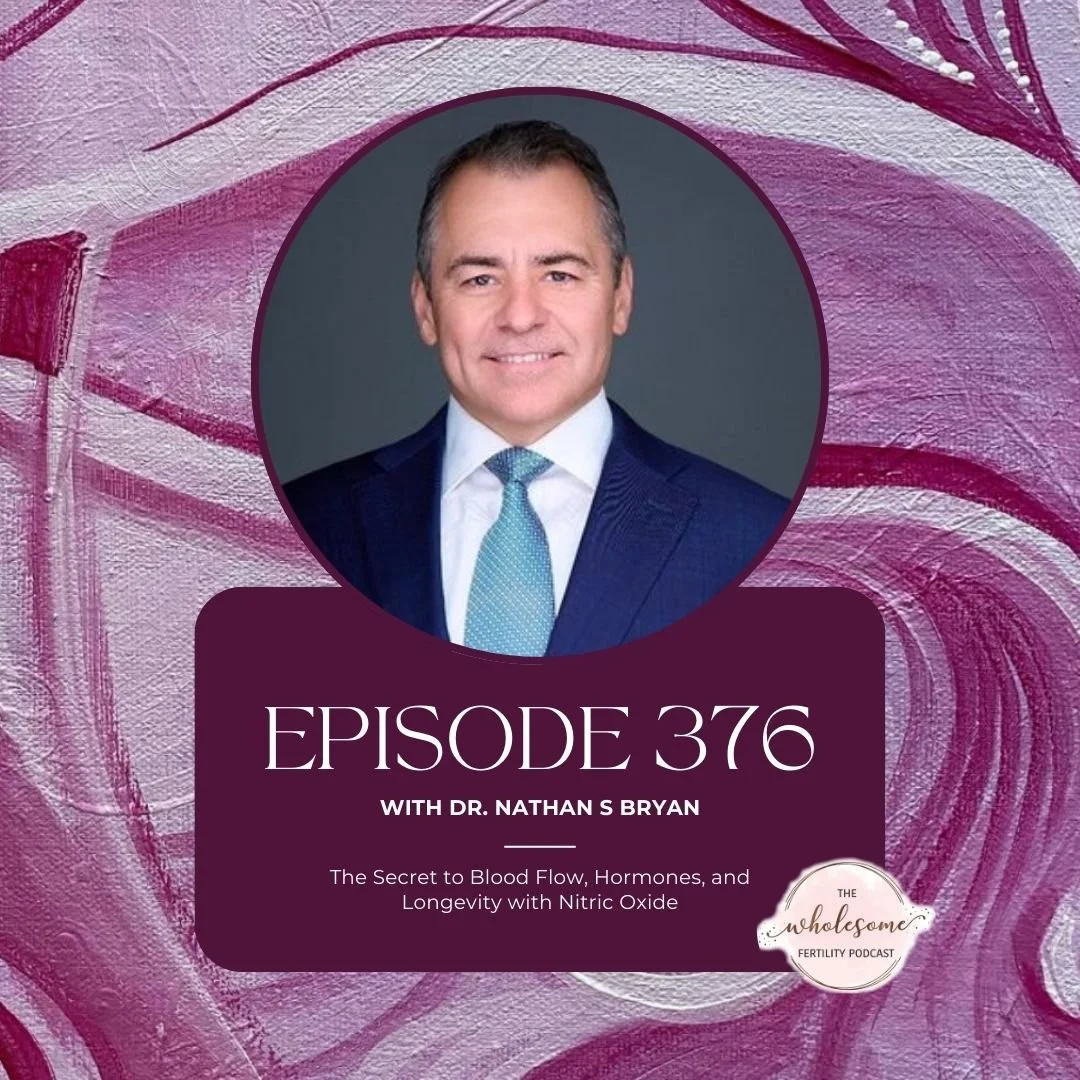
On today’s episode of The Wholesome Fertility Podcast, I’m joined by Dr. Nathan S. Bryan (@drnathansbryan), a leading scientist and world-renowned expert in nitric oxide research.
We explore why nitric oxide is foundational for fertility, blood flow, hormone health, and longevity, and how poor nitric oxide production impacts egg quality, uterine lining, sperm motility, insulin sensitivity, and mitochondrial function. Dr. Bryan also breaks down common misconceptions around beet supplements, mouthwash, fluoride, and medications that can quietly block nitric oxide production.
This episode is a must-listen for anyone trying to conceive, navigating hormonal imbalances, or looking to support long-term reproductive and metabolic health by addressing root causes.
Key Takeaways:
Why blood flow to the uterus, ovaries, and testes is essential for conception and IVF success
How nitric oxide supports cellular energy, oxygen delivery, and reproductive function
The connection between nitric oxide, blood sugar regulation, and PCOS
Why nitric oxide is critical for energy production, aging, and cellular repair
How sugar, fluoride, mouthwash, and acid-blocking medications impair nitric oxide production
Disclaimer: The information shared on this podcast is for educational and informational purposes only and is not intended as medical advice. Please consult with your healthcare provider before making any changes to your health or fertility care.
Ready to discover what your body needs most on your fertility journey?
Take the personalized quiz inside The Wholesome Fertility Journey and get tailored resources to meet you exactly where you are:
https://www.michelleoravitz.com/the-wholesome-fertility-journey
For more about my work and offerings, visit: www.michelleoravitz.com
Curious about ancient wisdom for fertility? Grab my book The Way of Fertility:
https://www.michelleoravitz.com/thewayoffertility
Join the Wholesome Fertility Facebook Group for free resources & community support:
https://www.facebook.com/groups/2149554308396504/
Connect with me on social:
Instagram: @thewholesomelotusfertility
Facebook: The Wholesome Lotus
Disclaimer: Some of the links shared are affiliates but this is at no cost to you and can even get you discounted prices!
-
Michelle: [00:00:00] Episode number 376 of the Wholesome Fertility Podcast. Welcome to the Wholesome Fertility Podcast. On today's episode, I'm joined by Dr. Nathan S. Bryan, a leading scientist biotech entrepreneur, and one of the most recognized experts in nitric oxide research. With over a hundred peer reviewed publications and dozens of patients, Dr.
Brian has spent nearly three decades studying how nitric oxide is produced in the body, where it goes, and why it matters for blood flow, cellular energy, longevity, and disease prevention. In this conversation, we go deep into what nitric oxide is. Why it's foundational for circulation and oxygen delivery, and how it influences key systems that matter for fertility, including uterine blood flow, mitochondrial function, and metabolic health.
Dr. Brian also challenges a [00:01:00] major misconception many of us have heard in the wellness world, including practitioners such as myself, that B products automatically boost nitric oxide. He explains why many commercial nitric oxide boosters don't deliver what they claim. And what needs to be in place for the body to make nitric oxide effectively.
We also cover what blocks nitric oxide production, including blood sugar issues, certain medications and disruptions to the oral microbiome, plus his perspective on testing dosing and what true nitric oxide support looks like. When the body can't produce enough on its own, if you're a practitioner, a biohacker, or someone who is on the fertility journey and really cares about fertility, circulation, and healthy aging, this episode will give you a fresh science-based understanding of a molecule that may be far more central to health than most [00:02:00] people realize.
All of Dr. Brian's links, including his book resources are in the episode notes, and this also includes a coupon code that you can use for the products we talk about. Now, let's dive in. Welcome to the Wholesome Fertility Podcast. I'm Michelle, a fertility acupuncturist here to provide you with resources on how to create a wholesome approach to your fertility journey.
Welcome to the podcast, Dr. Brian.
Dr. Nathan: So much for having me. Great to be with you.
Michelle: Yeah. So I'm really excited to get into the topic that we're gonna be talking about today. But before we get started, I always like to have a little introductory origin story and how you got into the work that you're doing.
Dr. Nathan: Yeah, for sure. You know, just like any life or career, it's been a journey. I'm a small town, Texas boy, grew up, you know, about an hour outside of Austin in central [00:03:00] Texas. Went to the University of Texas outta high school, got a degree in biochemistry, and then from there I went to LSU School of Medicine.
I got a PhD in Molecular and Cellular Physiology, and that was at the time the Nobel Prize had just been awarded for the discovery of nitric oxide. You know, I was a first year student, was looking to do research and was introduced to this new science of nitric oxide. So that's where. You know, I was first introduced to this.
We knew it was an important discovery, an important molecule because a Nobel Prize had just been awarded. But even then, you know, it's been 25, almost 30 years ago. Now when, and there were, and understand nitric oxide is a gas that's naturally produced in the body, and once it's produced, it's gone in less than a second.
So the work I did during my PhD was trying to figure out when nitric oxides produce, where does it go? What does it become and how does it signal? Then once we figured that out, then I went to Boston University School of Medicine. I did a, a postdoctoral fellowship there in cardiology and vascular biology, continuing the research on nitric [00:04:00] oxide and, you know, publishing a, a number of papers, high impact papers.
And then from there I was recruited by Fred Murad, one of the guys who shared the Nobel Prize and got my first faculty position as a professor of molecular medicine at UT Medical School in Houston. Back in. In Texas looking for a way to get back to Texas from Boston. You know, it was culture shock for a small town, country boy, but really my work continued There is, you know, for 10 years in academia made a lot of discoveries, fought a lot of patents ' cause we'd figured out how to make nitric oxide.
We understood how the human body made nitric oxide. We understand what, what led to a loss of its natural production. And then we could start to develop product technology and drug therapy. To overcome nitric oxide deficiency. So, you know, 25 years you know, a lot of education, a lot of training a lot of discoveries, a lot of research.
And you know, I've published today, I guess over a hundred peer reviewed papers, dozens of issues, patents. And so here we are and we've learned a lot, but we still have a lot to do.
Michelle: You sound very smart [00:05:00] and well versed. Which I love because I think that when you really spend your career focusing on one thing, you really become an expert and it's becomes like your, you know, and, and it is an important thing you're focusing on. I know with my work. We work a lot on trying to get more blood flow to the uterus to try to get help women conceive and also have more success in through IVF where when they're uterine lining is too thin.
So some of the things that I do is I try to, you know, suggest things like bee root things that increase nitric oxide. But I know, you know, a lot more on really how the body processes it, which I'm really excited to learn about today as a practitioner. And I know a lot of people listening to this, this is actually a really important molecule.
Molecule you said, right?
Dr. Nathan: Yeah, well hopefully after this conversation we're gonna get you off of beet juice. Juice is not a source of nitric oxide.
Michelle: Okay, so, so I wanna learn more about this 'cause I know that it [00:06:00] helps with blood. It's not beet juice. It's a beet root powder,
Dr. Nathan: Yeah. Good root powder. Yeah. But unfortunately most of the commercial products out there are, are, have, provide zero nitric oxide benefit. In fact, we've used a number of these as placebos in clinical trials. But because I think there's, there's a misconception and I, that's why these conversations are important because we have to, we have to correct the record.
Michelle: For sure. And I'll be the first to say that I'm always learning new things. And of course, you know, sometimes we, we learn wrong things as well. So, first of all, explain to people who are first hearing about this, what nitric oxide is past, like being a molecule. Like what is it, what does it do in the body?
And and then we can go into the misconceptions.
Dr. Nathan: Sure. Well now nitric oxide, as I mentioned, it's a gas, it's what we call a signaling molecule. It's how cells in the body communicate with one another. It was first discovered as a vasodilator, meaning that it, when it's produced in the lining of the blood vessel. It opens up the blood vessel. So now we're gonna get better blood flow and oxygen delivery to those [00:07:00] downstream tissues.
But today we know that it's much more than a vasodilator. It's a signaling molecule that it affects protein structure and functions and turns enzymes. And, and on or off, depending upon which enzymes it is, it mobilizes our own stem cells. So now we're gonna repair and replace dysfunctional cells and lead to better recovery.
It activates the mitochondria. The energy producing organelles of the cell. And then it also activates an enzyme called telomerase, which prevents the ends of our chromosomes or telomeres from our chromosomes from getting shorter. And we know now know today that the shorter telomere, shorter lifespan, longer telomeres, longer lifespan.
So when we look at what nitric oxide does, it improves blood flow circulation, oxygen delivery, mobilizes stem cells activates mitochondria, prevents telomere shortening. That's the foundation for human optimization, longevity disease prevention. Because the hot marks of every single chronic disease is low blood flow.
You lose the regulation of blood flow to that organ, [00:08:00] and then you develop inflammation, oxidative stress, and immune dysfunction. And fortunately for us, and fortunately for the world, nitric oxide overcomes all of this. It addresses the root cause of every age related chronic disease.
Michelle: That's incredible. You know, originally I'm thinking about how it dilates blood vessels and that helps with blood flow. They did actually see that blood flow as women age impacts equality as well. And you're mentioning also the mitochondria and how it really kind of is an anti-age or longevity molecule.
So I would love to talk about how how it is absorbed best in the body.
Dr. Nathan: Well, again, nitric oxides a gas, it's not a pill you can swallow. It's, you don't get it in a powder, you don't get it in a capsule, and you don't get it in a gummy or a chew. We have to understand how the human body makes this molecule. Then allow for its natural production, or you can do, like we did, we actually create a solid dose [00:09:00] form of ni oxide gas.
So, you know, in 2007, we, we published the very first study showing that nitric oxide is actually a hormone. So not dissimilar to estrogen replacement or estradiol in women, or testosterone in men, or, you know, thyroid hormone replacement. We have to restore the production of this molecule or actually give the actual molecule.
So if your body can't make it, then we have to provide it for you. But I think most importantly, you've gotta figure out why is your body not producing ample amounts of nitric oxide? That's the fundamental question we should try to answer. And then stop doing the things that inhibit its production, start doing the things that can activate and stimulate its production.
And then we, we've, we've addressed a lot of root cause of, of chronic disease. But again, nitric oxide is a gas when it's produced either in the lining of the blood vessel or it's produced in the stomach or in the oral cavity from bacteria. It's absorbed immediately. It binds to activates an enzyme called gu cyclase starts the second messenger system.
It binds directly to proteins or cystine ths on proteins, and it [00:10:00] affects the protein, the structure and function. Hemoglobin is the best example. You know, when we breathe in oxygen, oxygen binds the he iron of hemoglobin. It goes from the arteries to the vein, and then during that arterial transit, arterial venous transit through the capillaries.
A hemoglobin molecule senses what's called a P 50, the 50% oxygen saturation, and then once it senses that it undergoes a confirmational change to offload oxygen and pick up carbon dioxide. But nitric oxide is what regulates that nitric oxide bound to a single cysteine residue is what regulates hemoglobin allery and oxygen delivery.
So without mitric oxide, you can't deliver oxygen. And that's what we saw during COVID. People weren't out of oxygen, they were out of nitric oxide to deliver that oxygen.
Michelle: Oh, interesting.
Dr. Nathan: Yeah. The people that got sick and died from COVID with the same people get sick and died from the seasonal flu.
And those are the people who are nitric oxide deficient, the elderly hearted diabetics, kidney disease patients. Yeah, so [00:11:00] immunocompromised patients, especially the respiratory viruses, are always nitric oxide deficient.
Michelle: So, so that's what I was gonna ask you actually, what inhibits production. You had mentioned a couple of different things that can do that. You said immunodeficient people, what about autoimmune conditions?
Dr. Nathan: Yeah, autoimmune is just, it's really the inability to recognize self from non-self, and, you know, so that leads to chronic inflammation. So a lot of times nitric oxide isn't gonna fix. The autoimmunity from my perspective, it starts in the in the stomach and not having sufficient stomach acid to break down proteins into amino acid to get peptide fragments absorbed across the gut.
And your body recognizes as a foreign antigen you need develop autoimmune disease, but it certainly can suppress the inflammatory response. Nitric oxide is a potent anti-inflammatory molecule. In fact, they have a number of patents on a method of reducing inflammation by nitric oxide. But when, when we get back to the fundamental question of what leads to a loss of nitric oxide production, we had first understand how does the human body make it?
And so there's, there's two primary [00:12:00] pathways. There's an enzyme that we talked about called nitric oxide synthase, and this enzyme converts arginine into nitric oxide.
What leads to a loss of function of this enzyme is really sugar. Sugar binds to it and sugar is sticky, and it sticks to this enzyme and makes it to where it can't do its job.
Anything that leads to an elevation in blood sugar and an elevation in insulin is gonna completely inhibit nitric oxide production. And then, you know, it's the
Michelle: that's why diabetics.
Dr. Nathan: No, that's right. That's why diabetics have poor healing wounds. Diabetic macular degeneration, retinopathy peripheral neuropathy 'cause they're not getting adequate blood supply to the nerves, to the eyes, to the wound.
And the, you can't, you can't heal the body without adequate circulation and, and blood flow.
So, yeah, being a diabetic you know, then the common risk factors. Smoking, sedentary lifestyle some drug therapy, for instance, getting your cholesterol too low, cholesterol lowering medications, proton pump inhibitors, and acids completely shut down the body's ability to produce nitric [00:13:00] oxide.
Michelle: Hmm.
Dr. Nathan: so those are the ones that affect the enzyme, but then. We also discovered that, that there's bacteria that live in and on our body that produce nitric oxide. And so anything that we're doing to disrupt the bacteria.
What is that? Well, it's fluoride. Fluoride in drinking water, fluoride in our toothpaste that's killing the entire oral microbiome.
It's anything that's, that's labeled antiseptic, antiseptic mouthwash. You know, Listerine runs the commercials that they kill 99.99% of the bacteria in your mouth.
They're actually proud of that. They advertise that.
We know that, that doing that killing the sterilizing, the mouth, makes people sick and chronic disease.
And yet you see the advertising running. They're proud of it because they're making people sick. And so we and others have published that if you use mouthwash, it kills the bacteria, decreases nitric oxide production, and your blood pressure goes up. And high blood pressure is the number one driver of the number one killer of men and women worldwide.
En Listerine is leading the charge on killing people.
Michelle: Wow.
Dr. Nathan: they're driving the number one driver of the number one [00:14:00] killer of men and women worldwide. So we have to get rid of fluoride in our toothpaste. We gotta get rid of fluoride in the drinking water. We gotta stop using anything that's antiseptic, antiseptic mouthwash, and you gotta get off anac acids.
So now, and, and you gotta stop eating sugar, anything that causes an increase in blood sugar. Now, if you just address those four things, now you've released the breaks on the body's ability to make nitric oxide. And now if you exercise, if you do deep breathing. If you get balanced diet in moderation, 18 hour fast, good protein, good quality fats, less carbs, no sugar, then the body's optimized to produce its own nitric oxide.
Michelle: Amazing. And then are you, so typically you would say that it's best to make it yourself first of all, but then you had mentioned that there are certain, I guess, capsules or supplements or tablets that do give off this gas.
Dr. Nathan: Yeah, so the, the goal of medicine should be to give the body what it needs removed from the body, what it doesn't need, and let [00:15:00] the body do its job, right. That's what I've tried to do as a biochemist and physiologist, is understand the mechanism of disease to the extent that we can fix it. Yeah. The best approach is to remove from the body.
But you know, there's some people that have genetic SNPs or what we call single nucleotide polymorphisms. They don't have a functional copy of certain enzymes, so then you have to supplement or you have to intervene therapeutic. And so you can have snips in your nitric oxide synthase gene. You can have snips in the M-T-H-F-R, which, you know, 45
Of Americans have.
And then now you're compromised in the ability to make nitric oxide. So in those patients, you have to have some outside help. And that's where, you know, my product, technology comes in. Because again, if your body can't make it, we have to give it to you. We have to make it for you.
So you know, you, you can't find that in a capsule.
Nitric oxides a gas, you can't get it from a false swallowing, a capsule. So you have to make the gas. And I've made a
Michelle: why did they sell them? Trust me. Crazy.
Dr. Nathan: well [00:16:00] because there's a
Michelle: see them a
Dr. Nathan: There's a huge market for that. And these companies are for-profit companies and they're trying to convince the consumers that there's a nitric oxide benefit.
But you have to understand, these companies are run by executives. Marketing people, former marketing executives who don't have any idea about the science of nitric oxide. So just like most people out there, you see these commercials on tv. Hey, take this beats product because it produces nitric oxide. And I've tested every single one of these beat products.
They don't provide any nitric oxide because it's not the beets, it's not the beet root, it's not the beet root powder. There's a, there's a molecule in there that has to be present, that has to, then you have to have the right oral bacteria. You have to have stomach acid production. Assuming everything is in place and intact, there's a certain amount of of nitrate in that beep pedal that has to be present because this is an inherent, inefficient system.
So number one, most of the bead products out there don't contain any detectable nitrate in 'em, so they're not providing the active [00:17:00] ingredient in the bete. Number two is two outta three Americans use mouthwash. So even if there was nitrate and that beat powdered. 70% of the people wouldn't be able to metabolize it end nitric oxide because they're using mouthwash or because they're using fluoride toothpaste or because they have fluoride in their drinking water.
And then you have to have stomach acid for this process to work. And there's 200 million prescriptions written for anac acids every year. Two outta three Americans using over the counter anac acid. So even if the beets that you were taking contain sufficient amount of nitrate. 90% of the population would not get a nitric oxide benefit for it because they don't have the right bacteria.
They don't have stomach acid. But again, 95% of the beets that are sold on the market don't contain any detectable nitrate or nitrite. Because here's the deal, these are water soluble vitamins. And if people don't, most consumers don't know how to manufacture a finished product. So you gotta take beets out of the ground.
You gotta create this, what's called a high bricks concentrated. Then you gotta dry it to make a beet powder. And they [00:18:00] put this in high pressure, high temperature. And all the water soluble nutrients come out. So all you're left with is a dead beet. It's a dead beet powder. It does nothing. It provides absolutely no good.
The only thing it does is it turn your pee and your poop pink and red and causes a lot of anxiety. So beets are not nitric oxide, and that's, that's one of my biggest sources of frustration because you turn on your TV or turn on the radio and you see these companies advertising beats and it's fraudulent.
It's deceptive
Michelle: I'm seeing it on my, you know, some of the products or my you know, dispensary.
Dr. Nathan: Yeah.
Michelle: of that information
Dr. Nathan: Well, here's the problem. I mean, look, I'm, I'm for capitalism and, and for pro, but you have to be, we have to maintain the integrity of the field and maintain the integrity
Michelle: Yeah.
Dr. Nathan: 'cause people, and you as a practitioner who recommend this and want and understand the science to the extent that you're trying to increase blood flow to the uterus so you can improve IVF from prove natural conception, but.
People will come back and go, well look, nitric oxide doesn't work because I've [00:19:00] been taking this beat product. It didn't improve my blood pressure. It didn't make an effect positive effect on me. So nitric oxide doesn't work, and that's a gross misinterpretation because nitric oxide always works. What didn't work is that company, what didn't work was that product that they were selling you.
'cause that product didn't produce nitric oxide
Michelle: Right.
Dr. Nathan: body WA wasn't able to utilize the components in that to make nitric oxide naturally. So that product failed you, that company failed you, and it could kill the entire field. And that's why I'm so passionate and adamant about calling these companies out.
And you know, many of these companies have sued me because I reveal and tell the truth about their products and their si, their lack of science, and they don't like it. But we have to tell the truth.
Michelle: Yeah, I agree. And I appreciate that because it's information that I was given. As a practitioner and I'd rather know the science and really understand and kind of pick the brains of people like you to really know how it works. And as far [00:20:00] as testing this, are there ways people can test it? I know they have test strips, saliva strips.
Do those work?
Dr. Nathan: I'm the ones who developed that nitric oxide salivary test strip back in 2010.
Michelle: Okay.
Dr. Nathan: And so the idea was to answer the question that you posed is how do I know if I'm deficient in nitric oxide? And because nitric oxide is a gas and gone in less than a second. But also because I, I was the one who mapped out that this fingerprint of immunobiology, when it's produced, where does it go?
What does it become?
I, I developed a salivary test strip with the intention of this using salivary nitrite as a proxy for, for nitric oxide production. And so if you know what you're doing, they can be useful. But these are not nitric oxide test strips, by the way. They're not detecting nitric oxide.
What we found over time was there's really no false pos, false negatives. So if you, if you apply your saliva to that test strip and it doesn't turn pink, then that tells us that your saliva's deficient in a molecule called [00:21:00] nitrite. But if you, if you light it up, then it tells your saliva has nitrite. Now what's the source of that nitrite in the saliva?
It could be from in o production. It could be from you're eating a lot of green leafy vegetables and you have the right bacteria. Or it could be. You have an active oral infection that's completely independent and, and basically con contradictory to systemic nitric oxide production. This is why I abandoned those test trips back probably in 20 14, 20 15, because they were giving too many false positives.
You'd have people show up with high blood pressure, erectile dysfunction, diabetes, and they would like that test trip up, and it's not that they're replete in nitric oxide, it's they have an active oral infection.
So we would send them to the dentist and sure enough they'd have an asymptomatic infection that we picked up only through the saliva test strip.
So I abandoned those and I abandoned the patents on them at the University of Texas. So once you abandon the patent on something, now you have all these companies out there selling these test strips that I developed, but [00:22:00] abandoned and trying to convince you it's a nitric oxide test strip. So, you know, I don't, I don't measure, I don't test because we rely on symptoms, but I give nitric, there's only two people in the world who need nitric oxide.
There's people who are sick and wanna get well, and there's people who are well and don't wanna get sick.
All in one of those two categories, you should take a daily nitric oxide because the older we get
Michelle: so everybody pretty much.
Dr. Nathan: everybody, so if, if, if everybody needs it, just like everybody needs to drink water and, and breathe air, then what do we test?
Do we test that we, I mean you can during COVID for pulse oximeter and you can test levels of dehydration, but we know it's just good practice
Michelle: Right. So it's something that everybody can really benefit from.
Dr. Nathan: Yeah, for sure.
Michelle: And, and is there any downside to taking it too much or is there any anything that people need to consider?
Dr. Nathan: Well, yeah, dose dictates poison. Obviously you can drink too much water and die from hypotonic lysis of cells. But so what we try to do, and this is, this is very important and very different than any other company in [00:23:00] any of the product out there is what I try to do is understand how much nitric IDE does the human body make in 24 hours.
Then try to understand through diet, lifestyle, drug therapy how much is a normal or an average human making in that 24 hours? And then let's supplement the difference, right? So we know that, let's use vitamin D for an example. We know optimal levels of blood. Vitamin D is 80. If we do blood draws and it's 30, we treat to get it to 80.
So we're supplementing the delta or what's missing? That's easy for vitamin D because it's stable in blood and we can measure and, and treat the number. Nitric oxide is not so easy. So what I had to do was create a summation of how much nitric oxide is made through the enzyme, how much nitric oxide could be oly made through the diet, assuming oral bacteria, assuming stomach acid production.
And then we, we take the food, we take normal dietary patterns, we look at endothelial dysfunction in a wide variety of patients. We say, okay, the average American, this is how much optimal the average American's making this. So I need to supplement this. And that's what my logic does. It [00:24:00] supplements the delta.
So what we're finding is because of the pharmacokinetics and pharmacodynamics of this delivery, if you take one loss in every 12 hours, that gives you a 24 hour coverage. But that's for someone who needs, who's kind of a supplemental dose, right? But someone who's healthy. But that's much different than somebody with Alzheimer's, with cardiovascular disease, with erectile dysfunction.
So then the, the metabolic demands and the the needs for them are much, maybe much higher. Then what I need to kind of just be prophylactic and and proactive, but based on the published clinical data, we know that one lozenge every four hours is completely safe. But if
Michelle: And that's how you, that's how it gets administered.
Dr. Nathan: right through a lozenge, it dissolves over five to six minutes, and as it's dissolving, it's releasing nitric oxide gas.
Michelle: So, what did you say? One lozenge every how
Dr. Nathan: every four hours, the only safety data that we have, that we have published. A 15-year-old kid taking one lozenge every four hours for [00:25:00] management of his resistant hypertension. And we, we measured all signs of, of safety and toxicity. And in that particular patient population, there was no safety issue. So I, there's probably, we could, we could increase that, but I'm just tell to tear on the side of caution what's published in the medical literature is
Michelle: So that would be the safe amount that,
Dr. Nathan: Yeah.
But that's an
Michelle: unless they need.
Dr. Nathan: Yeah. That's an extreme case of a kid with a very rare genetic disorder. Most people you know can get away with one lozenge every, you know, six, eight, maybe 10 or 12 hours. But you dose, you dose based on demand and the underlying conditions or deficiencies.
Michelle: Got it. And what would happen if you had too much? What are the symptoms?
Dr. Nathan: There's only two signs of toxicity. Number one, you would lose an un. You, you would have an unsafe drop in blood pressure 'cause understand nitric oxide dilates the blood vessels. If you take too much, it's gonna dilate all the blood vessels. You're gonna use lose profusion pressure, you may get syncope or lightheaded because you can't perfuse the brain and you may pass out.[00:26:00]
And then number two is a condition called med hemoglobinemia. So again, too much will oxidize the heme iron of hemoglobin and reduce the oxygen carrying capacity of the red cells. You'll get cyanosis, you'll get blue around the lips. But that's, that's you'll, you'll have an unsafe drop in blood pressure long before you start to develop any clinical met hemoglobin levels.
But those, those are the only two signs of toxicity, unsafe drop in blood pressure, and, and met formation.
Michelle: Got it. And so the way your company administers it, you said, is a lozenge. You just let it dissolve in the mouth every six hours on average for just somebody who wants to kind of get ahead of the game and just supple.
Dr. Nathan: Yeah, that's right. So we, it's again, we, it's a gas, we're producing a gas, and my claim to fame has been, I've made a solid dose form of nitric oxide gas. People said it couldn't be done. The only way they've administered nitric oxide historically is in an inpatient setting. They hook you up to a nitric [00:27:00] oxide gas cylinder and administer it through a nasal canula.
They're delivering the actual gas. So my, my challenge was how do we deliver this in an outpatient setting for people who are not admitted to the hospital in critical care? And how do we do this prophylactically? So to create a delivery system that actually delivered this guest. So again, if your body can make it, we had to develop this, it's called an orally disintegrating tablet and it with a very specific dissolution rate that releases a certain amount of nitric oxide over a very finite period of time.
And the purpose of purpose of that is to recapitulate what the body would normally produce. So that's number one. Then number two, I wanted to improve the body's ability to naturally make it. So how do we, how do we address the root cause? We know how to now re couple the, the nitric oxide synthase and improve the function in the lining of the blood vessels.
So now we're, we're seeing about a 20% improvement in natural production of nitric oxide within 20 minutes of taking a single lozenge. And then also 'cause it resides in the mouth, it's completely [00:28:00] changing the oral microbiome. It's killing the pathogenic bacteria. It's giving the, the good non-pathogenic commensal bacteria an environment in which they can grow and repopulate.
And outcompete the bad guys. So if your body can't make nitric oxide, we're doing it for you, but we're fixing the reason your body's lost the ability to make it, and it's, it's remarkable technology.
Michelle: And what are you had mentioned some of the benefits, but can you give me as much, have a list of benefits
Dr. Nathan: Well, I'll tell you what's published. I mean, we do clinical studies on this technology, but if you have high blood pressure or an elevation of blood pressure, it'll, it'll normalize your blood pressure. It'll improve glucose Tate. So it'll, it'll bring down fasting glucose levels that improve insulin signaling,
Improve exercise performance, improve sexual performance, improve executive function, improve cognition increase stem cells in circulation.
We've reversed kidney disease within five days. We've reversed heart disease within five months.
Michelle: Wow.
Dr. Nathan: So that's, that's a short list.[00:29:00]
Michelle: That's incredible. And it works also for things like Alzheimer's, things that are because I know that there's a lot of people that say you can't really reverse it. What are your findings? Just on, on certain, 'cause you were just
Dr. Nathan: We're doing. Yeah, we're develop. So we have a drug discovery group. Brian Therapeutics my company. We're developing drug therapy specifically for Alzheimer's, and I'm absolutely convinced with a hundred percent certainty that nitric oxide will completely prevent your reverse and treat Alzheimer's disease.
Michelle: Wow,
Dr. Nathan: 'cause it addresses the root cause. Let's think about what Alzheimer's is. It's a vascular, metabolic disease, right? So if you don't have adequate blood flow to the brain, then you're not gonna deliver oxygen. The cells aren't gonna function. You have insulin resistance. In fact, Alzheimer's has been called diabetes Type three.
If you can't get glucose into the cell, the mitochondria can't produce energy and the proteins don't know what to do. They misfold and they show up as amyloid plaque and TALs. So mild cognitive impairment, vascular dementia, and Alzheimer's is, is a deficiency [00:30:00] or symptoms, a progressive symptom of nitric oxide deficiency?
Because nitric oxide is what dilates the blood vessels perfuse the brain. We publish 2 20 11 that nitric oxide is required for insulin signaling and glucose tate. So if you can't make nitric oxide, you can't dilate the blood vessels. You don't perfuse the brain. You don't get glucose into the cell. You have mitochondrial dysfunction, you get protein misfolding, and you call that amyloid plaque and tal tangles.
So if what we do now is if we, if we take these patients early enough and we start giving them nitric oxide through drug therapy, we're dilating the blood vessels, we're improving blood flow to the brain. We've demonstrated this through SPECT scans and functional MRIs. We're improving glucose Sub Tate.
We're more efficiently delivering oxygen. We're improving mitochondrial function. And when you do that, the neurons work. The mitochondria produce energy, proteins do their job. They don't misfold. There's no tangles and there's no amyloid plaque. And their memory improves, their cognition improves. And we've demonstrated this.
Now we're going through the FDA and [00:31:00] developing a FDA approved clinical trial to demonstrate that we, this will actually work in these early Alzheimer's patients. So this, you know, we hope to start that study maybe the end of the year, first of next year. But the data are very, very impressive. It makes sense because we understand the mechanism of Alzheimer's development, progression and disease.
And the reason that people think that Alzheimer's isn't curable or treatable is because they've gone after the wrong target. All Alzheimer's drugs have failed, and they failed because they're targeting the tangles and the amyloid plaque making monoclonal antibodies against those. The amyloid plaque and the tal tangos do not cause the disease.
They're the consequence of the disease. So of course these drugs look, these
Michelle: Isn't that kind of similar to cholesterol?
Dr. Nathan: say again.
Michelle: Similar to cholesterol? It's not. It comes for a reason.
Dr. Nathan: Yeah, no, look, treated treating cholesterol for heart disease. I mean, all you have to do is look at the numbers. Still the number one killer of men and women worldwide and [00:32:00] cholesterol lowering medication is causing a rampant of disease from diabetes to cancers to myalgia. So, yeah, that's the worst thing I could imagine was getting a cholesterol below 200.
Michelle: Wow. Yeah, it's fascinating 'cause of course, especially with re reproductive health, it really does impact it because it's the backbone of so many hormones and. I also think about, you know, the whole idea of how the glu, the glucose intake and like insulin resistance in cases of PCOS. So I imagine, I don't know if you have any data on that.
That would be really fascinating to hear.
Dr. Nathan: Yeah, no, for sure. You know, we, we see a lot of, and, and work with a lot of endocrinologists, OBGYNs, who treat a lot of PCOS women. But look, it's, it's a multifactorial disease. But at the end of the day, they, they suffer from the same thing. Insulin resistance, poor circulation, poor blood flow, poor cellular turnover, and so you can trace that back to a loss of nitric oxide production.
There, there are other contributing. Factors to that, but [00:33:00] certainly you can improve insulin signaling. And then the other thing is, you know, if you, and you mentioned it, if you cholesterol, if you don't have enough cholesterol, you can't make estrogen and testosterone. But really for the viability of a cell, whether it's an ovum or a sperm cell, you have to have a, a good cell membrane that maintains a cellular potential.
And these phospho, phospholipid bilayers are embedded with cholesterol 'cause it acts as an insulator to maintain that electrical potential or separation. And if you don't have a good cell membrane with a lot of good cholesterol in there, then you lose that electrical potential and the cell becomes dysfunctional.
Michelle: Right. This is so fascinating. So have you had any clinical trials or studies on reproductive dysfunction besides Ed you'd mentioned, which is important because a lot of. Couples that are trying to conceive, sometimes the man is experiencing that, so that can obviously throw wrench into the whole plan of trying to [00:34:00] conceive.
Dr. Nathan: Yeah. Not, not outside of erectile dysfunction. I mean, that's obviously the, the obvious indication because it's, it's, it's, it's a vascular problem. Typically in men, if you can't produce nitric oxide, you can't dilate the blood vessels so men don't get inor. And the same thing with women, right? We have to have clitoral erections and increase in, in clitoral pressure, in labial pressure, in order for women to have an orgasm.
And if they can't make nitric oxide, they. Can increase blood flow and increase volume and increase pressure. But I will tell you a story probably 20, 25 years ago when I was, I think a student at LSU and we were doing mouse studies and I realized early on I wasn't very good at sexing mouse determining if a mouse was male or female and so would've to sex them and then put them in separate cages.
But obviously I put a male in a female cage and we were doing experiments, a nitric oxide experiment, we had a placebo, and we had, you know, a solution. If they would improve nitric oxide production or availability in this, these mice. And what we found was that [00:35:00] in the, in the mi in the cage of mice where I put the male that was getting the, the en enhanced nitric oxide, when these females had litters, they had like 12 to 15, 16 pups per litter.
And this was consistent in the placebo. They were only getting, you know, eight, 10, maybe 11 pups. And so the, the vets would come to me and they'd go, what the hell is going on here? We've never seen this size of litters in these mice. And then I realized, well, how, then they go, well, how, why are they having babies?
If they're all female? Then they sex them and realized I'd put a male I'd placed a male in the female cases. And so it was an interesting observation. So then we did a little follow up experiments and found that it's, it's improving sperm motility and
The viability of the egg. Now, again, these are in healthy mice where we control the light environment, we control the food and everything they're doing.
And that's much different than humans that have, you know, different genetics different lifestyle, different diet, different you know, drug therapy. A lot of things going on that we [00:36:00] cannot control. But I think now even in the published literature, you'll find that nitric oxide is gonna increase sperm motility, which is extremely important.
Because now men today, sperm motility is a huge problem and I think part of the problem for, you know, the infertility and then, you know, you got the other side of the coin where, you know, how viable is the egg and do they have normal ovulation cycles and is it it proceeding down the fallopian tubes And is the uterine lining sufficient for embedding once it's fertilized to support the normal growth and replication of that cell?
But there's so many things that are required to them. That's, it's really the miracle of, of conception. And childbirth. But again, if you're, if you don't have good blood flow to the uterine lining or the placenta to, to, to
Michelle: Or the ovaries.
Dr. Nathan: in the ovaries, then you're never gonna conceive. But it's, it's all about circulation, oxygen delivery, mitochondrial function.
Michelle: That's fascinating. Are you thinking about maybe in the future looking in the reproductive [00:37:00] area?
Dr. Nathan: You know, probably eventually, you know, we have a kind of a, a list of priorities. Number one is we've got our, our heart disease drug. We're, we're going into clinical trials this year through the FDA. Alzheimer's is obviously a very important topic and high on our priority. And then we're also making a topical drug for diabetic ulcers and non-healing wounds.
So th those are really the top three because. You know, 65,000 Americans die in nursing homes every year from wounds that get infected and they get septic and die. And to me that's completely unacceptable because nitric oxide will heal every non-healing wound. We haven't seen a wound that we haven't been able to heal.
Yeah.
Michelle: Really fascinating. This, this work is so fascinating. I could definitely pick your brain for hours. I mean, it is just incredible to know, like, and I, and I always believe this, like there's always a solution out there. It just hasn't been discovered yet, but yet it's something so natural that the body produces, and I find this really remarkable.
And so for people listening to this that are really [00:38:00] curious s to what kind of product you have or created, how can they find more information?
Dr. Nathan: Well, number one, I, I'm less interested in selling a product and I'm more interested about providing education, but I, I encourage people to read my latest book called The Secret of Nitric Oxide, bring The Science to Life. 'cause it's, it's really. You know, it's informative and it's, it's one of these things that people need to know about this because they're things that they're doing that may be inhibiting the natural production of nitric oxide.
And, and simply making some very simple cost saving lifestyle changes can have a dramatic impact on their life. So that's number one. For those interested in product technology, it's n one oh one.com. It's the letter n number one, letter o number one.com. So NON 1 0 1 dot com. Yeah, we make, we make a, the lozenge, we make a fermented beet powder because, you know, I, I was so frustrated with people you know, being deceived through these advertising, that if they, if they wanted beets in a beat, the source of nitric oxide, then I felt like I had a [00:39:00] responsibility and obligation.
To give them a beat product that actually works, and that's called no beats or No beats. We make an entire skincare line of product because once I've figured out that we could heal wounds to topical nitric oxide, I thought, well, you know, the skin is an organ just like the sex organs, the heart and the brain, and we need blood flow to the skin.
So I make a topical nitric oxide for fine lines and wrinkles, and then, you know, understanding the harmful antiseptic effects of fluoride and fluoride based toothpaste. I had to develop my own nitric oxide friendly toothpaste. It's hydroxyapatite based, so it remineralize the teeth, but it supports the microbiome. And so we're now, we're developing a, a nitric oxide friendly mouth rinse for people who want to use a mouthwash. Let's not, you know, sterilize their mouth, let's support the microbiome instead of killing it like the b Listerine of the world. And this is having a remarkable effect on, on public health.
You know, we're finding people that have been on prescription medication for 30 or 40 years for their blood pressure. They switch to our toothpaste and start taking our lozenge and their blood pressure becomes normal, and now for the first time in 30 years, they don't get [00:40:00] prescription medication.
Michelle: Incredible. I'm thinking about so many people in my family that I can help with this and, you know, on a, a lot of it is preventative. You know, my mom, thank God she has a great brain, but I want her to have that, you know, and continue that for a long time. So it's definitely something that I'm thinking about myself plus my patients.
So it's also you know, for me, I am interested in looking into the product because I want it from. You know, somebody who really understands the whole process and how it can translate. And it sounds like you've done some clinical trials on the product itself.
Dr. Nathan: For sure. Look, we go through the same rigor as we do for drug therapy because we have to, number one, like I said, we have to maintain the integrity of the science. And, you know, I had to step away from academia to make sure that, because here's what's happens in, in academic institutions, you license the technology to companies and they run with it, and then they do with it what they will.
Because what we've done is so disruptive. You know, you can put your [00:41:00] technology in the wrong hands of people that really don't have your best interest or the interest of the field in mind. So I had to step away from academia to make sure that this technology saw the light of day because it's so disruptive.
There are a lot of companies out there who would like to shed this technology and never let it see the light of day. So because we're focused only on the science and advancing the science and putting to market products that actually deliver on nitric oxide, and so I am less interested in, in developing products that are profitable than I am on delivering products that actually work.
Obviously we're a for-profit company and we have to make money, but you know, I'm, I will never desert The science for profitability, which all companies out there do. I've seen it, I've been involved with 'em, and, you know, they, they become money hungry, envy or greedy and it, it doesn't do the field any good.
So that, that's my mission, is to continue to put products on the market that deliver on nitric oxide and eventually all these other pretend to be nitric oxide companies will go [00:42:00] away. 'cause. When pe when people don't feel the effects or people they don't provide benefit, then people stop buying them.
Michelle: Yeah, so interesting. Well thank you so much Dr. Brian. This was a great conversation. I think that a lot of people will be very interested in learning more about this and I guess they can find your book on Amazon. I have the link to. Your information, all your links in the episode notes if anybody wants to find them.
But thank you so much. I learned a lot.
Dr. Nathan: Well, thank you. Thank you very much. I would encourage people to subscribe to my YouTube channels, Dr. Nathan S. Bryan Nitric said we'll cover, you know, topics outside fertility and cardiovascular, so it's such an educational side. And then, you know, I'm on social media, Instagram, Dr. Nathan S. Bryan, LinkedIn.
So thanks so much for having this conversation and yeah, I look forward to continuing on with you.
Michelle: yeah, this is great. Thank you so much. Awesome.