
Ep 377 Peptides, GLP-1s & Fertility: What You Need to Know with Jay Campbell
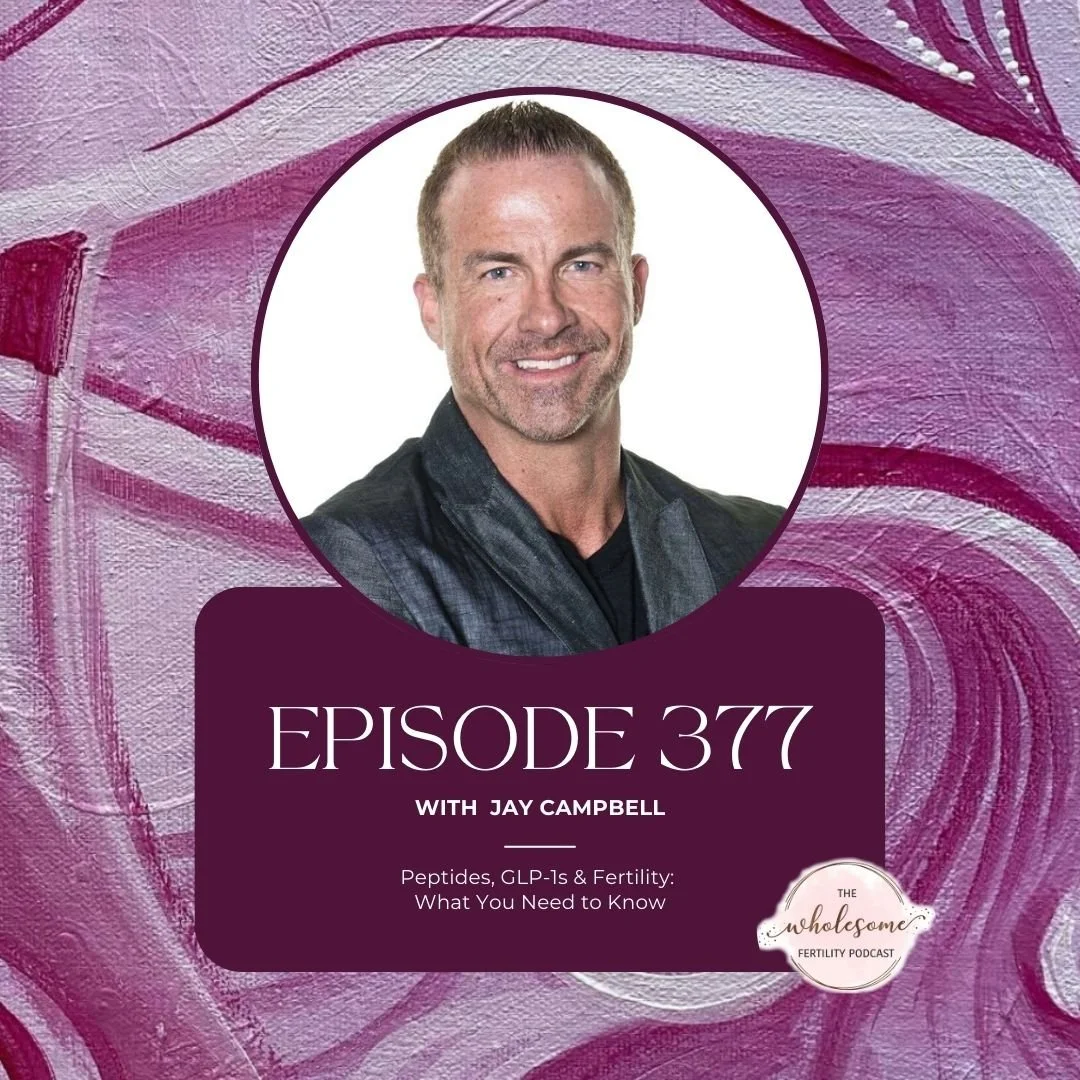
On today’s episode of The Wholesome Fertility Podcast, I’m joined by Jay Campbell (@jaycampbell333), health optimization expert, author, and founder of BioLongevity Labs, to explore the powerful intersection of peptides, metabolic health, and fertility.
Jay shares how therapeutic peptides like HCG, HMG, and GLP compounds can support male fertility, insulin resistance, and metabolic balance when used correctly. We discuss the rise of GLP-1 medications, why microdosing matters, and how inflammation and visceral fat are major contributors to declining fertility rates.
Beyond the physical, we also dive into mindset, consciousness, and how belief systems impact healing and reproductive outcomes. This conversation bridges cutting-edge science with empowered awareness, and offers a new perspective on fertility optimization in the modern world.
Key Takeaways:
Therapeutic peptides such as HCG and HMG can help stimulate FSH and LH to support male fertility.
Chronic inflammation and visceral fat are major drivers of insulin resistance and declining fertility.
GLP-1 medications can be helpful tools when microdosed and combined with proper lifestyle habits.
Insulin-controlled living and metabolic flexibility are foundational for hormonal balance.
Sustainable fat loss requires resistance training, adequate protein intake, and hormonal optimization.
Environmental toxins and endocrine disruptors contribute to the global fertility decline.
Mindset and consciousness play a significant role in healing, longevity, and reproductive success.
Disclaimer: The information shared on this podcast is for educational and informational purposes only and is not intended as medical advice. Please consult with your healthcare provider before making any changes to your health or fertility care.
Ready to discover what your body needs most on your fertility journey?
Take the personalized quiz inside The Wholesome Fertility Journey and get tailored resources to meet you exactly where you are:
https://www.michelleoravitz.com/the-wholesome-fertility-journey
For more about my work and offerings, visit: www.michelleoravitz.com
Curious about ancient wisdom for fertility? Grab my book The Way of Fertility:
https://www.michelleoravitz.com/thewayoffertility
Join the Wholesome Fertility Facebook Group for free resources & community support:
https://www.facebook.com/groups/2149554308396504/
Connect with me on social:
Instagram: @thewholesomelotusfertility
Facebook: The Wholesome Lotus
Disclaimer: Some of the links shared are affiliates but this is at no cost to you and can even get you discounted prices!
-
# Video\_TWF: EP 377 Jay Campbell
[00:00:00]
Michelle: Welcome to the podcast, Jay.
Jay: Michelle, thank you so much for having me. I'm always honored and humbled and privileged to be doing podcasts with people. Uh, I made a goal in December of 2025 to do 75 podcasts this year, and you are number 10. So thank you so much for having me.
Michelle: that's a good number.
Jay: Yep.
Michelle: Awesome. So tell me, um, I always like to start with an origin story so that my audience can get to hear your, you know, your background and, um, I'm, I, for one, I'm very interested in what I've read thus far, so I'm excited to have you share your story.
Jay: Thank you so much. Um, so I'm gonna give you the a hundred thousand foot summary. Um, I'm an ex-college athlete, played basketball, um, was still playing competitive basketball at the age of 29 in a men's league in Southern California. I got kicked into testicles. Uh, you know, checked out. But about seven [00:01:00] to eight weeks later, I started feeling really run out.
I was, I felt broken, I had low back pain, just didn't feel right, knew something was off. I went to my HMO slash P PPO doctor at the time, I worked for the Los Angeles Times, and as I like to say, there's no coincidences, only synchronicities. He recommended me to a world class, uh, Harvard educated endocrinologist by the name of Dr.
Raymond Scruggs. And he took my labs and saw that I had the testosterone levels of a geriatric, like an 85-year-old man. So he said, look, I can put you on therapeutic testosterone and eight weeks to nine weeks later, you'll be right as reign, and if you wanna come off, you can. So he is like, before you say yes, go home, talk to your.
Uh, at the time it was my wife to be, and I always say, shout out to Kelly because she is long gone. But, uh, you know, we did not have kids and we were like, yeah, we're both smart people. We could do this. So I went on therapeutic testosterone and again, I was literally seven weeks shy of turning 30 and everything he said was gonna happen happened.
And when I went to see [00:02:00] him, uh, at my eight week checkup, he was like, okay, I'm gonna take you off. And I'm like. You're not taking me off this, this is the most transformative, amazing I've ever felt in my life. I want to learn more about this. And so from that point forward, um, the next 10 to 12 years, I became this amazingly voracious student of hormones and also other things, which again, this was in the early two thousands, which happened to be therapeutic peptides.
You know, I tell people this and they freak out, but like, I've been using therapeutic peptides since 2003, right? So like on all this time that I was using therapeutic hormones, therapeutic peptides and other things, experimenting on myself, I was like, you know, I call myself an OG biohacker Guinea pig. I learned about all these amazing, you know, call 'em adjuvants or molecules or.
You know, biochemical miracles. Um, so fast forward, um, I built a really awesome physique using therapeutic hormones, using therapeutic peptides. People would always ask me, um, you know, how do you look the way you do? And I would always tell 'em straight to their face. I [00:03:00] use therapeutic testosterone and peptides, et cetera.
And so I would be met with this like, look of derision. Oh my God, you're on steroids. Or it would be like, wow, fascinating. Tell me more. And so eventually the fascinating, tell me more, people went out and I wrote a book, which was published in 2015. It was actually written in 2014, and it became a very, very big top selling book on Amazon and, and was number one in men's health for like five or six months in 2016.
Uh, and then from there it just kind of vaulted me to speaking on stages, talking about hormones. Uh, I wrote my book on peptides, uh, in 2023, and it exploded into mainstream consciousness. Uh, for one really apparent reason. I didn't know it at the time, but it was because it was in the middle of the vaccines.
Um, you know, the scam de and the COVID vaccine and all that. And so people were looking for alternative forms of healing and obviously peptides represented, you know, that. Uh, and so my book really blew up. And then, you know, subsequently then I've, uh, launched and sold a company and now I have another company called Bio Longevity Labs.
And I'm just in the right [00:04:00] place at the right time, uh, at the same time that I learned about all that stuff. And I was really walking the path of hormones and peptides and stuff. I really got really conscious. And, um, that's kind of really my jam now. I talk about consciousness, I talk about, you know, people raising their frequency, raising their vibration.
Um, and so on top of being like this health optimization expert, I also talk about conscious frequency and the universe and all that kind of stuff. And I think. Everybody really starts talking about that. Once you get to a level where you really have really clear awareness and so many people don't, right?
Because they're walking around and insulin dysregulated, inflamed, uh, you know, metabolically, deranged, all these different horrible things are happening because our society is so broken. But one, you are clear, uh, physiologically it's allowing I think the universe to kind of clear you up, uh, consciously too.
And so, like I've really become this person that, you know, it's great that I understand hormones and peptides and fertility and all these things, but I really like to talk about consciousness. 'cause I always say now that like if we don't raise our [00:05:00] frequency collectively as a, as a species, we're gonna blow ourselves up.
And we've done it so many times in the past that you can really start projecting that we might do it again. And so my mission now is to A, end obesity and B, teach people that their thoughts create their reality. So that's kind of like where I'm at now.
Michelle: Yeah, it's right up my alley actually.
Jay: Awesome.
Michelle: um, I'm a huge, uh, Dr. Joe Dispenza fan, um, groupie. You can call me. I've got already multiple week long retreats and when you go there and you experience, um, really the collective, that's where it's at. I mean, when you start to be in the collective soup of that similar and trained intention and consciousness, that's where you can actually say, okay, now I'm experiencing it.
It's more than just a theory. It's a felt experience and. When you experience that, I don't think you ever really go back. And I.
always say that yes, you can go into, you [00:06:00] know, the supplements, the diet, the, all the physical things, which matter a hundred percent. But if you don't, if you completely bypass the mind and your state of being really, then, and if there's some blocks in that category, then it doesn't matter what you do or how healthy of a lifestyle you have because you really need to address it.
'cause actually that is sort of the, that's the foundation. That's where everything manifests from.
Jay: Exactly. I mean, look, I, I'm so awesome that you and I are talking, and this is the universe lining us up, right? Because you thought I was just some peptide dork. But the truth is, is that we aren't anything but vibrating atoms and oscillating waves of
Michelle: True.
Jay: and, and the energy is infinite. And we, the only thing that limits us in this physical avatar body, in this current state of reality is our thoughts.
And so it's as simple as a Jedi mind [00:07:00] track, as you notice, of course, I have Yoda back here. It's as simple as changing your thought processes to be open-minded, sovereign, empowered, and free consciously, versus being close-minded. Which is limited and vibrating down here in the Red Root Chakra because you're in fear, right?
So every single day, no matter how shitty you envision, or you know, again, that's late li lacking and limiting by just saying that. But like, no matter how bad you find yourself or how bad you feel, you can change like that. And that's the beauty of living in third density reality because again, we, we can choose to serve others and be, you know, conscious and empowered, or we can choose to serve self and live as a victim.
And, and, and nobody can say otherwise. And as you know, our society is so broken. It constantly pushes victimhood. It constantly pushes my younger daughters. To think that it's not their responsibility, that they're not, you know, accountable for all of their actions. And it's insane because [00:08:00] like it's, you see it, I see it.
We have to really teach, you know, the younger generations that like, no, you are in complete control of your vibration and that's it. But that vibration is gonna ultimately give you the gateway to a better life.
Michelle: Mm-hmm. Yeah, a hundred percent. And, um, so we'll, we'll go into that for sure. I wanna talk about therapeutic peptides
because I, I'm sure a lot of people are listening to this and they're like, what are therapeutic peptides?
How, how is it gonna impact my body? And
like, how do I administer it?
Jay: Yep. So peptides are basically in, in the, the lowest common denominator of breaking them down. They're basically biomolecules that are created, uh, organically in our cells. And they're, from a scientific standpoint that people can understand. They're basically chains of amino acids.
Michelle: Which, which the shorter the chain.
Jay: Yeah, the, the shorter the chain. The more likely you can ingest it orally. The longer the chain, the more likely you have to inject it with [00:09:00] a insulin syringe because again, a peptide is an aqueous based, uh, solution. So most peptides are synthesized in a lab, but they are naturally occurring. I think most people probably on this show or your audience knows what BPC 1 57 is or has heard of it 'cause they have friends that are using it.
And it's basically known as body protective compound. And it's actually secreted in the, in the digestive juices, in the gut. So to, to use it though, obviously it has to be synthesized in a lab, but again, it's a naturally occurring, uh, biomolecule. So again, when you inject it, the synthesized form, you're basically injecting something that is already naturally found in the body.
It's, again, it's an organic peptide chain signaling molecule, so the risks of using them are very, very low. In fact, I tell people this all the time in the 24 years now that I've been using therapeutic peptides. I've never seen a person od, I've never seen a person have any kind of horrifying, have to be hospitalized effect.
Now, the [00:10:00] exception to that rule would be the idiots. I'm sure we'll get into this on this podcast that take super high doses of GLP peptides attempting to not eat for weeks at a time because they think that that's actually as intelligent strategy to lose weight. Right? So, but even those people don't die.
They just, you know, screw up their, um, colon and, you know, screw up their, um, digestive tract. And obviously there's all sorts of other negative things that happen because they, you know, they can have micronutrient and mineral deficiencies, protein deficiencies, nutritional deficiencies 'cause they haven't eaten for two or three weeks.
But, um, other than that there's very, very low risk and, and, and very, very high potential reward if you understand how you use them correctly.
Michelle: Got it. So what are the different types of peptide and specifically for fertility? 'cause you've, you've talked about actually male fertility, that you've helped a lot of men.
Which is an important topic that is not addressed as frequently, and I have to admit, I need to be starting to talk about it more on my podcast.[00:11:00]
Jay: So right now we are at the lowest birth rate in history. Fertility is the worst problem that it's ever been in the first world. Now why is that? Well, we live in a contaminated first world. People mostly consume engineered food, GMO food. There's endocrine disrupting chemicals in the water supply. There's phylates, there's phytoestrogens, BPA, I mean, I could go on there.
So I mean, like people young of, of let's just call it childbearing years, which is probably really realistically 25 to 40. I know there's lots of men and women having babies in their early and mid forties now because of in vitro fertilization, et cetera. But we were designed, you know, from the 25 to 40 time to really, especially women to get the womb, you know, is ready and et cetera.
But because the environment is so contaminated, um, because men have such low levels of FSH and, and lh, you know, follicle stimulating hormone and luteinizing hormone, they have such low levels of circulating actual spermatozoa. [00:12:00] Uh, and then the same thing is happening with women, right? Uh, you know, hormonal pathways and patterning.
So you've got that. And, and, and when you put them both together, you have the lowest birth rate that we've ever seen. Right Now, you don't see this in the, in the, uh, first, or I should say third and fourth worlds because in the third and fourth worlds, they don't have the endocrine, uh, the, um, the disruption, you know, from, just call it modernization, right?
Modernized living the chemicals in the environment, the EMF, you know, all the things that are in the first world that contribute, you don't see in the second and third, fourth world, uh, as much. I mean, it's starting to affect them, but it's still not as bad. So you're gonna see a higher birth rate, like in Latin America than you will in the United States.
Again, it's all due to the chemicals in the modernization, but, um, there are definite ways that you can utilize, you know, various peptides like, uh, kisspeptin, uh, like HMG, like HCG, I mean, there's various other ones. Teigen, [00:13:00] there's tons of now Russian bio regulators like Endo Lutin. Um, that you can take that improve, um, male and female, uh, endocrine systems.
So there's just a lot of really good advantageous, uh, you could call 'em natural means, um, where you can stimulate people's, uh, endocrine systems and obviously ultimately their fertility, but you really have to understand how to use them. And I think. I think I really should say this, I've never really said this on a podcast before, but the biggest issue that we have, um, preventing men and women from getting pregnant is inflammation due to visceral fat.
Because when I, and I've seen, and you know, I'm a studies dork, so when I see the studies and I see the lack of the birth rate falling, I also see the increase in body fat, right? Like over the age of 40. Now, uh, the average adult in America, this is in the, in the United States alone, the average adult over the age of 40 is b is clinically obese by the, [00:14:00] uh, BMI.
Right? So that's like, I think I saw a stat, this was in 2024, or most recent was 2024, that 63% of men and women over the age of 40 in the United States identify as obese according to the BMI. Now obviously there's some statistically variation because sometimes muscular people show as obese in the BMI, and that's also because.
The top end of the range is affecting or variant or varying, how do I say that? The variation is due to obesity. So they're, you know, they're classifying most people based on the average person being obese. So it's a horrible situation. So obviously if you factor that in and you really drill down, you're gonna see that if people lose body fat and improve their level of leanness, that naturally their birth, uh, rates will go up.
But again, that's not who, what we are, that's not Western society anymore. The average person walking around is clinically obese by the BMI. But if you do take those peptides you use, uh, you know, some of them are really not, um, peptides, they're kind of small [00:15:00] molecules. Uh, but you can improve birth, uh, rate and, and also the short time or the, or lessen the time it takes someone to get pregnant.
Michelle: And are there ways, um, because you talk about longevity, like does it help with the quality of eggs? Does it help with
mitochondria? Um, yeah. So what are some of the ways that it can do that?
Jay: So, I mean, I guess it just really depends on what you're using peptides for, right? I mean, there's, there's right now 56 or 57, maybe 58 peptides that are commercially available, uh, that people know about. But there's thousands of peptides that are not commercially available that we have identified in the science that we could eventually utilize.
There's peptides that can actually attack cancers, they can kill ontological tumors. Um, there's just so many different, you know, call it uses or use cases for peptides, but we don't have them yet commercially available. But in the ones that we do, um, you kind of have to classify them as like, what do they do?
Right. Well, the five biggest [00:16:00] needle movers are like cognition, fat loss, uh, longevity or wellness. You've got immunity and healing, right? So those are kind of the biggest five classifications. And I always tell people, because you know, some people, they get into peptides and they have the shiny object syndrome going on because they're like, oh my God, I want to use all these peptides for all these different things.
And it's like, you can't really look at your biological system functioning as like taking 'em all at once or stacking them all at once. It's like, what is the bleeding neck issue that you as an individual has? And for most people they, they've got insulin resistance or inflammation due to high levels of visceral body fat, which obviously creates the inflammation.
So you probably want to use some peptides to, to reduce or to help you with body fat. That would be like GLP peptides, GLP two, GLP three, uh, there's obviously lots of
Michelle: What are the difference between the different glp?
Jay: Yeah. So, so like a GLP one peptide is like the old school [00:17:00] semaglutide, or which is known as wegovy. In the mainstream.
And honestly, you know, I just wrote a book, it's not published yet. It comes out in February, mid-February, February 24th. It's called Metabolic Awakening with GLP one Peptides. And I go through all of these various GLP peptides, I explain what they do. Um, but most importantly, I explain how to use them correctly in the context of health and longevity and how to avoid the unmitigated disaster of the mainstream who uses them, uh, you know, with pharma instructions.
And they obviously take too high of a dose and then they whack out the
Michelle: Because I know that, um, in some cases my, my reservation is that there are cases where it can cause irreparable harm on the digestive system.
Um, is it too high of a,
Jay: So I can tell you this, as someone intimately familiar with the data on glp, then that will be proven when this book comes out. I mean, there's 1300 scientific references in it and 717 pages and it, and I [00:18:00] used it with no ai, just me and two copywriters is six months of research. All side effects with GMPs can be avoided.
The person that takes a GLP has to obviously live a correct lifestyle and has to use them in a microdose fashion. But 95% of people using GLP do not that do not do that. Okay. So microdose versus full dose. um, which
way too high of a dose, they blow out their receptors, and then none of them live the lifestyle that is A, necessary and b, conducive to optimizing their health.
Right? So think about it like this, and again, I, this is all covered in the book. I, I cover every single side effect ever listed on A GLP. I have literally a chapter three is, uh, I think it's 98 pages and I dropped 50 pages out of it. But it's so exhaustive going through every single side effect and explaining why this happens and how to avoid it.
But, um, every single thing. That people experience [00:19:00] negatively, um, from taking GLP are due to starting too high of a dose and then of course titrating higher. Um, and then b like I said, not doing any of the lifestyle requirements and the lifestyle requirements are very, very critical. But, and I'll just tell you there's like 10 of them, but I, I, I'll this podcast, we'll just talk four.
The most important number one is are you eating enough protein to avoid catabolism AKA muscle loss? And 99% of people that use GLP do not
Michelle: Mm-hmm.
Jay: Um, number two is, are you doing resistance training to strengthen the bones and to avoid catabolism of muscle, right? Because if you do do that while you're using these, you will not have muscle loss.
Um, so that's number two. And then, you know, three and four are, are you hormonally balanced or hormonally optimized? Which as you know, 80% of society is not. So that's also the fast path to. Losing muscle because again, this is a simple thing, thermodynamics, if you lose [00:20:00] muscle, you ultimately are going to shut down your metabolism or lower your metabolic rate because you obviously, you have to maintain muscle when you're losing body fat in order to keep everything running.
Thyroid, uh, you know, energy metabolism, all the different things that happen when you have muscle. So when you lose it, it breaks everything else down. And then I would just say, uh, number four is, you know, like everything else, it's just good sleep hygiene and stuff like that. But many, many people, I know this is insane to think about this, but they will take a very high dose of a peptide and think that if I don't eat for two weeks, I'm gonna lose all the weight.
It's insane. But again, the American public has not really been taught about ed, uh, nutrition at any level of education. You know, college, you know, degree doc doctors don't learn about
Michelle: Yeah. I was just gonna say like it's more than just the public.
Jay: Exactly. So, so, so that, and then, you know, when you really factor that in and you look at what is happening, they go to these doctors who don't understand how to give them proper instructions on lifestyle habits. And the doctor makes the most amount of money by prescribing [00:21:00] the highest amount of dose, and then they stare step the dose.
And so literally every 10 days to two weeks, the dose is doubling. And if it's not doubling, it's going from one to 1.5. Right? So it's insane what happens. And again, again, like I said, 95% of people that experience GMPs have done it wrong and then go into their, um, you know, wherever it is that they're, they, that they scream into the either and say, these are the worst things ever.
And then celebrity doctors glom on celebrity influencers
Michelle: Yeah, it's important to also know your body type and because in some
cases if you have like really bad insulin resistance and it's very difficult for your body to get on track sometimes, you know, it does require something a little stronger.
Jay: Yeah, no, a hundred percent. Look, insulin resistance is lifestyle.
And if you don't wanna change your lifestyle, you can't use a GLP And I, and obviously I talk about a lot of this in, um, you know, the book, and, and that's why I, I really [00:22:00] am, it's a labor of love for me because my mom was obese and my mom died of COVID.
But I mean, she was really struggling with obesity and being comorbid her, majority of her adult life. She did give birth to nine children. Um, but she, she was obese and, and she died of COVID. And, you know, I really wanted to help her. And so for 30 years of my life, I attempted to not physically, I I was probably two or three years of intervening with her when she was younger and I was younger, but then I became conscious and I realized that, you know, the, the teacher appears when the student is ready and you can't wave your arms, as you know.
So. Uh, but at the end, you know, I was very, um, humbled and, and, and, and I was also just sad, you know, um, to watch my mom deteriorate in the way she did. And so like, I was like, you know what? If there's any person. With the knowledge to cure obesity or to tackle obesity head on, it's gonna be me. And so I eventually wrote this book, and again, I'm really proud of it.
It's gonna come out in the end of February, around around the 24th. But it's, it's really powerful [00:23:00] book. And if we can get it into the hands of enough people, we can definitely teach people how to not be insulin resistant, metabolically deranged, and ultimately obese. Because I do teach people how to do this right.
And I, you know, I have like, like I said, you know, tons of studies that back me up. But then I also have a chapter on transformations. Uh, and I have 16 people, men and women equally from all over the world, all walks of life. Who, you know, have incredible before and afters, but most importantly talk in their own words about what the GLP did for them and you know, how it changed everything for them and completely transformed their life and, you know, spiritually made them more aware and, and, and, you know, awakened and et cetera.
So it's like I tell people like it's just a tool. You know, at the end of the day, it's just a tool, but like all tools we have to know how to use them, you know, in the context of health and longevity. And most people don't, as you already said. And most doctors, and of course pharma don't, that don't give a rat's ass because they just [00:24:00] wanna make money.
You know, they don't, they're not really in it for health. I'm sure there's some doctors that are and, and lack the education or lack the actual knowledge base to really, truly help people. But there's enough smart people out there talking about microdosing and doing it correctly and interpreting the research that it doesn't, it, it shouldn't be as bad as it still is.
And so I'm really hopeful that this book is gonna shine a really bright light, uh, on what I would call a dark hallway so far when it comes to
Michelle: Oh yeah, I, I, it was very dark because I'll be honest, I had a lot of resistance to GLP ones, like a lot when it first came out and
just seeing how people just took it. And, um, even friends of mine, people I know, and I was like, well, you gotta really do the research before you start this, because it's not like just some kind of simple thing.
Like I know that there are certain problems with, um, stomach paralysis and some of 'em are like irreversible. And so then, so I was kind of, I, I initially had a very strong like, resistance, you [00:25:00] know, other ways to, to lose weight. But then I realized, um. That it's not a black and white thing. And that in some cases, it was really helping people that no matter what they did, they were not losing weight and their insulin resistance was very stubborn.
It was really difficult for them to do anything. Like exercise sometimes made, you know, because they're so drained physically, like it
wasn't really helping. Um, then I started hearing about microdosing and I was like, okay, well this might be a little bit of a more compromised level, you know, where it's, you're not bombarding the body with something into their system. And I just think that it was, it, there were so many unknowns and it was, it became so like, it went like wildfire, like everybody was using it and there were too many unknowns. So that was my hesitation originally. Um, but I'm still learning, you know, as a practitioner I'm still learning, but it feels like the [00:26:00] microdosing. Is less, I guess, invasive than, you know, those really high doses.
Jay: So I actually, um, so I actually have, so I'm gonna read this to you. So, so there's a lot you just said there. There's a lot to unpack. Um, obesity is not a lack of willpower and. It's a very, how do I say it? It's a very nuanced and multi-pronged issue. And, uh, it's really, it's, it's honestly, it's, it's probably threefold.
Um, and I have so many windows. I was just gonna read to you this summary that somebody just wrote in my book, but I can't find it now. But I, I, I, I know what obesity is caused by obesity is caused by, number one, the addiction to the hyper palatability of foods. Now, number to to, to explain that for the average listener on your audience, there are people that get paid millions, the m word dollars a year to create molecules [00:27:00] that addict people's brainwave, patternings to the food.
And this is obviously in the fast food industry and the GMO Box food stuff industry. And so these people, the majority of them are the obese, insulin resistant people are not able to overcome the addiction from these chemicals. So they're, it's, it's really, really horrible. I mean, I, I explained this and go into detail, in depth in, in, in the book.
And then the number two reason is, uh, due to that addiction, um, they have, they're, they're obese, they're insulin resistant, they can't move. They have pain. People have to understand this, and there's not a lot of people out there saying this, but people who are obese are in a default state of suffering.
Michelle: Mm-hmm.
Jay: I mean by that is, is that you have cytokine storms in your body 24 7. So we have no idea as non-obese people what they are feeling. And so it's very, very difficult for them to exercise to [00:28:00] think clearly. 'cause you gotta understand when you're metabolically inflamed, you're mentally inflamed, so everything is affected negatively.
And then the number third thing is obviously the result of one and two, which is they don't have the energy to do the things that we all say that they can do. Right. Or they don't have the
Michelle: they do, sometimes they that, well, they, they don't necessarily have the energy. But I see my patients when they come to me, I mean,
we worked on, we work on many different
ways, like of, of, uh, trying to help through supplements. Um,
sometimes, uh, herbals.
So there are definitely like ways around it, but, um, they really do, they exercise like crazy.
They don't, they don't eat a lot. Like they give me a whole list of what they eat and they still can't shed the weight
and it's frustrating.
Jay: Yeah. Well, I mean, again,
Michelle: with PCOS, insulin resistant, PCOS
Jay: yeah, I mean, I mean there's, it, it's a multi causal thing, but tho those three things that I told you are what creates it. And then once it happens, [00:29:00] it's very difficult to lose it because they are metabolically resistant. Um, it is very hard to get off. I mean, look, if you live in the Midwest where you are being bombarded by atrazine and, and, and glyphosate at all times, those chemicals sit in your fat
tissue and are actually very difficult to metabolize.
Michelle: Because then your bodies, your body's protecting itself from like getting too many toxins all at once, and our
fat cells love to store them. Yeah.
Jay: the reason you have all that fat, because the fat is the protection from the toxins. So it, it, it is, it's
Michelle: it's a multi, yeah, for sure. Another thing is you can go to Europe. Where they don't have as many chemicals and
eat pasta and like, I mean, carbs galore and lose weight.
Jay: Yeah, exactly. No,
Michelle: And absolutely true.
so something in,
in the American food. And I think that it's beyond just like the addiction, it's beyond the taste.
'cause you can eat the same amount. It's the [00:30:00] chemicals that they put in, whatever it is in the they, they put, they process it. I think the best way to maybe control it is to, I don't know, grow your own food if you can. Or like do something
Jay: Well, you have to, you have to get, you have to su you have to order. There are companies out there that sell very organic, sustainable meals, and you have to obviously have money to get that. I mean, that's what my wife and I eat. I mean, look, I, I travel the world a lot. Um, I can't eat American food. I can't go to a restaurant in America and order anything.
I took my daughter out to dinner for her 18th birthday on Sunday night, and we went to a Ana Teki Steakhouse here in Tampa. Very famous one. I couldn't eat it, you know? Um, they put so much chemical, like you said, processed chemicals, additives, whatever, flavoring. It's insane. I just come back from two weeks in Mexico where I ate out every night at either a steak, a tie, uh, you know, different, uh, uh, uh, uh, Brazilian, um, you know, Ecuadorian, like just flavors of the world.
And the food is [00:31:00] succulent amazing. There's You taste delicious and you lose Exactly. E exactly. So, so we're, we are under assault in America, and it really does now take a very conscious being, uh, who's super proactive to avoid it. You know, I mean, that's, there's a reason I told my wife and I, we don't go out to eat. You know, you, you know, there's nothing to do.
I drink a lot of really, really good protein shakes. I get the free ingredient, almond milk, you know, I drink water and three ingredient almond milk. That's it.
Michelle: basics, you know?
Um, I think that that's the way literally cannot eat packaged food or go to grocery, or I'm sorry, restaurants that are layering all this crap on the food.
Jay: You literally be sick. Or if you're not sick, it's what you and I already talked about. You're, you know, metabolically, uh, resistant, insulin resistant and, and probably having too much body fat.
Michelle: Yeah, and it's interesting 'cause I think about it as more than obviously like what you're intaking, but also like the way your body's using energy, we're able to access energy. It's almost like there's a [00:32:00] block to our body's ability to access our own energy, which
is what keeps it into, into
Jay: The a hundred percent. I mean, America is the most metabolically, dysregulated nation on earth. That's a hundred percent fact. And it really is, you know, everything is broken down. Obviously since COVID, that's a whole nother thing. A lot of people broke psychologically and have given up. But if you don't, you know, well, let's just say this, th this is a statistical fact.
You'll, the L, the leaner you are, the longer you'll live, right? If you look at all the blue zone people and the octogenarian people. You know, I mean, you could get into a debate of quantity versus quality, but most of those people are, you know, Asians and they're very lean, they're tiny people. Uh, they live into their a hundred, you know, they get into 1 0 8, 1 0 9, 1 10.
The people are even into one teens. But all of those people have zero inflammation. They have no body fat. So if you want to [00:33:00] extend your life, and obviously you can't account for a plane crash or getting hit by a car or any of that stuff, but if you wanna extend your life, you wanna lower your level of body fat, because again, body fat is what creates inflammation.
Inflammation is what creates, uh, cellular degradation, which leads to disease. Every single disease state that we know of is coming from inflammation, uh, heart attack, inflammation. Uh, type three diabetes, type two diabetes, inflammation, insulin resistance, right? And so it's like if we understand that and we lower our body fat, you know, as much as we possibly can, as we age, then statistically we will live longer.
It just obviously becomes, as, you know, uh, especially doing the work that you do, that it, if, if you have all these other, you know, issues of resistance, um, it's much harder to lose the weight. And so that's why I say that if you understand how to use a GLP two or use a GLP three, and of course, of course, I explained that in the book, um, it, it is a good [00:34:00] tool to help people who otherwise lack tools or struggle, uh, to lose weight.
And by the way, just so you know, I, I think the GLP one is a completely worthless drug, and I talk about that in the book. Um, it was a, it was a useful tool when it had utility in the marketplace, but it's been passed up. And I also say now that like this book in two years. The stuff that I recommend. Now, I may say that is also useless and is now completely obsolesce because of what's in the pipeline.
And that's, to me, that's what's really cool about the industry is that we are in a biomedical golden age. But in order for you as a, as a, you know, call it a conscious consumer, um, you have to, like you said already, you have to do the work. You have to do your own research, you have to listen to intelligent people, uh, who can explain this stuff to you.
But the tools are accessible and available. You just have to learn how to do 'em. And I think you also know this too, the signal to noise ratio, especially on the internet, is [00:35:00] mostly noise and very little signal. So it also becomes harder for people who listen to, you know, fake influencers or people that act like they know what they're talking about.
I mean, I always tell people this, and we haven't said this on this call, 90 to 95, it's probably somewhere in the middle of that 92, 90 3% of people online that talk about peptides have absolutely no idea what they're talking about.
Michelle: Mm-hmm.
Jay: Literally no idea. They're making things up. I mean, I, again, I've been using 'em for 24 years.
There's very few people that understand it at the level that I understand, and that includes doctors, researchers, and I hear people talking about these, and I'm like, that person just made that up. But the average person who doesn't know this, doesn't understand that. Right? So they're constantly being led down paths that aren't true.
You know, and, and don't get me going about AI AI is literally hallucinating Right. Yeah, I know.
Do you know that I, I'll, I'll, this, you're the only person I've ever shared this with on a podcast. I, as I told you, [00:36:00] the book has zero ai, no AI summaries, no AI conclusions, no AI adaption. There was at one point in the Google document where I was like, you know what?
This book is amazing. Let me just see. And my, and my copywriter was like, I will resign. If you do it, we don't care. But.
Michelle: Yeah.
Jay: have done this. And by the way, my name is very big in AI because of my research and my work. I have asked AI in the past, in the last three weeks, and I don't use AI in anything to do, but I did this as a game, six different questions, about six different peptides.
Uh, and they were all the same questions, but asked in a different way. And every single answer was different and wrong.
Michelle: Ask, Ask,
Somebody told me,
Jay: one. Imagine the youth who are not, you know, as savvy as you and I are, have been a long, round longer, who are being influenced by ai. I think of my daughters, you know, they're 16 and 18 years old, um, and they think that AI is God.
They think that AI is [00:37:00] the answer. It's insane. I mean, literally they are learning nothing.
Michelle: Um, it's a tool. You could use it for some things. Um, but you really need to be leading that ship. You can't
allow it to be the
Jay: you can't use it to think.
Michelle: Yeah,
Jay: A lot of young people. A lot of young people do use it to think,
Michelle: Yeah.
Jay: and that's a big problem because they're outsourcing their discernment and their conscious communication. They're, they're outsourcing their brain power.
It's lowering iq. That's not
Michelle: Well, I think our phones already started that.
Jay: Well, of course, but I, but think about it, if you're 15 years old now and you ask AI for the answer, you're not thinking,
Michelle: Yeah.
Jay: and that's what all these kids do.
I mean, I, I talk to people that are, you know, old friends of mine that are now working as professors in college and stuff like that, and they tell me stories that I can't even, I mean, I, I can't comprehend it. I mean, imagine if your whole job was trying to determine like what papers that were submitted were, were written by ai and what was it?
Michelle: Uh, well, I mean, there's, I think there's ways to do [00:38:00] that. You can, um,
Jay: Well, yeah, well, they all know it. But I mean, imagine if that was your job.
Michelle: God, but you know what, um, I, I mean, I, I remember growing up having to remember like people's phone numbers. Like my brain used to actually
Jay: of us can
Michelle: and I fight it. I fight it now. Like I try to almost catch myself and I still try to, you know, write things down
and do things that I used to do where
Jay: write everything down.
Michelle: it's so much better.
And I because I, there was a time where I was typing, so, 'cause I type fast, so I always type and then I said, wait, I need to, like my handwriting, I need to use my hand. To write more. Yeah,
Jay: It's a weird, it's a weird day and age that we're in. Um, you're right. It's a tool just like peptides are tools. GMPs are tools, hormones are tools. But I do think that far too many people, especially going back to the signal to noise ratio with it mostly being noise, people think of these tools as answers or [00:39:00] as fundamental agents, and they're not,
Michelle: Yeah.
Jay: they're just a tool, as you said, very
Michelle: it's, we undermine ourselves. I think that we don't realize how powerful we are, which is
why we're always seeking outside of us.
And the ancients have always told us, you want, the answers go within.
It's always been go
Jay: Yes, yes, yes.
Michelle: And so I, I think that that's, um, we, you know, it's, it feels easier to go without, but you're, you're not, it's gonna be a fake illusion.
You're not, you're not getting the real thing.
Jay: Exactly. Exactly. I'm, we, we, we see, we see very eye to eye. Exactly. I mean, um, it's an interesting time because. Thankfully, there are a lot of people like us now. I mean, I, I don't know how many of there are like us, but I mean, I think there's a lot more than there was say, five years ago. Um, but there's not enough of us.
Michelle: Mm-hmm.
Jay: You know, like David Ike just wrote this amazing book called The Roadmap. I highly recommend you get it and read it. Um, you know, there's, he talks about Joe Dispenza in the book, but it's an amazing book [00:40:00] because he teaches you not that he always hasn't been teaching you, and there are of course, other people teaching you, and you and I already know this, but literally everything is a perception deception.
And when you change your view to be open-minded, you are connected to infinity. And when you are close-minded, you are connected to basically whatever lack and limitation mindset or scarcity mindset that you have. So it's like you could either be open-minded and open to everything and the abundance and the prosperity that the universe can provide, or you can be closed-minded and closed off.
It's as simple as that. I mean, I know that that sounds overly simplistic, but it's not, and I feel like that's a great way to teach people who are starting to really start walking the path that you and I have been walking for a long time. Because if they could just change their viewpoint from being limiting to being open and expansive, everything changes.
Michelle: well, I feel in, in the sense of, you know, I guess all the [00:41:00] data points that people get when they're on the fertility journey or the messages that they get from their doctors, like, um, well, you know, you're getting old and
all, all the things, all the things that were figured out thus far. And I
often say this and. Hopefully people have heard me say this a couple of times so that it really kind of gets in their minds. But the two things that I always say is, um, if you look up, the oldest person that conceived and had a baby naturally, um, was this woman named Dawn Brooks in England. And she was, uh, 59 when she had her.
She got
pregnant, 58, um, had the baby at 59 Healthy baby. Uh, good birth like, and I think to myself, okay, and then I kind of, uh, I always couple this with a Roger Banister effect
of, oh, it's impossible
to
beat the four minute mile. And then he goes ahead and like, after years and years and years of being told that it's physically impossible, beats it, and then within a month or [00:42:00] two, like multiple people beat it,
how is it that all of a sudden that opened the door?
It was just, it's a mindset that it's possible. And I think that what happens is, again, we put so much of our belief in other people and what they say. That we allow that to seep into our consciousness and we don't, without even realizing we're put, putting limitations. And I think, um, I will say, I think that one of the things that I'll attribute to a lot of my success, and I'm not saying this in any kind of conceited way or
anything like that, I really feel very dedicated to this work of helping couples conceive and, and have families.
And, and, um, I think the biggest thing that I can attribute it to is that I believe in them. I believe
that they can do it. And I think as a practitioner, when you believe in them, subconsciously, they don't realize, but it gives them permission to believe in themselves. It's unfortunate that they need me or anybody else to, to have that, but I guess we, you know, we're not islands.
We do need [00:43:00] people. We need, um. We need that support. But I think that it's important really to, when you're talking about that expansiveness, that open-mindedness to be, to go beyond the limitations of what we've been given, go beyond the
limitations of what has been studied thus far.
You know, it's just been studied thus far.
That
doesn't mean that there's not other possibilities out there. Um, and I think that we get so limited and science gets limited, and then, um, we look like crazy people talking about things that haven't yet happened. You know what I'm saying? And I think that that's, there's many like us that are probably afraid to speak because they're like, oh, well if I speak about this stuff, I'll seem too woo.
Or, you know, and that's literally what happens. It's because you're not limiting yourself to everything that's already been discovered.
Jay: Exactly. So if you understand, everything you just said can be summed up very simply that if you understand the quantum all is possible and all is probable. So when you [00:44:00] understand it at that level, there is no limitation. In fact, the mind is the prison. Of human consciousness, because again, you just said it, right?
Like if we are afraid, I mean, fear is the ultimate saboteur, but if we are afraid or if we think that others may judge us or label us, or you know, say like you said, woo, then you're instantly in that lack again, limitations, scarcity, you know, mindset, and you're not open to expansion, which is obviously abundance, um, prosperity, et cetera.
So you just have to play the game at a level of like, Hey, okay, all is possible. Not only is all is possible, but I'm going to allow that awareness into my conscious frequency in everything that I do, because I know that the opposite will limit me. It's as simple as that. But I mean, I agree with everything you said, and I know it's actually true.
Um, and, and that's why I always say it's like it's as simple as just changing your [00:45:00] perception that you are an infinite being and that you're not identifying, as you were saying, as this. I'm a white male, or I'm this religion, I'm this, you know, et cetera. And you just have this kind of like, I'm open and allowing to all, again, the quantum all is possible.
And so I don't have any limitations. I don't have any, uh, self identities of this, that, or everything. And because you, you said it best, like we usually are taught from an early age at birth to self-identify with limitation in everything. There's a limitation. You know, I'm this, you know how many people have come to you and they're like, oh, but you know, diabetes runs in my family, or autoimmune runs in my family, or, you know, they've been, they've heard this insane diagnosis given them to
Michelle: And, and there was a time, there was a time where the.
Jay: true. How, how was it a
Michelle: used to believe that there was no neuroplasticity until
they
Jay: oh, I see what you're saying.
Michelle: that there was a [00:46:00] so, so in the perception, I mean, like in the
matrix,
Jay: no, I got you. I, I understand what you're saying, but yeah, so
Michelle: so there was a saying. But that in and of itself proves that you are limiting in your thought process. Look, all the great accomplished people of society, going back thousands of years did not have a lack, scarcity, or limitation mindset.
Jay: It's as simple as that. You could not create, I could actually make an argument. I can't prove it, but I can make an argument that the more open your mind is to expansion, the less, I'm sorry, the more likely you are to be communicated with by higher density or higher dimensional sources. Because I truly think that even like Joseph Vicenza, like people like that, like they're so deep into the connection with the universe that they get i wisdom or information or insights imparted, imparted into them.
You know, you could probably call it telepathically or just again, just consciously because of the work they're doing, [00:47:00] right. I think that's really what happens. I think that all great advancements come from people that do not have that limiting mindset or that limiting belief, and so now it's kind of like seeping.
I mean, however you define it, it seeps into their consciousness and they're like, boom, I got this great idea
Michelle: So
here's what I'm gonna say very much in line with that. My belief in doing this for 10 years, um, is that people who feel deep in their gut or in their soul or viscerally that
Jay: Yeah.
Michelle: want to conceive. I don't think that's random. I don't
think that feeling is a random thing. I
Jay: I agree.
Michelle: it's isolated.
I don't think it's just a desire. I think it's actually a calling. And I think that if you have that calling, um, and I think that this kind of comes down to like not really realizing how powerful you are, um, if you have that calling, that is your intuition, that is your higher self, that is your intelligence telling you it's [00:48:00] possible.
Jay: That's awesome. Yeah. That's not a belief, that's a knowing. I would, I, I would, I would tell you,
Michelle: that's another, uh, yeah. Level.
Jay: tell you to change your conscious word languaging and stop using the word belief, because belief is actually the enemy of knowing. And so you know it. And everything that you told me today, you knew and know.
So it's like I state that I know this because my superconscious wisdom, my higher self, my connection to the divine is literally telling me this, and it's up to me to act on it.
Michelle: Mm-hmm.
Jay: So yes, I agree a hundred percent. You create your reality with your thoughts, and it just takes us to investigate that both consciously and through action to recognize that it's real.
Michelle: Yeah, I see it also as a connection with the spirit, baby, kind of the energy. There's
Jay: A hundred percent.
Michelle: I do feel there's a communication I've seen, um, I've heard crazy stories of synchronicities that happen once people are open to it or ask for that guidance and that communication,
Jay: Like [00:49:00] that. It
Michelle: so I don't feel like it's just this isolated, like, I, I just want it, therefore I'm gonna get it.
I feel like there's something even higher than that
where they're I, I, I'll say this, you can't, like a lot of people in the, call it new age, think that if they just wish it into existence, it's gonna happen. You have to take action at, at, at this level of reality. You can't think it into reality. You have to actually think it, see it perceptually, visualize it, understand it, and then take action to achieve it.
Jay: So I think like in energetic densities, you know, if we call 'em angelic beings or you know, whatever, divine guides or whatever, I think that they have that capability and that's why they're always constantly helping us, right? Like, if you're in this level of reality, you ask for help and you truly, intuitively desire it and, and, and are asking for the help, I think the help comes, I don't think it just like they just hand you.
A shovel, right? Or a bunch of money. But I think that intuitively you'll eventually get it. You just have to do the work that is necessary to [00:50:00] earn it, and that's how you ultimately will get it. But nothing is out of the realm of possibility. That's how I see things.
Michelle: And you've helped, um, kind of going back to, you had mentioned that you've helped a lot of men, um, also with their fertility.
Like what have you
Jay: thousands. I've literally helped thousands. I have tons of a-list celebrities that I've helped get pregnant. Uh, I can't of course mention their names, but I've helped a lot of, a lot of people, uh, get pregnant. And again, you know, I have a protocol. Um, it's really simple to increase, um, FSH and lh, which is obviously the most important factors for men.
And you have to use, uh, HMG and H CG in combination. Uh, and you don't need high dosages. Most doctors, you know, whack out people by giving them too high dosages. You just need a microdose and you just need to stay. Taking it. And you also have to have the mindset that you already mentioned. You know, you have to honestly think that you're going to get your wife or your significant other or your partner pregnant.
And when you do that, and obviously the lifestyle's important [00:51:00] too, right? You can't be doing a bunch of bad things and having bad habits. But if you're living the lifestyle that's conducive to being fertile with the right mindset and right with these agents, and again, that's, you know, it's human menopausal genotropin and human chorionic genotropin together, um, they will definitely stimulate FS, H and LH to get to a point where you will be shooting very, very fertile sperm.
Michelle: Mm-hmm. And then as far as, um, I, I'm gonna go back to the insulin resistance. You were talking about lifestyle choices. What are some of the lifestyle choices if somebody's listening to this and maybe has insulin resistant PCOS or is trying to get to a healthy weight and struggling?
Jay: Yeah, it's a great question. I mean, there's a lot of things to do, but the first thing to do is to change your lifestyle so that you live insulin controlled, and I don't think most people even understand what that means. I've said that to so many people and they're like, Jay, I don't know what the hell that means.
So I always say you eat carbohydrates relative to the energetic demand that you have in your life, right? So what does that [00:52:00] mean deeper? It means that if you lift weights. Uh, you know, you're a quote unquote biohacker. Bodybuilder, you know, not a professional or competitive one, but you'd lift weights three or four days a week.
You can eat more carbohydrates than a person who doesn't. And, and, and the reason that is, is because obviously when you lift weights, you are depleting muscle glycogen, which is the primary fuel source of glucose, substrate of glucose. And so someone like that who's doing resistance training or bone bearing training, or really any kind of serious athlete who's depleting muscle glycogen, they can eat more carbohydrates than a person who's sedentary, right?
So you really have to understand that. Um, I don't really ever get into like, types of eating. Um, but obviously I, I'm great. I, I love intermittent fasting. I love alternate day fasting. I love people that reduce their carbohydrate consumption. Um, you know, intelligently, I think metabolic flexibility is the most important tenet of in curing insulin resistance.
Again, you are fueling your body relative to your energetic demand. Uh, and [00:53:00] then you can get really, you know, deeper and esoteric. You can obviously, hormonally optimize yourself. Most people don't, are are walking around with a hormone deficiency. So therapeutic hormones, obviously testosterone, estradiol, progesterone, S-D-H-E-A, pregnenolone, there's a lot of things.
Uh, and then beyond that. Really, you can really get esoteric and use peptides like a GLP peptide, like a GLP three, which is ide uh, it improves appetite, um, I'm sorry, insulin signaling and nutrient partitioning. It bumps your metabolic rate slightly. Uh, so combined with hormones, combined with living insulin controlled, combined with doing weight training and doing cardiovascular training, uh, you could then, if you really wanna get deeper down the rabbit hole, you could start using mitochondrial optimizing peptides like a Mott C, like a five amino, like an SS 31.
There are others. Um, but that's kind of really the way, you know, at the really bleeding edge tip of the spear way to, uh, you know, improve insulin resistance, lower metabolic [00:54:00] dysregulation, uh, you know, lower cellular inflammation. Um, that's kind of the, those are the real ultimate, you know, pass from the base to the, to the higher end.
Michelle: So from all the different G LPs, um, one, two, and three, you had mentioned one is kind of like not as great. Um, would you say three is the best or
is there, is there a
Jay: So it's a good question. I think it depends on how metabolically dysregulated you are. And what I mean by that is if you are dealing with food addiction, uh, again, the hyper palatability of food is screwing with your brain and you have just unsatiable appetite, uh, you probably need a GLP two, like a tirzepatide.
There are others, cabri aide, something that will help suppress your appetite because IDE the GLP three is increasing everything else. And so you really want to have something with mild appetite suppression that will help you not overeat. But most people who don't have that, you know, addiction to [00:55:00] food or that cravings to food who are not overeating, they can just get by with a microdose of a GLP three and that's gonna help them do everything else.
Um, and you already said it. I mean, as long as you're exercising, you're doing a combination of lifting weights and doing a combination of cardiovascular training. You don't need much. You just, you have to do it effectively. That's a whole nother thing. You know, I see the majority of people that go to the gym and lift weights have no idea what they're doing, right?
They don't train to positive muscle failure. They don't train to an intensity where they actually get results. They just kind of go through the motions or just their fuck, their form sucks. Uh, you know, they're using ego or momentum. You see this equally in men and women. Actually, women know how to train better than most men.
I mean, 'cause they follow, they follow instructions. A lot better than men do. And you know, men will just like see a big strong muscular dude and be like, oh, I'm gonna do what that guy's gonna do, you know, and then just use a bunch of jerking ego momentum and not have any idea what they're doing. But, um, as long as you train effectively, and I always tell people like, [00:56:00] training effectively is not living heavy weights.
It's literally using your body's natural anatomical levers and, uh, physiology to contract muscle fibers at maximum rate. And, and you don't need heavy weight. You can lift it 50 to 55% of your one repetition maximum do 20 to 25 reps and do a couple sets, and you can still build an amazing physique and build muscle very easily regardless of your genetics.
So it just, it's learning on how to take your body to a specific level of intensity when you're trained. Uh, and then it's the same thing with your cardio. You know, you can't just spin your wheels, you know, you have to go in there, obviously intentional. With an idea that like, Hey man, I really wanna do this to help burn body fat, to help me burn calories at rest more effectively.
And I think, and you know, the studies show that steady state cardio consistently over time will burn more fat while you're at rest or per unit of rest than actually high intensity [00:57:00] cardio. I'm not against high intensity cardio. I think high intensity cardio is good at times, but it's the duration and it's also the, uh, you know, what would I say, the consistency of cardio because you can't just do one event of HIT every week and expect to be in condition.
You know, especially when you've got, you're going up against people or competing against people who are doing cardio every day.
Michelle: And actually, too much exercise can also impact the
hormone. So it's a good, you, know, you, want a good
Jay: there's no such thing as too much exercise.
Michelle: Oh, no, there is. Oh no, there is.
Jay: No, no, no. It'll shut down the
Michelle: hypothalamic.
Jay: exercise. 99% of people cannot do too much exercise.
But yes, what you're saying is,
is shut down their periods.
Yeah, yeah, yeah. No, I mean, don't get me wrong, like that's where I was going with this. Like people that exercise too much have a compulsion, but if you walk like three times a day uphill for 10 or 15 minutes, that's not too much
Michelle: No, no, [00:58:00] no. A hundred
Jay: No, I know. We agree on the same thing.
I'm just saying that like I hear people say, I'm overtrained and I'm like, you wouldn't even know what overtrain was if you got hit with a board in the head. Like Overtrained is what you just said. Like people that do um, ultra endurance stuff and they run 40 miles a day or stupid shit like that, right?
Where they do lose their periods. And by the way, all of those people I've worked with, a lot of those people, they've come to me like I have to correct their their life, but many of them have like a compulsion. Running or doing it, like you said, over training. And so it's like you have to actually psychologically show them like, Hey, dude, if you keep doing this, burning through all these calories every day, it's not actually helping you.
It's making you worse. But yes, um, you don't need much. I mean, um, the average person to to, to lower their body fat, improve their insulin resistance, you know, needs three or four cardio sessions a week and two or three, uh, you know, 15, 20 minute lifting weight sessions. That's it. But again, you have to do them effectively.
You really have to do them effectively. And I [00:59:00] always tell people, if you don't know what that means, hire a professional coach or trainer that can teach you the movements and teach you the correct form, um, to understand how to do this. Because obviously most people go through their whole life and never hire a coach or a trainer and just continually do the same thing over and over again and literally get no results and actually physiologically get wor worse as they age.
Michelle: Mm-hmm. Well, that's, um, great information. And so for people listening that wanna check out your books and wanna follow you and get more information, how can they find you?
Jay: Yeah. So, um, the, the primary way to find me is my website, which is JAY campbell.com. I also have a domain there that for people who watch me on podcasts, they can go to j campbell.com/free-info and they can download a copy of all the books I've written right now, there's eight. The ninth one will be up probably in like 60 days once it's out and published.
I do give my books away for [01:00:00] free all the time because obviously I do know that there are many people who are disadvantaged in third and fourth and fifth World who can't, you know, economically afford, uh, a book purchased on Amazon or purchased wherever. So I always give away my books for free. And then of course, you can also find me, uh, on social media, j Campbell 3, 3, 3.
And then my company is Bio Longevity Labs. Um, dot com and um, right now we're probably the second biggest company in the world selling therapeutic peptides and bio regulators and small molecules.
Michelle: Okay. Awesome. Well, thank you so much Jay. This was a great conversation. Um, we
went into lots of different topics, but it was all fun. It was
all great stuff.
Jay: definitely was. I really appreciate you having me on.
Michelle: Okay.
[01:01:00]