
Ep 391 The Hidden Conversation Inside Your Body That Could Be Affecting Your Fertility
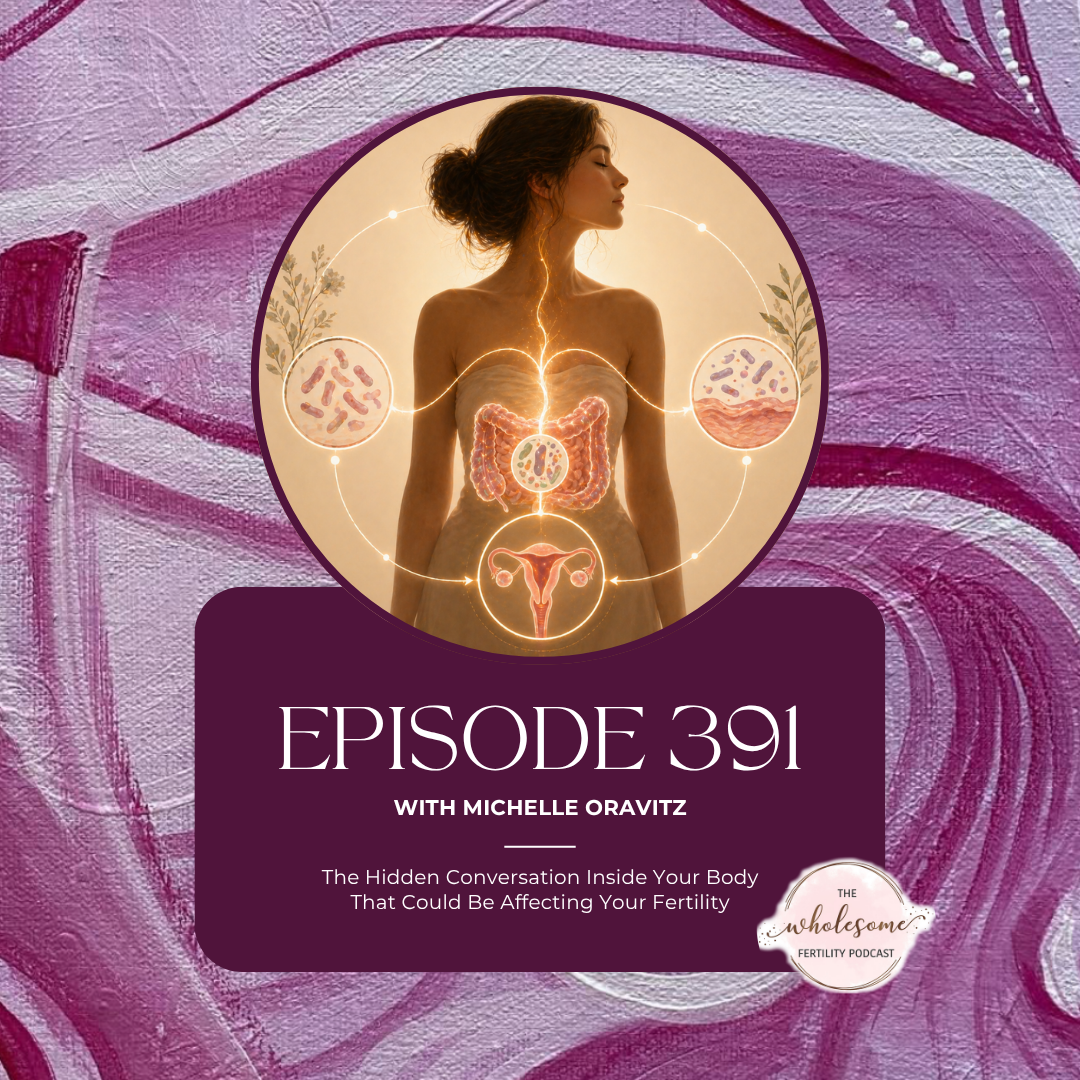
There is a quiet conversation happening inside your body that may be shaping your fertility more than almost anything else you have been told to focus on. It is happening in your gut, your reproductive tract, and your uterus. Until recently, science assumed the uterus was sterile. We now know it is not, and the bacterial communities living in these three places are in constant communication with one another, influencing your hormones, your immune response, and your ability to conceive and carry a pregnancy.
In this solo episode, Michelle walks you through what the research actually shows about the gut, vaginal, and uterine microbiomes, why this is one of the most overlooked pieces of the fertility puzzle, and what you can realistically do to support these ecosystems without falling into fear or expensive supplement spirals. You will learn why diversity is wonderful in the gut but not always ideal in the reproductive tract, how the estrobolome regulates your hormones, and how nervous system regulation, sleep, fiber, and fermented foods quietly shape the entire system. This is a grounded, science-backed conversation that gives you a clearer map of your own body.
Key Takeaways:
The uterus is not sterile. It has its own microbiome that influences implantation, pregnancy, and live birth rates.
A reproductive tract dominated by Lactobacillus is associated with significantly better fertility outcomes, including higher IVF success and lower miscarriage and preterm birth rates.
Diversity in the gut microbiome is healthy. In the uterus and lower reproductive tract, the opposite is true. A quieter, Lactobacillus-dominant environment is what supports fertility.
The estrobolome, a collection of gut bacteria, regulates how your body metabolizes and clears estrogen. When it is off, estrogen can recirculate and contribute to issues like endometriosis, fibroids, and irregular cycles.
Roughly 70 percent of your immune system lives in your gut, and gut inflammation can show up as uterine inflammation, affecting implantation.
Antibiotics, hormonal birth control, chronic stress, poor sleep, and harsh products like douches and scented washes all disrupt these microbiomes.
Foundational support is simple and accessible: a wide variety of plant fibers, real fermented foods, consistent sleep, nervous system regulation, and leaving the lower reproductive tract alone.
Microbiome testing is now far more accessible and gives you specific information about your own body, so you can stop guessing and make targeted choices instead of throwing every wellness tool at the problem.
Disclaimer: The information shared on this podcast is for educational and informational purposes only and is not intended as medical advice. Please consult with your healthcare provider before making any changes to your health or fertility care.
Research and Resources Cited:
The endometrial microbiome and its impact on reproductive outcomes
Evidence that the endometrial microbiota has an effect on implantation success or failure
Lactobacillus-dominant vaginal microbiome and pregnancy outcomes
Ready to discover what your body needs most on your fertility journey?
Take the personalized quiz inside The Wholesome Fertility Journey and get tailored resources to meet you exactly where you are:
https://www.michelleoravitz.com/the-wholesome-fertility-journey
For more about my work and offerings, visit: www.michelleoravitz.com
Curious about ancient wisdom for fertility? Grab my book The Way of Fertility:
https://www.michelleoravitz.com/thewayoffertility
Join the Wholesome Fertility Facebook Group for free resources & community support:
https://www.facebook.com/groups/2149554308396504/
Connect with me on social:
Instagram: @thewholesomelotusfertility
Facebook: The Wholesome Lotus
Disclaimer: Some of the links shared are affiliates but this is at no cost to you and can even get you discounted prices!
-
Speaker 2: [00:00:00] Welcome back to the Wholesome Fertility Podcast. I'm your host Michelle Orbits, and today we're going into one of the most important conversations around fertility. We're going to talk about the microbiome, but not just the gut microbiome that you've probably heard about, but the vaginal microbiome and the uterine microbiome, and the conversation that is constantly happening between all three of them.
This is one of the fastest moving areas of reproductive science right now, and almost no one is translating it for the woman who actually needs to hear it. So that is what I want to do today. I want to give you a clear, honest picture of what's happening inside your body and why it matters for fertility and what you can actually do about it.
So let's get started.
Welcome to the Wholesome Fertility Podcast. I'm Michelle, a fertility acupuncturist here to provide you [00:01:00] with resources on how to create a wholesome approach to your fertility
journey.
Speaker 3: Let me start with a piece of context that I think is going to surprise some of you. For most of modern medical history, the inside of the uterus was assumed to be sterile. The thinking was that the cervix acted as a gatekeeper and that the bacteria found inside the uterus must be a sign of infection.
That assumption is wrong. Research over the last decade has shown that the uterus has its own resident microbial community. It is much smaller and quieter than the gut or the reproductive tract, but it is there. And the composition of that community appears to influence implantation, pregnancy maintenance, and even early pregnancy loss.
So we're not talking about one microbiome anymore. We're talking about three. The gut, the lower reproductive [00:02:00] tract, and the uterus. Each one with its own dominant species. Each one shaped by what you eat, how you sleep, how stressed you are what medications you've taken, and what your hormonal environment looks like.
And here is where it gets really interesting. These three communities are not isolated. They're in constant communication. Let's start with the lower reproductive tract because this is the one with the clearest fertility implications. A healthy reproductive microbiome is dominated by a single strain of bacteria called Lactobacillus.
In women whose reproductive microbiome is more than 90% Lactobacillus, fertility outcomes are measurably better. IVF success rates are higher, miscarriage rates are lower, preterm birth rates are lower. And when Lactobacillus drops below the threshold and other bacteria start to take up more space, we see what is called dysbiosis.
And [00:03:00] dysbiosis in the environment is associated with implantation failure, recurrent pregnancy loss, and chronic inflammation. This is not a small effect. In some studies, women with non-Lactobacillus dominant reproductive microbiome had implantation rates roughly half of those with a healthy microbiome.
And here's what almost no one talks about. A lot of standard fertility workups do not test for this. You can do round after round of blood work, ultrasounds, and hormone panels and never have anyone look at the bacterial environment your embryo's actually trying to land in. The lower reproductive tract is not just a passageway.
It's actually an ecosystem, and that ecosystem is talking to the uterus on the other side of the cervix all the time. Now let's go up one level into the uterus itself. This is the newer research, and it's still being refined. But what we are seeing consistently is that the [00:04:00] uterine microbiome influences something called endometrial receptivity.
Receptivity is just a clinical word for whether the lining of the uterus is in a state where an embryo can successfully implant. In a study that's been replicated several times, women whose uterine microbiomes were dominated by Lactobacillus had significantly higher implantation, pregnancy, and live birth rates compared to women whose uterine microbiomes had more bacterial diversity in the wrong direction.
This is counterintuitive. In the gut, we actually want diversity. A diverse gut microbiome generally is a healthy one. But in the uterus and in the lower reproductive tract, the opposite is true. We want a quieter, more lactobacillus-dominant environment, and that is really an important distinction because if you've heard about the microbiome health in general, you've [00:05:00] probably heard the message that diversity is a good thing, and it is, but only in the right place.
Now let's talk about the gut, because the gut is the through line that connects all of this. Your gut microbiome influences your hormones in several specific ways. There's a collection of gut bacteria called estrobolome that helps regulate how your body metabolizes and clears estrogen. When the estrobolome is functioning well, estrogen is processed and eliminated in a healthy rhythm.
When it's not, estrogen can recirculate, build up, and contribute to conditions like endometriosis, fibroids, PMS, and irregular cycles. Your gut also produces and influences neurotransmitters that affect the HPA axis, which is the stress response system, and the stress response system is in direct conversation with the reproductive system.
So when the gut [00:06:00] is inflamed, when it is dysbiotic, when it is leaky, the downstream effects show up in places that have nothing to do with digestion. They actually show up in the cycle, in the lining, and they show up in implantation. So this is why so many women are doing everything right on paper, eating clean, taking prenatals, tracking their cycle, and still feeling like something's off.
Because the gut is the upstream piece that Often people don't really get tested. So how does this conversation actually work? There's a direct migration. Bacteria from the gut can travel and influence the reproductive microbiome. This is part of why women with chronic gut issues often also have recurrent imbalances in the reproductive tract.
There is hormonal signaling, and the gut influences estrogen. Estrogen influences the lining of the reproductive tract, and that lining is what feeds lactobacillus. So a gut [00:07:00] imbalance can cascade upward into the reproductive imbalance without even direct migration. And there's also immune signaling.
Roughly 70% of your immune system lives in your gut. That immune system communicates with the immune cells in the uterus, which are heavily involved in implantation. A chronically inflamed gut creates a chronically inflamed uterus, and there is nervous system layer too, which I always come back to. The vagus nerve runs through the gut and signals up to the brain, which then signals down into the ovaries and the uterus And when the gut is distressed, that distress travels along this pathway.
Everything is connected by design. So what disrupts these microbiomes? A short list, because this is where the practical part starts. Antibiotics, especially repeated courses, can disrupt all three microbiomes for months or [00:08:00] even years. This doesn't mean antibiotics are wrong. In many cases, they can save lives.
But what it does mean is recovery from them takes intentional support. And hormonal birth control changes the reproductive microbiome in measurable ways. Some women bounce back quickly when coming off of it, but others can take a year or more. Chronic stress also shifts the gut microbiome through the gut-brain axis.
The bacteria in the gut respond to your nervous system because your gut has its own nervous system. And diet also matters, especially fiber, fermented foods, and the absence of high amounts of processed sugar and emulsifiers. Sleep matters as well. Alcohol matters. And one more piece, douching, scented products, and harsh soaps disrupt the lactobacillus dominance that you actually want to protect.
The body is self-cleaning, so we don't [00:09:00] really need to do extra to clean it. Here's the part where I wanna keep things grounded Because the wellness world tends to turn this into a long list of expensive products, and that is not where I want to take you. The foundation is fiber. A wide variety of plant fibers feeds the beneficial bacteria in your gut, which then sets the conditions for everything downstream.
Aim for diversity, so different colors, different plants, different sources of fiber across the week. Fermented foods that are actually fermented. Real sauerkraut, kimchi, kefir, plain yogurt with live cultures, full fat, of course. A small amount of daily dose does a large amount once a week. And sleep. The gut microbiome has its own circadian rhythm, and it is disrupted by inconsistent sleep, so this is one of the most underrated interventions.
And nervous system regulation. The gut microbiome in your gut respond [00:10:00] to your vagal tone, so the vagus nerve is the bidirectional communication between your enteric nervous system, which is the nervous system of your gut, and your central nervous system, which encompasses your brain. So the bacteria in your gut respond to your vagal tone.
Slow exhales, time outdoors, and real rest are all microbiome interventions, even though they may not look like they have any connections to your gut. And for the lower reproductive tract specifically, leave it alone. No douching, no scented products, breathable underwear, and gently unscented cleansing on the outside only.
I would even go as far as Try to avoid tampons, and if you really must, if you really must and you have things to do, then use organic ones only. So here's what I want to leave you with before the close. So much of what I've seen in my work is women doing all the right general things and still feeling like they're missing information.
[00:11:00] Because general advice can only take you so far. At some point, you need to know what is actually happening in your specific body. That is what microbiome testing offers. So instead of guessing whether your gut or reproductive environment is supporting your fertility, you can actually look. You see what is dominant, you see what is missing, you see what is overgrown possibly, and then you make targeted decisions instead of throwing the whole wellness toolkit at the problem.
This kind of testing has become much more accessible in the last few years. It's not as out of reach as it used to be, and the information it gives you can change the entire direction of your fertility journey, which is why I wanna mention before we close that this is something that I now offer in my practice and online.
I work with women on both gut and reproductive microbiome testing, and we use those results to build a real specific plan rather than a [00:12:00] general one that might not be as effective. So if this is something you've been wondering about, you can find out more information through the links in the show notes, and I would absolutely love to support you.
Your body is not a mystery. It's an ecosystem, and ecosystems can be tended to. The microbiomes inside your body are listening to how you live, responding to how you eat and how you sleep, and how safe your nervous system feels. They're not asking for perfection. They are asking for consistent care and nurturing.
So if this episode opened something up for you, you might wanna share this with a friend who's on a similar path. And if you're ready for more specific support, you know where to find me
Speaker: So that concludes today's episode. You can find all of the links mentioned on the episode notes. If you're enjoying these episodes, please take a moment to share and leave a review. Reviews mean everything to podcasters, and I really enjoy hearing from my listeners. You can find me on my [00:13:00] website at www.michelleorbitz.com.
You could also reach out to me on Instagram, and I love getting DMs from my listeners. My handle is @thewholesomelotusfertility. I thank you so much for tuning in today, and I hope you have a beautiful [00:14:00] day.