
Ep 403 Genetics, Epigenetics, and Fertility: What Your DNA Can and Can’t Tell You with Natalie Samson
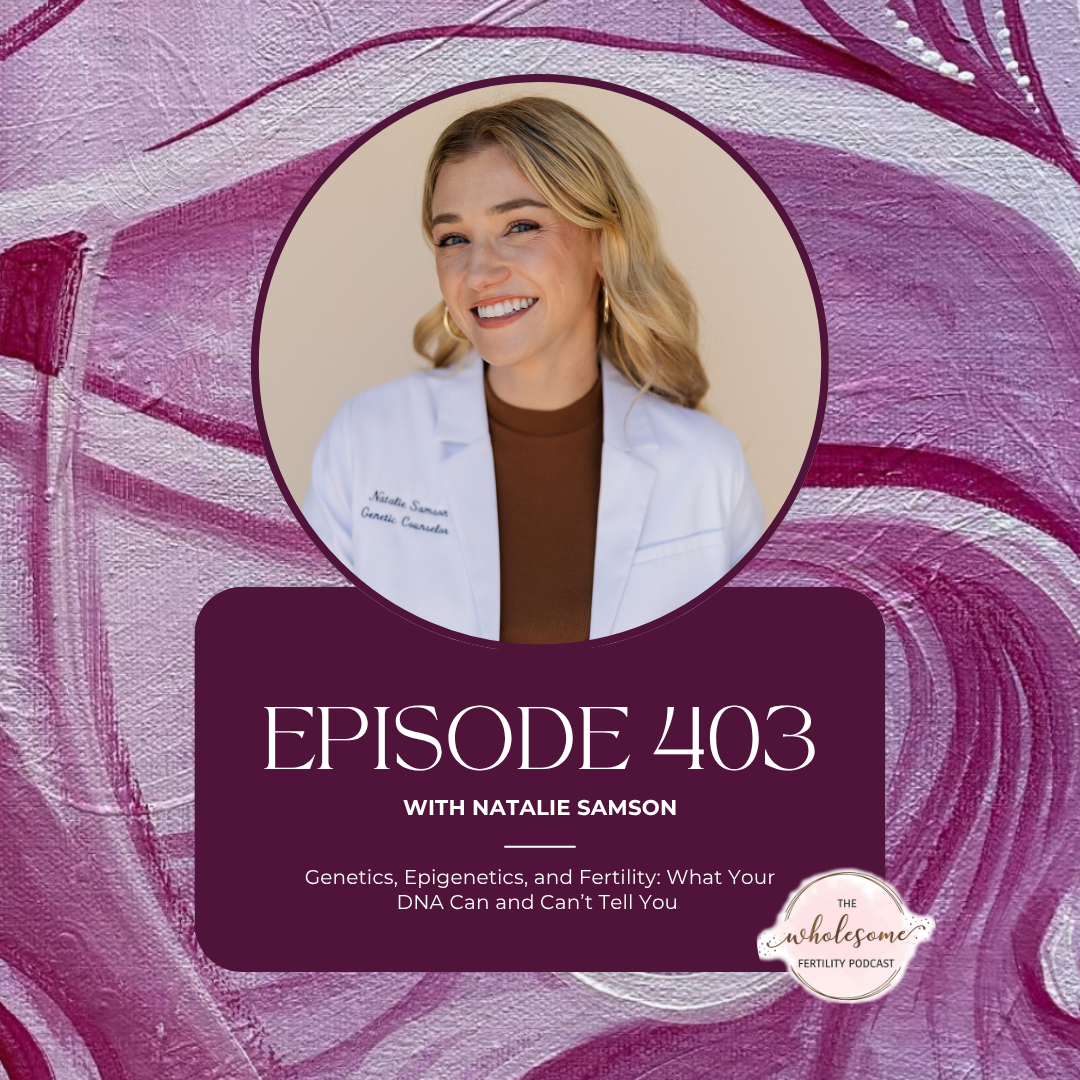
How much of your fertility is written in your DNA, and how much can you actually influence? In this episode, I’m joined by genetic counselor Natalie Samson to explore the fascinating world of genetics, epigenetics, and what they really mean for your fertility journey.
Natalie breaks down the difference between the genes you’re born with and how those genes get expressed, which is where epigenetics comes in. We talk about how your nutrition, stress, environment, and daily choices can turn certain genes on or off, and why that shift is so empowering. We also get into why MTHFR is only one gene out of more than 20,000, the role of methylation and hormone metabolism, what carrier screening can reveal about both male and female fertility, and how personalized testing can take the guesswork out of supporting your body.
This is a grounded, hopeful conversation about understanding your unique blueprint. Your body isn’t broken. Sometimes it’s simply waiting for the right information.
Key Takeaways:
The genes you’re born with don’t change, but how they’re expressed can shift based on your nutrition, stress, environment, and lifestyle. This is the heart of epigenetics, and it puts more in your hands than most people realize.
MTHFR is just one gene out of more than 20,000. Looking at the full methylation pathway, rather than MTHFR alone, gives a much clearer picture of how to support your body.
More methylated B vitamins isn’t always better. With certain gene variants like COMT, too much can actually drive anxiety, a racing heart, and trouble sleeping, so personalized dosing matters.
Carrier screening can reveal more than inherited conditions. It can sometimes uncover hidden contributors to both male and female infertility.
Genetic testing can guide truly personalized nutrition by showing how you process folate, omega-3s, histamine, and gluten, instead of prescribing a one-size-fits-all diet.
Your intuition counts as data. The most useful approach combines genetic testing, bloodwork, and your own felt sense of your body.
Privacy matters. Working with a HIPAA-compliant provider keeps your genetic information protected in ways that direct-to-consumer testing often does not.
Guest Bio:
Natalie Samson, MS, CGC, INHC, is a board-certified genetic counselor and integrative nutrition health coach, and the founder of Golden Genetics. After training in cancer genetics, she felt called toward a more proactive and preventative approach, inspired in part by watching her brother thrive through holistic, lifestyle-based care. Today she blends conventional genetic testing with functional, nutrition-focused interpretation to help people understand their unique genetic blueprint and make personalized, empowered choices for their health and fertility. Her practice is fully virtual, and she works with individuals and couples through preconception and beyond.
Connect with Natalie:
Natalie’s Instagram: https://www.instagram.com/geneticswithnatalie/
Golden Genetics Instagram: https://www.instagram.com/goldengeneticshealth/
Website: https://www.goldengeneticshealth.com/
Book a Logistics call with Natalie: https://www.goldengeneticshealth.com/book-a-discovery-call-1
Natalie’s 4P Framework Quiz: https://form.typeform.com/to/RkvZ32qV
Disclaimer: The information shared on this podcast is for educational and informational purposes only and is not intended as medical advice. Please consult with your healthcare provider before making any changes to your health or fertility care.Ready to discover what your body needs most on your fertility journey?
Take the personalized quiz inside The Wholesome Fertility Journey and get tailored resources to meet you exactly where you are:
https://www.michelleoravitz.com/the-wholesome-fertility-journey
For more about my work and offerings, visit: www.michelleoravitz.com
Curious about ancient wisdom for fertility? Grab my book The Way of Fertility:
https://www.michelleoravitz.com/thewayoffertility
Join the Wholesome Fertility Facebook Group for free resources & community support:
https://www.facebook.com/groups/2149554308396504/
Connect with me on social:
Instagram: @thewholesomelotusfertility
Facebook: The Wholesome Lotus
-
[00:00:00]
Michelle: Welcome to the podcast,
Natalie. So happy to have you
Natalie: Thank you so much for having me.
I can't wait to chat
Michelle: too. So, uh, we just had a little pre-talk about how exciting, and interesting genetics i- are. I mean, it's, it's a whole other world. So I'm actually really excited to dive in. But before we get started, I would love for you to share your origin story, how you got into
such interesting work.
Natalie: Yes. Okay, so this question is always interesting for me to answer because I'm always like, "How far back do I go?"
Michelle: the rabbit
Natalie: sure people feel the same. Yeah, it's such a rabbit hole.
but I do start with my childhood because I grew up with a brother who was neurodivergent. He was, diagnosed with many different diagnoses from autism spectrum disorder to OCD, ADHD, bipolar.
and so growing up, he really influenced me of course, and, the way that he [00:01:00] experienced treatment, which I'll get into, it definitely influenced me. And so, I just grew up loving and wanting to understand the body on such a deep level. And so when I went through my undergraduate program, I studied biology and I had no idea what I wanted to do with it.
I knew I wanted to work with people 'cause I loved people too, and I was like, "Is there a world in which you work with people, you can enjoy science, but maybe not take the entire med school route?"
Michelle: Mm-hmm
Natalie: And so I found genetic counseling. Someone came in and chatted with us about pediatric genetic counseling.
She was seeing patients with autism at the time, and so obviously I felt very drawn to that population. And, you know, I, I realized that I could study genetics, which is like such a micro scale of the body, and understand, you know, how the body works from that teeny-tiny scale, and be able to work with patients.
I loved how it also included psychology in the program, and so after I graduated, I [00:02:00] pursued, a genetic counseling degree. And, during my journey of genetic counseling, I originally went in for pediatrics because of my brother and wanting to work with patients with autism, but I felt actually more drawn to the proactive, personalized, preventative aspect of genetics, because I felt like pediatrics was maybe a little bit too close to home, and I was...
ended up being more drawn to cancer genetics. So I routed to cancer genetics, and ultimately kind of ended up in a situation where I felt disconnected from that world too because it still didn't feel like proactive. And in my head I was like, "But genetics can be so helpful for proactive care, you know, why aren't we using it in that way?"
And at the same time, my brother actually ended up being treated with more of a holistic approach using nutrition, lifestyle, mindfulness, and supplementation, and that really ended up helping him. So I [00:03:00] felt pulled into more of a proactive and integrative world. So with all of that being said, I went back to general genetics and started my practice to really bring more of a holistic approach to the world of genetic testing and interpretation.
Michelle: It's so wild. So tell me, um, I guess for the listener listening to this, obviously we know what, uh, genetics are and DNA, you know, people are like, "You know, I have my mom's genes, my dad's genes." But most people don't know it the way you know it. so can you break it down, like really why it matters? And I know that now we're learning that it's a blueprint and that the environment can affect it as to what can open it...
You know, that's the, I guess, the proactive aspect of it, of what can, turn certain genes on and off, which is the whole epigenetics world where they're finding... It, it's sort of, to me, it's almost like the neuroplasticity of the epigeneti- of, the genes 'cause neuroplasticity was like a, you know, they used to think your brain [00:04:00] is just the way it is.
You are the way you are. Then they found neuroplasticity. They were like, "No, you can actually shift things and change things." And it seems to me like the n- the epigenetics... I mean, this is just from my perspective. I'm not an expert on that. But to me, the epigenetics is sort of like that for genetics where you were like, "Oh, well, you have these genes, and that's that, and you're gonna have exactly like what your mom had if you have her genes."
and now we're finding, no, there's something called epigenetics where the environment, and that can also be emotions that can trigger certain hormones or, you know, chemicals in your blood that can be the environment of the genes because your blood is like the petri dish. So it's kind of that whole thing, so that it sort of, brings a little more power into our hands or empowerment.
So, um, I'm just fascinating by the whole topic, but I love that you're here because you know so much more than I do. So I'd love for you to break it down for
people who, like, really don't know much.
Natalie: Yeah, [00:05:00] absolutely. And it's so true. I love talking about epigenetics and nature versus nurture because it is such a complex topic, but it's also so exciting and empowering to understand it. So, I always start with the basics. So inside our cells, we have these structures called chromosomes, and people in preconception and prenatal, they may have heard of chromosome testing because that's actually how you actually normally determine the gender of your baby, when you're doing NIPT, it's called, or NIPS.
And so we have these structures called chromosomes. Chromosomes are basically just wound up DNA or genetic material. So if we stretch out the DNA and we segment certain parts of that DNA, that's what we call our genes. So it's almost like, a chromosome is a chapter of our book, and sentences are DNA and words or, you know, sentences inside that chapter are our genes.
And so genes give our bodies instructions to do [00:06:00] things. we have genes for pretty much everything in our body. We have genes for development, hair color, eye color, but we also have genes for making hormones, you know, making melatonin. We have genes, that are, influenced every day, inflammation genes, glucose and insulin genes.
So we have so many genes in our body, and we have spelling of these genes that we're born with. And so that spelling of that gene doesn't change throughout our life. It's what you're born with. But the expression of that gene can change, and so that's where we get into epigenetics, which I'll talk about.
but I always also like to mention, so we have two copies of each gene. We get one from our mom and one from our dad. And so
when we look at the spelling of those genes, because, like I mentioned, genes are made up of letters, so when we look at the spelling of those genes, most of the time we have human diversity and differences in those genes.
You know, everyone has such a different and unique genome, we say. and so when we're doing genetic testing for health, we're looking to see if there [00:07:00] are changes in genes that can cause the gene to work differently. That's what we call variants or mutations sometimes people hear. and what we're studying and understanding is how does that change in that gene impact you?
and so that's kind of the basics of, you know, what we're doing with genetic testing, what your genes tell us. And so when we're thinking of the topic of nature versus nurture- some genes are really impactful in our bodies, and if you have a change in those genes, you might have a diagnosis of a genetic condition.
And so when we're thinking of preconception and fertility, carrier screening, is a test that's sometimes run. but these are conditions such as like Huntington's disease, Tay-Sachs disease, cystic fibrosis, Down syndrome. So these are conditions that when you're born with a genetic change, you have a diagnosis.
But many of our genes fall on the other side of the spectrum, where you can have changes in these genes, but you might be at [00:08:00] increased risk. But how we eat, what our lifestyle is like, what we are exposed to, our stress levels will influence how those genes are turned on or off, and that's where epigenetics comes into play.
And so to answer your question in a very long-winded way, when, when I answer the question, when people say, "Is it nature versus nurture?" I always say it's both, and it's dependent on what gene and genes we're talking about. But most of the time, we have lots of influence on, you know, what our genes are doing in our bodies
Michelle: Yes. So you're saying that there are certain things or conditions that immediately if there's a shift or change to that gene, or
DNA, I think, um, um, and they're born that way, then it's an automatic diagnosis. But in some cases, it could be kind of like just something that we have that may not be, like, automatic and 'cause it's not, like, as, I guess, like, solidified, [00:09:00] where it, it can turn on and off, and that would obviously, shift and, and, you know, the diagnosis.
But it sounds like it... There's so much
nuance to it.
Natalie: Exactly. Exactly. And yeah, that's why, I mean, I always tell patients we have over 20,000 genes in our bodies, and so genetic testing has kind of exploded with ancestry genetics and the availability we now have to sequence your genome, which is all of your genes. however, that doesn't make it less complex.
So that's why, you know, interpretation and understanding what this information means is almost bigger than the ability to just test for everything, because that is the piece that really helps us be actionable with, with our results
Michelle: for sure. And, and are you guys, finding that as time goes on more gets discovered? I'm sure,
'cause there's just so much
Natalie: Exactly. We are, a big part of our jobs as just genetic counselors [00:10:00] in general is staying up to date with the research as genetics is rapidly evolving, which makes our field so exciting to be in because it's never boring. So
Michelle: new.
Natalie: yes.
Yeah, Yeah. Okay, go ahead
Michelle: No, no. So go on.
Uh, what were you gonna
Natalie: Okay. Yeah, I was gonna say sometimes the concept of nature versus nurture I think can be helpful if I bring up an example too.
So I was, I was gonna mention an example of, right now it seems that there's a lot of patients with, you know, questioning diagnoses of Ehlers-Danlos syndrome. I don't know if you've heard about, hypermobile Ehlers-Danlos syndrome before? Okay. It seemed to be a trend on TikTok, so all of a sudden everyone was asking us for this.
but if you heard of it, it's, it's a connective tissue disorder, so it makes you hyper flexible, but you
can
have
Michelle: of it. Actually, somebody had
mentioned it, but the name I didn't know. Yes
Natalie: Yes. Okay, so I, I wanted to bring up this example 'cause it might seem familiar. So if someone has, a certain subsite [00:11:00] or certain subtype we say of Ehlers-Danlos syndrome, that can be genetic in nature. So that person might be born with a genetic change that gives them a diagnosis of Ehlers-Danlos syndrome.
However, there are many genes that also relate to symptoms that we're now seeing, so genes such as your inflammation pathway or how you break down histamine. those genes are very influenced, especially the inflammatory pathway, that's very influenced by our environment. So if someone has a diagnosis of Ehlers-Danlos syndrome, of course there are clinical things we want to consider to help with that.
And if someone also has changes in genes related to inflammation, they might be more prone to chronic inflammation, and so how can we support that genetic pathway? Of course, that would be doing things like Mediterranean style diet or anti-inflammatory diet, you know, considering supplementation like omega-3s or curcumin and turmeric.
how can we, support lifestyle to lower inflammation? So those [00:12:00] are all things that are very much in our power, and it's not that these patients can never enjoy ice cream and pizza and, you know, do the things they love, but it just helps us understand maybe you're more prone to chronic inflammation, which is impacting your symptoms more.
So how can we balance in majority of our time, help shut that pathway down? And that is full epigenetics. So that's how we as, in our practice, how we integrate both worlds and support patients from both aspects.
Michelle: Yes. And it's interesting 'cause as you were talking about it, it seems like if you have one genetic tendency and then you have another one, that can exacerbate or kind of like shift the other. So it's almost like
they have a community
Natalie: Yes. Yeah, everything works together in the body. And I think that's one reason I also wanted to start my practice because it seemed that healthcare was very siloed. So you'd go to this specialist for GI, and then you'd go to this specialist for OB. [00:13:00] And then what about, you know, do they talk? Most of the time, no.
So practitioners aren't really talking about the one case. And in genetics that happened where we are trained in certain specialties, which I think is so important because you can obviously have expertise. However, for us in our practice, we actually... Because we're trained in all specialties, we wanted to open everything to general genetics, and the reason is because everything is connected as well.
So part of our job, at Golden Genetics is really being able to or- order any tests that make sense for you and interpret all tests in that context. Of course, we have s- you know, there's certain scope, and if we need to refer out, we will. But in general, we actually want to look at how different pieces of the body are working together because like you mentioned, you know, they, they oftentimes influence each other.
For, for another example, cancer. If someone has a high-risk cancer mutation, like a BRCA mutation, for example, how are their other genes potentially influencing that, like [00:14:00] detoxification, oxidative stress? How is that playing a
Michelle: That's so interesting. It's just really fascinating work. Um, as far as the fertility world or reproduction, what have you seen impact that? Um, we know the, the mo- like a very common one that I think everybody knows about is the MTHFR gene mutation. but what are some of the other things that you've seen that people might have not realized and kind of go through years of just tr- trying and, and not realize that maybe that can be contributing, and/or what are some of the things that people can do or are some of them, like, workable?
Natalie: Absolutely. And so many people have heard of MTHFR, but I always tell patients that that's one gene out of 20,000 genes. So, um, MTHFR can be very important, and it's something we do test for in our practice. And when it comes to preconception, there are so many other genes that can give us really good insight [00:15:00] to support fertility.
So, uh, and I'm showing with my hands, and I know listeners who are listening on audio can't see that, but I kind of think of two different worlds. So if we think of the left world, this is more conventional, traditional genetic testing. On the right, this is more functional, holistic genetic testing. And again, we combine both.
So when we're thinking about the left side, more medical traditional, this is where tests such as carrier screening, karyotype, which I'll go into, NIPT, these are amniocentesis, CVS. These are tests some women may have heard about. So carrier screening, for example, is a test that looks at how your genes, how you and your partner together may pass something down to offspring.
We call this recessive conditions. So the reason it's called recessive is because we have two copies of each gene. If we have one gene that has a change but our other one works, we might not have symptoms. But if our partner also has one change in [00:16:00] one gene and we both pass down that change, that can lead to a recessive condition.
That would be like cystic fibrosis, Tay-Sachs disease, those recessive conditions. So carrier screening can be really helpful during preconception and fertility, n- not just because of assessing for potential, disorders that could be passed down that you can be proactive and plan ahead with, but also people don't realize that sometimes we can find changes that can influence fertility.
So for example, um, if men are carriers, meaning they have one change in a cystic fibrosis gene, that can sometimes lead to them having something called an absence of the vas deferens, which just impacts sperm. And so it can actually be a situation of male infertility if that comes up, and we have options and things we can do about it.
So an example of why this can be important, I have a friend who, was on an infertility journey for five plus [00:17:00] years, and they finally r- got genetic testing done. Unfortunately, it's usually, you know, the story of how it's late. And they figured out that's what happened to him. And so they were just excited at that point to finally have an answer, and they were able to actually use, utilize IVF and conceive, through IVF and have two beautiful babies now.
And so
it just shows, yeah. So that's, that's one piece. and then there's also the functional side of things, which I can get into too.
Michelle: Yeah, Yeah, sure. Um, one of the things too, before we go onto that, is, I was thinking about also compatibility. One of my patients was trying for years and then found out that her and her husband, it just... There was a, an incompatibility with, the sperm and the egg, and I thought that was kinda interesting.
it was kind of one of the first times I've heard of it, 'cause it doesn't really... Is that something that that is
tested through genetics?
Natalie: Yes. Yes. So there's, I actually, it's so funny 'cause [00:18:00] I have, we just actually, from a lab that we use, we, we just found out about a genetic test that can look at carrier screening mixed with the compatibility test as well. So that's really exciting. That's out right now. yeah, so that can come up.
The other thing that can sometimes happen is, so I mentioned karyotype. Karyotype is testing the parent's chromosomes. So if we go back to chromosomes are just all of our wound up DNA or genetic material.
Michelle: Mm-hmm.
Natalie: Sometimes what can happen is, so chromosomes kind of look like, it's hard 'cause I use my hands to talk a lot, but it, they look like an X.
And so sometimes what can happen is someone's left side of their X can be switched with the right side of their X. So it looks like,
Michelle: Is it, is it trans, um, what is it?
Trans... Translocation,
Natalie: exactly, translocation.
Michelle: yeah
Natalie: Exactly. So that, because they have the X switched, that doesn't affect them because they have all the genetic material, so their [00:19:00] chapter, their chapter's complete.
But what can happen is when, meiosis, which occurs during implantation, that takes away the chromosome incorrectly, and so it can lead to, a zygote, meaning egg and sperm, that it doesn't have complete DNA, and that can result in miscarriage. And so sometimes, um, that can happen for people as well.
So we, we can test for that too if there is, um, history of miscarriage, which can be really helpful to, you know, have answers there too.
Michelle: For sure.
Natalie: yeah, so
Michelle: great. Well, thank
you for that, and then we'll talk about
the functional
Natalie: Perf- okay, so this is my favorite, me- my favorite stuff to talk about. so basically in the more holistic functional world, MTHFR, let's talk about methylation first actually So MTHFR is a gene that is involved in something called methylation. methylation is a biochemical process in our body that does many things.
One being processing [00:20:00] folate and B12, as well as choline. So obviously we've heard that folate is really important for women, during pregnancy to, inhibit or reduce risk of neural tube defects. But folate can be really helpful in our bodies for many other reasons. So when we're doing genetic testing for methylation, it's actually really helpful to not only look at MTHFR, but also all the other genes involved in the methylation pathway.
So that would be things like, people may have heard of COMT or MTR, MTRR. these are genes involved in the entire methylation pathway. And so the reason we wanna do this is because this can help us understand how to support your methylation specifically. So it's actually not just about taking methylated versions of methylf- folate, methyl B12, and choline, but sometimes we need to adjust dosing as well specifically for you.
So for example, if someone has a [00:21:00] gene variant in the COMT gene, C-O-M-T, you actually need to take m- less methylated B12 and folate than other people because you might have increased risk of anxiety if you take too much.
And so some people come to us and they're like, "I can't sleep. I have MTHFR so I've been taking this methyl B complex in the morning and at night, and I, I'm just anxious."
And we're like, "Well, actually that's because what happens is because you... if you have COMT, um, COMT helps process dopamine, adrenaline, and norepinephrine. So if you have too many methyl donors, you're processing those too quickly, and that can lead to, um, fast heart rate, anxiety, and, um, insomnia." So it's really helpful.
Um, we always tell patients like, "Okay, let's start there", and then that can help us understand what prenatal that you might, you know, benefit from 'cause some prenatals have a little bit more dose, some prenatals have a little bit less [00:22:00] of a dose. So that's really helpful. and then we have genes that actually help us understand how you metabolize and process hormones.
So anyone, you know, in the fertility space, I'm sure, uh, in the TTC journey has started to understand their hormones a bit better and why estrogen and progesterone can be so important. Sometimes women, we have genes that can indicate risk for, um, estrogen dominance, which can keep estrogen, you know, lower and s- and I mean, keep progesterone lower, and so that can have inf-, you know, influence on, um, the ability to conceive and, uh, miscarriage risk as well.
So we have hormone metabolizing genes. We have genes, you know, with again, um, histamine detoxification, inflammation, glucose and insulin. All of these can be so helpful in preconception and also during pregnancy. Like the glucose and insulin genes can be really helpful for us to understand, you know, during [00:23:00] pregnancy, um, risk of blood sugar spikes and drops and things like
Michelle: Yeah, that's fascinating. And it's really amazing to be able to really, uh, to get that perspective because even sometimes labs don't pick up on the, you know, the subtleties of the body or the things that are maybe, like, uh, subclinical. So it's, it's just fascinating to really just take a look at the genes and see what people have tendencies for
Natalie: Absolutely. Yeah. Yeah
Michelle: And does it also, can you figure out like what, types of foods people would be sensitive to? I mean, you mentioned like the Mediterranean diet or, you know, anti-inflammatory diet. Can it go in more detail on like the types of foods that would work best for people?
Natalie: Yes. Yes. And so, the study of nutrigenetics and nutrigenomics is so interesting and, and we utilize it in our practice. It is very mis- [00:24:00] or there's a lot of mi- misinformation around it, unfortunately. So we always think it's so important to make sure you're working with someone who has genetics expertise, because the way that nutrigenetics and genomics works is we're not necessarily giving patients a specific diet plan to follow.
What we're looking at is how you process and respond to nutrients. So an obvious example, an easy example I'll start with is we actually do test for the celiac genes, which are a little bit more black and white. So the celiac genes can actually tell us, if you should be, uh, avoiding gluten or not. And the reason I love the celiac genes is because many people go undiagnosed celiac for years because our celiac testing, even if they do the blood test, sometimes isn't always the most accurate because you'll have, you have to eat a lot of gluten for that antibody test to show up.
And what happens is some people stop eating gluten because they notice it hurts, then they do the antibody test and [00:25:00] it's negative, and they're like, "Oh, I guess I don't have celiac," then they go back to eating gluten. But genes, you know, genes don't lie, so if you have a high, high risk of celiac from a genetics test, it really helps us uncover the fact that you probably have developed it, you know, in adulthood, and that it g- would be good to do trial elimination without having to do an endoscopy and a biopsy to really confirm that.
If you test negative with the celiac genes, you rule celiac out, which is also helpful in its own way. So that's one example, but, other examples that are not as black and white that gene- genetics can help us with in terms of what you can be eating to support your health, we do have genes that help us understand how you break down omega-3s, for example, and if you me- if you may need more or less oma- omega-3s.
We also have- Right ... yeah, we also have genes, that help us understand if you need more or less detoxification support, which could [00:26:00] impact if we recommend sulforaphane or cruciferous vegetables. the histamine genes are so helpful and interesting because if you have issues breaking down histamine, things like fermented foods might actually make your GI symptoms worse.
Michelle: Um, that's true. Yeah. No, Um, some people get really sensitive to that
Natalie: Yeah. And yeah, exactly. And we have patients that are like, "I don't understand why I have GI issues. I'm eating so many fermented foods all
day."
We're like, "Well, actually, your genes show you can't break down histamine, so you're...
Michelle: Oh, so interesting
Natalie: Yeah. So, so it's less about, you know, sometimes, like, the Mediterranean anti-inflammatory style diet we will recommend if there's inflammation genes, but it's less about, like, this specific diet, and it's more about what food groups maybe can be helpful to avoid or add in to support you.
Michelle: Right. And then another question I had was blood type. I know that it's, you know, it's different, but you are [00:27:00] born with, you know, it, it is genetically passed down in a sense. It's not necessarily a, a, a gene, it's a blood type, but I'm sure the genes inform how that is expressed. Am I correct? I don't, I don't, I'm not a
I don't know
Natalie: Yeah. That's a good question. Yeah, that one, it's ... So the genes definitely inform what type of blood type you have, but they're less interactive. Once you have the specific blood type, since that doesn't change, it's less interactive in epigenetics.
Michelle: Mm-hmm
Natalie: But it's helpful, you know, definitely helpful information to also know.
And that's why w- what you were saying earlier too with, um, blood tests, w- we also always like to put things in context. So we obviously think that genetics could hone- you know, could honestly benefit everyone. It's so important. And we also think that other genetic tests ... I mean, sorry, other tests like blood tests are also helpful to hel- help, help us understand [00:28:00] another layer of data.
And, you know, just in general, we also wanna put together different tests and pieces of data, including we always tell the patient, "You know your body best." And it's fascinating how many patients will actually ... When we read their DNA, it's fascinating how many patients will actually be like, "Oh my gosh, I just feel like intuitively this aligns
so much," you
know?
Michelle: That's why everybody should always listen to their patients because they know, like, people know their bodies, and I, I think that that... I feel very strongly about that because so many people, um, I get it, you know, you go to school and you learn your, your information, but there's something about the intelligence of the body and the communication that people get from their own bodies that should
never be dismissed
Natalie: 100%. I, I love that so much, and we think that, you know, being a good practitioner is taking every question seriously and telling the patient to listen to their body at the end of the [00:29:00] day. Because, you know, I think, like you said, it's... It... No matter what, it's the patient... If we give a bunch of information and the, and, or advice, and the patient's not feeling good on a certain supplement, there's definitely a reason they're not feeling good on that supplement, you know?
And so we obviously don't wanna disregard why, and, and there's always, you know, always the, the data. So that's... We always say put it into context. We can get all the data we can from genetic testing, from blood tests, from wearables, and at the end of the day, we think that the, you know, some of the strongest piece of data is also the, patient listening to their body.
Michelle: I love that. That's a great way to put that. And, um, but, you know, it's interesting about the blood type, kind of going back to that, because I remember reading a book about that. But there's a lot of truth to some of the things that I read. I don't know that it's really proven though. So I'd be curious to know if, if, you've ever heard of anything about the blood type influencing, like, the foods or, you know, [00:30:00] anything like that, or if that's even looked at in
the genetic scope
Natalie: I know. Such a good question. Honestly, it's not in our, in our s- training. sounds like something we need to
Michelle: It's interesting. It's interesting. Um, you know, like the O, O blood type being the oldest, and it's, it's funny because they, the idea is that like the oldest back in the day, um, they used to eat a lot of... They were more carnivores, and they didn't eat fish, as many fish. So people with O blood type, um, tend to, the idea is or the thought is that they don't really do well with fish and typically don't like fish.
But I've found anecdotally just asking people with O blood type, "Do you like fish?" Sometimes they will say yes, but a lot of times they're like, "Ugh, I can't stand fish." So I, I just thought that was interesting. I'm like, the... It, it's just, it's
kind of fascinating work.
Natalie: that's interesting. Yeah. So yeah. Oh, okay. We definitely need to, I need to look into [00:31:00] that 'cause I'm not a fan of fish, which is so unfortunate
working in disease. I'm not sure. I don't even know my
blood type. I'm like, I know all, all of, all my DNA, but I need to figure out my blood type. So funny. Like, yeah, working in disease prevention,
I, you know, it's been, I've been pushed to eat more fish, but it's not something I love.
So I, now I need to know my blood type. I'm gonna find
out and report
back.
Michelle: Um, that's so interesting. So, so how do people go about this? I'm sure that you guys-- It sounds like you run many different types of tests, and it's not one size fits all. Um, you had mentioned that you do kind of like the more... You, you have one that's more nutrition-oriented, right?
You were saying?
Natalie: Yep. Yep. Yeah.
So the way that we work, and, with preconception too, we, we do have a quiz, that's free for you to take if you want to assess if genetic testing could be an best next step for you. And it... The questions help us understand both worlds, so more traditional conventional testing, but also [00:32:00] nutrigenomics.
Um, obviously, I will say though, again, biased, our, you know, our marketing officer always hates when I say that everyone could benefit with it. She's like, "No, you need to actually be very targeted." And I'm like, "No, everyone benefits from genetics." So that's the caveat. However, the quiz can help you understand if it's a really good best next step.
With that being said, the way that we normally work is we always meet with patients for a pretest session. And so because we run various tests, we're not tied to one lab or one test. And so we always want to assess, personal and family history in more detail. As genetic counselors, we're very much trained to assess family history in a lot of detail.
But if people don't know their h- family health history, that's okay 'cause we see that all the time. Mm-hmm. However, in that appointment, we usually talk about personal family history, and then we'll also talk about genetics education and what tests are out there that we think could be beneficial to the person [00:33:00] And so in that appointment, we'll go through the different options, then we place the test orders.
Most of the time, people are surprised to hear that genetic testing is actually, saliva or cheek swab sample now. So we don't need blood. A lot of people, question the accuracy, and we always say we actually can sequence the DNA with saliva or cheek swab sample just as accurately as blood at this point.
And so that's really exciting. We only need blood if we are doing specialized tests or like chromosome tests for, for t- fertility. Um, but for the most part, we ship the test kits to the patient's house. They complete those tests on their own, and then we get results. We spend time interpreting them, and then we meet for a results review for 75 minutes.
And our practice is for fully virtual, so we meet on Zoom, and then we go through that, protocol. So speaking of one size fits all, we always talk about how genetic testing hits on four main [00:34:00] things, four Ps we say. So personalized care, so how can we personalize your plan right now away from one size fits all?
Um, preventative, so if anything comes up that, um, there could be an increased risk of disease and there's opportunity for us to be preventative, we will talk about that. Proactive care, so similar but different because proactive we oftentimes, or I often say that it's more about catching things early if they do come up, which we know is better than things caught late.
And then the last P is precision, so how can we be precise with any treatment plans? So we cover those four Ps in four buckets, which is diet, lifestyle, supplementation, and then any conventional, traditional recommendations we have. So that's, that's normally how we work with patients. And so, um, if someone was coming to us for preconception, we also work with both partners too.
Michelle: So interesting. And then my last question, because, um, I know there was this whole thing with, uh, [00:35:00] 23andMe and people wanting privacy, and I, I don't, I, I still don't know exactly what happened. I just... My mom was like, "You gotta sell," um, you know, "Delete your account. Delete..." She just, like, saw something on, on social media.
So I, I don't know. Um, maybe I should know more about it. I just get too busy in my daily, routine. But what was the whole story with that, and then, what are the privacy, I guess the privacy rights or support that people get
with you guys?
Natalie: Yeah, thank you. Definitely. Yeah, thank you for bringing this up because we have so many patients that are confused about privacy of genetics because of the 23andMe scandal. So, so one thing we... When we think about genetic testing for health, it really started off in the prenatal space and, you know, started kind of emerging into the cancer space, but it was always in healthcare.
and that means it was covered under HIPAA, which is obviously privacy protection. Right. [00:36:00] So when ancestry genetic testing started coming out, all of a sudden it, this wasn't protected under HIPAA. So, you know, genetic testing is just like any other healthcare test, and it kind of became more of, you know, something that a- again, was direct to consumer, so people could order it without their practitioner.
So of course, like, that helps us with awareness about genetic testing and can be, you know, amazing to figure out things like where you came from. But it did take away the privacy that normal, you know, that you normally have in a healthcare setting. and then the ancestry genetics, um, started offering health genetics, so all of a sudden, like health genetic testing became out of healthcare space too.
And so, what we always say in our practice is, of course, we're a HIPAA compliant medical practice, and so your genetic test is, the same security that you would get through HIPAA, so it's in a private electronic medical record system. And, and we also choose genetic tests that [00:37:00] prioritize privacy. So for example, one lab we use, um, we actually toured their lab, so we know that the g- the sample is a number when it reaches their lab.
The sample is destroyed after we get results. They're also, you know, HIPAA compliant, so it's going into our medical records system. The only people seeing the results are us and the patient. So we, we take privacy very seriously, and that's something we caution about. You know, it's, it's not... Everyone has, you know, their opinion about, you know, their information being out there, and we always just say th- you know, something to think about when it comes to doing genetic testing through just a lab directly and not through a, a provider, because there is that risk basically where labs can sell data to outside companies, and there's less protection on who gets their hands on the, on the DNA.
Michelle: I think it's important for people to hear because I think that that definitely caused a lot of alarm. So just to know that it's secure and that they can [00:38:00] feel safe doing so, is definitely gives
people peace of mind, I'm sure
Natalie: Exactly. Yeah, exactly. And, and yeah, I think people think that genetic testing... People think of genetic testing with ancestry or, like, designer babies, which is, like, more of the news, or they think of genetic testing for just disease risk and, like, why would I need it if I don't have a disease, or my family history, there's no diseases.
But it's so much more than that, as, you know, I hope that listeners can get from this conversation. There's so much with genetics, and so, um, you know, yeah, just exploring how that could be beneficial for you in, like, a private and secure way is, you know, could be incredible information for your health
Michelle: Yeah, definitely. So, um, this is such a great conversation. I really appreciate it. And, uh, for people who are interested and wanna
learn more, how can they find you guys?
Natalie: Yeah, so we would love to support you. I also say too that everyone on our team, you know, [00:39:00] just wants to support you and would love to talk. So we do have a, uh, the ability to book a complimentary logistics call, we say. So this is about reviewing, you know, your goals and making sure we can support you. And you can do that through our website or through our Instagram at Golden Genetics Health, or mine is Genetics with Natalie.
And then, um, feel free to also contact us through our website if you have questions before booking a call. And then we do have the preconception quiz as well that can help guide and give direction immediately if, if genetic testing could be useful for you
Michelle: Awesome. And all of the notes will be, uh, found in the show notes if anybody wants to find them. but Natalie, this is such a great, conversation. It's fascinating, like absolutely fascinating work. I'm curious about my own now and, like, and my family. It's really interesting.
Natalie: need to set you up.
Michelle: so interesting. So thank you so much for coming on today.
This is a great conversation
Natalie: Oh, thank you so much for having me.
[00:40:00]