
Ep 404: What Your Cycle Is Trying to Tell You: Prolonged Bleeding, Ovulation, and Body Literacy with Robyn Srigley
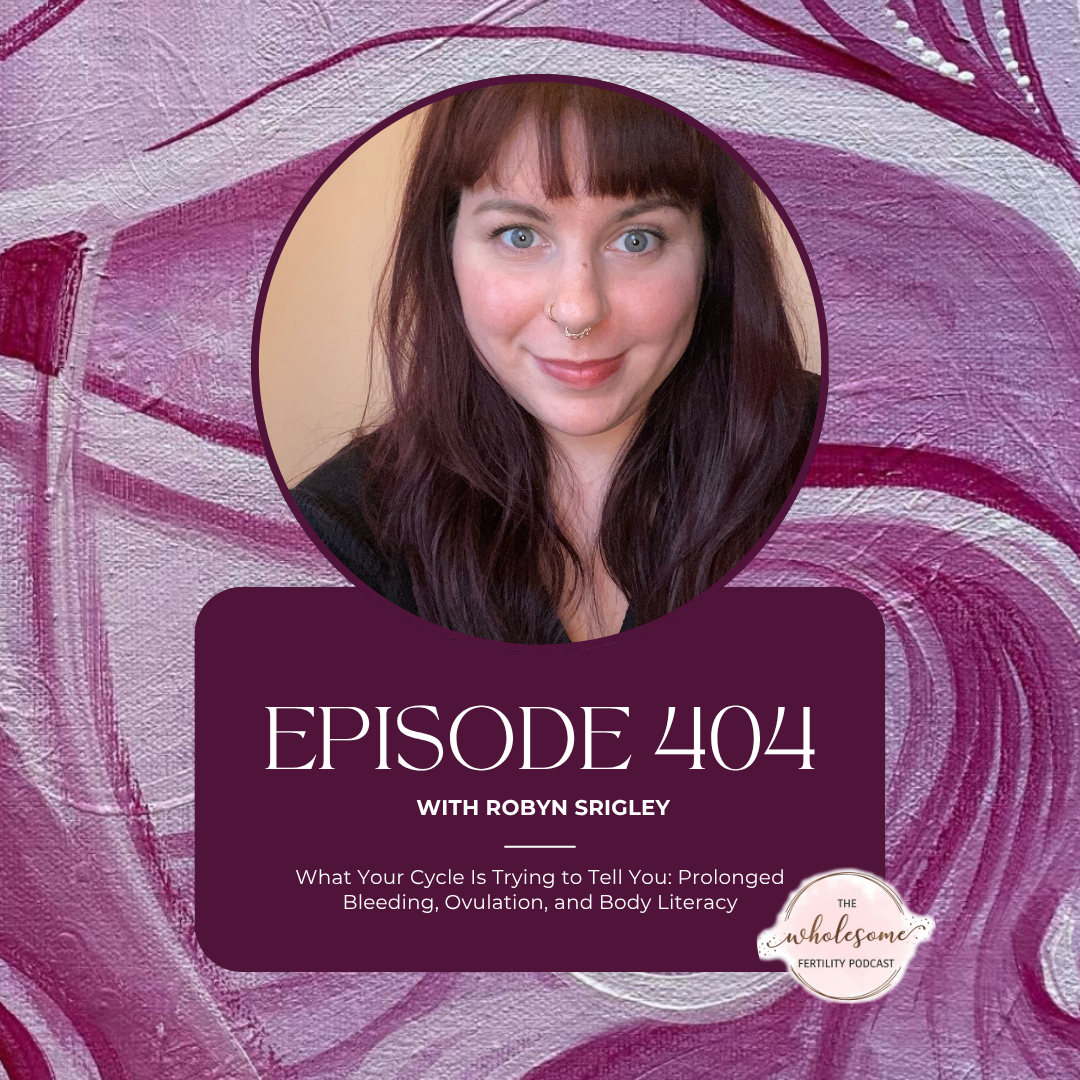
On today’s episode of The Wholesome Fertility Podcast, I am joined by holistic nutritionist Robyn Srigley to discuss menstrual health, prolonged bleeding, ovulation tracking, and the pressure many women feel to “optimize” every part of their fertility journey.
Robyn explains why a positive LH test does not always confirm ovulation, how low progesterone and iron may contribute to prolonged bleeding, and why normal lab results do not always mean the body is functioning optimally. We also discuss the importance of listening to your body, simplifying your wellness routine, and focusing on nourishment rather than perfection.
Key Takeaways:
A normal period runs about three to seven days. Bleeding or spotting that drags on for weeks, or shows up throughout the cycle, is worth investigating rather than waiting out.
Low progesterone is one of the most common patterns behind prolonged bleeding. When ovulation is weak or absent, estrogen runs unopposed and the lining sheds unpredictably.
LH strips show that the brain is signaling for ovulation. They do not confirm it happened. Basal body temperature lets you see, in hindsight, whether you actually ovulated.
Heavy bleeding and low iron feed each other. Standard iron salts often absorb poorly, while gentler forms like iron glycinate, paired with vitamin C, and whole food sources such as beef liver tend to be better tolerated and more effective.
“Within range” on a lab is not the same as optimal. What you feel in your own body is real information, even when results come back normal.
More is not always better. Slowing down, simplifying, and removing what your body does not need can matter more than adding another supplement to the pile.
Nervous system regulation comes first. When the body feels safe and settled, digestion and absorption improve, which supports everything else you are working toward.
Guest Bio:
Robyn Srigley is a Cycle Guide, Fertility Nutritionist, and Women’s Health Educator who helps women understand irregular cycles, prolonged bleeding, ovulation, and fertility through a grounded, holistic lens. Her work blends body literacy, nourishment, nervous system support, and herbal wisdom to help women hear what their cycles are communicating and feel more informed, empowered, and confident in their bodies. After her own PCOS, now PMOS, diagnosis sent her searching for real answers, she went on to conceive both of her sons naturally and has spent more than a decade guiding other women to better understand their bodies. She shares daily on TikTok.
Connect with Natalie:
TikTok: https://www.tiktok.com/@robynsrigley
Instagram: https://www.instagram.com/robynsrigley
Beacons (all links): https://beacons.ai/robynsrigley
Disclaimer: The information shared on this podcast is for educational and informational purposes only and is not intended as medical advice. Please consult with your healthcare provider before making any changes to your health or fertility care.
Ready to discover what your body needs most on your fertility journey?
Take the personalized quiz inside The Wholesome Fertility Journey and get tailored resources to meet you exactly where you are:
https://www.michelleoravitz.com/the-wholesome-fertility-journey
For more about my work and offerings, visit: www.michelleoravitz.com
Curious about ancient wisdom for fertility? Grab my book The Way of Fertility:https://www.michelleoravitz.com/thewayoffertility
Join the Wholesome Fertility Facebook Group for free resources & community support:https://www.facebook.com/groups/2149554308396504/
Connect with me on social:
Instagram: @thewholesomelotusfertility
Facebook: The Wholesome Lotus
-
# Video\_TWF: EP 404 Robyn Srigley
[00:00:00]
Michelle: Welcome to the podcast, Robyn. I'm so happy to have you
Robyn: Thank you so much, Michelle. I'm excited
Michelle: So I always like to start with an origin story. I'd love to hear, like, your background, how you got into the world that you're in
Robyn: Yeah, absolutely. So I've been working as a holistic nutritionist for 13 years, since 2013. But the reason that I got into women's health and hormones and cycles is because around that same time I was, actually diagnosed with PCOS, or now it's PMOS, and at the time my doctor was like, "Lose weight," despite the fact that I was a completely normal and healthy weight.
They suggested birth control, which I had come off of a year prior, and that's kind of what led to the diagnosis anyways. and that was basically it, and I was left feeling extremely confused. I was already in nutrition [00:01:00] school, already sort of wanting to do things like as naturally as I could. and that kind of led me down the rabbit hole of figuring out what would regulate my own periods and reduce the other symptoms of PMOS that I was experiencing, and then I started doing the same, with women in my practice and have since then.
Michelle: Yeah, we have similar stories. I had, um, I, I think it was undiagnosed PCOS 'cause I look back and I'm like, I had all of the signs. missed periods and similarly was given the birth control pill. Like, "Just take this, you'll be fine." I'm like, "Wait, I don't know about that." Um, acupuncture was the only thing really after 12 years that helped me.
Um, and, and it's true, like People go often and, and they really get told that there's no... And they don't just get told that, there's nothing that can be done. It's almost like so definitive that people don't realize there are other options to help them. And that, and that I [00:02:00] guess is where I get frustrated because it's personal.
Like I've gone through it myself, and it can be really frustrating to... 'Cause you feel like, wait, there's gotta be something else. Like it's intuitively you feel like there's gotta be something that can be done about this. It just doesn't make sense. And then you're told just because, I guess, a certain type of medicine doesn't see that aspect of it or doesn't have like an answer specifically, doesn't mean it's definitive and there is no other answer.
So
Robyn: Yeah. 100%. And like I was told too, like, "You'll probably never be able to conceive, certainly not without IVF," and things like that. I have two sons who are both conceived naturally. Like, all these things are possible, and so it's been really exciting over the past 13 years to kind of help bring that awareness as well.
Michelle: Yeah
for sure. Um, so I know that you cover... Well, one of the things that really kind of, uh, stuck out for me is you talked about prolonged bleeding and spotting. that's actually, like, a [00:03:00] big thing, and we haven't really dove deep into this topic in the podcast. I've talked about regulating, uh, periods and everything, so but that's a big one because, um...
And we had just talked about it before, a lot of people have, and there can be many reasons For it. But I'd love for you to talk about it kind of like a really, I guess like zoom out and then kind of zoom in 'cause of course there's so many different factors that can contribute to this.
Robyn: For sure. For sure. So it's probably a good way to start by like explaining what that actually means. So prolonged bleeding would really be anything outside of a normal like three to seven-day period. Like if you're going longer than that, some of the women that I work with or that, you know, follow me on social or whatever, they're bleeding for weeks or months or even years at a time.
This is not normal whatsoever. And the same thing with spotting. Like if you have a tiny bit of something the day before your period comes or whatever, like that's normal for some women. [00:04:00] But there are some who are spotting for weeks at a time or literally throughout their whole cycle, and that's anything that's really just not a full bleed or a proper period.
So sometimes it shows up as being brownish, sometimes it's pinkish, sometimes it's a mix. You'll get a random clot here and there, things like that. And these situations can happen with seemingly no explanation. So if they're going to their doctor and they're doing an ultrasound or blood work, and so many are being told, "Eh, nothing wrong, like wait it out or maybe get on some birth control."
or they can sometimes come along with diagnoses like adenomyosis, endometriosis, fibroids, and so on.
Michelle: Yeah. Definitely, um, the fibroids is a big one I remember. Um, it... and it's also, just for people listening, it's usually when it's in the inside, not on the outside of the lining. so within the lining it can cause, um, a lot of bleeding. but then it was interesting, I had somebody come on.
the [00:05:00] podcast that talked about iron, and she had mentioned that most of the iron supplements are actually not...
They're causing more problems. They're, because they're causing more, circulation of iron in the blood, but not getting absorbed the way they're supposed to. And what happens is, Or maybe not. It's stored in the tissue, is what she was saying, and then that sometimes the body wants to release that iron, and so it'll bleed more.
it'll be like a natural way of the body wanting to let blood out. But, um, it's because it's not processing iron the way it's supposed to. So, like, taking things like beef liver, like a synergistic blend of nutrients that can help absorption of the iron can make a difference. And I thought that was really fascinating, 'cause that's not something that you typically hear people talking about.
So I was wondering if you've heard of that before?
Robyn: Yeah, iron definitely plays a big role here. And I mean, to their credit, a [00:06:00] lot of doctors will test for that, and they'll tell you to take an iron supplement. Usually it's an iron salt like ferrous fumarate or something like that, and those are the ones that tend to, like accumulate. They're not absorbed well, digestive issues, constipation, like so many potential issues with those.
And they don't necessarily even increase the iron when it's retested in blood work. They don't necessarily stop the bleeding. But there is like what I like to call the iron depletion loop, right? So if you are bleeding and you're bleeding frequently or you're bleeding heavily, obviously you're losing iron, right?
'Cause it, you know, through your blood that's leaving your body. But having low iron, having not enough iron can also exacerbate the bleeding too. So it can kind of become this vicious cycle, and you can be still on iron supplements for months and months at a time and not seeing a difference, which is really unfortunate.
So that's where like absorption and circulation of the iron, like you were just talking about, is really important. Like [00:07:00] vitamin C helping with absorption, taking a different form of iron than the standard one that's often recommended, like a glycinate form or through natural ways, like you said, like a beef liver supplement can be much more effective
Michelle: Yeah, and I've actually seen, um, uh, I recently spoke with somebody, but I've heard of people using organ meat supplements, and that would, would be really the only supplement that actually helped increase their ferritin. So I thought that was interesting.
Robyn: Yeah, for sure
Michelle: very interesting. So, um, what are some of the thing...
And I know too, like, uh, uh, low progesterone, you talked about that, right? being a big factor
Robyn: For sure. So there's like four major core patterns I see behind this prolonged bleeding. Progesterone issues would be one of them, and a lot of times it's like one of two things. Either they're not ovulating in their cycle, or most of the time they're not ovulating, or their ovulation is kind of weak and so that corpus luteum is not producing enough progesterone.
And the thing is like [00:08:00] progesterone helps to stabilize that lining, right? So if you don't have that 'cause you're not ovulating or your ovulation is weak, then it's gonna be shedding constantly, right? Because estrogen is kind of running unopposed. So it's a good thing to kind of investigate, like what's going on in your cycle?
Are you ovulating or not? How long is your luteal phase? All of these things can kind of point towards whether progesterone is one of the patterns, right, that's contributing to the bleeding.
Michelle: Yeah
And then of course, let's talk about the LH sticks 'cause that's probably the most misleading, test that people are taking because it's really just all it does is signal, say that the brain is signaling the body, but it doesn't necessarily confirm ovulation. it could be good if you know you're already ovulating.
Maybe you went to the doctor, they did the ultrasound. They, they know that you ovulated so that your body is ovulating, then okay, it could be kind of like a good [00:09:00] timing tool. but for people who don't know, they're... You know, because people can have cycles that are not ovulatory. They could still get a period which can seem confusing and, and, you know, make people think that they're actually ovulating, but not necessarily.
So, um, so talk about what you, how you approach that with the people you work with because, it's important to really understand your cycle, like to, to see it, to really investigate and, and to understand what things mean because of course women are not taught these things unfortunately.
Robyn: Absolutely. And it, and it's important to understand your cycle, whether you're trying to conceive or not too. Like, we have to learn what our bodies are telling us. And so to your point about the LH strips, or sometimes they're marketed as ovulation tests, which is something that is a pet peeve of mine.
But basically, LH is the brain hormone that's going to signal to your ovaries to release an egg. It does not guarantee that this actually happens. And so a lot of women will see what they [00:10:00] consider a positive on that, and they think, "Oh, I ovulated. Great." A lot of the times that is not the case, especially if cycles are irregular.
There's things like PCOS, PMOS going on. and so they're not really reliable. You can get your pr- progesterone blood test, approximately seven days after you think you've ovulated. A doctor will usually recommend day 21, which is not necessarily accurate for everyone, or by
Michelle: Because, um, people could be ovulating early or late or, or, um, early or late. Yeah
Robyn: Exactly, right? Like you, if you have an irregular or a long cycle, you might not ovulate until like cycle day 30. You know what I'm saying? And if you went on day 21, it would be a useless result. But you don't even have to go to that extent of blood tests and ultrasounds. You can do it at home with your basal body temperature.
I do this with every single one of my clients in the beginning so we can see what their cycle is doing. And essentially, basal body temperature is the temperature of your body when [00:11:00] you first wake up in the morning. So like before you get up, before you drink water, before you go pee, any of those things, you take your temperature.
There's wonderful apps where you can chart all that out. And before ovulation, your temperature will be on the lower side, and then after ovulation it will spike up usually around like a half a degree kind of give or take, and it will sustain that rise. It's progesterone that causes that lift, in your temperature.
And so by doing that, you can actually confirm, oh yeah, I did ovulate, right? It's a retrospective kind of looking back, oh yeah, I did probably on that day. Versus LH, which is trying to predict when that may happen soon, but it's not a guarantee.
Michelle: Yeah, and what's good is, of course, if you do it a couple of months in a row, you start to understand the patterns of your body, and see if it is regular, like more, regular within its pattern so that it repeats itself, 'cause sometimes it could really go all over the place
Robyn: Exactly. Exactly. And it can give you clues too, like we were talking about progesterone, as a pattern behind bleeding. Like [00:12:00] if you see you're tracking that and your luteal phase is short, that could also indicate progesterone issues. If you see your temperatures in that phase are not sustaining high, maybe you get a few days and then it starts to drop, right?
Again, your progesterone may not be maintaining. So there's so many different things that you can learn based on your, your patterns with the basal body temperature, which is why I do it with everyone, at least in the beginning, so we can see what's actually happening.
Michelle: And you also talk about why normal doesn't always mean healthy when it comes to menstrual cycles
Robyn: Yeah. So I can't tell you the amount of women who I work with DM me, comment, whatever, and they're like, "Well, I'm having XYZ issues," or, "I can't get pregnant." And I'm like: Have you gone to your doctor? And they're like: Yep, and I had hormones tested and all this stuff, and everything came back normal. But they're still experiencing symptoms with their periods, with their cycles, irregularities, whatever, even their mood, their weight, their sleep, [00:13:00] everything, right?
And of course, struggling to get pregnant, but they have all these normal results. And so it's important to look at it from a lens of like within range is essentially what your doctor is saying normal, right? But that's not necessarily optimal. Personal example, literally from this week of this, I had some blood tests 'cause I've been working on my own iron, and my ferritin in the last three months only went up eight points.
And from my perspective, it's still under what I would consider an optimal range. But my doctor says, "Oh, it's perfect now. You can stop taking your iron. You're all good to go. Nothing else needs to be done there." Right? But with my training and history and knowledge, like I know, and also in my body, I still feel it, right?
I know that I need to continue, and so this is not like anti-medical. It's important to have someone you [00:14:00] can go to for conversations, for testing, for investigation. But it's also important to like do your own research, take what they say about results with a grain of salt, especially if you are having issues and you're being told that everything is normal.
Michelle: You said something that was so key. You said, "I feel it in my body." And I really wanna stress that because, uh, every time I work with somebody, and I've been doing this for over 10 years now, like, I always, always, I'm like, "What do you feel? Like, what does your body feel?" Um, let me tell you, that is not something that should...
That's not an element that should be ignored. It should be part of the conversation because nobody else knows, and I've seen so many cases where people have felt things being off and that being dismissed, later to find out that they were actually feeling something very significant and specific. one person had a blockage in, like, the [00:15:00] tube.
It was like a, almost like a stenosis, so, and they ended up, they felt it. They felt something was off years before, and it was like the body was telling them. And sure enough, there was something there. So
Robyn: Absolutely. Yeah. As women, we have that intuition, and it's really important to, to listen, to that because it can lead to, you know, a lot of good things if we go down that road and support what we're actually feeling versus what a lab test tells us on paper. Yeah.
Michelle: then you also talk about nourishment versus over-optimization. I, I, I feel that. I definitely feel that
Robyn: Yeah, absolutely. So there's this tendency in the wellness sphere and women's health on social media like, "Oh, just, you know, take all these supplements. Make sure you have this exact morning routine. Go lift weights five days a week. Like, do all of these things to optimize your fertility, to optimize your health, to make sure that everything [00:16:00] is perfect."
And women run themselves into the ground trying to do this, right? And, and they'll come to me and they'll be like, " I'm doing everything right. I'm eating well. I'm not eating these things. I am eating these things. Look at all these supplements that I'm taking. I've researched them all." They go down the Google rabbit hole instead of sleeping every night.
You know what I mean? Like, they're up and they're looking and they're reading and they're consuming information and all they see is, "Oh my gosh, like I'm missing this. Okay, I better add this in." Right? And then if they have like a cheat day or, they miss a supplement day or they don't do their routine exactly, they can be so hard on themselves.
And I'm no stranger to that in the past either. It takes some like reprogramming to kind of get out of that. What really what we need is simplification and slowing down, honestly, and like nourishment piece as well. Like you don't need to be [00:17:00] necessarily tracking your macros and counting your calories and weighing all your food and stuff like that if you're not entering a bodybuilding show or whatever.
Like we don't need that. What your body needs is nourishment. It needs real food. It needs you to slow down when you eat. It needs you to not rush through brushing your teeth in the morning. It needs you to like take a breath, you know what I mean? Like through the day, just really slow down and get rid of a lot of the things that you might already be doing.
I was working on a protocol for a client, new client this morning, and she's taking so many different things and I'm actually advising that she remove like 80% of those things because at this point in time they're not necessary and they're just gonna put more load and burden on the body trying to deal with all of these like capsules and things, right?
Michelle: Oh, 100%. Those capsules, I'm... And people get so nauseated from taking all of the supplements. And sometimes if I [00:18:00] have to, especially if they have, like, sensitive, stomachs, I give them, Quicksilver, you know, like, uh, some of the liquid, uh, supplements, which is a lot easier on the gut. But it's just, it's overwhelming.
It really is overwhelming. In some cases, sometimes they do need certain things if they're, like, really prepping for, like, egg retrieval or really trying to up the egg quality for a little bit, but it's not forever, and I tell them to space it out. But it could be very overwhelming. But what I do find is that, you know, the, the, the checklists, everything that you have to get done, but, like, the nervous system should be number one, because if the nervous system is off, nothing's gonna get digested.
I mean, not nothing, but, like, it really does impact the gut and your ability to digest. If you feel overwhelmed, you're not going to... You know, your body is not gonna be digesting optimally, because, you need to be in rest and digest to be optimally digesting. people, Yeah
it, you know, they, they're rushing through trying to get everything [00:19:00] done, and it always tends to be put on the back burner how they're feeling and, like, the feeling of safety.
and so that's something that is invisible. We can't really see it or quantify it. It's a state of feeling. So I think that that's why it's often missed, because, it's something that requires us to go inward to sense.
Robyn: And that makes it one of the harder things to do. It's easy to pop a supplement capsule. It's easy in comparison to eat your vegetables and get more protein, right? But slowing down is much harder. Regulating your nervous system and focusing a lot of your energy there is much more difficult, and that's valid, right?
Michelle: because you feel like, um, you're, you're getting stuff done. you're actually, like, seeing it and, uh, and you feel unproductive, like, slowing down. And I think that we're conditioned like that as a society, and we get rewarded f- a lot for getting things done and, and being [00:20:00] overachievers. So it is...
You had mentioned actually, and I thought that was really on point on deprogramming yourself, you know? Because for so long you're so used to seeing the world that way, and you don't realize, wait, the body doesn't necessarily run that way. Nature doesn't necessarily run that way
Robyn: Yeah. And I don't think anyone expects that when they go into a journey with their health, trying to conceive, fixing their hormones, whatever. They expect, okay, I'm gonna eat a certain way, I'm gonna take these supplements, I'm gonna exercise, I'm gonna do all these kind of basic foundational things. No one expects that they're gonna have to turn inward, that they're gonna have to slow down.
It's gonna fundamentally change how they approach their life even, uh, as a person. so it can be kind of surprising and, and almost make them like more hesitant, I find.
Michelle: 100%. I've had that happen. I've had people that I've coached, and when I told them that, they're like, "Wait, wait, but what supplements and what..." A- and [00:21:00] I can see the resistance, and then I kind of like ease them in, you know. If I, if I sense that, you kind of like go with them until they're ready to hear.
But
Robyn: Mm-hmm.
Michelle: do feel the resistance is like, "Wait, but, but what should I do? Like, give me something to do." And, and so... And I'm like, "Wait, but here, here's what it is." And sometimes I'll, you know, show some studies and research so that they can understand kind of behind the scenes what happens with the nervous system and why that really impacts their body and trickles down.
It, it, it's fascinating.
Robyn: It is
Michelle: Yeah
But I totally get it. I mean, I, um, I've had to work on my own programming for years, and I think we all started, a lot of us started as patients ourselves. And I had to really train myself to like receive, to be in a state of like bringing in, kind of filling my own cup, because It felt very foreign.
And, and that's the key thing is
that whenever you're changing any habit or [00:22:00] shifting your perspective to something that you're not used to, your body and your subconscious mind are gonna resist it at first, 'cause it just does not feel like home. It doesn't feel familiar
Robyn: Yeah. It can be easier to stay in the habits and lifestyles that are problematic because it's what you know and what you're used to. Yeah
Michelle: 100%. so interesting. So talk about, building body literacy. Um, we, we kinda talked about the ovulation, kind of beyond apps and predictions. You were saying that it's important to really understand, BBT charting. I think is amazing. I think even if people... You know, there are so many other tools, but even if people could use those tools, I always say at least do it for a couple of months, 'cause I feel like it just gives you so much information, and it's so old school.
I love it. It kind of, it goes back to the basics, is to really understand the temperature. And in Chinese medicine, it's amazing because you can, like, imprint the yin [00:23:00] and the yang onto the cycle. the yin being really estrogen, the yang being the progesterone. luteal being the yang, which is heat, and, you know, temperature rises, and it's cooler and more moist in the, um, follicular phase.
And it's really fascinating how you can see all of the things that they described in Chinese medicine
Robyn: Mm.
Michelle: of years ago, and you can, like, literally just superimpose it onto whatever it is, whatever cycle it is, and see it. It's incredible. but you talk about body literacy, really understanding your body rather than looking at it as a textbook.
Like, to really, like, embody it and feel it.
Robyn: Yeah, absolutely. And I find like so many women, 'cause w- again, like we were talking about earlier, like nobody was ever really taught any of this. You know what I mean? We were taught like once a month you get a period, use some pads, take some Advil, whatever. But like nobody's really taught anything outside of that.
And then when you try to conceive, you start learning about [00:24:00] all the different phases of your menstrual cycle. You start to learn about, oh, I better figure out when I'm ovulating 'cause that's when I can get pregnant. and one important thing when you are charting is, yes, you will see a lot of other women's charts online when you start going down that rabbit hole.
You don't have to have perfect textbook charts, perfect examples of what your temperature is doing, to be optimally fertile, let's say, or to get pregnant, right? learning your own patterns is more important than comparing it to anyone else's or even what you might see in books or things about this.
The goal is understanding, not perfection. And like you said, we can tell so many different things, even to the point of like a lot of women will be tested for their thyroid and their TSH is within that range. And again, back to that like normal versus optimal conversation or whatever, but when you're doing basal body temperature, you can pick that right out if you [00:25:00] know what you're looking for.
If you have temperatures that are chronically much lower on average than what's considered optimal, then there's likely some thyroid involvement e- even if your TSH is within range, right? And so there's just endless things that you can learn from doing that type of thing, even if it is just for a few months, right?
Because sometimes that is actually more helpful. You learn what your cycle is doing at first and then let it go. One of those things of like not over-optimizing, right? We don't need to track everything all the time forever. Once you know what your body is doing, if you're trying to conceive, then you know around about when you're fertile and you can attempt and you can just otherwise be living your life.
You know what I mean? And just not constantly be focused on numbers. And BBT is a pattern as well, right? We don't need to focus on, uh-oh, this day is this random temperature that I don't normally see. Well, what is the overall pattern of [00:26:00] your cycle actually looking like? That might just be a random blip 'cause you didn't sleep well, you know, or you went to bed later or you had alcohol or something and that's fine to note, but it's not a make or break when you're looking at the overall pattern.
Michelle: Yeah
totally. That's, uh, so key. you're gonna have off days, you're gonna have times where it's not gonna be consistent. You're gonna have times where maybe you got up to pee in the middle of the night, which can, you know, if it's, like, too close to the time you wake up, can impact that. So, um, it's okay if things are a little out of whack 'cause I, I get that too.
Uh, people are like, "Oh, what, what happened here?" And I'm like, "If you look at the overall, it's like the stock market." Zoom out, and then you can see an overall picture, and then it makes a lot more sense than, you know, the, the day-to-day. but for people who are, looking into doing BBT, you had mentioned a couple of things that, doing it, like, early in the morning before getting out of bed, taking...
What tips would you give if somebody's never done a BBT before and they're [00:27:00] like, "Hmm, I'm curious, like, how do I get started?"
Robyn: For sure. So get yourself a basal thermometer. Sometimes pharmacies have them in, usually in the section with like pregnancy tests and stuff, or with the other thermometers or Amazon. I mean, they're super inexpensive. And you get the digital one, and typically the thermometers when you use it, when the temperature is ready, it will beep at you so you know you're good to go.
But get your thermometer, put it somewhere you can reach it very easily without getting up, without sitting up when you open your eyes in the morning. There's three different places that you could potentially take your temperature from. The biggest thing is to pick one and stick with it. So you can do orally under the tongue, you can do in your armpit, or you can do vaginal temping as well.
And again, it doesn't matter, just pick one and stick with it because I find that like the vaginal temps especially tend to be slightly warmer
than, than the other areas. My favorite way is, is orally under the [00:28:00] tongue. You'll turn on your thermometer, put it under the tongue, hold it there nice and steady until it beeps at you that it's done.
Then you can look at your temperature. There's tons of apps out there. I prefer the ones that don't try to predict your cycle based on an algorithm. So I personally prefer one called Kindara for that reason. You can still input your period, intercourse, your temperatures, like all the things that normal cycle and fertility apps have, but without the interference of an algorithm which often is incorrect in predicting your cycle and your fertile window and all of that.
And then that's it. That's literally it. It takes like 30 seconds in your morning. Input it into your app. You'll see the graphs over time of what everything is looking like, and then you just observe your patterns
Michelle: Yeah. definitely something that I recommend at least doing once. definitely better to do it at least three months [00:29:00] than just one month. well, you had mentioned actually briefly, some people do feel more stressed. It's kind of like over-optimizing or over-checking. that can happen, but if you know that it's only, like, a few months, then I think in your mind it might not feel as stressful.
It's just kind of like, oh, you know, out of cu- with curiosity, look into it and kind of approach it in that way rather than, "I have to do this," and it's like another thing to do. Just more of kind of like data collection of your own. But it is really nice to observe it on your own, and it does give a sense of empowerment that you might not have when you're kind of at the whim of, you know, whoever's testing and going somewhere else and, and having it done.
So it is a really nice thing. now for people who, are curious to learn more about you, find out, get more information, 'cause I know that you share a lot on your content and social media, and then even work with you, how can they find you?
Robyn: Yeah. So the biggest place I [00:30:00] am is on TikTok as far as social media. I'm posting there at least once a day. we have a lot of good conversations about everything we talked about here and more, so definitely come on over there. and my link there will provide you with all of the other details as far as like where to go if you want to chat with me about working together, my programs and other services and all of that stuff.
Everything is over there. and I always love to connect and hear about everyone and what you guys are dealing with so that we can have these conversations, especially things like cycle tracking and the optimization and the prolonged bleeding that are not, I feel, talked about enough in this space
Michelle: Yeah, for sure. Well, Robin, Thank you so much, This was such a great conversation. We really got into, uh, depth with the menstrual cycle, which is always, always very important when it comes to fertility health, 'cause it really is the heartbeat of your fertility. So thank you so much for coming on today
Robyn: Thank you so much, Michelle
[00:31:00]